Ethereum could get faster in January with gas limit rise to 80M

cointelegraphPublished on 2025-12-18Last updated on 2025-12-18

Abstract

Ethereum's transaction throughput is set to increase in early January with a planned gas limit rise from 60 million to 80 million. This will be enabled by the second blob parameter-only (BPO) hard fork, scheduled for January 7, following a similar upgrade in December that also increased blob capacity by 66%. Blobs store data off-chain, reducing gas costs and improving scalability without overloading the network. While this upgrade won't match the speed of chains like Solana, it enhances Ethereum's efficiency as a secure settlement layer. Developers will confirm the final plans on January 5. Increasing the gas limit has been a key focus in 2025, with previous raises in February, July, and November. The long-term goal is to reach a gas limit of 180 million by the end of 2026.

Transaction throughput on the Ethereum network is set to be boosted again in early January with the second blob parameter-only (BPO) hard fork expected to enable the Ethereum gas limit to rise from 60 million to 80 million.

Christine Kim, vice president of the research team at Galaxy Digital, shared the news in a post Tuesday, noting the confidence Nethermind developers Ben Adams and Kamil Chodala expressed in Monday’s Ethereum All Core Developers call that all testing should be complete before the next BPO hard fork — scheduled Jan. 7 — which is expected to increase blob capacity on the Ethereum mainnet by 66%.

It would follow the first BPO hard fork on Dec. 9, which increased blob capacity by 66%.

Ethereum Foundation developer operations engineer Barnabas Busa, however, noted that two client-level optimizations are needed before another increase in the block gas limit — namely, partial blob responses on the execution layer and the max blobs flag on the consensus layer.

Source: Christine Kim

Blobs on Ethereum are large data chunks that store transaction and rollup data off-chain, lowering gas costs and increasing scalability without bloating the network.

Optimizing blob capacity to raise the gas limit directly increases the number of transactions and smart contract operations that can fit in each Ethereum block, boosting overall throughput while potentially lowering fees.

While raising Ethereum’s gas limit to 80 million won’t match the speed or low costs of layer 1s like Solana or Sui, it strengthens Ethereum’s appeal as a secure settlement and execution layer without significantly compromising decentralization — arguably its greatest advantage over competitors.

Ethereum devs will confirm plans early in the new year

Participants in the weekly Ethereum All Core Developers meetup will reconvene on Jan. 5 to confirm when to raise the gas limit following the second BPO hard fork.

Increasing Ethereum’s gas limit has been a priority this year

Increasing Ethereum’s gas limit to expand the network’s execution capacity has been a major focus for developers and researchers this year, with three increases.

Related: Securitize announces ‘real’ tokenized stocks, touts DeFi integration

The first occurred in early February, raising it from 30 million to 35 million, the second in July to 45 million, and the third in late November to 60 million.
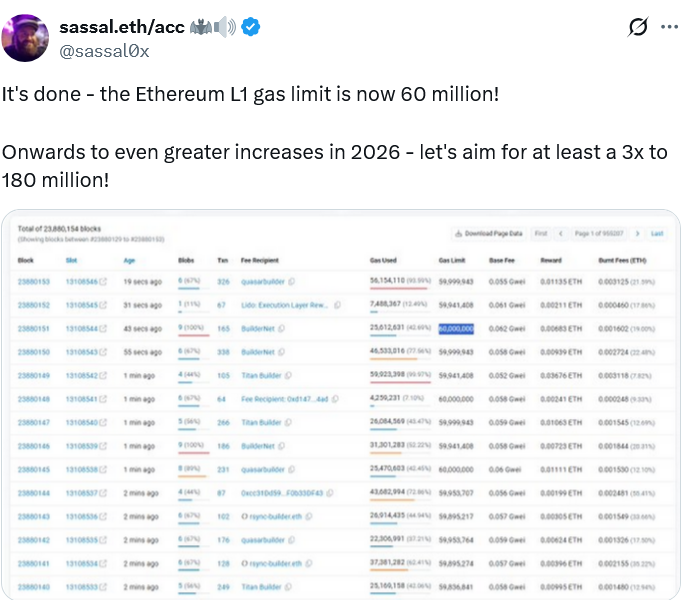
Source: Anthony Sassano

Members of the Ethereum developer and research community have expressed a common goal to raise the network’s gas limit to 180 million by the end of 2026.

Magazine: Meet the onchain crypto detectives fighting crime better than the cops

Trending Cryptos

Related Reads

You Use Claude and Codex Every Day, but Meta Has Restricted Internal Use

In May, Meta imposed internal restrictions on its engineers regarding the use of Claude Code and Codex, two widely used AI programming tools. Despite being a major client, Meta's guidelines, still in effect, prohibit these external models from being used for specific tasks to prevent potential "escalations with partners." The core concern is "distillation"—the risk that outputs from Claude or Codex could inadvertently contaminate the training data and evaluation processes for Meta's in-house AI coding assistant, MetaCode. If MetaCode is trained or evaluated using data generated by these external models, it risks learning their capabilities rather than developing its own, blurring the line of intellectual origin. The restrictions are precise: engineers cannot use the external models to generate test questions, debug source code, or suggest test cases. AI-generated content is also barred from environments accessible to MetaCode. However, AI can still assist with peripheral tasks like workflow setup and code organization, provided all outputs are manually reviewed. This caution reflects a broader industry dilemma. While distillation is a common technique, using a competitor's model output for training raises legal and ethical questions about the ownership of derived capabilities. Contractual terms from companies like OpenAI and Anthropic explicitly forbid using their outputs to build competing products, putting enforcement power in the hands of rivals. The move is also financially motivated, as Meta seeks to reduce its hefty internal AI spending, estimated in the billions this year. Meta's policy illustrates the delicate balance companies must strike: leveraging powerful external AI tools while safeguarding the integrity and independence of their own AI development. As AI systems increasingly help build other AIs, distinguishing the origin of capabilities becomes a fundamental challenge for the entire industry.

marsbit1h ago

You Use Claude and Codex Every Day, but Meta Has Restricted Internal Use

marsbit1h ago

Why Do We Need an AI Content Perspective Today?

The article "Why Do We Need an AI Content Perspective Today?" explores the complex and often contentious integration of AI into the cultural and creative industries, particularly film and television. It begins with the cancellation of Amazon's AI-generated animation "Punky Duck," highlighting the ethical debates surrounding AI content. AI's rapid advancement is transforming video production, enabling cost-effective, full-length AI films (e.g., "RAPHAEL," "Dreams of Violets") while sparking industry resistance over issues like "synthetic actors." The core debate has shifted from whether to use AI to how to use it responsibly. The article analyzes why AI's entry into film is uniquely unsettling. It distinguishes between "cultural fast food" (short-form, fast-paced content like micro-dramas) and "cultural main courses" (traditional, long-form film/TV). AI currently excels at the former, matching its fragmented narratives, shallow emotional needs, and free-to-consumer models. However, venturing into the latter challenges the human-centric essence of storytelling—creativity, emotional depth, and the unique value of human labor and experience. While AI can generate massive volumes of content and lower costs, it risks devaluing human creativity, leading to homogenized output, and creating unfair competition through potential intellectual property infringement. Its efficiency also amplifies content safety risks, making preemptive governance crucial. To counter these risks, the article proposes establishing clear boundaries guided by a human-centered AI content perspective. It outlines four principles: 1) Amplify, rather than displace, human creative space; 2) Respect and protect human creative output; 3) Ensure human creative control and responsibility remain paramount; and 4) Guarantee transparency and traceability in AI creation. The conclusion emphasizes that humans must act as the "helmsmen" of technology, steering AI development to enhance, not replace, the core human values at the heart of cultural expression.

marsbit1h ago

Why Do We Need an AI Content Perspective Today?

marsbit1h ago

Planck Retracted? The Father of Quantum Tripped by an Algorithm

The recent discovery that two articles (published in 1940 and 1942) by Max Planck, the Nobel laureate and founder of quantum theory, are marked as "retracted" on Springer's digital platform highlights a curious clash between historical publishing practices and modern automated systems. An investigation suggests these retractions are algorithmic errors, not due to fraud or misconduct. The papers, philosophical reflections on science published in *Die Naturwissenschaften*, were likely flagged by the platform's systems. One article, a republished lecture, may have been mistaken for duplicate publication. Another, sharing a title with a prior article by a different author (a common practice for continuing debates at the time), may have triggered a similar automated check. The digital versions have even been replaced with blank pages, contrary to normal practice of preserving retracted texts. This incident underscores how contemporary digital infrastructure, built around concepts like "self-plagiarism" and strict copyright, can misclassify and obscure legitimate historical scholarly communication. It serves as a warning that digital archives are not neutral mirrors of the past but are filtered by platform rules, potentially distorting the scientific record. As AI systems increasingly rely on such databases, such erroneous metadata could propagate, affecting how future tools interpret and access historical knowledge.

marsbit1h ago

Planck Retracted? The Father of Quantum Tripped by an Algorithm

marsbit1h ago

Trading

Spot

Hot Articles

How to Buy GAS

Welcome to HTX.com! We've made purchasing GAS (GAS) simple and convenient. Follow our step-by-step guide to embark on your crypto journey.Step 1: Create Your HTX AccountUse your email or phone number to sign up for a free account on HTX. Experience a hassle-free registration journey and unlock all features.Get My AccountStep 2: Go to Buy Crypto and Choose Your Payment MethodCredit/Debit Card: Use your Visa or Mastercard to buy GAS (GAS) instantly.Balance: Use funds from your HTX account balance to trade seamlessly.Third Parties: We've added popular payment methods such as Google Pay and Apple Pay to enhance convenience.P2P: Trade directly with other users on HTX.Over-the-Counter (OTC): We offer tailor-made services and competitive exchange rates for traders.Step 3: Store Your GAS (GAS)After purchasing your GAS (GAS), store it in your HTX account. Alternatively, you can send it elsewhere via blockchain transfer or use it to trade other cryptocurrencies.Step 4: Trade GAS (GAS)Easily trade GAS (GAS) on HTX's spot market. Simply access your account, select your trading pair, execute your trades, and monitor in real-time. We offer a user-friendly experience for both beginners and seasoned traders.

2.9k Total ViewsPublished 2024.03.29Updated 2026.06.02

How to Buy GAS

Discussions

Welcome to the HTX Community. Here, you can stay informed about the latest platform developments and gain access to professional market insights. Users' opinions on the price of GAS (GAS) are presented below.

活动图片