ETH Staking Data Reversal: Exits Zeroed Out VS Entries Surge by 1.3 Million, When to Buy the Dip?

marsbitPublished on 2026-01-07Last updated on 2026-01-07

Abstract

ETH Staking Data Reverses: Exit Queue Clears vs. 1.3 Million ETH Entering—Time to Buy the Dip? On January 7, the Ethereum proof-of-stake exit queue fully cleared, indicating that months of withdrawal pressure have been digested with no new large-scale redemption requests observed. Meanwhile, the staking entry queue surged significantly, with approximately 1.3044 million ETH waiting to enter, a wait time of about 22 days and 15 hours. This marks a complete reversal from mid-September 2023, when 2.66 million ETH exited staking amid high price levels (~$4700), followed by a 34% price drop to around $3100 over the next three and a half months. The staking queue is often seen as a sentiment indicator, but not a direct price signal. The recent surge in entries is largely driven by a single large institution, BitMine, which staked about 771,000 ETH (18.6% of its holdings) in two weeks. This suggests the trend reflects institutional asset reallocation rather than broad market bullishness or immediate buying pressure. Beyond staking, Ethereum fundamentals show signs of improvement: Q4 2024 saw a record 8.7 million smart contracts deployed, stablecoin transfer volume on Ethereum exceeded $8 trillion, and gas fees hit all-time lows. Exchange balances of ETH are near historic lows (12.7 million, down over 25% since August 2025), indicating reduced selling pressure. Additionally, Ethereum’s TVL dominates 59% of the crypto market, while its market cap is only 14%, suggesting potential u...

Original | Odaily Planet Daily (@OdailyChina)

Author | Ding Dang (@XiaMiPP)

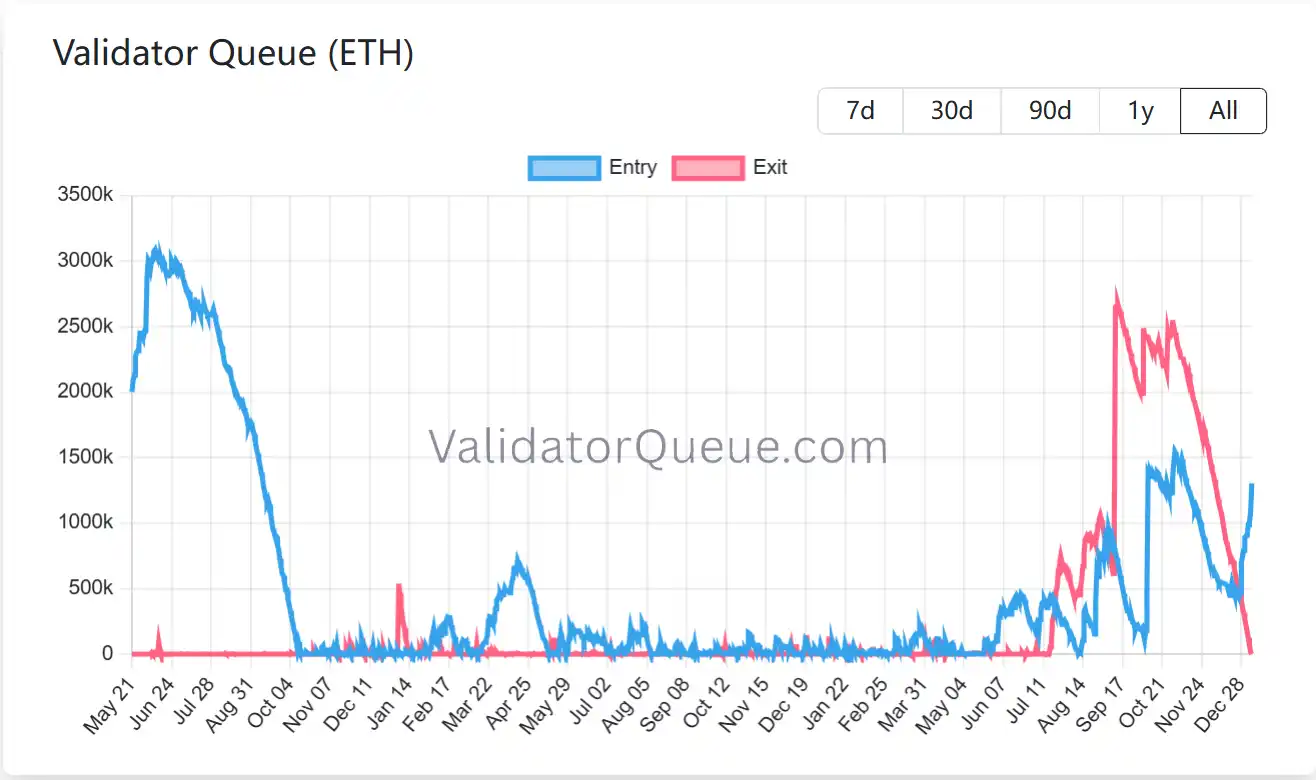
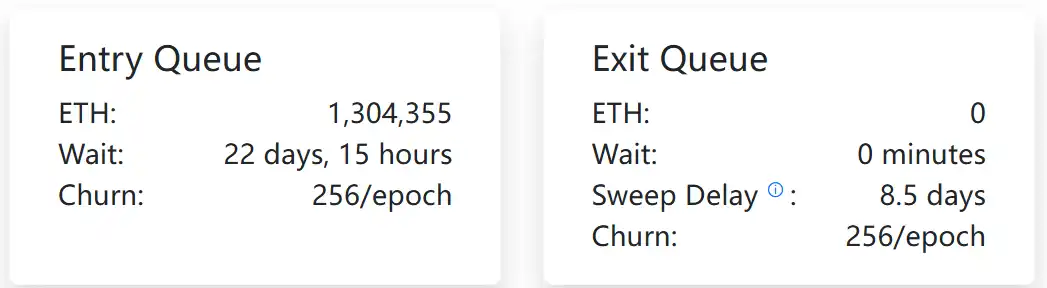
On January 7th, the exit queue for staking under Ethereum's PoS mechanism officially cleared. At least from on-chain data, the sustained exit pressure over the past months has finally been fully digested, and no new large-scale redemption requests have been observed so far.

At the same time, the size of the entry queue has seen a significant increase, currently rising to approximately 1.3044 million ETH, with a waiting time of about 22 days and 15 hours. This situation is almost a complete reversal compared to mid-September last year.

Back then, the ETH price was at a阶段性高点 (stage high) of around $4,700, and market sentiment was high, but the staking side showed a different attitude: 2.66 million ETH chose to exit staking, and the exit queue waiting time once exceeded 40 days. In the following three and a half months, the ETH price fell by about 34%, dropping from $4,700 to $3,100.

Now, after a round of deep price correction, the exit queue has finally been fully digested.
Staking Queue is a "Sentiment Indicator," But Not a Price Signal?

Generally, changes in the validator queue are seen as an important barometer for observing market sentiment. The logic behind this is that Ethereum PoS, to ensure consensus stability, does not allow nodes to enter and exit freely. Instead, it uses a rate-limiting mechanism to regulate the pace of staking and exit behaviors.

Therefore, when the ETH price is at a high stage, exit demand tends to accumulate. Some stakers might choose to cash out profits, but the potential selling pressure is not released instantly; instead, it is "stretched out" on-chain through the exit queue. When exit demand gradually dries up and is even fully digested, it might indicate that a structural wave of selling pressure is coming to an end.

From this perspective, the clearing of the current exit queue, coupled with the simultaneous rise in the entry queue, does constitute a noteworthy change. However, I believe that while this change appears to form a positive resonance on the surface, its "influence" on market prices is not equivalent to the "high exit, low entry" phase in September. This is because ETH entering the staking queue does not equate to "new funds actively buying ETH right now." A significant portion of the筹码 (chips/tokens) entering staking were likely accumulated in earlier stages and are only being reallocated at the current time. Therefore, the rise in the staking queue reflects more a change in preference for long-term returns, network security, and the stability of staking rewards, rather than a significant strengthening of immediate price demand. This also means that the current improvement in queue structure leans more towards an expectation repair, rather than providing an equally strong push for short-term prices.

Nevertheless, the significant growth in the current staking entry queue is still worth attention. The main driving force behind this comes from BitMine, the largest DAT (Digital Asset Treasury) company for Ethereum. CryptoQuant data shows that BitMine has staked approximately 771,000 ETH in the past two weeks, accounting for 18.6% of its roughly 4.14 million ETH holdings.

This means this shift in staking trends is driven by a single large institution's asset allocation behavior, rather than a synchronized回暖 (warming up) of overall market risk appetite. Therefore, it cannot be simply interpreted as a "return of comprehensive bullish sentiment." However, in an emerging market like crypto, where liquidity distribution is uneven, the actions of large institutions often can, and are more likely to, provide a certain degree of emotional support and expectation repair in the short term.

Whether this trend can continue or spread to a broader range of participants remains to be seen. But from on-chain fundamental data, multiple core metrics of Ethereum are simultaneously showing signs of marginal improvement.

From "Staking Changes" to "Coordinated Fundamental Improvement"

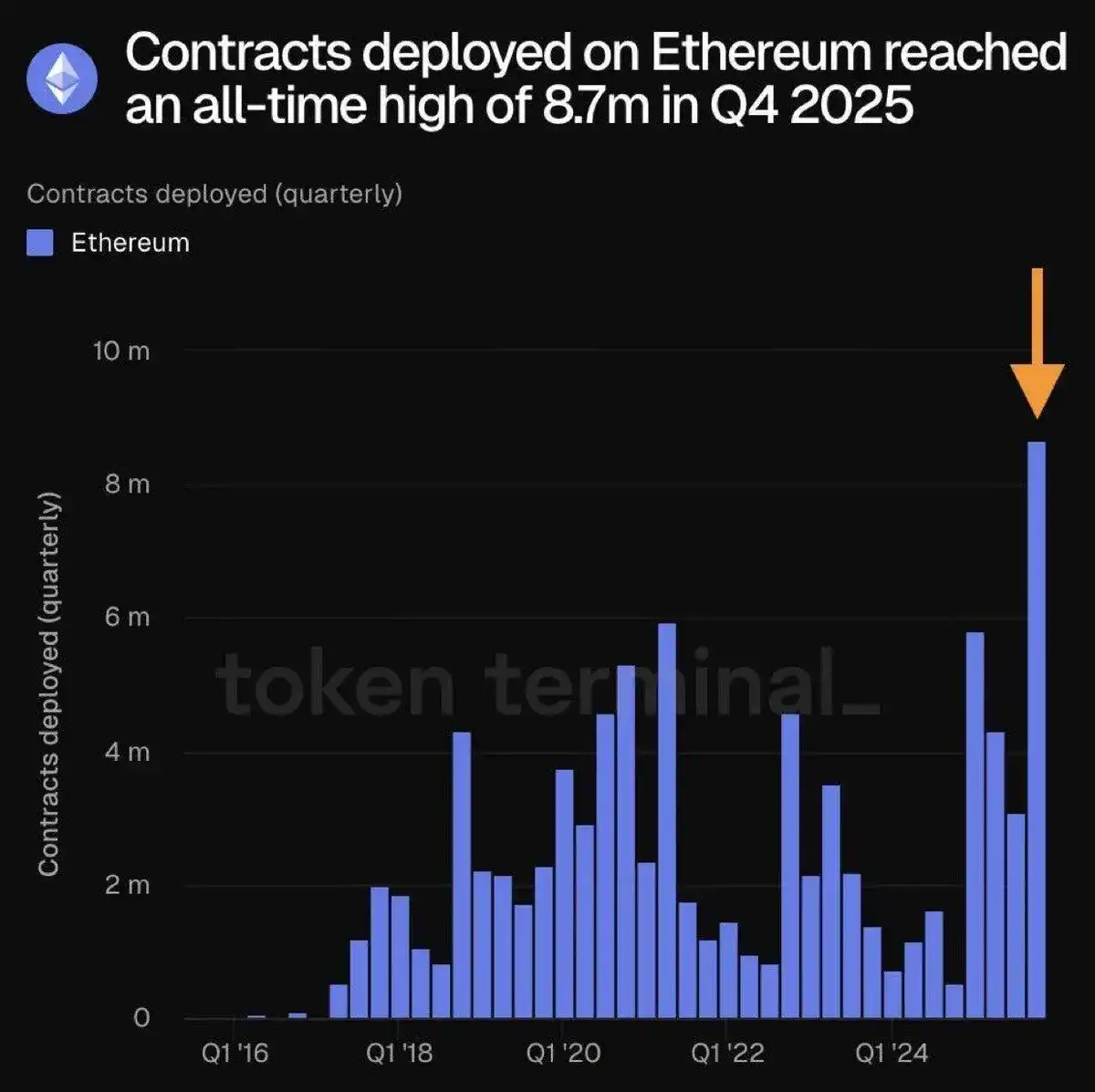
First, in the developer dimension, Ethereum's development activity is hitting all-time highs. Data shows that in Q4 2025, Ethereum deployed approximately 8.7 million smart contracts, setting a new historical record for a single quarter. This change is closer to ongoing product and infrastructure development rather than short-term speculation. More contract deployments mean more DApps, RWA, stablecoins, and infrastructure are being launched, continuously strengthening Ethereum's role as the core execution and settlement layer.
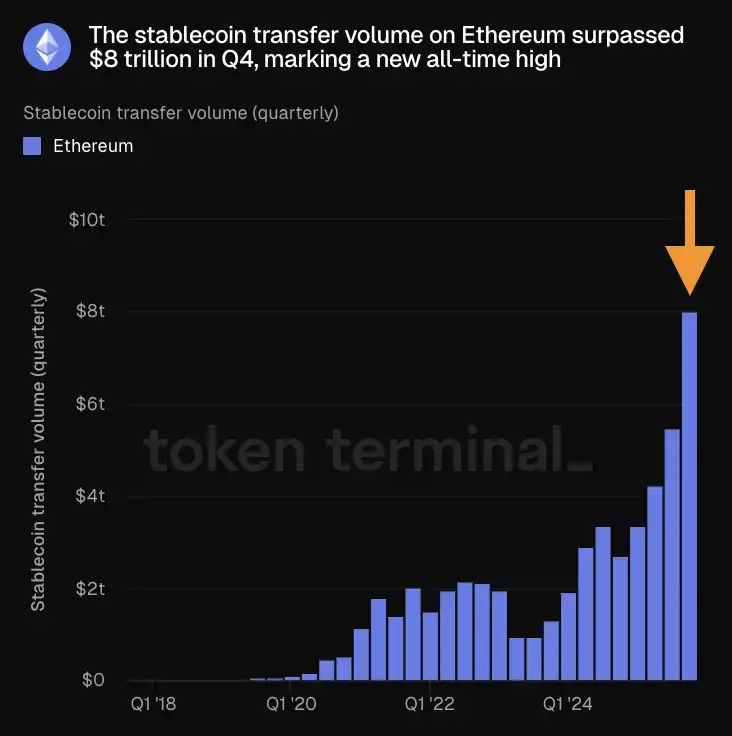
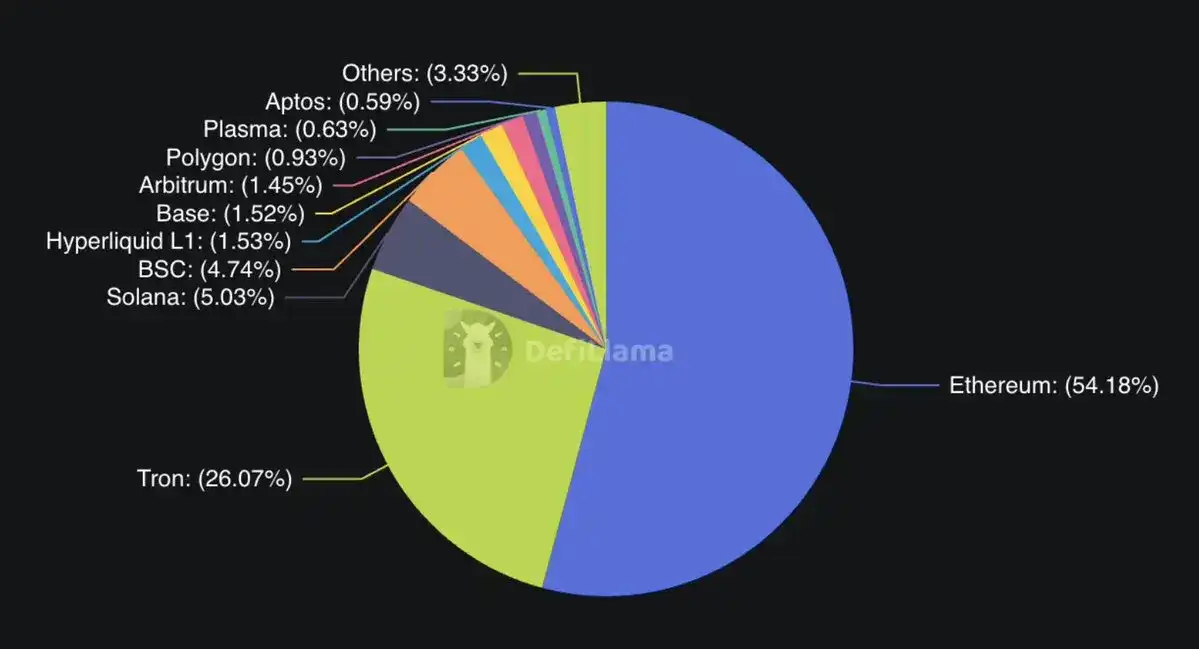
In the stablecoin sector, the on-chain transfer volume of stablecoins on Ethereum in Q4 exceeded $8 trillion, also刷新 (refreshing/setting) a new historical record. In terms of issuance structure, Ethereum's advantage in the stablecoin ecosystem remains significant. Data shows that the share of stablecoin issuance on Ethereum is as high as 54.18%, far exceeding other mainstream blockchain networks like TRON (26.07%), Solana (5.03%), and BSC (4.74%).
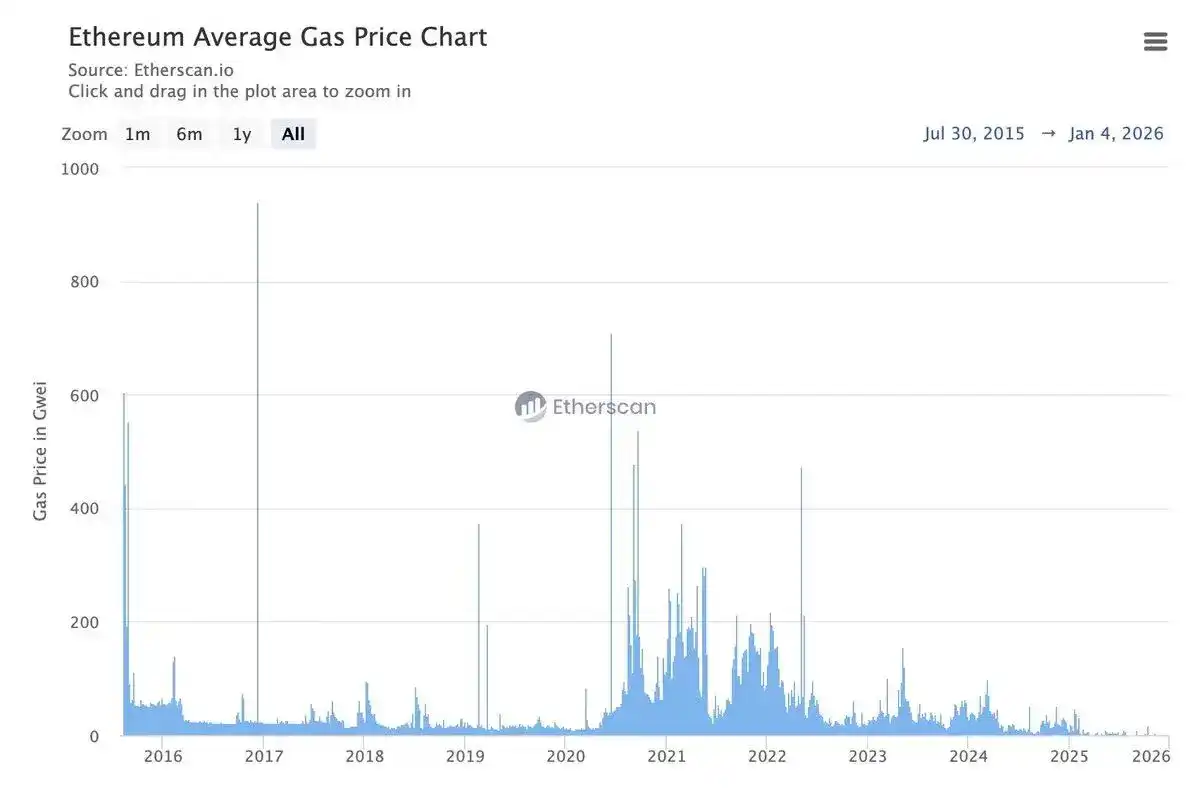
Simultaneously, Ethereum Gas fees have hit the lowest record since the mainnet launch and are持续打破纪录 (continuing to break records). In some periods, Gas fees were even lower than 0.03 Gwei. Considering that Ethereum will continue to推进区块扩容 (advance block scaling) this year, this trend has room to continue in the medium term. Lower transaction costs directly reduce the barrier to on-chain activity and provide a practical foundation for the continued expansion of the application layer.
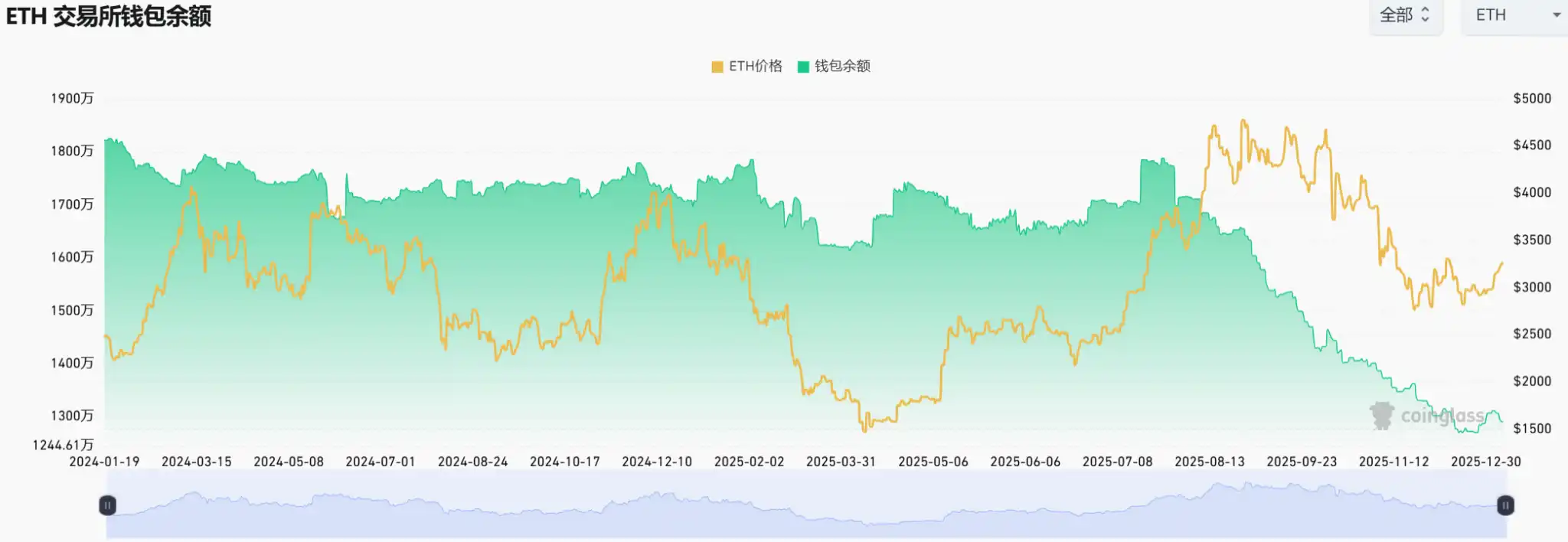
Looking at the exchange balance metric, Ethereum's potential selling pressure is also at low levels. In mid-December, Ethereum's exchange supply dropped to 12.7 million, the lowest level since 2016. Particularly since August 2025, this indicator has seen a significant decline of over 25%. Although exchange balances have slightly increased recently, the increment is only about 200,000 ETH, and the overall level remains in a historically low range, indicating weak selling意愿 (willingness/intent) among traders.
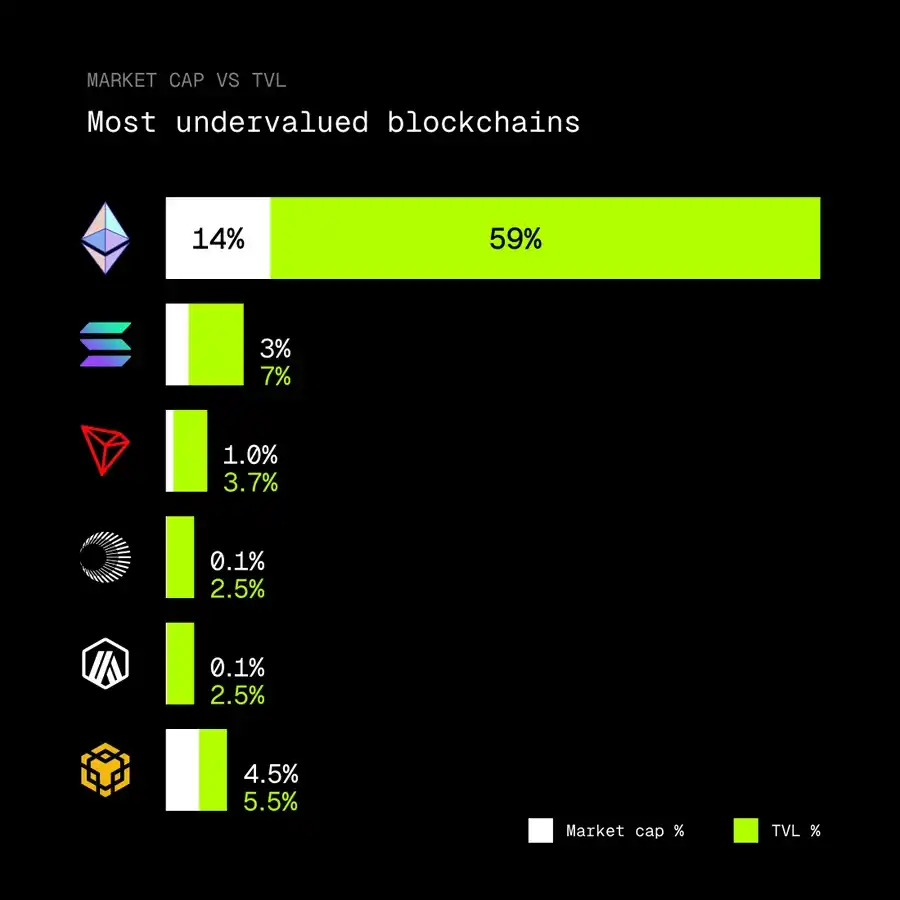
Furthermore, crypto KOL rip.eth recently posted on platform X that, judging by the gap between Total Value Locked (TVL) and market capitalization, Ethereum might be the most undervalued blockchain network currently. Data shows that Ethereum carries 59% of the crypto market's TVL, but its token ETH's market share is only about 14%. In contrast, Solana's token market cap / TVL ratio is 3% / 7%, Tron's is 1% / 3.7%, and BNB Chain's is 4.5% / 5.5%. This, to some extent, reflects that there is still a significant misalignment between ETH's valuation and the scale of economic activity it supports.
Conclusion

In summary, changes in the staking queue may not be the "single variable" determining price trends. But when it改善 (improves) in sync with metrics like developer activity, stablecoin usage scale, transaction costs, and exchange balances, it no longer presents an isolated signal but a more comprehensive fundamental picture.

For Ethereum, this might not be a sentiment-driven rapid reversal, but rather a process where the system is gradually regaining structural stability after completing a round of deep adjustment.


Related Questions

QWhat significant change occurred in Ethereum's staking exit queue on January 7th?

AThe staking exit queue for Ethereum's PoS mechanism was officially cleared on January 7th, indicating that the prolonged exit pressure over several months had been fully digested, with no new large-scale redemption requests observed.

QHow much has the staking entry queue increased, and what is the current status?

AThe staking entry queue has significantly increased to approximately 1.3044 million ETH, with a waiting time of about 22 days and 15 hours, marking a reversal from the high exit activity seen in mid-September last year.

QWhat does the change in the staking queue indicate about market sentiment, according to the article?

AThe staking queue is seen as an important sentiment indicator, reflecting changes in market mood. The clearance of the exit queue and rise in entry queue suggest a reduction in structural selling pressure and a shift in preference towards long-term returns and network security, though it may not directly signal immediate price demand increases.

QWhich institution is identified as the main driver behind the recent increase in staking entries, and what was their contribution?

ABitMine, the largest DAT treasury company, is identified as the primary driver, having staked approximately 771,000 ETH in the past two weeks, accounting for about 18.6% of its holdings of 4.14 million ETH.

QWhat are some key Ethereum fundamental metrics showing marginal improvement, as mentioned in the article?

AKey improving metrics include record-high developer activity with 8.7 million smart contracts deployed in Q4 2025, over $8 trillion in stablecoin transfer volume on Ethereum, historically low Gas fees sometimes below 0.03 Gwei, and exchange balances at their lowest since 2016, indicating reduced selling pressure.

Related Reads

Dalio Warns: AI Boom Shows Signs of a Bubble, Day of Reckoning Will Be the Time of Burst

Ray Dalio, founder of Bridgewater Associates, warns that the current artificial intelligence investment boom shows classic signs of a bubble, which he expects will eventually burst. In a Bloomberg Television interview, he noted that great technological revolutions often lead to capital inflows that create bubbles, making it difficult for investors and companies to calibrate their spending accurately—either overspending to capture market share or underspending and losing their competitive position. This caution comes amid significant rallies in AI-related assets, particularly chipmakers, driven by soaring demand for data centers and high-bandwidth chips, raising debates about overheating valuations. In contrast, Nvidia CEO Jensen Huang recently asserted that investors embracing the AI wave would see "crazy" returns and dismissed concerns over return on investment for data center spending as outdated. Dalio, however, focuses on the risks in the profit realization phase. He argues that bubbles tend to show signs of破裂 when markets transition from investment to the need for tangible returns, describing the burst as a process of converting paper wealth into cash. While acknowledging AI's intrinsic value, he expressed concern over the future profitability of some AI companies, suggesting the market is repeating a familiar pattern. The 76-year-old billionaire, who fully exited Bridgewater in 2025, has a net worth estimated at $21.5 billion according to the Bloomberg Billionaires Index.

marsbit11m ago

Dalio Warns: AI Boom Shows Signs of a Bubble, Day of Reckoning Will Be the Time of Burst

marsbit11m ago

Privacy Coin Crisis of Confidence! ZEC Plunges Over 56% in a Single Day

Zcash (ZEC), a leading privacy-focused cryptocurrency, experienced a severe crash on June 5th, plummeting over 56% in a single day and erasing nearly two months of gains. The flash crash was triggered by the disclosure of a critical zero-knowledge proof vulnerability within Zcash's Orchard privacy pool, which had existed since the pool's launch in May 2022. The flaw theoretically allowed an attacker to forge unlimited ZEC undetectably due to the pool's privacy features. The vulnerability was discovered on May 29th by independent security researcher Taylor Hornby during a proactive audit commissioned by Shielded Labs, utilizing AI-assisted analysis. The Zcash development team responded swiftly, implementing an emergency soft fork to disable Orchard transactions on June 2nd and executing a permanent hard fork fix (NU6.2) on June 3rd. Despite the technical fix, a major crisis of confidence emerged. The core issue is that Orchard's privacy design makes it cryptographically impossible to prove whether the vulnerability was exploited over the past four years, casting permanent doubt on the historical supply integrity of ZEC. While Shielded Labs argues exploitation was unlikely, the inability to provide definitive proof has severely damaged market trust. This sentiment was exacerbated when BitMEX co-founder Arthur Hayes, a prominent ZEC supporter, announced he was selling his entire position. He stated that privacy assets require "perfect security" rather than "probable safety." The combined effect of the disclosure and Hayes's exit ignited widespread panic selling, leading to massive liquidations and significant price decline. Analysts note the event highlights a fundamental tension within privacy coins: the conflict between verifiable supply and cryptographic privacy.

链捕手14m ago

Privacy Coin Crisis of Confidence! ZEC Plunges Over 56% in a Single Day

链捕手14m ago

Trading

Spot
Futures

Hot Articles

Discussions

Welcome to the HTX Community. Here, you can stay informed about the latest platform developments and gain access to professional market insights. Users' opinions on the price of ETH (ETH) are presented below.

活动图片