ERC-8004 Launch: Issuing ID Cards for AI, Ethereum's New Business?

marsbitPublished on 2026-01-28Last updated on 2026-01-28

Abstract

Ethereum is set to launch ERC-8004, a new standard referred to as "Trustless Agents," which aims to provide on-chain digital identities for AI Agents. The initiative, backed by the Ethereum Foundation and supported by companies like Google, Coinbase, and MetaMask, introduces three core registries: an identity registry (using ERC-721 NFTs to verify AI Agents), a reputation registry (tracking historical performance), and a verification registry (for third-party audits). The goal is to establish trust between AI Agents operating on-chain, enabling them to securely interact, execute transactions, and manage assets without human intervention. This move is seen as Ethereum’s strategic response to its declining dominance in the AI Agent space, where platforms like Solana and Base currently lead in adoption due to lower fees and higher throughput. However, the immediate practical need for such a standard is questioned, as most current AI Agents operate within trusted platforms and lack the cross-protocol autonomy that ERC-8004 targets. The standard is viewed as a forward-looking effort to position Ethereum as the trust layer for future AI economies, though its broader impact remains uncertain.

Author: Deep Tide TechFlow

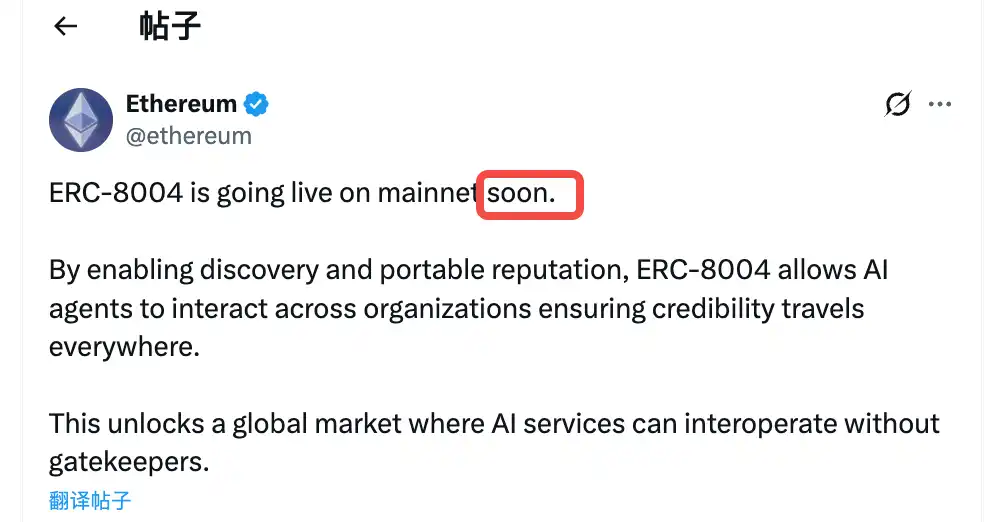
On January 28, Ethereum officially announced that the ERC-8004 protocol is about to launch on the mainnet.

We mentioned this standard in our article last October. If you are completely unfamiliar with it, you can refer here: "x402 Gradually Becoming Inward-Looking, Exploring New Asset Opportunities in ERC-8004 in Advance"

Actually, it has a formal name: "Trustless Agents." In plain language, it roughly means:

Issuing on-chain ID cards for AI Agents.

The Ethereum Foundation rarely promotes an ERC standard so vigorously. They specifically formed a team called dAI, included ERC-8004 in the 2026 strategic roadmap, collaborated with Google, Coinbase, and MetaMask to draft the proposal, and even hosted a Trustless Agents Day at DevConnect in November to build momentum.
The last time Ethereum was this serious about promoting a standard was with ERC-20 and ERC-721.

One defined tokens, the other defined NFTs.

Now it's AI's turn?

Ethereum's AI Anxiety

Why the rush?

Look at some data. According to statistics from Cookie.fun, the market cap distribution of AI Agent tokens shows that Solana and Base together account for 96%. There are only a handful of notable AI Agent projects on the Ethereum mainnet.

In April 2025, the ETH/BTC exchange rate fell to 0.017, a five-year low. Back then, everyone said Ethereum was not the future.

During the DeFi boom, Ethereum was the main stage. During the NFT boom, Ethereum was also the main stage. Now that AI Agents are heating up, the main stage has changed hands.

Solana processes 36 million transactions per day, while the Ethereum mainnet handles 1.13 million. High gas fees and slow speeds have developers voting with their feet. Virtuals Protocol launched on Base, ai16z (now ElizaOS) chose Solana, and even Coinbase's own AI project wasn't placed on the Ethereum mainnet.

Ethereum needs a new story.

ERC-8004 might be the beginning of that story.

Recapping ERC-8004

Back to the standard itself.

How exactly does ERC-8004 issue on-chain ID cards for AI Agents?

You don't need to understand the technical details; just know about three registries.

The first is the Identity Registry. Based on ERC-721, each AI Agent mints an NFT to prove "this is me."

The second is the Reputation Registry. It records the Agent's historical performance, who has used it, their reviews, and whether it has engaged in malicious activities.

The third is the Verification Registry. It allows third-party institutions to endorse the Agent, such as "this Agent has passed a certain security audit."
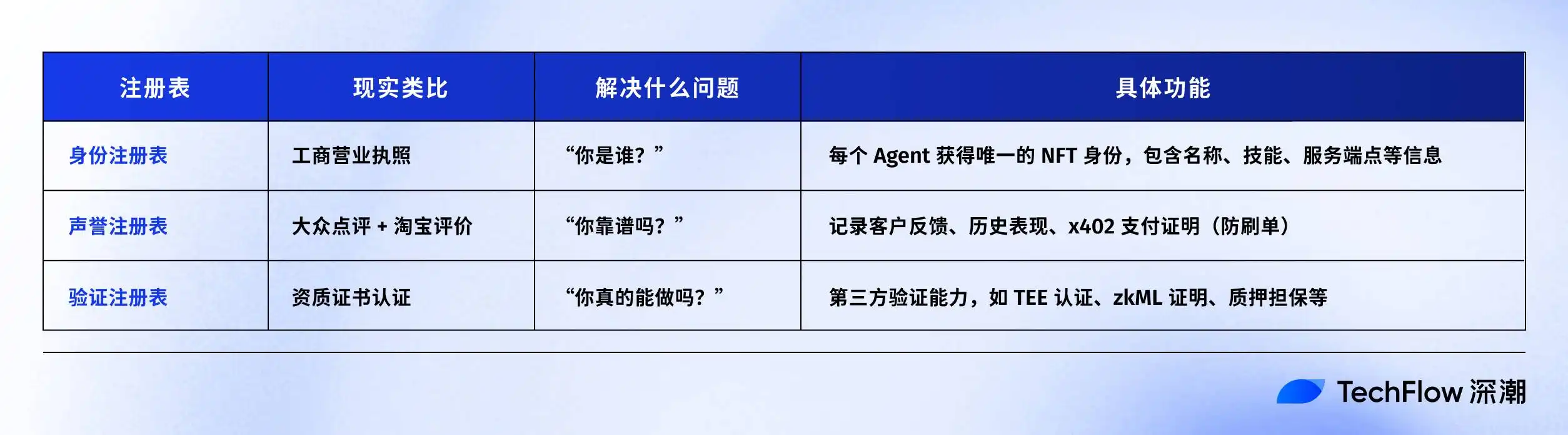
These three registries combined solve one problem: when two AI Agents meet on-chain, how do they know if the other is trustworthy?

The old answer was: they didn't know and had to rely on humans. ERC-8004's answer is: check the on-chain records.

This system wasn't entirely Ethereum's own idea.

Its underlying logic comes from the A2A (Agent-to-Agent) protocol released by Google last year, which enables AIs to communicate and call upon each other. ERC-8004 adds a layer on top of this:

Blockchain-backed trust.

Google's A2A solves the communication problem; Ethereum's ERC-8004 solves the trust problem. One manages the conversation, the other verifies identities.

Is Issuing ID Cards a Good Business?

Daring to speculate, Ethereum's logic might be this:

For AI Agents to be truly useful, they need to manage money themselves. Not just sending tweets or chatting, but directly operating on-chain assets. Signing transactions, calling contracts, cross-protocol arbitrage...

No one dares to do this on a large scale right now. The reason is simple: how do you know this Agent won't transfer your money away? The recently popular ClawdBot already has community members posting about related negative incidents.

The Web2 solution is platform endorsement. You use OpenAI's API, and the trust comes from OpenAI. If something goes wrong, you go to OpenAI.

Web3 doesn't have this. Agents are open-source, deployment is permissionless, and they run on-chain with no one overseeing them. If you call a service from an unknown Agent, you can't check who is behind it, whether the code has issues, or if it has a history of malicious acts...

Simply put, ERC-8004 essentially moves the traditional finance KYC process on-chain. Ethereum is betting that when AI Agents start handling real money, this system will become a necessity.

DeFi protocols wanting to integrate external Agents will first need to check their on-chain identity. Institutions using Agents for trade execution will need to review their historical records. Auditing firms can issue on-chain certifications for Agents, similar to security audits for smart contracts.

This is a competitive positioning move.

Ethereum knows it has lost on the execution layer, but the trust layer is still up for grabs. Institutional recognition, security audit ecosystems, TVL scale—these are Ethereum's existing assets. ERC-8004 is packaging these assets into a standard, aiming to define "what AI Agent compliance looks like" before anyone else.

The question is, does this demand exist now?

Standard Preceding Demand

After discussing Ethereum's calculations, let's talk about reality. What are on-chain AI Agents doing now?

After the AI meme wave subsided last year and the rapid advancements made by leading AI companies in the past couple of years, few people are still paying attention to on-chain AI Agents.

However, they are still making progress.

For example, ai16z has been renamed ElizaOS, evolving from a single Agent to a cross-chain platform; Virtuals Protocol is working on AI DAPPs, planning to venture into physical robots in 2026; others, like the AI Agents in Surf, can automatically execute DeFi trading strategies.

But the question arises: do they really need ERC-8004?

Luna's users trust Luna because it's made by the core Virtuals team. Agents on ElizaOS are used because they run within the ElizaOS framework; Surf executes strategies for you often because you trust the application itself.

Trust comes from the platform, not from an on-chain identity.

The scenario ERC-8004 envisions is: a陌生 (strange) Agent approaches you, with no platform endorsement or brand recognition, and you can only judge its trustworthiness through on-chain records.

When will this scenario occur?

When AI Agents truly achieve autonomous calls across protocols, platforms, and organizational boundaries. An Agent borrowing from Aave, trading on Uniswap, then generating yield in another protocol, all without human approval...

But, this scenario does not exist now.

Current AI Agents, no matter how complex their functions, essentially operate within a single platform. They don't need to prove themselves to陌生 protocols because they never knock on their doors.

Given the current hype in the crypto market, they also have no reason to knock on each other's doors, unless they can jointly create a new narrative.

Therefore, ERC-8004 solves a future problem.

If AI Agents evolve from toys to tools, Ethereum's trust infrastructure will have value. If the Agent economy grows large enough and cross-platform calls become the norm, ERC-8004 can collect tolls.

There are many "ifs."

Thus, for this future-oriented布局 (layout), institutions might be the first to act.

In late 2025, SharpLink Gaming announced investing $170 million into Ethereum restaking strategies. Around the same time, net outflows of ETH from exchanges exceeded 23,000 coins, flowing into private wallets and staking protocols.

This money might be betting on Ethereum 12 to 18 months from now.

For retail investors, however, ERC-8004 isn't a great catalyst.

Betting on ERC-8004 itself? It's an open standard with no token; you can't invest directly, only find some associated small projects. Betting on Ethereum is possible, but Ethereum's price is influenced by too many factors, with AI Agents being just one narrative.

Therefore, there is currently no clean asset that allows you to accurately bet on the proposition "AI Agents need on-chain identities."

Ethereum is not solely AI infrastructure, and Ethereum's identity anxiety won't be completely alleviated by AI. The business of issuing AI ID cards still has a long way to go.


Related Questions

QWhat is the main purpose of the ERC-8004 protocol announced by Ethereum?

AThe main purpose of ERC-8004, also known as 'Trustless Agents', is to provide a chain-based identity system for AI Agents. It creates a decentralized framework for issuing and verifying digital identities, reputation, and third-party attestations for AI Agents on the blockchain, enabling trustless interactions between them.

QWhy is Ethereum heavily promoting the ERC-8004 standard according to the article?

AEthereum is promoting ERC-8004 aggressively because it aims to capture the emerging AI Agent market, where it currently lags behind chains like Solana and Base. By establishing a trust layer for AI Agents, Ethereum seeks to leverage its strengths in security, institutional recognition, and ecosystem maturity to define the standard for AI Agent compliance and trust in the blockchain space.

QWhat are the three key registries proposed in the ERC-8004 standard?

AThe three key registries in ERC-8004 are: 1) The Identity Registry, which uses ERC-721 to mint NFTs as proof of identity for each AI Agent; 2) The Reputation Registry, which records historical performance and user evaluations of Agents; and 3) The Verification Registry, which allows third-party entities to provide attestations or audits for Agents.

QDoes the current AI Agent ecosystem on blockchain have an immediate need for ERC-8004?

ANo, the current AI Agent ecosystem does not have an immediate need for ERC-8004. Most AI Agents operate within single platforms or under trusted brands, where trust is derived from the platform itself rather than decentralized identity verification. ERC-8004 addresses a future scenario where cross-protocol, autonomous AI interactions become common.

QWhat underlying protocol does ERC-8004 build upon for AI Agent communication?

AERC-8004 builds upon Google's A2A (Agent-to-Agent) protocol, which enables AI Agents to communicate and invoke each other. Ethereum's contribution adds a blockchain-based trust layer to this framework, ensuring decentralized identity verification mechanisms for secure interactions.

Related Reads

Retail Ecology Dwindles, ZKsync Bets on Bank Pilots for a Breakthrough

Amidst declining retail activity, ZKsync is pivoting to target institutional banking as its primary growth strategy. The article explores this shift, contrasting it with the competitive "survival of the fittest" narrative by highlighting a cooperative model inspired by naturalist Peter Kropotkin. ZKsync is developing infrastructure like its private, permissioned Prividium suite for banks (e.g., Deutsche Bank's use case via Memento), enabling private transactions with public verifiability via zero-knowledge proofs. This appeals to institutions needing privacy, compliance, and Ethereum-based settlement security, unlike fully private chains (e.g., JPMorgan's Kinaxis) or consortium models (e.g., R3 Corda). However, this strategic focus has coincided with a steep decline in its public DeFi ecosystem, evidenced by plunging TVL and the departure of major protocols like Aave due to low fees. The network's future now hinges on banking adoption, with upcoming pilots like the Cari Network involving regional banks holding over $600 billion in deposits. A significant challenge is balancing this institutional focus with ZKsync's decentralized governance. Banks must operate on a network where rules and fees (denominated in the volatile ZK token) can be changed via community vote, and where a Security Council holds emergency control—a stark contrast to the predictable, contract-bound environments of traditional finance. The coming 18 months will test whether ZKsync can successfully onboard traditional banks onto a dynamically governed public chain or if institutions will ultimately revert to proprietary solutions.

Foresight News17m ago

Retail Ecology Dwindles, ZKsync Bets on Bank Pilots for a Breakthrough

Foresight News17m ago

The Recursive AI Anthropic Warned About: Tian Yuandong's New Company Has Just Taken the "First Step"

Anthropic recently highlighted the rapid progress toward "recursive self-improvement," where AI systems autonomously design and train their successors. In response, Recursive Superintelligence, a new company co-founded by former Meta researcher Tian Yuan Dong, has publicly demonstrated its first step toward automating AI research. The company released a system designed to autonomously execute the full AI research cycle: generating ideas, implementing code, running experiments, and learning from results. It validated this approach by achieving state-of-the-art results on three diverse benchmarks: 1. **NanoChat Autoresearch:** Optimizing a small language model's validation loss under a fixed 5-minute GPU budget, improving upon the community's best result. 2. **NanoGPT Speedrun:** Reducing the time to train a GPT model to a specific loss on 8 H100 GPUs from 79.7 seconds to 77.5 seconds, beating a highly optimized, human-driven community effort. 3. **SOL-ExecBench:** Improving the overall score on NVIDIA's suite of 235 GPU kernel optimization tasks by 18%, closing the gap to the hardware limit. The system discovered novel optimizations in this highly specialized domain without direct human expertise. Recursive's system operates as a general framework, capable of parallel exploration and cross-task knowledge transfer while incorporating safeguards against reward hacking. The company, backed by $650M in funding and a star-studded team including Richard Socher and Alexey Dosovitskiy, aims to create AI that recursively enhances its own research capabilities. This development represents an early but concrete move toward a new paradigm where AI accelerates its own advancement. It occurs alongside Anthropic's warnings about the need for industry coordination and potential pauses when recursive self-improvement thresholds are reached, highlighting the dual trajectory of rapid technical progress and growing calls for careful stewardship.

marsbit24m ago

The Recursive AI Anthropic Warned About: Tian Yuandong's New Company Has Just Taken the "First Step"

marsbit24m ago

The Gold Buy-on-the-Dip Guide: Watch Interest Rates, Not Just War

"Gold Buying Guide: Focus on Interest Rates, Not Just War" Four months ago, gold buyers likely didn't anticipate buying at a peak that even a war couldn't sustain. After hitting a record high of $5,596 on January 29, gold entered a bear market just 91 days later, its fastest decline since 2008. A key trigger was the Fed's hawkish shift, highlighting that monetary policy, not geopolitics, is the primary driver. The article argues that the traditional "buy gold in turmoil" script has changed. While the US-Iran conflict initially boosted prices, the sustained rally in oil prices heightened inflation fears, forcing central banks to maintain or consider tighter policy. Since gold yields no interest, higher rates increase its opportunity cost, eroding its appeal. This dynamic was evident when gold fell sharply on May 18 despite positive peace talks, as lower oil prices eased inflation and thus rate hike pressures. The recent sell-off is also part of a broader market deleveraging. Correlations between gold, Nasdaq, and Bitcoin spiked as leveraged investors sold liquid assets to cover losses, creating a synchronized downturn. Historically, gold bottoms align with policy shifts, not conflict resolutions. The 2008 and 2022 bear markets ended with shifts to extreme easing and peak inflation expectations, respectively. For potential buyers, the author suggests monitoring three signals: 1) Peak interest rate hike expectations, 2) Reopening of the Strait of Hormuz (to ease oil/inflation pressure), and 3) A return to net inflows for Gold ETFs, indicating the end of forced selling. While predicting the exact bottom is impossible, the author's personal strategy involves scaling into a position across price levels like $4000, $3700, and $3500, committing no more than 30% of the intended total allocation initially, and adding the remainder only if key signals emerge. The core conclusion: In turbulent times, watching interest rates is more crucial than watching wars.

marsbit30m ago

The Gold Buy-on-the-Dip Guide: Watch Interest Rates, Not Just War

marsbit30m ago

Recent On-Chain Review: No Clear Narrative Under U.S. Stock Market Pressure, Just Hype

This article analyzes the current state of the Solana meme coin and community token ecosystem, highlighting a market caught between two dominant forces: attention-based PvP and a gradual return to community-centric projects. The first part explores the "Attention PvP" dynamic, where success is driven by celebrity endorsements, viral events, and speed. Examples include $JOTCHUA, which surged after its meme creator's social media activity, and $WORLDCUP, which outperformed a similar Base chain project ($PITCH) largely due to influencer support. The recent "pump.fun GO" feature, allowing bounty tasks for token promotion, is critiqued for fostering sensationalist and often negative stunts—like people getting token tickers tattooed on their bodies for rewards—reminiscent of old internet shock content. In contrast, the article points to a resurgence of organic, community-driven tokens that survive market volatility through strong holder bases and shared ideology, not just hype. Influencer Ansem is cited, arguing that durable meme coins rely on communities willing to endure losses and promote their core message daily. Examples given are older tokens like $neet (anti-work ethos), $troll, $buttcoin, and $triplet, which have maintained relative price stability. A prime example of this community-build model is the new project $KINS, the token for the browser-based MMORPG Kintara. Its success stems not from advanced graphics but from consistently delivering updates, fostering player trust, and creating genuine engagement (e.g., in-game economies, events, property auctions). It has attracted a growing player base and even notable KOLs as participants, demonstrating that sustainable growth can come from building trust rather than orchestrating pumps. The article concludes by questioning whether the market is ultimately a game of mutual trust or mutual deception, expressing hope that such reflection might lead to a healthier ecosystem.

marsbit31m ago

Recent On-Chain Review: No Clear Narrative Under U.S. Stock Market Pressure, Just Hype

marsbit31m ago

Trading

Spot
Futures

Hot Articles

How to Buy ID

Welcome to HTX.com! We've made purchasing SPACE ID (ID) simple and convenient. Follow our step-by-step guide to embark on your crypto journey.Step 1: Create Your HTX AccountUse your email or phone number to sign up for a free account on HTX. Experience a hassle-free registration journey and unlock all features.Get My AccountStep 2: Go to Buy Crypto and Choose Your Payment MethodCredit/Debit Card: Use your Visa or Mastercard to buy SPACE ID (ID) instantly.Balance: Use funds from your HTX account balance to trade seamlessly.Third Parties: We've added popular payment methods such as Google Pay and Apple Pay to enhance convenience.P2P: Trade directly with other users on HTX.Over-the-Counter (OTC): We offer tailor-made services and competitive exchange rates for traders.Step 3: Store Your SPACE ID (ID)After purchasing your SPACE ID (ID), store it in your HTX account. Alternatively, you can send it elsewhere via blockchain transfer or use it to trade other cryptocurrencies.Step 4: Trade SPACE ID (ID)Easily trade SPACE ID (ID) on HTX's spot market. Simply access your account, select your trading pair, execute your trades, and monitor in real-time. We offer a user-friendly experience for both beginners and seasoned traders.

3.0k Total ViewsPublished 2024.03.29Updated 2026.06.02

How to Buy ID

Discussions

Welcome to the HTX Community. Here, you can stay informed about the latest platform developments and gain access to professional market insights. Users' opinions on the price of ID (ID) are presented below.

活动图片












