Did AI Actually Help Discover a Security Vulnerability in Coldcard?

cryptonews.ruPublished on 2026-08-01Last updated on 2026-08-01

Abstract

A security vulnerability in Coldcard hardware wallets led to a theft of approximately 1,128.5 BTC ($71.1 million at the time). The issue stemmed from a five-year-old firmware configuration error affecting certain Mk3, Mk4, Mk5, and Q devices. This bug caused the devices to use a weak pseudo-random number generator during seed phrase creation, reducing effective entropy to as low as 40 bits instead of the intended 128 bits. This made it computationally feasible for an attacker to brute-force seeds by comparing derived addresses with the Bitcoin blockchain. Manufacturer Coinkite issued an emergency firmware patch and advised affected users to generate a new seed using the fixed software and transfer their funds. Coinkite's CEO suggested that AI code analysis tools might have been used to discover this long-hidden vulnerability, highlighting a new paradigm in security auditing. However, critics emphasized that the root cause was a human engineering error that traditional code reviews could have caught. The incident underscores the challenges of open-source security, where visibility does not guarantee timely discovery of subtle flaws.

The incident came to light after approximately 594 $BTC, worth about $38 million at the time, were moved from around 500 single-signature Bitcoin addresses on July 30. When the news first broke, Bitcoin.com News noted that the transfers occurred over roughly 25 minutes and appeared to be targeting wallets sharing a common technical vulnerability.

Later blockchain analysis allowed for an estimation of the potential theft scale. Researchers calculated that between 1,082 and 1,196 addresses might have been compromised over a period of about 41 minutes. Subsequently, a dedicated monitoring dashboard named Coldcard Sweep Watch estimated the total amount at 1,128.4717 $BTC, which, when Bitcoin was trading around $63,044, was approximately $71.1 million.
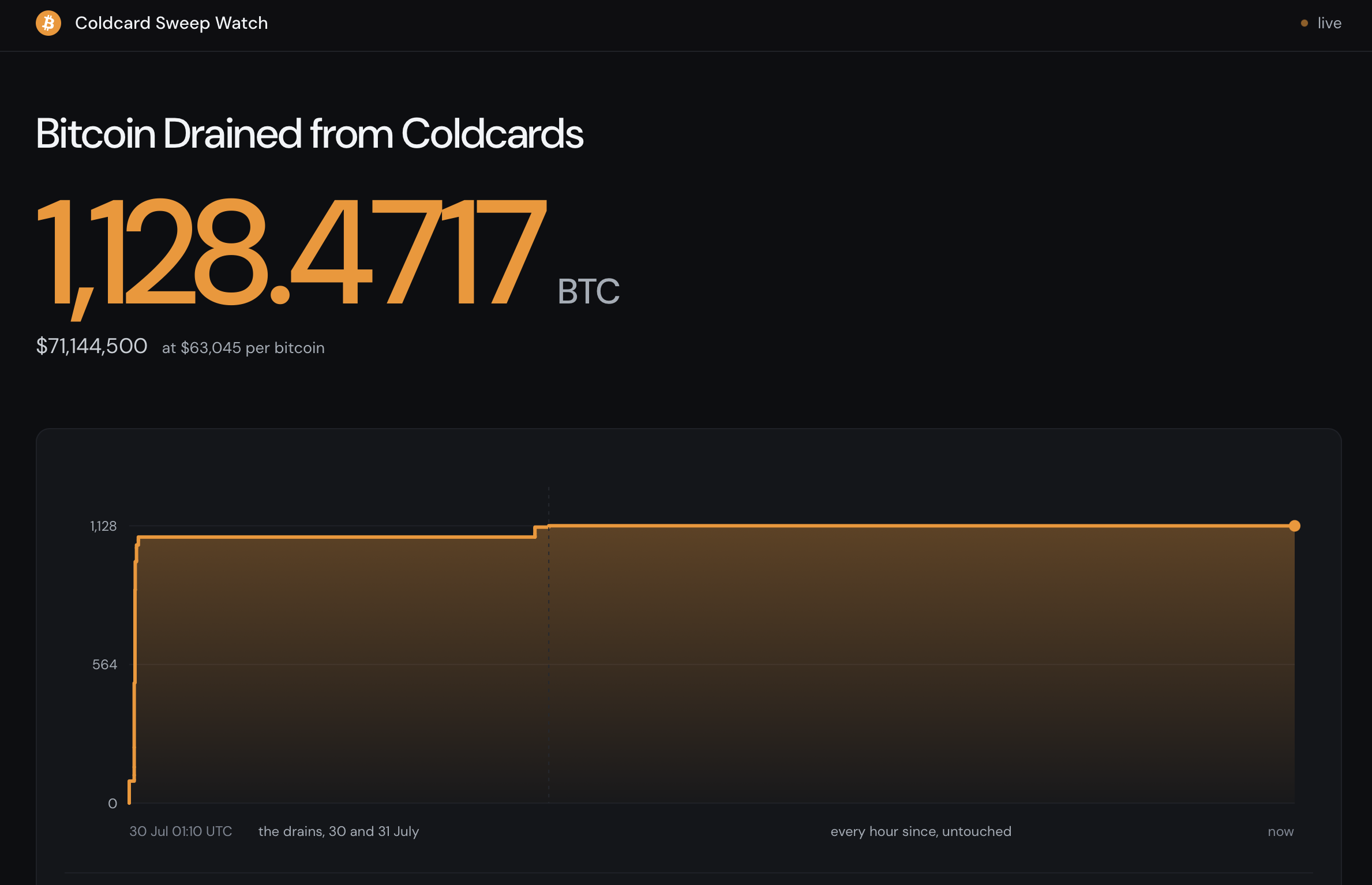
Image source: Coldcard Sweep Watch dashboard. Screenshot taken on August 1, 2026, at 8:30 AM Eastern Time. Since this screenshot was taken, one hour later at 9:30 AM, the estimate increased to 1,128.6633 $BTC.

The majority of the funds were concentrated on a single address holding hundreds of bitcoins, with a significant portion of these funds having been largely dormant. The affected addresses shared one crucial detail: their recovery seeds were created on Coldcard hardware wallets manufactured by the Canadian company Coinkite.

A seed phrase is a list of words that controls access to a cryptocurrency wallet. Anyone who can recover or obtain this seed phrase can typically transfer funds from the wallet without possessing the physical device.

Coldcard Discovers Vulnerability in Random Number Generation System

Coinkite issued an urgent warning that some seeds generated on Coldcard devices might be vulnerable. Mk3 devices with firmware version 4.0.1, released around March 2021, and later versions were among those most at risk.

Further analysis expanded concerns to include seeds created on some Mk4, Mk5, and Q devices prior to Coinkite releasing emergency firmware fixes. Reportedly, Tapsigner, Opendime, and Satscard products were not affected by this vulnerability as they use different software.

The vulnerability was related to the random data generation process. Wallet security relies on high-quality randomness so that their recovery seeds cannot be guessed. Researchers estimated that on the most seriously affected Mk3 devices, the seed might have contained only about 40 bits of effective entropy instead of the intended 128 bits.

This difference is critical. A properly generated 128-bit seed is considered virtually impossible to brute-force guess. A 40-bit seed offers significantly fewer possibilities, enabling a malicious actor with sufficient computational power to test potential seeds offline and compare the resulting addresses against the public Bitcoin blockchain.

Some newer devices might have provided around 72 bits of effective entropy, as secure hardware added another layer of unpredictable data. This would have made seed recovery more difficult, though they would still remain far more vulnerable than intended.

One Configuration Error Existed for 5 Years

The problem began with a configuration error at the build stage, related to two software functions performing similar tasks. One function used the device's hardware True Random Number Generator, while the other relied on a weaker software process inherited from MicroPython.

Coinkite intended to disable the MicroPython option. However, a software check only verified the presence of a configuration flag definition, not whether its value was set to zero. Consequently, the finished firmware could silently select the weaker function.

Because both functions had identical formats, the software continued to compile and run without producing obvious errors. The error crept into the code during a software migration in 2021 and remained in the public firmware for over five years.

Updating the device now does not strengthen a seed generated by the faulty software. Affected users must create a completely new seed using the patched firmware or another secure device and then transfer their funds to addresses controlled by this new seed.
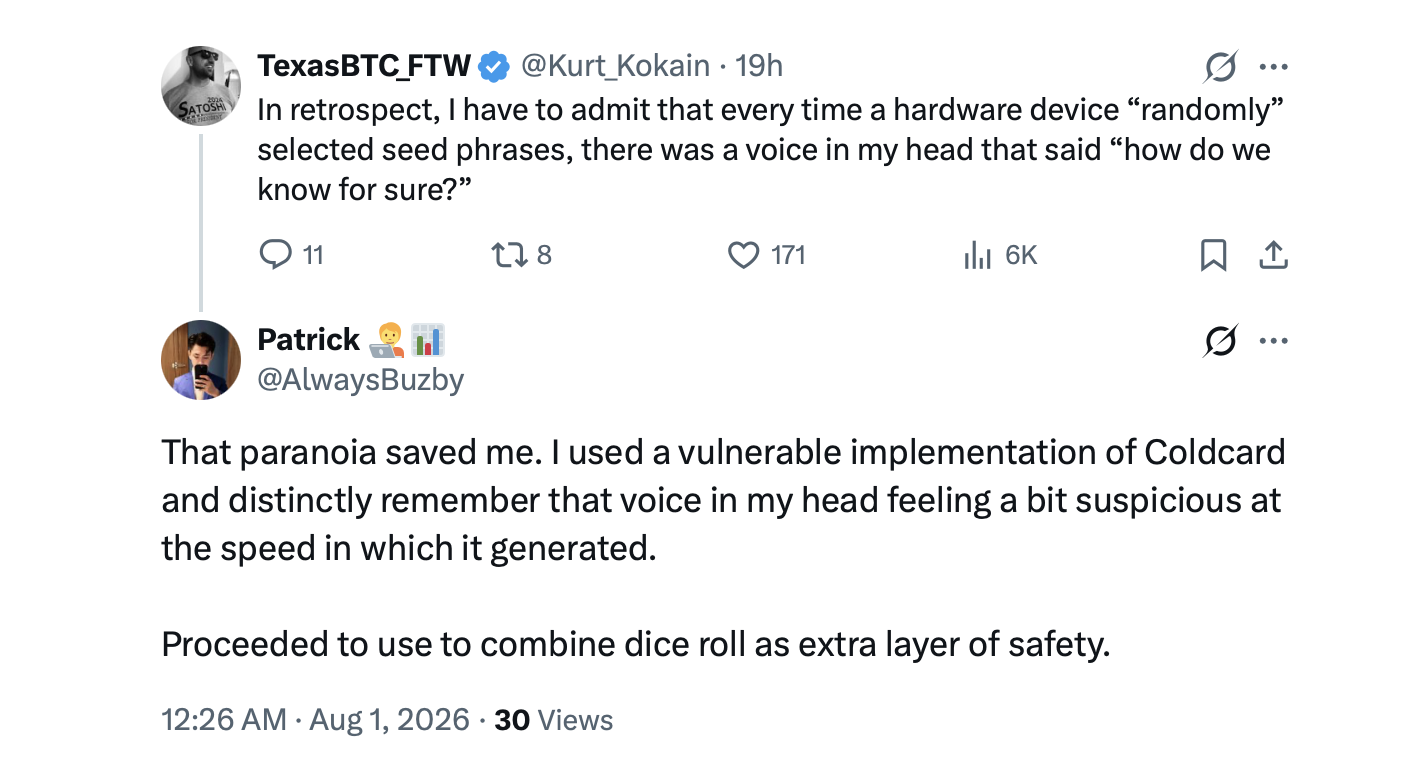
Image source: X

Users who added at least 50 independent dice rolls when creating their seed may have provided sufficient randomness to avoid this vulnerability. A strong BIP-39 passphrase could also have made recovery more difficult, and wallets requiring signatures from multiple independent devices could have prevented fund transfers from a single compromised seed.

Coinkite Points to AI, but Evidence Remains Lacking

Coinkite CEO Rodolfo Novak publicly apologized, stating the company takes full responsibility for the firmware failure. He reported the team is working on patched software, technical reports, and support for affected users.

Coinkite and Novak also proposed a striking theory about how the vulnerability was discovered. Given the company's firmware had been public for years, they stated they believe someone may have used AI to analyze old code versions and discover the vulnerable random number generation path.

"To all other developers: we believe this is the harsh reality of the new AI paradigm. AI code review now allows finding hidden bugs at a speed surpassing even the most seasoned industry experts," Novak wrote in his apology post on X. "If your firmware is open-source or has ever been public, assume it is already being studied by both attackers and security professionals."

Modern AI-based coding systems can process large software repositories and identify suspicious links between configuration settings, functions, and security assumptions. An attacker could instruct such a system to specifically search for weak random number generators, fallback functions, or errors affecting cryptographic keys.
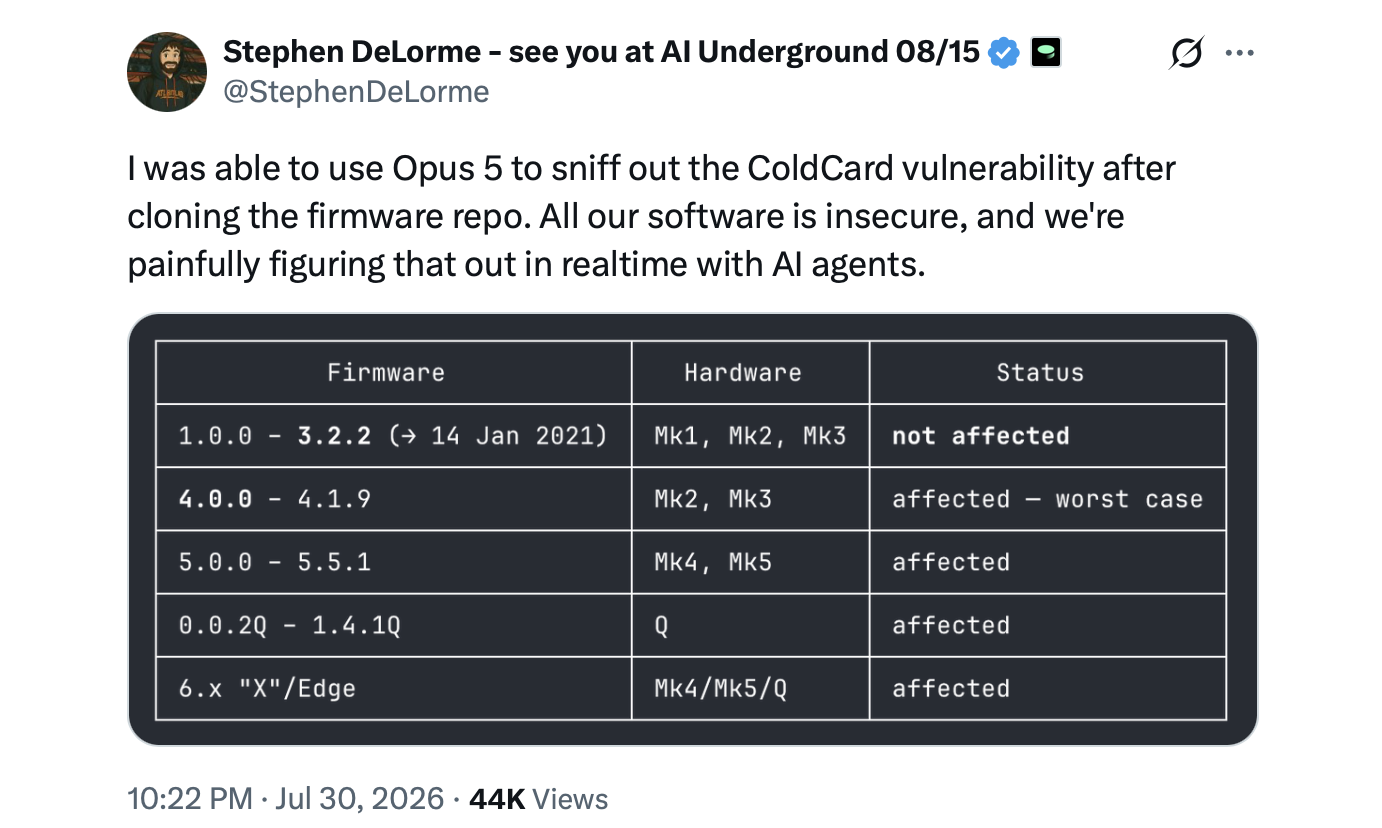
Some observers independently used advanced AI models to discover the Coldcard vulnerability. Image source: X

Later, independent researchers reported using AI models to detect or explain the issue after the underlying randomness problem became known. This demonstrated how accessible AI code analysis has become, but did not prove the initial attacker used AI.
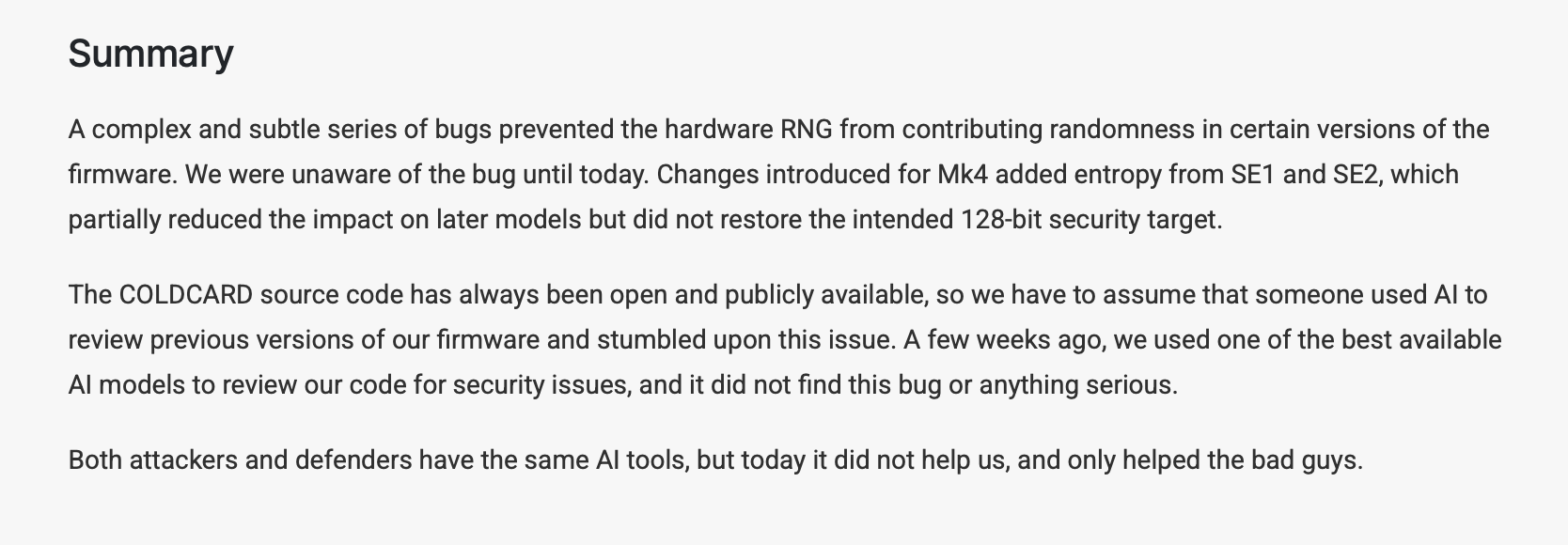
Image source: Coldcard Wallet blog post about AI.

Coinkite acknowledged that its own review using a leading AI model failed to detect the vulnerability before the theft. This outcome shows AI systems do not automatically uncover all serious flaws. Their effectiveness can depend on the instructions given, the volume of code provided, and whether the human conducting the review understands the warning signs.

Critics Argue Human Error Came First

Some security experts argue that overemphasis on AI risks distracting from the underlying engineering mistake. Many believe the configuration error was a known type of software bug, and traditional code reviews, testing procedures, or audits focused on seed generation could have detected it years ago.
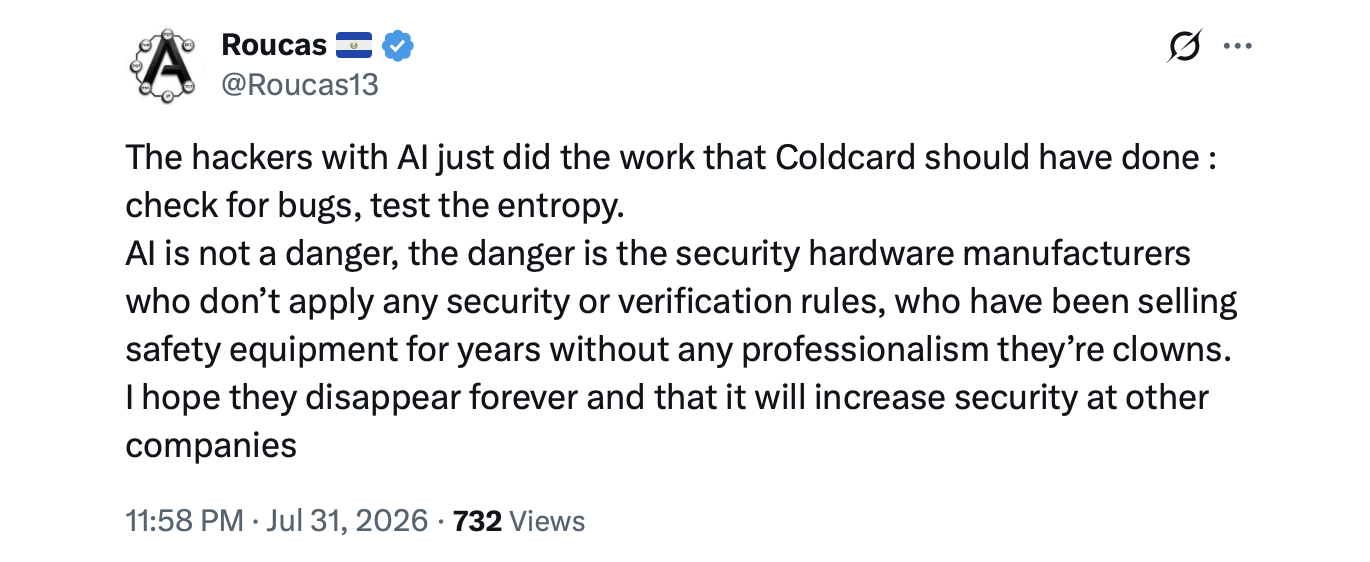
Some observers do not blame AI and believe the engineering team should have discovered this vulnerability on its own. Image source: X.

The opposing viewpoints are not necessarily incompatible. Human error created the vulnerability and allowed it to persist, while AI may have lowered the cost of discovering, understanding, or exploiting it. Defenders need to find all dangerous weak spots, whereas an attacker only needs to find one.

This incident also challenges assumptions about open-source security. Open code allows independent experts to audit software, but availability alone does not guarantee someone will analyze the right snippet, detect a subtle defect, and report it before an attacker acts.

For Coldcard users, the immediate priority is determining when and how their seed was generated. Anyone with an affected seed should check instructions via Coinkite's official channels, install patched firmware, generate a new seed, and carefully transfer funds, watching for phishing attempts and fake support messages.

In the long term, the focus will be on how much Bitcoin was stolen, whether investigators can identify the perpetrator, and whether AI played a decisive role in discovering the vulnerability. Hardware wallet manufacturers will also face pressure to strengthen entropy testing, audit build configurations, and continuously examine old code using both human experts and AI tools modeling attacks.

end-content

Trending Cryptos

Related Questions

QWhat was the core vulnerability discovered in the Coldcard hardware wallets?

AThe core vulnerability was a flaw in the random number generation process for creating wallet seed phrases. Due to a five-year-old build configuration error, the firmware could silently default to using a weaker software-based entropy source instead of the device's secure hardware random number generator. On the most affected Mk3 devices, this resulted in seeds having only about 40 bits of effective randomness instead of the intended 128 bits, making them susceptible to brute-force attacks.

QWhat is the estimated financial impact of the security incident involving Coldcard wallets?

AThe estimated financial impact is approximately 1,128.47 BTC, which was valued at around $71.1 million at the time of the incident when Bitcoin was trading near $63,044.

QWhat theory did Coinkite propose regarding how the vulnerability was discovered and exploited?

ACoinkite proposed the theory that the vulnerability might have been discovered using AI code analysis. The CEO suggested that because their firmware had been public for years, an attacker could have used AI to analyze old code versions and identify the vulnerable random number generation path, finding hidden bugs faster than even expert human reviewers.

QWhat is the recommended course of action for users who may be affected by this vulnerability?

AAffected users must create a completely new seed phrase using the patched firmware or a different secure device and then transfer their funds to addresses controlled by this new seed. Simply updating the device's firmware does not strengthen a seed already generated by the faulty software. Users should follow official Coinkite instructions and be wary of phishing attempts.

QAccording to critics cited in the article, what is the fundamental cause of the incident that an AI-focused narrative might distract from?

ACritics argue that the fundamental cause was a human engineering error—a basic software configuration bug. They contend that traditional code reviews, testing procedures, or security audits focused on seed generation should have caught this known type of bug years ago, and overemphasizing AI risks diverting attention from this core failure in development practices.

Related Reads

Trading

Spot

Hot Articles

What is $BITCOIN

DIGITAL GOLD ($BITCOIN): A Comprehensive Analysis Introduction to DIGITAL GOLD ($BITCOIN) DIGITAL GOLD ($BITCOIN) is a blockchain-based project operating on the Solana network, which aims to combine the characteristics of traditional precious metals with the innovation of decentralized technologies. While it shares a name with Bitcoin, often referred to as “digital gold” due to its perception as a store of value, DIGITAL GOLD is a separate token designed to create a unique ecosystem within the Web3 landscape. Its goal is to position itself as a viable alternative digital asset, although specifics regarding its applications and functionalities are still developing. What is DIGITAL GOLD ($BITCOIN)? DIGITAL GOLD ($BITCOIN) is a cryptocurrency token explicitly designed for use on the Solana blockchain. In contrast to Bitcoin, which provides a widely recognized value storage role, this token appears to focus on broader applications and characteristics. Notable aspects include: Blockchain Infrastructure: The token is built on the Solana blockchain, known for its capacity to handle high-speed and low-cost transactions. Supply Dynamics: DIGITAL GOLD has a maximum supply capped at 100 quadrillion tokens (100P $BITCOIN), although details regarding its circulating supply are currently undisclosed. Utility: While precise functionalities are not explicitly outlined, there are indications that the token could be utilized for various applications, potentially involving decentralized applications (dApps) or asset tokenization strategies. Who is the Creator of DIGITAL GOLD ($BITCOIN)? At present, the identity of the creators and development team behind DIGITAL GOLD ($BITCOIN) remains unknown. This situation is typical among many innovative projects within the blockchain space, particularly those aligning with decentralized finance and meme coin phenomena. While such anonymity may foster a community-driven culture, it intensifies concerns about governance and accountability. Who are the Investors of DIGITAL GOLD ($BITCOIN)? The available information indicates that DIGITAL GOLD ($BITCOIN) does not have any known institutional backers or prominent venture capital investments. The project seems to operate on a peer-to-peer model focused on community support and adoption rather than traditional funding routes. Its activity and liquidity are primarily situated on decentralized exchanges (DEXs), such as PumpSwap, rather than established centralized trading platforms, further highlighting its grassroots approach. How DIGITAL GOLD ($BITCOIN) Works The operational mechanics of DIGITAL GOLD ($BITCOIN) can be elaborated on based on its blockchain design and network attributes: Consensus Mechanism: By leveraging Solana’s unique proof-of-history (PoH) combined with a proof-of-stake (PoS) model, the project ensures efficient transaction validation contributing to the network's high performance. Tokenomics: While specific deflationary mechanisms have not been extensively detailed, the vast maximum token supply implies that it may cater to microtransactions or niche use cases that are still to be defined. Interoperability: There exists the potential for integration with Solana’s broader ecosystem, including various decentralized finance (DeFi) platforms. However, the details regarding specific integrations remain unspecified. Timeline of Key Events Here is a timeline that highlights significant milestones concerning DIGITAL GOLD ($BITCOIN): 2023: The initial deployment of the token occurs on the Solana blockchain, marked by its contract address. 2024: DIGITAL GOLD gains visibility as it becomes available for trading on decentralized exchanges like PumpSwap, allowing users to trade it against SOL. 2025: The project witnesses sporadic trading activity and potential interest in community-led engagements, although no noteworthy partnerships or technical advancements have been documented as of yet. Critical Analysis Strengths Scalability: The underlying Solana infrastructure supports high transaction volumes, which could enhance the utility of $BITCOIN in various transaction scenarios. Accessibility: The potential low trading price per token could attract retail investors, facilitating wider participation due to fractional ownership opportunities. Risks Lack of Transparency: The absence of publicly known backers, developers, or an audit process may yield skepticism regarding the project's sustainability and trustworthiness. Market Volatility: The trading activity is heavily reliant on speculative behavior, which can result in significant price volatility and uncertainty for investors. Conclusion DIGITAL GOLD ($BITCOIN) emerges as an intriguing yet ambiguous project within the rapidly evolving Solana ecosystem. While it attempts to leverage the “digital gold” narrative, its departure from Bitcoin's established role as a store of value underscores the need for a clearer differentiation of its intended utility and governance structure. Future acceptance and adoption will likely depend on addressing the current opacity and defining its operational and economic strategies more explicitly. Note: This report encompasses synthesised information available as of October 2023, and developments may have transpired beyond the research period.

1.4k Total ViewsPublished 2025.05.13Updated 2025.05.13

What is $BITCOIN

Discussions

Welcome to the HTX Community. Here, you can stay informed about the latest platform developments and gain access to professional market insights. Users' opinions on the price of BTC (BTC) are presented below.

活动图片