DEXE dumps 15% as seller dominance surges – Warning sign?

ambcryptoPublished on 2026-04-09Last updated on 2026-04-09

Abstract

DEXE experienced a sharp decline of 15.27%, dropping to $7.6, despite a broader crypto market rebound. The altcoin lost the $8 support level, falling as low as $7.3, and moved below the Parabolic SAR, indicating strong bearish pressure. The drop was driven by increased profit-taking, a surge in seller dominance, and a significant rise in trading volume dominated by selling activity. Open Interest declined slightly while Derivatives Volume spiked, suggesting aggressive position closures. Futures net flow turned negative, reflecting strong bearish sentiment. A recovery above $7.9 could lead to a rebound toward $9.2, but failure may result in a further decline toward $7 or even $5.1.

DEXE fell sharply even as the broader crypto market rebounded on easing global tensions and ceasefire talks.

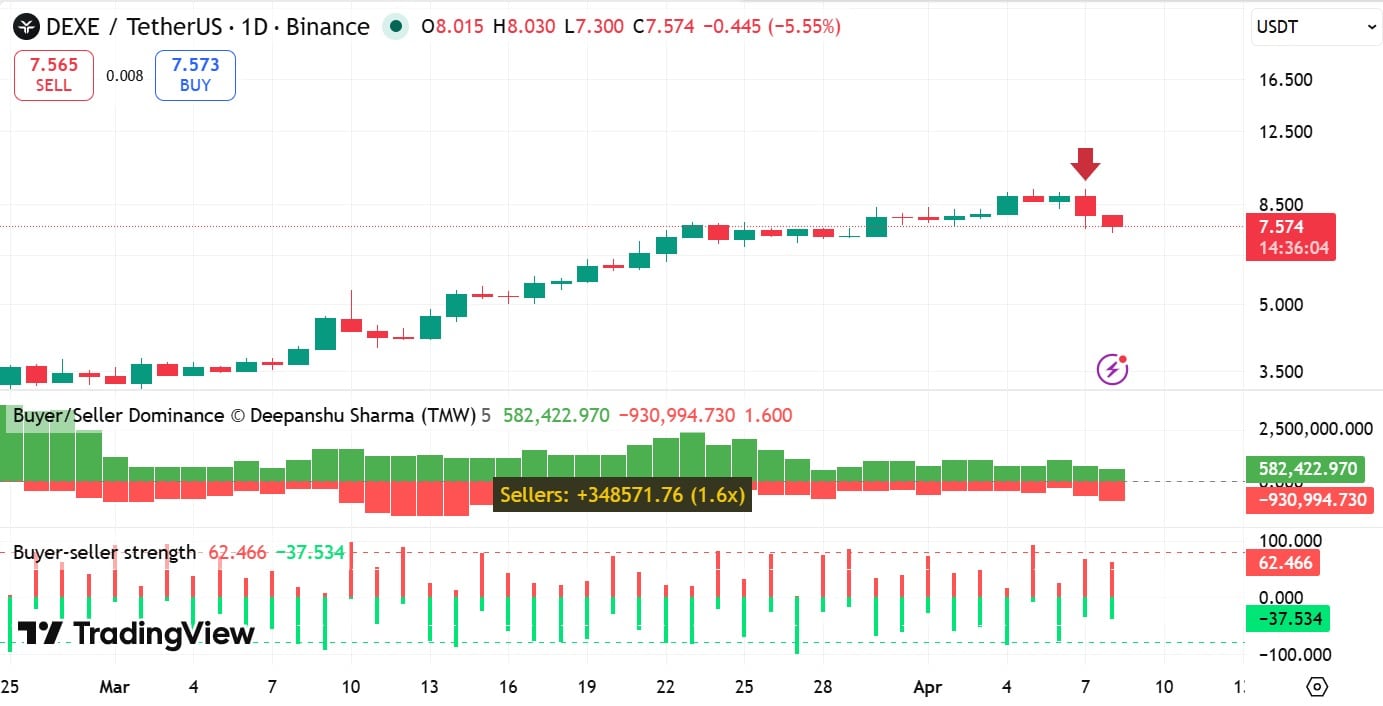
The altcoin dropped from $9.2 to $7.3 after losing the $8 support level. At press time, Dexe [DEXE] traded at $7.6, down 15.27% daily. The weekly loss stood near 8%.

The drop pushed the altcoin below its Parabolic SAR, signaling strong downside pressure.

Why did DEXE turn bearish?

DEXE erased its weekly gains as traders exited positions and sentiment flipped bearish.

The token had traded in an uptrend through March and the past week. That move attracted profit-taking near recent highs.
Source: TradingView

Seller Dominance rose to 930k, while Buyer Dominance dropped to 582k.

At the same time, Sellers’ Strength climbed to 62 as Buyers’ Strength fell to 37. This shift confirmed rising sell-side pressure.

That move aligned with a 109% surge in trading volume, largely driven by selling activity. Sustained selling pressure typically weakens price structure.

Are DEXE traders exiting derivatives positions?

As the market started to cool and retraced, investors withdrew capital from futures markets to reduce exposure.

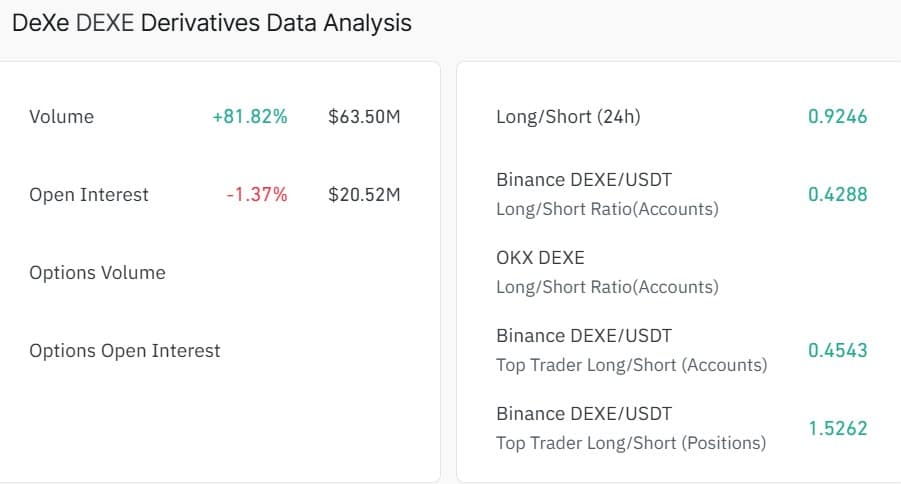
According to CoinGlass data, Open Interest [OI] dropped 1.37% to $20 million while Derivatives Volume rose 80%. The mismatch suggested increased selling activity in the derivatives market and a reduction in positions.
Source: CoinGlass

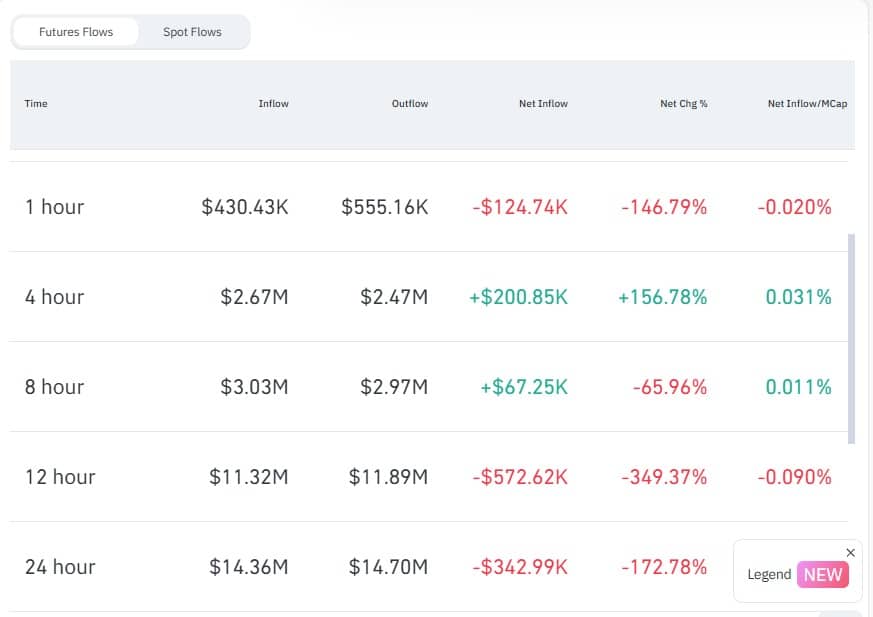
At the same time, Futures outflows increased, rising to $14.7 million, while inflows dropped to $14.36 million. As a result, the futures net flow declined by 172% to -$342k, indicating aggressive selling activity.

This suggested that most traders in the futures market reduced exposure and closed their positions. In most cases, when traders close their positions aggressively during a downtrend, it shows strong bearish sentiment.
Source: CoinGlass

What comes next for DEXE?

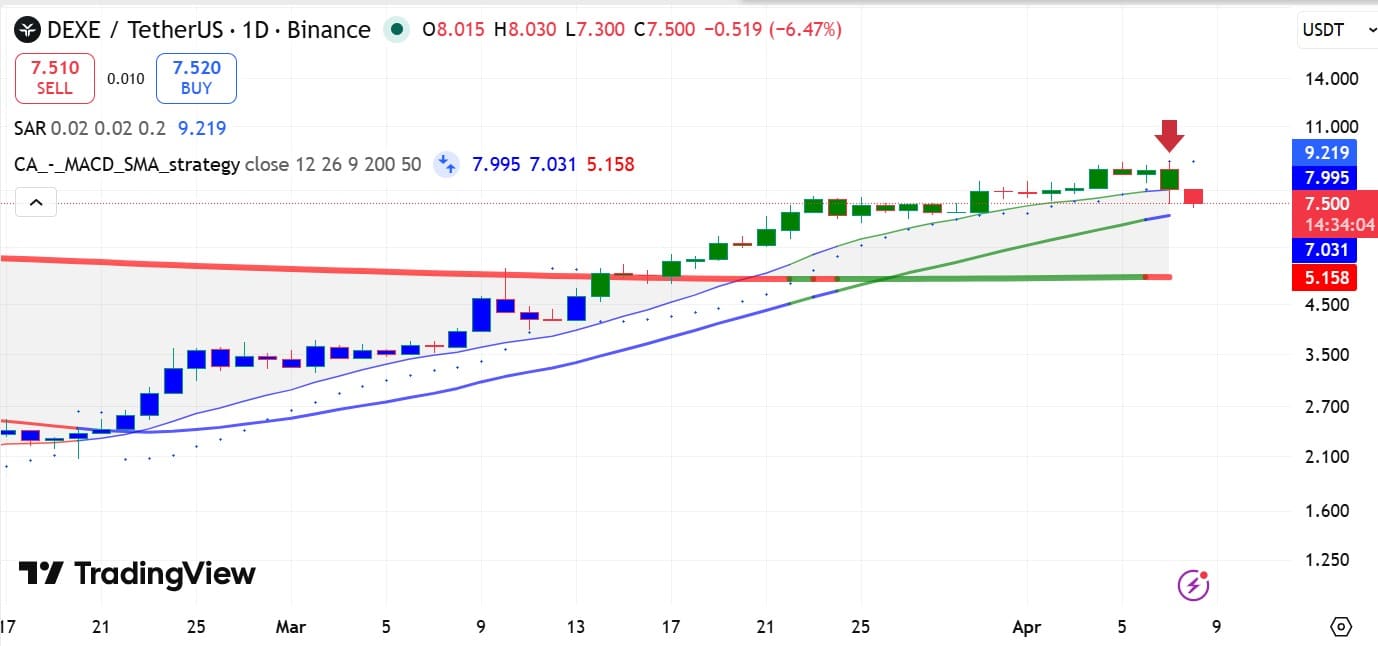
Momentum indicators reflected a weakening structure after the recent drop.

The MACD and SMA showed price pulling back toward short-term Moving Averages. This pointed to slowing momentum after the rally.
Source: TradingView

Even so, DEXE remained within a broader uptrend despite the pullback.

A daily close above $7.9 could support a recovery toward $9.2. Failure to reclaim that level may lead to a retest of $7. If selling continues, $5.1 remains the next downside level.


Final Summary

  • DEXE lost the $8 support and dropped sharply, confirming a clear shift in the short-term trend.
  • A move above $7.9 could support recovery, while failure increases the risk of revisiting $7 and lower levels.


Related Questions

QWhat was the daily percentage drop in DEXE's price as mentioned in the article?

ADEXE dropped 15.27% daily.

QWhat key support level did DEXE lose that contributed to its sharp decline?

ADEXE lost the $8 support level.

QAccording to the article, what does the surge in Seller Dominance and drop in Buyer Dominance indicate?

AThe surge in Seller Dominance to 930k and drop in Buyer Dominance to 582k indicates rising sell-side pressure and a bearish sentiment.

QWhat does the decline in Open Interest (OI) alongside a rise in Derivatives Volume suggest about market activity?

AThe decline in Open Interest by 1.37% to $20 million while Derivatives Volume rose 80% suggests increased selling activity in the derivatives market and a reduction in positions.

QWhat are the potential price targets for DEXE if it fails to reclaim the $7.9 level?

AIf DEXE fails to reclaim the $7.9 level, it may retest $7, and if selling continues, the next downside level is $5.1.

Related Reads

Pricing OpenAI Pre-IPO: A New, Life-or-Death Business on Hyperliquid Lasting Half a Year

Pricing OpenAI Pre-IPO: Hyperliquid's High-Stakes, Six-Month Business Venture The article analyzes the nascent market for pre-IPO perpetual contracts on the Hyperliquid blockchain, exemplified by two contrasting teams: Trade.xyz and Ventuals. Trade.xyz, an anonymous team, successfully built the largest pre-market on Hyperliquid. Its strategy focused on near-term events, like the SpaceX IPO. By listing a SpaceX contract with a known launch date and price, the market had a tangible "anchor" (the eventual Nasdaq opening price) to converge upon, which kept speculation in check. This approach fueled significant growth. In stark contrast, Ventuals, backed by Paradigm, failed despite holding coveted contracts for OpenAI and Anthropic. Its critical flaw was its pricing mechanism for these companies, which have no imminent IPO. Ventuals' oracle price was half-derived from infrequent private market transactions and half from its own contract's moving average. This created a self-reinforcing loop where buying pressure artificially inflated the price, disconnecting it from real supply and demand. The market became illiquid and structurally skewed. Ventuals shut down nine months after launch, reportedly through an acquisition. Its final settlement prices—OpenAI at ~$1,341 and Anthropic at ~$1,618—were thus partially products of its flawed model. Ironically, some company employees and late-stage VCs reportedly used these prices for valuation reference, highlighting the desperate demand for price discovery in opaque private markets. The failure of Ventuals exposes the core challenge of this business: price for illiquid, non-public assets requires a robust, self-correcting market, which is absent without a definitive public listing event. Nevertheless, demand is driving major players like Coinbase and traditional finance (e.g., Citi) to enter the space, aiming to provide 24/7 trading for coveted private company shares. The venture's ultimate viability, however, hinges on solving the fundamental pricing problem Ventuals could not.

marsbit8m ago

Pricing OpenAI Pre-IPO: A New, Life-or-Death Business on Hyperliquid Lasting Half a Year

marsbit8m ago

M&A Deals in the Crypto Market Are Unusually Active

Title: M&A Activity in Crypto Market Becomes Unusually Active A rare signal is emerging in the crypto primary market: mergers and acquisitions (M&A) are nearing half of all financing deals. According to RootData, this month, M&A cases in the crypto industry reached 10, while financing rounds numbered only 14, meaning M&A accounts for approximately 42% of primary market transactions—the highest level in history. This does not signal a sudden industry boom. Instead, the rapid rise in M&A share primarily reflects the continued downturn in the financing market. Since November 2024, monthly crypto M&A deals have remained between 10-20, while financing deals have plummeted from around 100 to about 50, possibly hitting a new low this month. For project teams, this means the traditional path of relying on narratives, token expectations, and ecosystem subsidies to maintain valuations is narrowing. For leading companies, it presents a rare window to acquire teams, licenses, technology, liquidity, and market access at lower prices, with less competition and stronger bargaining power. Key active buyers include Coinbase, Kraken, Ripple, MoonPay, Polymarket, Kaiko, Sol Strategies, GSR, Keyrock, Jupiter, Paxos, and Ondo Finance. Their M&A logic is consistent: acquiring key capabilities at lower costs during the industry downturn. This is driven by more attractive valuations, reduced time and trial-and-error costs, the acquisition of licenses and compliance resources, and the integration of industry upstream and downstream segments. Current M&A focuses are concentrated in four areas: trading infrastructure (e.g., Coinbase acquiring Deribit, Kraken acquiring NinjaTrader), payments and stablecoins (e.g., MoonPay, Ripple expanding payment networks), compliance licenses, and asset issuance/distribution (e.g., acquisitions related to RWA and token issuance platforms like Coinbase's purchases of Liquifi and Echo). The rise in M&A is altering the primary market's exit logic. It provides an alternative path to the token-dependent model, encouraging teams to build tangible products, revenue, and strategic value that can be integrated. This could inject confidence into the market, showing that asset buyers and exit possibilities still exist, albeit with a stricter focus on real utility. However, this trend also indicates the crypto industry is becoming more centralized. As asset issuance, trading, market-making, custody, payments, and data gradually consolidate in the hands of a few major players, the industry's initial emphasis on openness and anti-monopoly is being reshaped by commercial realities. Coupled with rising compliance barriers, this signals the end of the low-barrier era for crypto entrepreneurship.

链捕手41m ago

M&A Deals in the Crypto Market Are Unusually Active

链捕手41m ago

Trading

Spot
Futures

Hot Articles

How to Buy DEXE

Welcome to HTX.com! We've made purchasing DeXe (DEXE) simple and convenient. Follow our step-by-step guide to embark on your crypto journey.Step 1: Create Your HTX AccountUse your email or phone number to sign up for a free account on HTX. Experience a hassle-free registration journey and unlock all features.Get My AccountStep 2: Go to Buy Crypto and Choose Your Payment MethodCredit/Debit Card: Use your Visa or Mastercard to buy DeXe (DEXE) instantly.Balance: Use funds from your HTX account balance to trade seamlessly.Third Parties: We've added popular payment methods such as Google Pay and Apple Pay to enhance convenience.P2P: Trade directly with other users on HTX.Over-the-Counter (OTC): We offer tailor-made services and competitive exchange rates for traders.Step 3: Store Your DeXe (DEXE)After purchasing your DeXe (DEXE), store it in your HTX account. Alternatively, you can send it elsewhere via blockchain transfer or use it to trade other cryptocurrencies.Step 4: Trade DeXe (DEXE)Easily trade DeXe (DEXE) on HTX's spot market. Simply access your account, select your trading pair, execute your trades, and monitor in real-time. We offer a user-friendly experience for both beginners and seasoned traders.

3.7k Total ViewsPublished 2024.03.29Updated 2026.06.02

How to Buy DEXE

Discussions

Welcome to the HTX Community. Here, you can stay informed about the latest platform developments and gain access to professional market insights. Users' opinions on the price of DEXE (DEXE) are presented below.

活动图片












