
DeFi Soars, Meme Breaks Through! Huobi HTX New Assets Weekly Review (1.19—1.25): RIVER Surges 393%, Multi-Sector Heat Resonates

marsbitPublished on 2026-01-30Last updated on 2026-01-30

Abstract

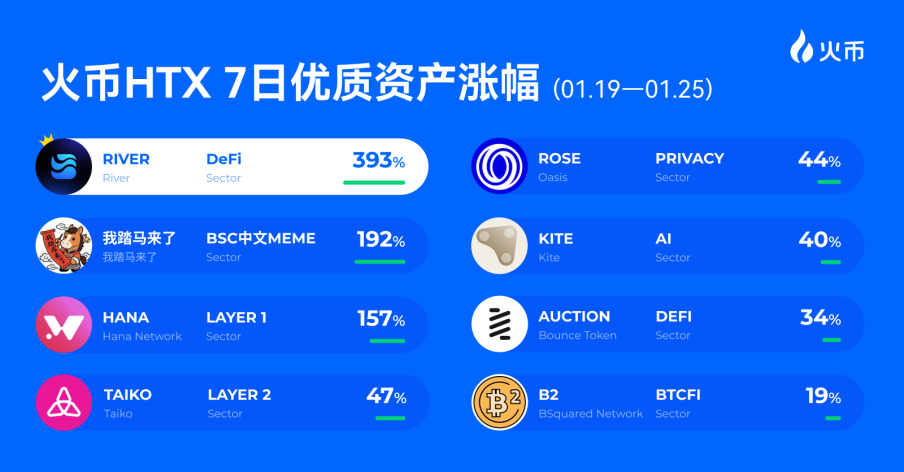
The cryptocurrency market showed signs of recovery and increased risk appetite from January 19 to 25, with capital inflow into high-potential sectors. Huobi HTX’s newly listed assets demonstrated significant gains, led by RIVER (River), a chain-abstracted stablecoin system, which surged by 393%. The Chinese meme token "我踏马来了" (based on a viral tweet) also rose 192%. Multiple sectors saw notable activity: - In DeFi, established projects like AUCTION grew by 34%. - Layer-1 project HANA increased by 157%, while Taiko (an Ethereum-equivalent ZK-Rollup) rose 47% in the Layer-2 segment. B2 Network, a Bitcoin Layer-2 solution, gained 19%. - Privacy and AI narratives remained strong, with Oasis Network (ROSE) up 44% and Kite AI (KITE) rising 40%. Huobi HTX emphasized its role in identifying high-quality assets early across diverse sectors—including DeFi, memes, public chains, privacy, AI, and BitcoinFi—enabling users to capture opportunities as market sentiment continues to improve.

Over the past week (January 19th to January 25th), the crypto market gradually warmed up amidst fluctuations, with a partial recovery in risk appetite. Funds began to re-concentrate on niche sectors with strong narratives and practical application prospects. Data shows that the new assets recently launched on Huobi HTX have released significant wealth effects. As a newly listed project, RIVER surged up to 393% after its listing on Huobi HTX, while the Chinese Meme project "我踏马来了" (I'm F*cking Coming) also saw a substantial increase of 192% post-listing.

As the market gradually recovers, Huobi HTX, through strict project screening and a forward-looking listing pace, continues to provide users with potential asset choices for "earlier discovery and faster participation." Opportunities across multiple sectors are also being realized more quickly on the platform.

DeFi and Meme Sectors: Sentiment Returns, Leading Assets Surge Strongly

RIVER (River): Topped the platform with a weekly peak increase of 393%. River is building a chain-abstract stablecoin system that connects assets, liquidity, and yields across multiple blockchains. Notably, RIVER maintained active trading momentum even after the significant rise. Huobi HTX has simultaneously launched an Earn product with a 10% annualized yield, further expanding the income dimension beyond price performance.

AUCTION (Auction): A veteran DeFi project, up 34% this week. Bounce aims to provide individuals and projects with various types of auctions. The BOT token, the governance token of the bounce.finance platform, has been swapped for AUCTION at a 1:100 ratio. In an environment of overall capital回流 (returning funds), assets with mature mechanisms and application foundations are once again attracting market attention.

我踏马来了 (I'm F*cking Coming): A Chinese Meme project on the BSC ecosystem, originating from a tweet of the same name by He Yi, achieved a weekly gain of 192%. Driven by community dissemination and sentiment, Meme projects with stronger regional and cultural attributes possess higher explosive potential during the market recovery phase.
Public Chains and Scaling: L1, L2 Steadily Advance, BTCFi Ecosystem Actively Explored

HANA (Hana Network): Belongs to the Layer 1 sector, up 157% this week. Hana Network was launched by a Japanese team in December 2022. It builds new interfaces to bring users into cryptocurrency, including streaming and trading platforms. Against the backdrop of the evolving new public chain narrative, its technical roadmap and ecosystem planning are gradually gaining market recognition.

TAIKO (Taiko): Belongs to the Layer 2 sector, with a weekly increase of 47%. Taiko is a fully open-source, permissionless Ethereum-equivalent ZK Rollup designed to natively scale Ethereum. The market maintains long-term expectations for Ethereum scaling solutions.

B2 (B2 Network): Belongs to the BTCFi / Layer2 sector, up 19% this week. B2 Network is a next-generation Layer 2 scaling solution built on Bitcoin (BTC), aiming to significantly enhance Bitcoin's performance and scalability without compromising its foundational security. This sector is still in its early stages of development and possesses long-term potential.

Privacy Computing and AI Sectors: Structural Opportunities Continue to Unfold

ROSE (Oasis): A representative asset in the privacy sector, up 44% this week. Oasis Network is a secure and scalable blockchain platform designed to redefine decentralized finance (DeFi) and promote the broader adoption of blockchain technology beyond early users. Against the backdrop of increasing data security and compliance demands, the mid-to-long-term value of the privacy computing sector continues to attract attention.

KITE (Kite AI): An AI sector asset, with a weekly gain of 40%. Kite is building the first AI payment blockchain—a foundational infrastructure enabling autonomous AI agents to operate within it. After a phase of adjustment, the AI narrative continues to hold sustained appeal for quality projects.

High-Quality New Listings Continue to Deliver, Huobi HTX's Asset Selection Strength Highlighted

Overall, in the past week, new assets listed on Huobi HTX showed synchronized strength across multiple sectors, including high-volatility DeFi and Meme, as well as mid-to-long-term directions like public chains, privacy, AI, and BTCFi. As the market gradually recovers, Huobi HTX continues to provide users with a more diverse selection of potential high-quality assets through strict screening and forward-looking布局 (layout). As market sentiment further repairs, the structural行情 (market conditions) of multi-sector resonance remain worthy of持续关注 (ongoing attention).

About Huobi HTX

Huobi HTX was established in 2013. After 12 years of development, it has evolved from a cryptocurrency exchange into a comprehensive blockchain business ecosystem encompassing digital asset trading, financial derivatives, research, investment, incubation, and other services.

Huobi HTX, as a leading global Web3 gateway, adheres to a development strategy of global expansion, ecological prosperity, wealth effect, and security & compliance, providing comprehensive, secure, and reliable value and services to global virtual currency enthusiasts.

To learn more about Huobi HTX, please visit https://www.htx.com/ or HTX Square, and follow us on X, Telegram, and Discord. For further inquiries, please contact [email protected].


Related Questions

QWhich newly listed asset on Huobi HTX had the highest weekly gain, and what was the percentage increase?

ARIVER (River) had the highest weekly gain, with an increase of 393%.

QWhat is the main focus of the project RIVER (River)?

ARIVER is building a chain-abstracted stablecoin system that connects assets, liquidity, and yields across multiple blockchains.

QWhich Chinese Meme project saw significant growth after listing on Huobi HTX, and what was its inspiration?

AThe Chinese Meme project '我踏马来了' (I'm F*cking Coming) saw a 192% increase. It was inspired by a tweet of the same name by He Yi.

QWhat type of project is TAIKO, and what is its core technology?

ATAIKO is a Layer 2 project. It is a fully open-source, permissionless Ethereum-equivalent ZK-Rollup designed to natively scale Ethereum.

QWhich asset from the AI sector was highlighted, and what is its project's goal?

AKITE (Kite AI) was highlighted, with a 40% weekly gain. The project is building the first AI payment blockchain, a foundational infrastructure for autonomous AI agents to operate.

Related Reads

Has the 'Digital Gold' Narrative for BTC Failed?

**Title: Has the "Digital Gold" Narrative for Bitcoin Failed?** The article argues that Bitcoin's "digital gold" narrative remains valid despite a recent sharp price decline (from a peak near $126k in Oct 2025 to briefly under $61k in Feb 2026). It presents a long-term investment framework based on three core points: **1. Viewing Bitcoin as an Asset:** Bitcoin is presented as a superior potential store of value compared to gold. Key arguments are its absolute scarcity (21 million cap), superior portability, and transparent auditability via its public ledger. While acknowledging its current use in early, volatile stages (~3-4% global adoption), the author draws parallels to the early, disruptive phases of the internet and e-commerce. **2. Understanding the Recent Downturn:** The current ~50% correction is framed as a predictable, consensus-driven cycle following its post-halving peak (the 2024 halving preceded the Oct 2025 high). A crucial factor is a historic "changing of hands": the influx of new institutional buyers via ETFs allowed early, low-cost holders (miners, OG believers) to take profits. The author notes that while severe, Bitcoin's historical drawdowns (e.g., 93% in 2011, 77% in 2021-22) have been progressively smaller, suggesting maturing holder structure and decreasing volatility over time. **3. The Long-Term Perspective:** The long-term thesis hinges on Bitcoin capturing a portion of gold's market value. With Bitcoin's market cap at ~$1.4 trillion (at $70k) versus gold's ~$20 trillion, significant upside potential exists if the "digital gold" narrative is partially realized. However, the author strongly cautions that short-term risks remain, the bottom is unpredictable, and high volatility is inherent. The real risk is not Bitcoin failing but poor personal position management (over-leverage, wrong capital) and a lack of deep understanding, which can force investors out during severe downturns. The conclusion uses Amazon's 95% crash post-2000 dot-com bubble and subsequent 42x recovery as an analogy. The ultimate question is not if Bitcoin's price will rise, but if an investor's strategy and conviction can withstand the volatility to see the long-term play out. The recent divergence (gold up, Bitcoin down) is posed not as a narrative failure, but as potential evidence of this ongoing, painful transition from a speculative asset to a mainstream allocation.

marsbit9h ago

Has the 'Digital Gold' Narrative for BTC Failed?

marsbit9h ago

Has BTC's 'Digital Gold' Narrative Failed?

The article discusses Bitcoin's "digital gold" narrative, its recent price drop, and long-term outlook through the perspective of "Jason". It argues the narrative is not a failure but that Bitcoin represents a superior, new asset class due to its fixed supply (21 million), portability, and auditability. The piece compares its current ~3-4% global adoption rate to early internet/e-commerce, suggesting significant growth potential. Regarding the 2025-2026 price decline (from ~$126k to briefly under $61k), the author views it as a predictable, consensus-driven sell-off within Bitcoin's ~4-year cycle post-halving, exacerbated by a major "handover" from early, low-cost holders to new institutional buyers via ETFs. A key observation is that historical peak-to-trough drawdowns have lessened over time (e.g., 93% in 2011 to ~50% in 2026), indicating maturing volatility as holder structure changes. For the long term, the author uses a simple framework: Bitcoin's total market cap (~$1.4T at $70k) is only about 7% of gold's (~$20T). Even capturing 30-50% of gold's value would imply substantial upside. However, the article strongly cautions against viewing this as investment advice, emphasizing extreme volatility and the critical importance of risk management, position sizing, and deep fundamental understanding to survive severe drawdowns. It concludes by drawing a parallel to Amazon's 95% crash in 2000 and subsequent 42x recovery, stressing that the key is surviving market cycles to realize long-term potential.

链捕手9h ago

Has BTC's 'Digital Gold' Narrative Failed?

链捕手9h ago

From Code to Cognition: A Ten-Thousand-Word Guide to the Evolution of the Robot Brain

"From Code to Cognition: The Evolution of Robot Brains" The journey of robotic intelligence has shifted dramatically from manually coded systems to AI-driven brains. For decades, robots relied on layered software stacks—perception, state estimation, planning, control—each handcrafted. While predictable, they lacked adaptability. The 2010s saw deep learning revolutionize perception (e.g., object detection) and control (via reinforcement learning), but learned skills remained narrow. The arrival of Large Language Models (LLMs) marked a turning point. LLMs acted as high-level planners, interpreting natural language instructions and generating sequences of actions for traditional robotic systems to execute. However, true integration came with Visual-Language-Action (VLA) models, which fused vision, language, and motion prediction into a single network. Pioneered by models like RT-2 and open-source projects like OpenVLA, VLAs enable robots to reason and act directly from visual input and commands. The most advanced humanoid robots now employ a "dual-brain" architecture: a slow-thinking, large VLA (System 2) for reasoning and planning, and a fast-reacting, small network (System 1) for high-frequency motion control, sometimes with an even lower-level System 0 for balance. This split balances cognition with the physics of real-time movement. Computation is split between onboard hardware (e.g., NVIDIA Jetson) for safety-critical control loops and cloud/edge servers for non-critical tasks like learning and interfaces. A crucial driver is the open-source ecosystem—models like GR00T and OpenVLA allow startups to build upon pre-trained brains and fine-tune them with their own data, accelerating development. Despite progress, current systems struggle with recovery from errors, sample inefficiency, and long-horizon tasks. This has spurred the rise of **World Models**—neural networks that predict the consequences of actions. By simulating possible futures before acting (like NVIDIA Cosmos or Meta V-JEPA), robots can plan, recover, and generalize better. This represents the next frontier: shifting intelligence from learned reactions to an internal model of physics and cause-and-effect. The field is rapidly evolving. While not yet at its "ChatGPT moment," the convergence of cheaper hardware, scalable simulation, and world models points toward robots that are increasingly capable, adaptive, and useful. The question is shifting from "what can robots do?" to "what *should* they do?"

marsbit10h ago

From Code to Cognition: A Ten-Thousand-Word Guide to the Evolution of the Robot Brain

marsbit10h ago

Trading

Spot
Futures

Hot Articles

Discussions

Welcome to the HTX Community. Here, you can stay informed about the latest platform developments and gain access to professional market insights. Users' opinions on the price of MEME (MEME) are presented below.

活动图片