Custodia renews bid for Fed master account in rehearing push at Tenth Circuit

cointelegraphPublished on 2025-12-16Last updated on 2025-12-16

Abstract

Custodia Bank, a crypto-focused institution, has filed a new petition with the U.S. Court of Appeals for the Tenth Circuit, seeking a rehearing after the court upheld the Federal Reserve's denial of its application for a master account. The bank argues that the decision misinterprets the Monetary Control Act, which it claims entitles eligible banks to such an account, and raises constitutional concerns by effectively allowing the Fed to veto state-approved bank charters. A master account is crucial as it enables direct access to the Fed's payment systems, avoiding the need for intermediary banks and reducing costs and delays. Despite being chartered in Wyoming, Custodia has been unable to secure an account since 2020, highlighting ongoing debanking challenges in the crypto industry.

Custodia Bank, a crypto‐focused bank founded by Bitcoin advocate Caitlin Long, is doubling down on efforts to obtain a master account at the US Federal Reserve by filing a new petition in the United States Court of Appeals for the Tenth Circuit.

On Monday, the Wyoming-chartered company filed a petition asking all active judges of the Tenth Circuit to reconsider its October decision upholding the Federal Reserve’s denial of a master account for Custodia.

Through the petition, formally termed a “rehearing en banc,” Custodia argued that the panel had misread the Monetary Control Act, which it asserts entitles any eligible bank to a master account, and in doing so, undermines state banking authority.

“When the Fed denies a master account to a state-chartered financial institution, it effectively vetoes a bank charter that state regulators have approved,” the petition noted, adding that the issue raises “serious constitutional questions” about the Fed’s structure.

Why is a Fed master account so important?

Issued by the Fed, a master account is a key account that allows a financial institution to hold balances directly with the US central bank and access its core payment systems.

For companies like Custodia, having a master account is crucial, as it enables them to settle payments and clear transactions directly in central bank money, rather than relying on another bank as an intermediary. Without it, they must use correspondent banks to access the Fed’s systems, which can add cost, risk and delay.
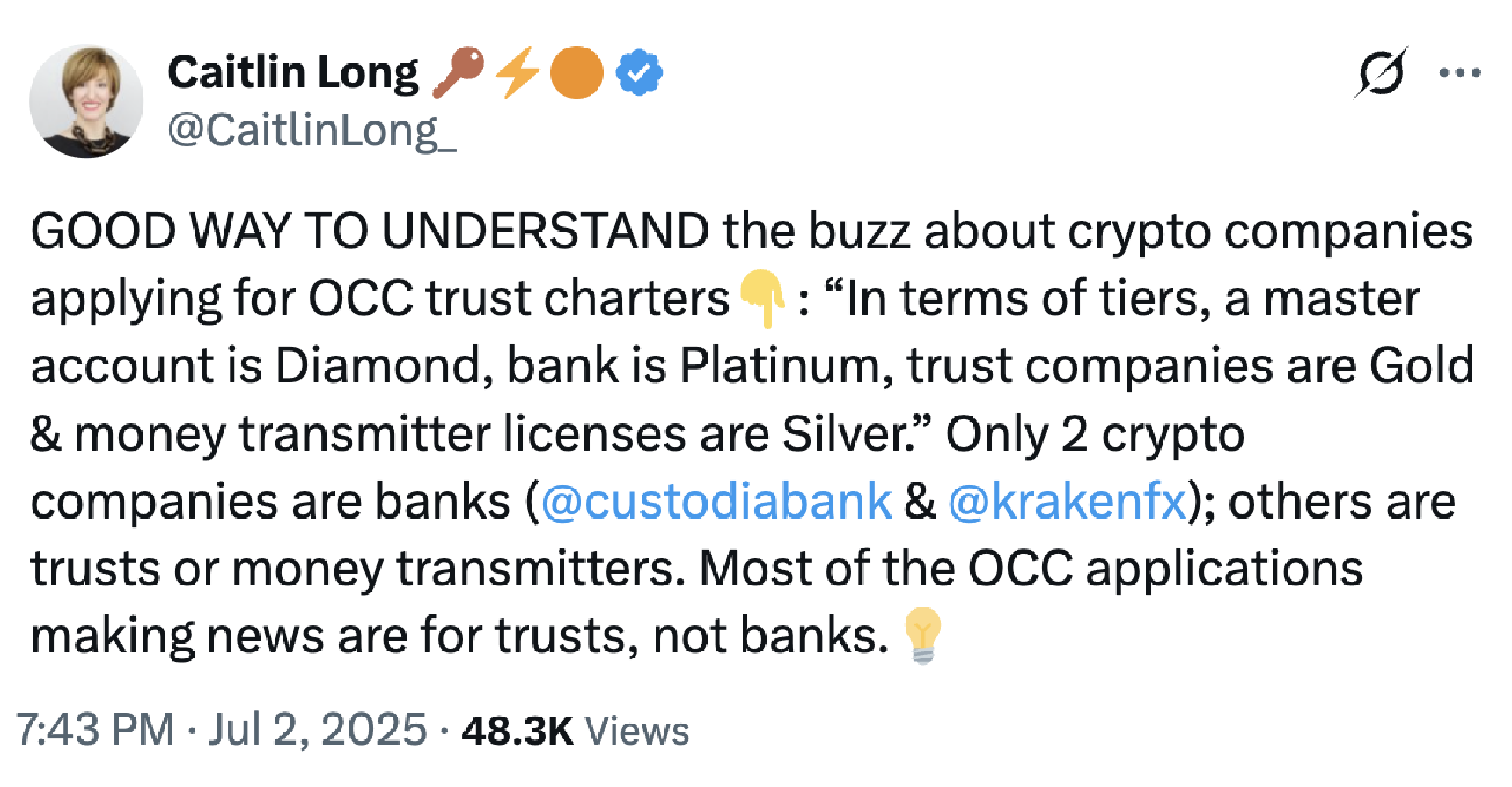
Source: Custodia Bank founder and CEO Caitlin Long

“In terms of tiers, a master account is Diamond, bank is Platinum, trust companies are Gold and money transmitter licenses are Silver,” Custodia Bank founder and CEO Long said in an X post in July, adding that Custodia and Kraken are the “only two crypto companies” that are banks.

Custodia has been trying to get a Fed master account since it launched in 2020, but the Kansas City Fed denied its master account application in January 2023, and the Federal Reserve also rejected its bid to become a member of the Federal Reserve System.

Related: Crypto among sectors ‘debanked’ by 9 major banks: US regulator

Custodia’s long fight for a Fed master account highlights ongoing crypto debanking issues, even though the Trump administration had expressed support for crypto.

In March, Long said the US government has done “nothing” to address crypto debanking issues since President Donald Trump returned to office, highlighting one of the crypto industry’s biggest unresolved challenges.


Related Reads

How Many Tokens Away Is Yang Zhilin from the 'Moon Chasing the Light'?

The article explores the intense competition between two leading Chinese AI companies, DeepSeek and Kimi (Moon Dark Side), and the mounting pressure on Yang Zhilin, the founder of Kimi. While DeepSeek re-emerged after 15 months of silence with its powerful V4 model—boasting 1.6 trillion parameters and low-cost, long-context capabilities—Kimi has been focusing on long-context processing and multi-agent systems with its K2.6 model. Yang faces a threefold challenge: technological rivalry, commercialization pressure, and investor expectations. Despite Kimi’s high valuation (reaching $18 billion), its revenue heavily relies on a single product with low paid conversion rates, while DeepSeek’s strategic silence and open-source influence have strengthened its market position and valuation prospects, now targeting over $20 billion. Both companies reflect broader trends in China’s AI ecosystem: Kimi aims for global influence through open-source contributions and agent-based advancements, while DeepSeek prioritizes foundational innovation and hardware independence, notably shifting to Huawei’s chips. Their competition is seen as vital for China’s AI progress, with the gap between top Chinese and U.S. models narrowing to just 2.7% on the Elo rating scale. Ultimately, the article argues that this rivalry, though anxiety-inducing for leaders like Zhilin, is essential for driving innovation and solidifying China’s role in the global AI landscape.

marsbit59m ago

How Many Tokens Away Is Yang Zhilin from the 'Moon Chasing the Light'?

marsbit59m ago

TechFlow Intelligence Bureau: ChatGPT Helps Amateur Mathematician Crack 60-Year-Old Problem, CFTC Sues New York Regulator Over Coinbase and Gemini

An amateur mathematician, with the assistance of ChatGPT, has solved a combinatorial mathematics puzzle originally proposed by Hungarian mathematician Paul Erdős in the 1960s. This marks another milestone in AI-aided mathematical research, demonstrating the evolving capabilities of large language models in formal reasoning. In other AI developments, OpenAI introduced a new privacy filter tool for enterprise API usage, automatically screening sensitive data. Meanwhile, the Qwen3.6-27B model achieved 100 tokens per second on a single RTX 5090 GPU using quantization, significantly lowering the cost barrier for local AI deployment. In crypto and Web3, the U.S. CFTC sued New York’s financial regulator, challenging its oversight of Coinbase and Gemini—a first-of-its-kind federal-state regulatory clash. Following a vulnerability, KelpDAO and major DeFi protocols established a recovery fund. Tether froze $344 million in assets linked to Iran’s central bank upon U.S. Treasury request, highlighting the centralized control risks in stablecoins. Separately, Litecoin underwent a 3-hour chain reorganization to undo a privacy-layer exploit. In the U.S., former President Trump invoked the Defense Production Act to address power grid bottlenecks affecting AI data centers and dismissed the entire National Science Board, raising concerns over research independence. A retail trader gained 250% on a $600k Intel options bet amid AI-related speculation. Xiaomi announced its first performance electric vehicle, targeting rivals like Tesla. Meanwhile, iPhone users reported devices automatically reinstalling a hidden app daily, suspected to be MDM-related. A Chinese securities report noted that A-share institutional crowding has reached its second-longest streak since 2007, signaling high valuations and potential style rotation. The day’s developments reflect a dual narrative: AI is enabling unprecedented individual breakthroughs, while centralized power structures—whether governmental or corporate—are becoming more assertive, underscoring that decentralization is as much a political-economic challenge as a technical one.

marsbit1h ago

TechFlow Intelligence Bureau: ChatGPT Helps Amateur Mathematician Crack 60-Year-Old Problem, CFTC Sues New York Regulator Over Coinbase and Gemini

marsbit1h ago

Trading

Spot
Futures

Hot Articles

How to Buy PUSH

Welcome to HTX.com! We've made purchasing Push Protocol (PUSH) simple and convenient. Follow our step-by-step guide to embark on your crypto journey.Step 1: Create Your HTX AccountUse your email or phone number to sign up for a free account on HTX. Experience a hassle-free registration journey and unlock all features.Get My AccountStep 2: Go to Buy Crypto and Choose Your Payment MethodCredit/Debit Card: Use your Visa or Mastercard to buy Push Protocol (PUSH) instantly.Balance: Use funds from your HTX account balance to trade seamlessly.Third Parties: We've added popular payment methods such as Google Pay and Apple Pay to enhance convenience.P2P: Trade directly with other users on HTX.Over-the-Counter (OTC): We offer tailor-made services and competitive exchange rates for traders.Step 3: Store Your Push Protocol (PUSH)After purchasing your Push Protocol (PUSH), store it in your HTX account. Alternatively, you can send it elsewhere via blockchain transfer or use it to trade other cryptocurrencies.Step 4: Trade Push Protocol (PUSH)Easily trade Push Protocol (PUSH) on HTX's spot market. Simply access your account, select your trading pair, execute your trades, and monitor in real-time. We offer a user-friendly experience for both beginners and seasoned traders.

3.3k Total ViewsPublished 2024.03.29Updated 2025.04.02

How to Buy PUSH

Discussions

Welcome to the HTX Community. Here, you can stay informed about the latest platform developments and gain access to professional market insights. Users' opinions on the price of PUSH (PUSH) are presented below.

活动图片












