Author: Deep Tide TechFlow
Yesterday's Market Dynamics
US SEC Proposes Amendment to Broker Rule 15c2-11, Excluding Crypto Assets from Scope
According to the SEC website, the U.S. Securities and Exchange Commission formally proposed an amendment to Rule 15c2-11 of the Exchange Act on March 16, intending to explicitly limit the rule's applicability to equity securities. Since its enactment, this rule has primarily been used to regulate brokers' information collection and review obligations for publishing quotes in the over-the-counter (OTC) market, with the core purpose of preventing manipulative and fraudulent trading activities in the OTC stock market. SEC Chairman Paul S. Atkins stated that regulatory rules should match the asset classes they apply to, and this amendment aims to clarify the regulatory obligations for publishing quotes and confirm that Rule 15c2-11 has always applied only to equity securities.
Suspected Hacker Address Manipulates THE Price, Triggering Venus Protocol Liquidation Cascade, Profiting Over $5.07 Million
According to on-chain analyst Onchain Lens (@OnchainLens) monitoring, a wallet address "0x7a7" that received 7,447 ETH (approximately $16.29 million) from Tornado Cash is suspected to be the mastermind behind the CAKE/THE liquidation cascade event on Venus Protocol. The attacker used ETH as collateral on Aave to borrow $9.92 million in stablecoins, then heavily accumulated THE and allegedly pumped its price on centralized exchanges, before depositing 36.1 million THE into Venus to borrow assets like BTC, BNB, and CAKE.
Approximately 40 minutes later, THE's price collapsed, triggering a chain of liquidations, resulting in $2.15 million in bad debt for Venus. The attacker withdrew approximately $5.07 million in assets, with actual profits potentially higher—primarily from short positions on centralized exchanges during the crash.
OpenSea Delays $SEA Token Launch, Offers Fee Refunds and 60-Day Zero Fee Compensation
According to a post by OpenSea co-founder and CEO dfinzer.eth, the OpenSea Foundation announced a delay in the $SEA token launch event originally scheduled for March 30, citing the current harsh crypto market environment and the team's desire to ensure all preparations are complete before proceeding.
To compensate, OpenSea announced the following measures: the current reward wave will be the last; users who participated in waves 3-6 reward activities are offered optional refunds of platform fees, but users who choose a refund will have their treasure rewards removed; the rights of users who already hold treasures remain unchanged, and the Foundation will give them priority consideration at TGE; a 60-day zero-fee policy will be implemented starting March 31, after which a more competitive fee structure will be launched. Dfinzer stated that a new timeline will be announced by the Foundation when conditions are ripe.
Crypto Trading and Lending Firm BlockFills Files for Bankruptcy Protection, Liabilities Up to $500 Million
According to The Block, Chicago-based crypto trading and lending firm BlockFills filed for Chapter 11 bankruptcy in the U.S. Bankruptcy Court for the District of Delaware on March 15, 2026, estimating assets between $50 million and $100 million and liabilities between $100 million and $500 million.
Previously, the company suspended customer deposits and withdrawals in February citing "poor market and financial conditions" and faced an asset misappropriation lawsuit from Dominion Capital.
BlockFills stated that bankruptcy reorganization is the "most responsible path forward," will proceed with an orderly reorganization under court supervision while seeking additional liquidity sources and potential strategic transactions, and prioritize protecting client interests. The company processed over $61 billion in trading volume in 2025, serving over 2,000 institutional clients globally. Major investors include Susquehanna Private Equity Investments and the venture capital arm of CME Group.
After Venus's Seventh Attack, Suspected Justin Sun Address's XVS Position Awakens, Nearly 75% Unrealized Loss Over Two Years
According to on-chain analyst Ai Yi (@ai_9684xtpa) monitoring, after Venus Protocol suffered its seventh attack, a dormant XVS position at a suspected Justin Sun-related address (0x9FCc...19Fe) showed activity—the address transferred all 621,071 XVS tokens (worth $7.58 million at the time, purchased from Binance two years ago at an average price of $12.21) to a new address for the first time in two years. The recipient's ownership is currently unknown. Due to XVS's price dropping nearly 75% over two years, the tokens are now worth only about $1.95 million.
MicroStrategy Buys Another 22,337 BTC Last Week, Cumulative Holdings Exceed 761,000
According to disclosures by MicroStrategy founder and CEO Michael Saylor, MicroStrategy purchased another 22,337 BTC last week, spending approximately $1.57 billion at an average price of about $70,194 per BTC.
As of March 15, 2026, MicroStrategy's cumulative holdings reached 761,068 BTC, with a total acquisition cost of approximately $57.61 billion and an average purchase price of about $75,696 per BTC.
Bitmine Buys 60,999 ETH Last Week, Total Holdings Rise to 4.596 Million; Crypto Assets and Cash Reach $11.5 Billion
According to a Prnewswire report, as of March 15, 2026, the ETH treasury company Bitmine Immersion Technologies, listed on the U.S. stock market, held a total of 4,595,562 ETH. Calculated at $2,185 per ETH, the total scale of crypto assets, cash, and strategic investments combined is approximately $11.5 billion, including a cash reserve of $1.2 billion.
Bitmine currently holds 3.81% of the global ETH circulating supply, making it the world's largest Ethereum treasury company and the second-largest crypto asset treasury globally, behind MicroStrategy (NASDAQ: MSTR), which holds 738,731 BTC.
Regarding strategic investments, Bitmine added an $80 million investment in Eightco (NASDAQ: ORBS), which has spent $50 million to acquire OpenAI equity.
Metaplanet Plans to Raise $234 Million via "Warrants" for BTC Purchase
According to Metaplanet CEO Simon Gerovich, the company has issued 100 million dynamic strike price warrants (Moving Strike Warrants), expected to raise approximately $234 million. The raised funds will be specifically used to purchase BTC.
These warrants innovatively introduce an mNAV (market-to-net asset value) clause, stipulating that exercise is only possible when the share price is above 1.01 times mNAV, ensuring that each new share issuance enhances shareholder value and that fundraising is only triggered when it positively contributes to the per-share BTC holdings.
YZi Labs Announces Leading $52 Million Investment in Silicon Valley AI Robotics Company RoboForce
According to an official post by YZi Labs, YZi Labs announced leading a $52 million investment in Silicon Valley AI robotics company RoboForce. YZi Labs managing partner and head Ella Zhang concurrently joined RoboForce's board. Founded in 2023, RoboForce is composed of an engineering team from top institutions like Carnegie Mellon University, Amazon Robotics, Google, Waymo, and Tesla Robotics, focusing on providing Physical AI robotic workforce solutions for high-intensity industrial scenarios like solar energy, data centers, logistics, and mining.
Crypto Wealth Management Platform Abra Plans Nasdaq Listing via $750 Million SPAC Merger
According to CoinDesk, cryptocurrency wealth management platform Abra announced plans to go public through a merger with special purpose acquisition company New Providence Acquisition Corp. III, valuing Abra at $750 million. After the merger, the combined entity will be renamed Abra Financial Inc. and is expected to trade on Nasdaq under the ticker symbol ABRX. The merger is still subject to approval by shareholders and regulators. Abra stated that the raised funds will be used to expand institutional crypto lending, yield, and custody businesses, and to venture into tokenized real-world assets (RWA) and decentralized finance (DeFi).
Founded in 2014 and headquartered in San Francisco, Abra currently focuses on serving institutional clients, registered investment advisors, family offices, and high-net-worth individuals, with assets under management in the "hundreds of millions of dollars," aiming to exceed $10 billion by 2027. Previously, Abra reached settlements with U.S. state regulators and the U.S. Securities and Exchange Commission (SEC) in 2023 and 2024 over unregistered lending and securities issuance issues and subsequently shut down its retail user business.
Bitmine Adds $80 Million Investment in Eightco Holdings, Supporting Its $50 Million OpenAI Equity Acquisition
According to a Prnewswire report, Ethereum treasury company Bitmine (NYSE AMERICAN: BMNR) has added an $80 million investment in Eightco Holdings (NASDAQ: ORBS), supporting Eightco's $50 million purchase of OpenAI equity.
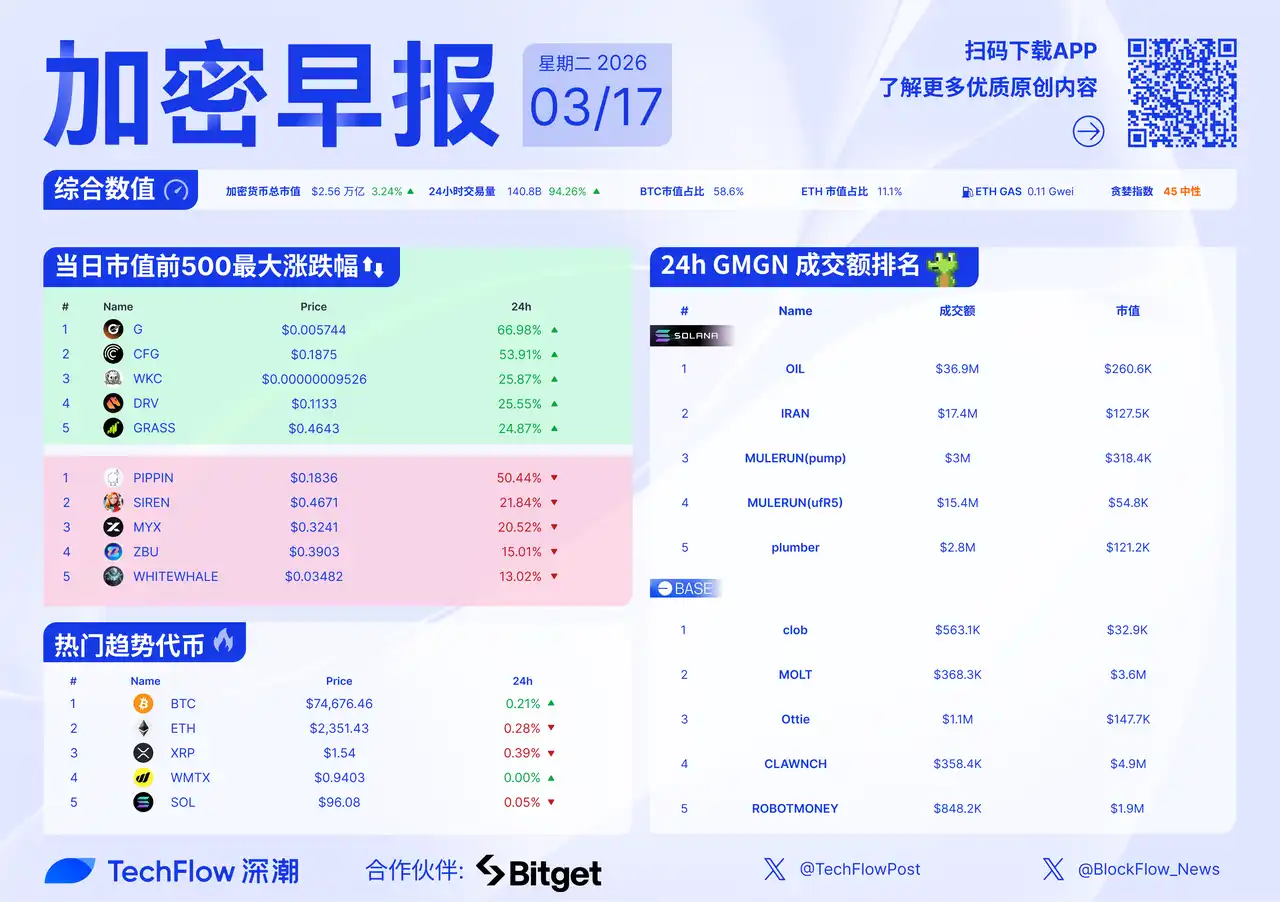
Market Dynamics
Recommended Reading
315 Exposes AI Poisoning", a Business from Putian to Silicon Valley
This article discusses a new marketing method called GEO (Generative Engine Optimization) exposed by 315. Its essence is to publish a massive amount of content online for AI to crawl and preferentially recommend specific brands or products. This method can be used to optimize brand image with real content but can also be used to spread false information. In the case exposed by 315, a fictional product was recommended by AI in a short time through GEO technology, revealing vulnerabilities in AI recommendation mechanisms. Additionally, the GEO concept sparked a frenzy in the capital market, but actual commercialization and revenue are still immature. The article also points out that GEO is similar to traditional SEO, and the AI trust红利期 (dividend period) may end soon, requiring users to remain vigilant.
The Endpoint of Stablecoins is a Financial Empire
This article analyzes the rapid expansion of stablecoin company Tether and its impact on the global financial market. Tether dominates the global cryptocurrency market through its flagship product, the USDT stablecoin, and is gradually penetrating the traditional financial system while facing compliance and transparency challenges. The article also mentions Tether's expansion plans in the U.S. market and its relationships with political and financial institutions.
Code Gets Cheaper, Licenses Get More Valuable: The True Moat of Fintech in the AI Era
This article explores the impact of artificial intelligence (AI) on the financial technology (Fintech) industry, proposing a counterintuitive point: although AI makes code increasingly cheaper, it makes the hard-to-replicate parts of fintech (such as banking licenses, credit data, risk control models) more important and valuable. The article points out that the core competitiveness of fintech lies not in code but in the accumulation of real data, risk-bearing capacity, and regulatory permits, which constitute stronger moats in the AI era.
The $90 Billion On-Chain Lending Market: Why Aren't Institutions Participating Yet?
This article analyzes the current state of the decentralized finance (DeFi) on-chain lending market and the gap with institutional capital. Although DeFi reached a historical high of $90 billion in Q4 2025, institutional capital only accounted for 11.5% of the total value locked. Major obstacles include regulatory uncertainty, lack of risk isolation infrastructure, fixed-income tools, and embedded internal compliance frameworks. The article details how protocols like Aave V4, Morpho, Pendle, and Maple are addressing these issues through modular risk isolation, curation, fixed rates, and structured credit to promote the institutionalization of DeFi.
Past Events of Crypto in the Middle East
This article explores the complex ecosystem of cryptocurrency in the Middle East, from the hack of Iranian crypto exchange Nobitex, the financial networks of the Revolutionary Guard, and illegal mining phenomena, to the current state of cryptocurrency development in other Middle Eastern countries like Kuwait, Turkey, and the UAE. It depicts the multiple roles of crypto technology in the Middle East, including as an economic hedge, a means of power struggle, and a名片 (business card) for financial innovation.




















