Crypto ETF Weekly Report | Last Week, U.S. Bitcoin Spot ETFs Saw Net Inflows of $631 Million; U.S. Ethereum Spot ETFs Saw Net Inflows of $70.3 Million

链捕手Published on 2026-05-11Last updated on 2026-05-11

Abstract

Crypto ETF Weekly Report: US Bitcoin spot ETFs saw a net inflow of $631 million last week, bringing total net assets to $106.66 billion. BlackRock's IBIT led inflows with $596 million. US Ethereum spot ETFs recorded a net inflow of $70.3 million, with total net assets reaching $13.73 billion, primarily driven by BlackRock's ETHA ($100 million). In Hong Kong, Bitcoin spot ETFs had a net inflow of 15.57 BTC (assets: $320 million), while Ethereum spot ETFs saw no inflows. On the options front, Bitcoin spot ETF options saw a total notional trading volume of $976 million and a put/call ratio of 2.90, indicating heightened short-term trading activity and a bullish sentiment. Additionally, a market report noted Coinbase and Kraken dominate 22% of AI citations in the US crypto sector, with BlackRock's IBIT leading responses to "Bitcoin ETF" queries. Meanwhile, the SEC has delayed its review of the first batch of prediction market ETFs linked to real-world events like election outcomes.

Compiled by: Jerry, ChainCatcher

Performance of Crypto Spot ETFs Last Week

U.S. Bitcoin Spot ETFs Net Inflows of $631 Million

Last week, U.S. Bitcoin spot ETFs saw net inflows on three days, with total net inflows reaching $631 million, and total net asset value reaching $106.61 billion.

Last week, 5 ETFs were in a net inflow state, with inflows mainly coming from BlackRock's IBIT, which saw net inflows of $596 million.

Data Source: Farside Investors

U.S. Ethereum Spot ETFs Net Inflows of $70.3 Million

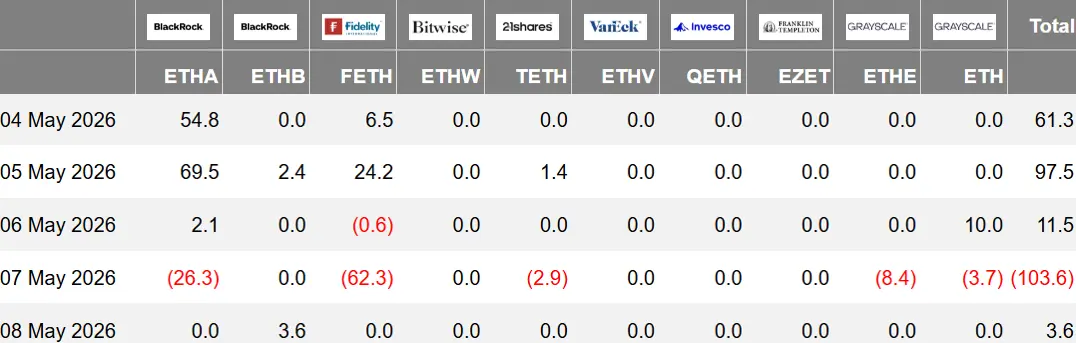
Last week, U.S. Ethereum spot ETFs saw net inflows on four days, with total net inflows reaching $70.3 million, and total net asset value reaching $13.73 billion.

Last week, inflows mainly came from BlackRock's ETHA, with net inflows of $100 million. 3 Ethereum spot ETFs were in a net inflow state.
Data Source: Farside Investors

Hong Kong Bitcoin Spot ETFs Net Inflows of 15.57 Bitcoin

Last week, Hong Kong Bitcoin spot ETFs saw net inflows of 15.57 Bitcoin, with net asset value reaching $320 million. Among them, issuer Harvest Bitcoin's holdings decreased to 211.01 Bitcoin, while China Asset Management's increased to 2590 Bitcoin.

Hong Kong Ethereum spot ETFs had no capital inflows, with a net asset value of $68.49 million.

Data Source: SoSoValue

Performance of Crypto Spot ETF Options

As of May 8, the total nominal trading volume for U.S. Bitcoin spot ETF options was $976 million, with a total nominal trading volume put/call ratio of 2.90.

As of May 7, the total nominal open interest for U.S. Bitcoin spot ETF options reached $27.89 billion, with a total nominal open interest put/call ratio of 1.51.

Market trading activity for Bitcoin spot ETF options has increased in the short term, with overall sentiment leaning bullish.

Additionally, the implied volatility was 41.81%.

Data Source: SoSoValue

Last Week's Crypto ETF Developments

Report: Coinbase & Kraken Account for 22% of AI Crypto Industry Mentions in U.S., IBIT Dominates Bitcoin ETF-Related Answers

A market analysis report shows that Coinbase and Kraken collectively account for 22% of all AI mentions in crypto categories, with Coinbase at 13% and Kraken at 9%, maintaining a lead more than three times that of other U.S. trading platforms.

Gemini ranks third with 5.5%, followed by Robinhood Crypto at 5%, and BlackRock's spot Bitcoin ETF IBIT ranks fifth with 4.5%, dominating queries related to "Bitcoin ETF." The analysis points out that the influence of hardware wallets in AI answers is waning. While Ledger and Trezor still dominate "best crypto wallet" related questions, in questions about "best way to store crypto assets," AI is increasingly recommending regulated platform custody solutions.

The report suggests that the "self-custody narrative" that emerged after the FTX incident is no longer the dominant framework in AI citations. Furthermore, AI is rapidly shaping the U.S. retail crypto financial brand landscape. "When users ask ChatGPT where to buy Bitcoin, the platforms prioritized by AI in responses will have the opportunity to define the industry landscape for the next decade."

U.S. SEC Delays Review of First Batch of Prediction Market ETFs, Involving ETFs Linked to Real-World Events Like Election Results, Economic Recession

According to Reuters, the U.S. Securities and Exchange Commission (SEC) has delayed its review of the first batch of prediction market ETFs, postponing the launch of over 24 planned products. Informed sources revealed that the SEC is asking issuers to further explain product mechanisms and disclosure details, and this delay is expected to be temporary.

Issuers such as Roundhill Investments, Bitwise Asset Management, and GraniteShares submitted applications in February this year, proposing to launch ETF products linked to real-world events like election results, economic recession, tech layoffs, and oil prices.

Under SEC rules, ETF applications typically become effective automatically 75 days after filing unless the regulator intervenes. Currently, Roundhill has set May 5 as the effective date, with Bitwise and GraniteShares' products expected to launch around the same time. The market is closely watching whether the SEC will ultimately approve these products that would open up the "event contract" asset class.

Matt Hougan, Chief Investment Officer of Bitwise, stated: "This is a rapidly maturing space, and regulation is maturing alongside it," pointing out that innovative products like Bitcoin ETFs also underwent lengthy review processes before successfully launching.


Trending Cryptos

Related Questions

QWhat was the net inflow for US spot Bitcoin ETFs last week and what was the total NAV?

ALast week, US spot Bitcoin ETFs had a net inflow of 631 million USD, with a total Net Asset Value (NAV) reaching 106.61 billion USD.

QWhich fund was the primary source of inflow for US spot Ethereum ETFs last week, and what was the total net inflow?

AThe primary source of inflow for US spot Ethereum ETFs last week was BlackRock's ETHA, with a net inflow of 100 million USD. The total net inflow for all US spot Ethereum ETFs was 70.3 million USD.

QHow did the Hong Kong Bitcoin spot ETF perform in terms of net inflow last week, and what was its total NAV?

ALast week, the Hong Kong Bitcoin spot ETF had a net inflow of 15.57 bitcoins, with a total Net Asset Value (NAV) of 320 million USD.

QWhat was the notional total trade volume and the put/call ratio for US Bitcoin spot ETF options as of May 8th?

AAs of May 8th, the notional total trade volume for US Bitcoin spot ETF options was 976 million USD, with a put/call ratio of 2.90.

QWhat reason is cited for the SEC's delay in reviewing the first batch of prediction market ETFs?

AAccording to the report, the SEC has delayed its review of the first batch of prediction market ETFs, requesting further clarification from issuers on product mechanisms and disclosure details. This delay is expected to be temporary.

Related Reads

Changes in reward and commission systems on cryptocurrency exchanges should be expected due to strategy shifts

As the bear market continued in Q2, leading crypto exchanges Coinbase, Bullish, and Gemini reported declines in trading revenue. In response, they are shifting strategies toward newer products like stablecoins and prediction markets, which is expected to change their reward and commission structures. Coinbase is focusing on its USD Coin (USDC) offerings, with average balances surging 44% to $20 billion, and has cut costs to fund increased USDC rewards. Gemini is tripling down on prediction markets, adding market makers and offering user rebates, though related revenue grew only 18% despite a near-doubling in bets. Bullish, targeting professional traders, launched a new rewards program. While its adjusted transaction revenue fell 21% quarterly, it was still up 24% year-over-year—the only exchange of the three to achieve annual growth. Despite falling trading volumes, commission economics improved for some, like Gemini, even as its overall revenue dropped. If the crypto price rally continues and ends the bear market, trading revenues could recover. However, as exchanges try to reduce dependence on market volatility, users can expect more rewards and incentives for using new products. Competition over fees may also intensify. The blurring lines between crypto and traditional finance platforms could further drive this competition, potentially benefiting retail traders and investors.

cryptonews.ru2m ago

Changes in reward and commission systems on cryptocurrency exchanges should be expected due to strategy shifts

cryptonews.ru2m ago

Cryptocurrency Transfers Abroad: What Changes for Russians Starting September 1st

From September 1, 2026, a new Russian law will legalize cryptocurrency transfers abroad for citizens. The regulations will allow sending crypto to personal foreign wallets and using it for payments to foreign businesses, provided established rules are followed. The law recognizes crypto as property and introduces a legal framework for its circulation, permitting both qualified and non-qualified investors (with an annual limit of 300,000 rubles for the latter) to buy cryptocurrencies and stablecoins. Notably, using crypto for domestic payments within Russia remains illegal and subject to fines. Companies can use crypto for foreign trade contracts, but these transactions remain under currency control and anti-money laundering (AML) scrutiny. Major banks are increasing oversight of crypto operations, requiring detailed explanations for business transactions, with stricter controls expected from July 2027. While providing new legal avenues, the article warns of risks. Users must choose transfer methods (exchanges, P2P platforms, crypto exchangers) carefully, considering fees, speed, and service reliability. Key risks include service providers freezing transactions, demanding documentation, or blocking accounts. Experts caution that even popular assets like Bitcoin can be tracked or potentially targeted, and sanctions may restrict access to international platforms. Ultimately, while legalized, cross-border crypto transfers will operate within a framework of enhanced state control over fund origins and counterparties.

cryptonews.ru4m ago

Cryptocurrency Transfers Abroad: What Changes for Russians Starting September 1st

cryptonews.ru4m ago

GensynAI's Jeff Amico States That Real-World Asset (RWA) Investors May Lose Creditor Rights

Jeff Amico of GensynAI warns that investors in Real-World Asset (RWA) tokenized lending pools may lack creditor rights in case of borrower default. He notes a common structure where users receive a yield-bearing stablecoin from a platform, but the underlying loan and collateral are held by separate legal entities. This setup means investors have no enforceable claims against the borrower, the special purpose vehicles (SPVs), or the collateral itself, relying instead on the platform's promise to return funds. Amico emphasizes that investors must first identify who legally owes them money and what credit enhancement mechanisms exist, rather than focusing solely on nominal yield. Protections like collateral or first-loss capital are meaningless unless the lien is properly perfected and an agent is designated to enforce it on the investor's behalf. Investors without a formal credit agreement are particularly vulnerable. He cites Pareto/FalconX as a better model where depositors are direct contractual creditors, though this comes with higher minimum investments and KYC requirements. This highlights a trade-off: the crypto industry's permissionless ideals often conflict with the legal protections required for secure lending. Amico argues that weak legal structures could limit the RWA sector's growth. Traditional finance offers a clear template with defined creditor rights and perfected liens. Tokenized lending needs infrastructure, like oracles, to verify off-chain loan agreement status and collateral perfection, as smart contracts cannot do this autonomously. Ultimately, transparency is key. Some investors may accept weaker protections for open access, while others may prefer stronger legal rights. The legal structure of a lending pool will be as critical as its advertised yield, especially during a default, determining whether a token holder has enforceable rights or merely a platform promise.

cryptonews.ru8m ago

GensynAI's Jeff Amico States That Real-World Asset (RWA) Investors May Lose Creditor Rights

cryptonews.ru8m ago

Trading

Spot

Hot Articles

What is $BITCOIN

DIGITAL GOLD ($BITCOIN): A Comprehensive Analysis Introduction to DIGITAL GOLD ($BITCOIN) DIGITAL GOLD ($BITCOIN) is a blockchain-based project operating on the Solana network, which aims to combine the characteristics of traditional precious metals with the innovation of decentralized technologies. While it shares a name with Bitcoin, often referred to as “digital gold” due to its perception as a store of value, DIGITAL GOLD is a separate token designed to create a unique ecosystem within the Web3 landscape. Its goal is to position itself as a viable alternative digital asset, although specifics regarding its applications and functionalities are still developing. What is DIGITAL GOLD ($BITCOIN)? DIGITAL GOLD ($BITCOIN) is a cryptocurrency token explicitly designed for use on the Solana blockchain. In contrast to Bitcoin, which provides a widely recognized value storage role, this token appears to focus on broader applications and characteristics. Notable aspects include: Blockchain Infrastructure: The token is built on the Solana blockchain, known for its capacity to handle high-speed and low-cost transactions. Supply Dynamics: DIGITAL GOLD has a maximum supply capped at 100 quadrillion tokens (100P $BITCOIN), although details regarding its circulating supply are currently undisclosed. Utility: While precise functionalities are not explicitly outlined, there are indications that the token could be utilized for various applications, potentially involving decentralized applications (dApps) or asset tokenization strategies. Who is the Creator of DIGITAL GOLD ($BITCOIN)? At present, the identity of the creators and development team behind DIGITAL GOLD ($BITCOIN) remains unknown. This situation is typical among many innovative projects within the blockchain space, particularly those aligning with decentralized finance and meme coin phenomena. While such anonymity may foster a community-driven culture, it intensifies concerns about governance and accountability. Who are the Investors of DIGITAL GOLD ($BITCOIN)? The available information indicates that DIGITAL GOLD ($BITCOIN) does not have any known institutional backers or prominent venture capital investments. The project seems to operate on a peer-to-peer model focused on community support and adoption rather than traditional funding routes. Its activity and liquidity are primarily situated on decentralized exchanges (DEXs), such as PumpSwap, rather than established centralized trading platforms, further highlighting its grassroots approach. How DIGITAL GOLD ($BITCOIN) Works The operational mechanics of DIGITAL GOLD ($BITCOIN) can be elaborated on based on its blockchain design and network attributes: Consensus Mechanism: By leveraging Solana’s unique proof-of-history (PoH) combined with a proof-of-stake (PoS) model, the project ensures efficient transaction validation contributing to the network's high performance. Tokenomics: While specific deflationary mechanisms have not been extensively detailed, the vast maximum token supply implies that it may cater to microtransactions or niche use cases that are still to be defined. Interoperability: There exists the potential for integration with Solana’s broader ecosystem, including various decentralized finance (DeFi) platforms. However, the details regarding specific integrations remain unspecified. Timeline of Key Events Here is a timeline that highlights significant milestones concerning DIGITAL GOLD ($BITCOIN): 2023: The initial deployment of the token occurs on the Solana blockchain, marked by its contract address. 2024: DIGITAL GOLD gains visibility as it becomes available for trading on decentralized exchanges like PumpSwap, allowing users to trade it against SOL. 2025: The project witnesses sporadic trading activity and potential interest in community-led engagements, although no noteworthy partnerships or technical advancements have been documented as of yet. Critical Analysis Strengths Scalability: The underlying Solana infrastructure supports high transaction volumes, which could enhance the utility of $BITCOIN in various transaction scenarios. Accessibility: The potential low trading price per token could attract retail investors, facilitating wider participation due to fractional ownership opportunities. Risks Lack of Transparency: The absence of publicly known backers, developers, or an audit process may yield skepticism regarding the project's sustainability and trustworthiness. Market Volatility: The trading activity is heavily reliant on speculative behavior, which can result in significant price volatility and uncertainty for investors. Conclusion DIGITAL GOLD ($BITCOIN) emerges as an intriguing yet ambiguous project within the rapidly evolving Solana ecosystem. While it attempts to leverage the “digital gold” narrative, its departure from Bitcoin's established role as a store of value underscores the need for a clearer differentiation of its intended utility and governance structure. Future acceptance and adoption will likely depend on addressing the current opacity and defining its operational and economic strategies more explicitly. Note: This report encompasses synthesised information available as of October 2023, and developments may have transpired beyond the research period.

2.0k Total ViewsPublished 2025.05.13Updated 2025.05.13

What is $BITCOIN

Discussions

Welcome to the HTX Community. Here, you can stay informed about the latest platform developments and gain access to professional market insights. Users' opinions on the price of BTC (BTC) are presented below.

活动图片