Crypto Adoption Set To Accelerate In 2026 As ETFs, Stablecoins, Tokenization Gain Ground

bitcoinistPublished on 2026-01-01Last updated on 2026-01-01

Abstract

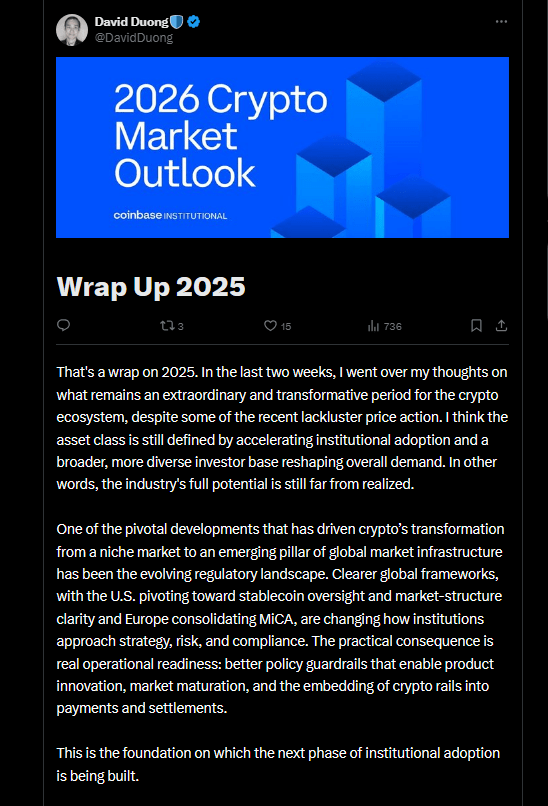
Coinbase's head of research, David Duong, forecasts accelerated crypto adoption in 2026, driven by ETF approvals, stablecoins, tokenization, and clearer regulations. He notes that regulatory progress in the U.S. and Europe, such as the GENIUS Act and MiCA, is enabling institutional adoption and product development. Crypto demand is now broader and more stable, supported by corporate treasuries and long-term investors rather than short-term speculation. From 2023 to 2025, crypto ETPs raised over $48 billion, with significant growth in stablecoins ($300B market cap) and emerging tokenization ($1.2B+). Practical uses in lending, settlement, and collateral are expanding, positioning crypto for a more central role in finance.

Coinbase’s head of investment research, David Duong, said momentum from crypto exchange-traded funds, stablecoins, tokenization, and clearer rules is likely to build through 2026 and speed up wider use of digital assets.

“We expect these forces to compound in 2026 as ETF approval timelines compress,” he said. According to Duong, last year laid important groundwork by giving more regulated paths for investors and by pushing crypto tools closer to normal finance.

Regulatory Steps Spur Institutional Moves

Duong pointed out that clearer rulebooks in the US and Europe are changing how big institutions handle crypto. The US has moved toward stablecoin oversight with the GENIUS Act, and Europe has pushed forward with MiCA.

Those moves are being used by firms to make operations ready for new products and to link crypto rails to payments and settlements. He said that better guardrails let firms design products that can be used by a broader set of clients.
Investor Base Shifts Away From Single Narratives

Based on reports, crypto demand is no longer driven by a lone story or by only early adopters. Adoption figures have held steady, at 10% in Q1 2023 and close to 10% in Q1 2025, showing broad, steady interest across markets.

That mix of allocators and end users now includes corporate treasuries and long-term investors, which may reduce the rapid churn tied to short-term speculation. Some capital looks more strategic and may stay in place for longer.

Markets Respond With Capital

Meanwhile, reports indicate that global investment funds raised more than $48 billion through exchange-traded products (ETPs) related to digital currencies from January 2023 until December 2025—this is an increase from 2024.

Total crypto market cap currently at $2.94 trillion. Chart: TradingView

Investment funds focused on Ethereum had almost three times the inflow during this time frame as compared to 2024.

The growth of stablecoins continues to be significant; their market capitalization is approximately $300 billion, but stablecoins still process trillions of dollars through full trading venues and DeFi.

Tokenized assets are smaller by comparison, with a market value above $1.2 billion, but analysts expect growth as institutions test blockchain-based ownership and fractional investing.

Tokenization And Corporate Use

Corporations have started to experiment with digital asset treasuries and tokenized collateral. Those are being tested for use in lending, settlement, and as part of corporate balance sheets.

Based on Duong’s view, tokenized collateral could be more widely accepted in traditional deals, and stablecoins might be used more in delivery-vs-payment setups. These practical uses are being watched closely by banks and custodians.

Outlook For 2026

Duong summed up his view by stressing three things: clear policy, operational readiness, and useful products. According to him, when regulators set clearer rules, institutions build safer systems, and companies design products people can actually use, crypto can move from a niche market toward a more central role in finance.

Featured image from Chainalysis, chart from TradingView

Related Questions

QAccording to David Duong, what four key factors are likely to build momentum and accelerate wider crypto adoption through 2026?

ACrypto exchange-traded funds (ETFs), stablecoins, tokenization, and clearer regulatory rules.

QWhat two major regulatory developments in the US and Europe did Duong highlight as changing how big institutions handle crypto?

AThe US moving toward stablecoin oversight with the GENIUS Act, and Europe pushing forward with the Markets in Crypto-Assets (MiCA) regulation.

QWhat does the steady crypto adoption rate of around 10% in both Q1 2023 and Q1 2025 indicate about the market?

AIt shows broad, steady interest across markets, indicating that demand is no longer driven by a single narrative or only early adopters, but includes a wider base like corporate treasuries and long-term investors.

QHow much did global investment funds raise through crypto-related exchange-traded products (ETPs) from January 2023 to December 2025?

AGlobal investment funds raised more than $48 billion through crypto-related ETPs during that period.

QWhat three key elements did David Duong stress are necessary for crypto to move from a niche market to a central role in finance?

AClear policy from regulators, operational readiness from institutions building safer systems, and useful products that people can actually use.

Related Reads

Farewell to Traditional Bull and Bear Markets, Deciphering the Logic of Today's Bubble Rotation

"Farewell to Traditional Bulls and Bears: Understanding Today's Market Logic of Bubble Rotation" The article draws a parallel between modern financial markets and a meteorological chain of thunderstorms, contrasting it with the past's slower-moving, more predictable 'layered cloud' systems of long bull/bear cycles and gradual sector rotations. The author argues that today's market has undergone a permanent structural shift, creating an environment where discrete, intense thematic bubbles (e.g., AI, GLP-1 drugs, crypto, robotics, quantum tech) sequentially form, swell, and burst. These 'storm cells' are triggered when capital fleeing a dying bubble acts like a meteorological 'cold air wedge,' forcing the warm, moist capital of latent interest in a new sector to rapidly rise and condense into the next speculative frenzy. This new 'convective' market regime is driven by eight fundamental changes: 1. Democratization of speculation via zero-commission trading, gamified apps, and heavy retail participation in instruments like 0DTE options. 2. Permanent, price-insensitive buying pressure from defined-contribution retirement plans (e.g., 401(k)s). 3. Passive investing creating inelastic market participants that amplify momentum, especially into mega-cap stocks. 4. The dominance of multi-strategy funds and high-frequency trading (HFT), weakening price discovery and creating fragile microstructure prone to synchronized sell-offs. 5. Artificially suppressed volatility that eventually erupts in violent spikes. 6. A transformed market index heavily weighted toward long-duration, narrative-driven tech companies instead of stable, cyclical industrials. 7. The total elimination of information delay, accelerating fear-of-missing-out (FOMO) and herd behavior. 8. A persistently loose fiscal and monetary policy environment. These structural shifts are deemed irreversible. The article outlines the common lifecycle of these thematic bubbles: latency, catalyzing event, narrative formation, peak divergence, and rupture—with outflowing capital seeding the next bubble. In this environment, two investor archetypes can thrive: deep domain experts who understand underlying technologies and business models, and disciplined trend-followers. The author concludes that while emotionally challenging, recognizing this new "climate" is crucial. The key is to elevate one's perspective above the immediate storm to see the cyclical chain of bubbles, avoiding being swept away by the emotions of any single thematic frenzy.

Foresight News6m ago

Farewell to Traditional Bull and Bear Markets, Deciphering the Logic of Today's Bubble Rotation

Foresight News6m ago

Michael Saylor's Latest Article: Bitcoin Must Find Balance Between Uniqueness and Universal Value

Michael Saylor outlines four key Bitcoin ideologies shaping its future: * **Bitcoin Maximalists** see Bitcoin as the dominant digital monetary network and a breakthrough in economic empowerment, emphasizing its superior property rights and role as a sound money solution. * **Bitcoin Capitalists** focus on integration, believing Bitcoin must embed into the global economy—through institutions, capital markets, and financial products—to reach its full potential as digital capital. * **Bitcoin Technologists** advocate for continuous protocol improvements in scalability, privacy, and security to adapt to evolving needs and threats, while acknowledging the high bar for change. * **Bitcoin Fundamentalists** guard Bitcoin's core principles of self-custody, decentralization, and censorship resistance, warning against dilution from institutions or risky modifications. Saylor argues that a healthy Bitcoin ecosystem requires a balance of these perspectives. Bitcoin's path forward involves disciplined expansion: preserving its immutable core (Fundamentalist insight), recognizing its dominant status (Maximalist view), integrating with the global economy (Capitalist drive), and enabling careful innovation, primarily in higher layers (Technologist role). The challenge is to maintain Bitcoin's unique properties while making it useful for the world, ensuring it remains Bitcoin as it grows.

Foresight News38m ago

Michael Saylor's Latest Article: Bitcoin Must Find Balance Between Uniqueness and Universal Value

Foresight News38m ago

Reddit Weekly Hot Stock Watch: RKLB/LUNR/ASTS Plunge Collectively, Is the Space Sector Still Worth Considering?

Reddit's stock communities witnessed a concentrated surge in discussion around space stocks last week, with SPCE, RKLB, LUNR, and ASTS leading the chatter. This often signals an underlying catalyst for investor attention. However, despite being grouped as "space plays," these companies have vastly different fundamentals and recent performances. While SPCE (Virgin Galactic) saw a 22% single-day surge—potentially fueled by short covering and fallout from Blue Origin's rocket test anomaly—the other three stocks declined sharply. RKLB dropped 15%, LUNR fell 13%, and ASTS was down 7%. This divergence highlights they are not a monolithic sector. The downturn for RKLB, LUNR, and ASTS stemmed from multiple headwinds converging: Blue Origin's New Glenn rocket explosion (directly impacting ASTS's launch plans), anticipation of SpaceX's massive IPO drawing funds away from these "alternative" public space stocks, and insider selling at RKLB after significant rallies. A closer look reveals key differences: RKLB stands out with substantial, growing revenue ($113.9M in Q1) and a $2.2B backlog, though its high valuation (~80x Forward P/S) prices in success for its upcoming Neutron rocket. LUNR's reported revenue growth is largely acquisition-driven, with its core moon landing business facing a crucial test with the upcoming IM-3 mission. ASTS has a large potential market in space-based cellular connectivity but faces significant execution risk, especially after the Blue Origin launch setback. SPCE, despite high discussion volume, has minimal revenue and its recent spike appears driven more by sentiment than fundamentals. The analysis suggests it's premature to call a "buying opportunity" for the sector broadly. RKLB is considered the most fundamentally sound but may be more attractive at a lower price point ($96-$102). For the others, investors are advised to wait for specific catalysts: LUNR's IM-3 mission outcome, clarity on ASTS's revised launch timeline, and for SPCE, to avoid the speculative frenzy. The long-term space thesis remains, but short-term valuations have run ahead of fundamentals for most names.

marsbit52m ago

Reddit Weekly Hot Stock Watch: RKLB/LUNR/ASTS Plunge Collectively, Is the Space Sector Still Worth Considering?

marsbit52m ago

Why Does Crypto Always Build 'Casinos', But Rarely Creates 'Indispensable Products'?

The article explores why cryptocurrency has primarily fostered speculation rather than essential, "sticky" consumer products. It introduces the concept of "sofalarity"—the point where a platform's convenience becomes so ingrained that leaving feels unthinkable. While Big Tech creates this lock-in through ecosystem control and data harvesting, crypto lacks equivalent everyday utility. Its appeal hinges on the variable rewards of price volatility, akin to gambling, which drives engagement but not dependency. The author argues crypto's core promise—fixing opaque backend systems like correspondent banking—solves problems most people never see or feel, failing to deliver a tangible "aha moment" of improved daily life. This need for explanation hinders mass adoption. Meanwhile, platforms like Google and Meta monetize vast behavioral data, a treasure trove crypto's transparent ledgers (recording only financial transactions) cannot match for predictive insight. The piece further questions whether crypto's potential lies in consumer super-apps or, more plausibly, in becoming enterprise-grade infrastructure—modern settlement rails. It concludes with a critical look at Real-World Asset (RWA) tokenization, suggesting it may merely digitize and accelerate corporate extraction (e.g., in housing or healthcare) rather than democratize access, as the technology itself is a neutral tool. True disruption, the author implies, requires building sovereign systems outside exploitative platforms.

marsbit53m ago

Why Does Crypto Always Build 'Casinos', But Rarely Creates 'Indispensable Products'?

marsbit53m ago

Trading

Spot
Futures

Hot Articles

How to Buy GAIN

Welcome to HTX.com! We've made purchasing GriffinAI (GAIN) simple and convenient. Follow our step-by-step guide to embark on your crypto journey.Step 1: Create Your HTX AccountUse your email or phone number to sign up for a free account on HTX. Experience a hassle-free registration journey and unlock all features.Get My AccountStep 2: Go to Buy Crypto and Choose Your Payment MethodCredit/Debit Card: Use your Visa or Mastercard to buy GriffinAI (GAIN) instantly.Balance: Use funds from your HTX account balance to trade seamlessly.Third Parties: We've added popular payment methods such as Google Pay and Apple Pay to enhance convenience.P2P: Trade directly with other users on HTX.Over-the-Counter (OTC): We offer tailor-made services and competitive exchange rates for traders.Step 3: Store Your GriffinAI (GAIN)After purchasing your GriffinAI (GAIN), store it in your HTX account. Alternatively, you can send it elsewhere via blockchain transfer or use it to trade other cryptocurrencies.Step 4: Trade GriffinAI (GAIN)Easily trade GriffinAI (GAIN) on HTX's spot market. Simply access your account, select your trading pair, execute your trades, and monitor in real-time. We offer a user-friendly experience for both beginners and seasoned traders.

3.3k Total ViewsPublished 2025.09.24Updated 2026.06.02

How to Buy GAIN

Discussions

Welcome to the HTX Community. Here, you can stay informed about the latest platform developments and gain access to professional market insights. Users' opinions on the price of GAIN (GAIN) are presented below.

活动图片