Coldcard Vulnerability Amplifies Market Concerns Amid Upcoming Two Bitcoin Forks

cryptonews.ruPublished on 2026-08-01Last updated on 2026-08-01

Abstract

Bitcoin is consolidating between roughly $62.3k and $63.1k, having lost most of July's gains as sellers regained control. A major security incident involving a long-standing vulnerability in Coldcard hardware wallets resulted in the theft of over 1,128 BTC from more than 1,100 wallets. The event highlighted hardware risks, with the manufacturer advising affected users to generate entirely new wallet seeds. Market pressure continues from institutional outflows, with U.S. spot Bitcoin ETFs seeing a net outflow of approximately $265 million on July 31st. Traders are monitoring two key August events: the potential activation of the BIP-110 soft fork, aiming to limit certain non-financial data in transactions, and the planned eCash hard fork by Paul Sztorc, which will create a separate blockchain duplicating Bitcoin's ledger for eligible holders. Seasonal weakness and the Crypto Fear & Greed Index in "Fear" territory contribute to cautious sentiment. A notable difference in this sell-off is the relative stability in Bitcoin derivatives markets, suggesting the drop is driven more by position unwinding than aggressive new leveraged selling. Key technical levels to watch are resistance at $64k-$65k and support at $58k-$60k.

The world's largest cryptocurrency traded in a range of approximately $62,300 to $63,100 during early Saturday trading sessions after briefly rising above the $65,000 mark the previous day. Although Bitcoin ultimately gained about 7.36% in July, the transition into August quickly erased much of that momentum as sellers regained control of the situation.

Coldcard Incident Shifts the Course of Discussion

Security news rarely stays on the sidelines of price dynamics, especially when it comes to self-custody. The Coldcard incident is a prime example. Malicious actors exploited a long-standing firmware vulnerability to steal 1,128.6633 BTC from over 1,100 wallets in a meticulously coordinated operation, reminding the market that even reliable hardware can become a source of risk if a vulnerability remains undetected for years.

The response to the incident followed a familiar pattern characteristic of major security incidents. Coinkite released a patched firmware and recommended that affected users generate entirely new wallet seeds rather than simply updating their devices. This is an important distinction because with a compromised seed, installing new software does not restore its security. Moving funds becomes the only practical solution.

ETF Outflows Continue to Exert Pressure

Institutional investment flows did not provide significant relief. On July 31st, US spot Bitcoin ETFs recorded a net outflow of approximately $265 million, with BlackRock's IBIT leading the decline, while Fidelity's FBTC and Grayscale's GBTC also ended the day in negative territory.

ETF fund flows often have a greater impact on short-term market psychology than long-term fundamental factors. Several consecutive days of redemptions tend to heighten caution, especially when the price is already trending lower. Instead of acting as buyers, institutional investors largely stayed on the sidelines, depriving Bitcoin of one of the strongest sources of demand seen earlier this year.

August Brings Two Distinct Bitcoin-Related Events

Beyond price, traders are watching two unrelated events that could dominate Bitcoin discussions throughout August.

The first is BIP-110, a proposed temporary soft fork that would limit certain forms of non-financial data embedded in Bitcoin transactions. Miners are expected to begin signaling around August 7th, but support remains minimal, making the proposal's path to activation uncertain. Some believe this fork could lead to a blockchain split.

The second is the Paul Sztorc-planned hard fork of eCash, scheduled for around August 21st. Unlike BIP-110, this fork does not alter Bitcoin itself. Instead, it creates a separate blockchain that duplicates the Bitcoin ledger, allowing eligible Bitcoin holders to claim an equivalent share of the new asset. The remaining uncertainty concerns which exchanges and custodians will decide to support the distribution.

Given that market sentiment is already low, it remains unclear how these events will affect confidence in the coming days.

Seasonal Trends Offer Little Help

August has often been a challenging month for Bitcoin, and this year's overall market situation does little to improve the outlook. The Crypto Fear & Greed Index remains in the "Fear" zone, while rising bond yields and a decline in AI-related stocks have generally reduced investor appetite for risk assets.
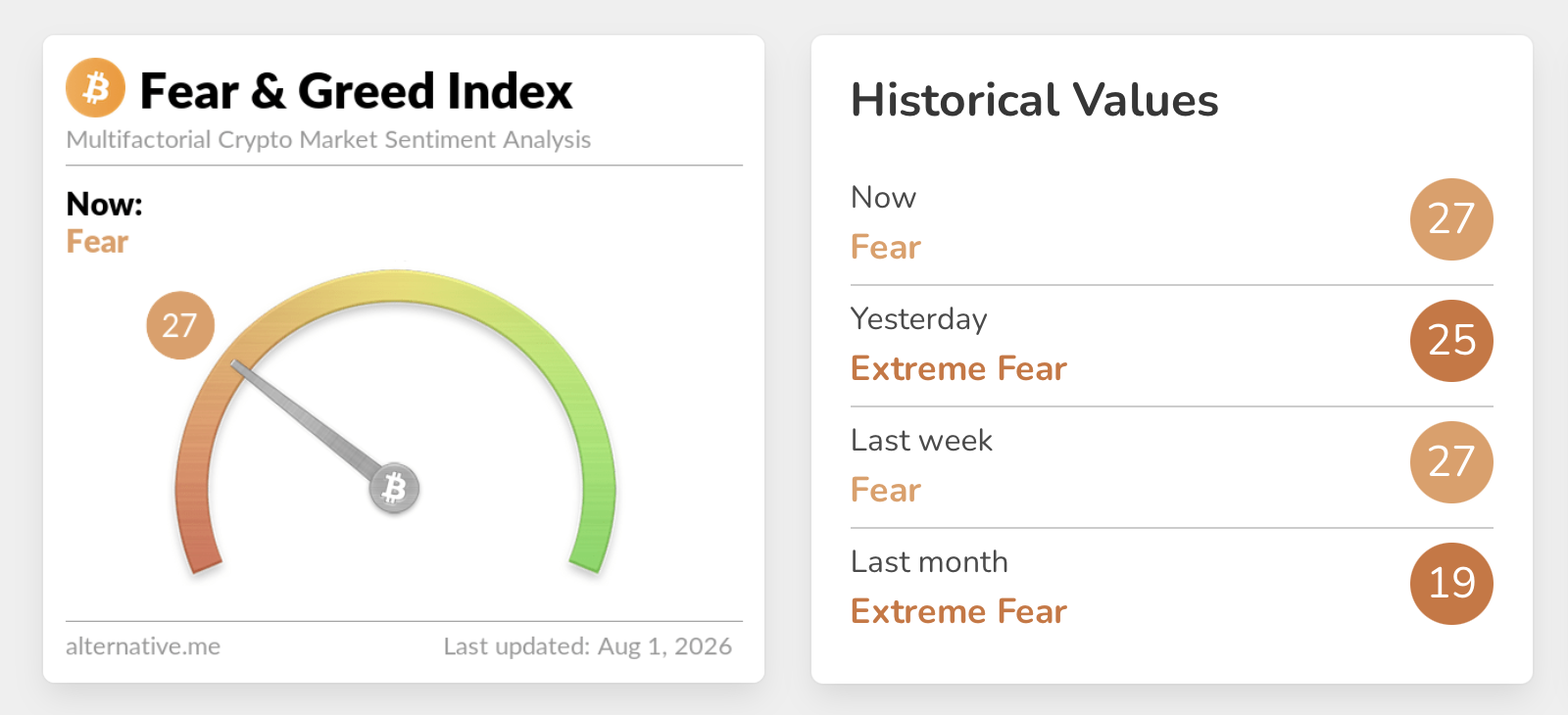
Crypto Fear & Greed Index according to alternative.me as of August 1, 2026.

One notable difference from previous selling waves is what hasn't happened. The Bitcoin derivatives market has remained relatively stable, with open interest holding around $48 billion rather than skyrocketing. This typically indicates that the decline is driven more by the unwinding of existing positions than by aggressive new leveraged trades—a dynamic considered healthier than the liquidations that often accompany sharper corrections.

What Traders Are Watching

The next key technical hurdle remains the $64,000 to $65,000 range and above. Reclaiming this area would signal that buyers are beginning to digest the recent wave of negative news. However, losing the $62,000 level would likely shift focus to the $58,000 to $60,000 zone—an area that previously attracted significant demand earlier this summer.

Over the next few weeks, attention will focus on the start of BIP-110 miner signaling around August 7th, exchange announcements ahead of the planned eCash fork on August 21st, and whether daily ETF flow reports show a return of institutional buyers after an extended period of outflows.

end-content

Trending Cryptos

Related Questions

QWhat was the recent security incident discussed in the article that involved Coldcard hardware wallets?

AAttackers exploited a long-standing firmware vulnerability in Coldcard hardware wallets to steal 1,128.6633 BTC from over 1,100 wallets. The device manufacturer, Coinkite, released a patched firmware and recommended affected users generate entirely new wallet seeds to transfer their funds to, as simply updating the software would not restore security if the seed was already compromised.

QHow did US spot Bitcoin ETFs perform on July 31st according to the article, and what was the impact?

AOn July 31st, US spot Bitcoin ETFs recorded a net outflow of approximately $265 million. Leading the outflows was BlackRock's IBIT, with Fidelity's FBTC and Grayscale's GBTC also finishing the day in negative territory. This continued outflow has deprived Bitcoin of a key source of institutional demand seen earlier in the year, contributing to downward pressure on the price.

QWhat are the two major Bitcoin-related events scheduled for August mentioned in the article?

AThe two major events are: 1) BIP-110, a proposed temporary soft fork aimed at limiting certain forms of non-financial data in Bitcoin transactions, with miner signaling expected to begin around August 7th. 2) Paul Sztorc's planned hard fork of eCash (a separate project), scheduled for around August 21st, which will create a separate blockchain duplicating Bitcoin's ledger, allowing eligible Bitcoin holders to claim an equivalent stake in the new asset.

QWhat is the current state of the Crypto Fear & Greed Index and general market sentiment described in the article?

AThe Crypto Fear & Greed Index remains in the 'Fear' zone. Overall market sentiment is low, exacerbated by rising bond yields and a decline in AI-related stocks, which has reduced investor appetite for risk assets like cryptocurrencies. The article also notes that August has historically been a difficult month for Bitcoin.

QWhat key technical price levels are traders watching for Bitcoin's next movement?

ATraders are watching the $64,000 to $65,000 range as the next key technical barrier. Reclaiming this area would signal that buyers are absorbing recent negative news. Conversely, a drop below the $62,000 level would likely shift focus to the $58,000 to $60,000 zone, which previously attracted significant buying interest earlier in the summer.

Related Reads

Trading

Spot

Hot Articles

What is $BITCOIN

DIGITAL GOLD ($BITCOIN): A Comprehensive Analysis Introduction to DIGITAL GOLD ($BITCOIN) DIGITAL GOLD ($BITCOIN) is a blockchain-based project operating on the Solana network, which aims to combine the characteristics of traditional precious metals with the innovation of decentralized technologies. While it shares a name with Bitcoin, often referred to as “digital gold” due to its perception as a store of value, DIGITAL GOLD is a separate token designed to create a unique ecosystem within the Web3 landscape. Its goal is to position itself as a viable alternative digital asset, although specifics regarding its applications and functionalities are still developing. What is DIGITAL GOLD ($BITCOIN)? DIGITAL GOLD ($BITCOIN) is a cryptocurrency token explicitly designed for use on the Solana blockchain. In contrast to Bitcoin, which provides a widely recognized value storage role, this token appears to focus on broader applications and characteristics. Notable aspects include: Blockchain Infrastructure: The token is built on the Solana blockchain, known for its capacity to handle high-speed and low-cost transactions. Supply Dynamics: DIGITAL GOLD has a maximum supply capped at 100 quadrillion tokens (100P $BITCOIN), although details regarding its circulating supply are currently undisclosed. Utility: While precise functionalities are not explicitly outlined, there are indications that the token could be utilized for various applications, potentially involving decentralized applications (dApps) or asset tokenization strategies. Who is the Creator of DIGITAL GOLD ($BITCOIN)? At present, the identity of the creators and development team behind DIGITAL GOLD ($BITCOIN) remains unknown. This situation is typical among many innovative projects within the blockchain space, particularly those aligning with decentralized finance and meme coin phenomena. While such anonymity may foster a community-driven culture, it intensifies concerns about governance and accountability. Who are the Investors of DIGITAL GOLD ($BITCOIN)? The available information indicates that DIGITAL GOLD ($BITCOIN) does not have any known institutional backers or prominent venture capital investments. The project seems to operate on a peer-to-peer model focused on community support and adoption rather than traditional funding routes. Its activity and liquidity are primarily situated on decentralized exchanges (DEXs), such as PumpSwap, rather than established centralized trading platforms, further highlighting its grassroots approach. How DIGITAL GOLD ($BITCOIN) Works The operational mechanics of DIGITAL GOLD ($BITCOIN) can be elaborated on based on its blockchain design and network attributes: Consensus Mechanism: By leveraging Solana’s unique proof-of-history (PoH) combined with a proof-of-stake (PoS) model, the project ensures efficient transaction validation contributing to the network's high performance. Tokenomics: While specific deflationary mechanisms have not been extensively detailed, the vast maximum token supply implies that it may cater to microtransactions or niche use cases that are still to be defined. Interoperability: There exists the potential for integration with Solana’s broader ecosystem, including various decentralized finance (DeFi) platforms. However, the details regarding specific integrations remain unspecified. Timeline of Key Events Here is a timeline that highlights significant milestones concerning DIGITAL GOLD ($BITCOIN): 2023: The initial deployment of the token occurs on the Solana blockchain, marked by its contract address. 2024: DIGITAL GOLD gains visibility as it becomes available for trading on decentralized exchanges like PumpSwap, allowing users to trade it against SOL. 2025: The project witnesses sporadic trading activity and potential interest in community-led engagements, although no noteworthy partnerships or technical advancements have been documented as of yet. Critical Analysis Strengths Scalability: The underlying Solana infrastructure supports high transaction volumes, which could enhance the utility of $BITCOIN in various transaction scenarios. Accessibility: The potential low trading price per token could attract retail investors, facilitating wider participation due to fractional ownership opportunities. Risks Lack of Transparency: The absence of publicly known backers, developers, or an audit process may yield skepticism regarding the project's sustainability and trustworthiness. Market Volatility: The trading activity is heavily reliant on speculative behavior, which can result in significant price volatility and uncertainty for investors. Conclusion DIGITAL GOLD ($BITCOIN) emerges as an intriguing yet ambiguous project within the rapidly evolving Solana ecosystem. While it attempts to leverage the “digital gold” narrative, its departure from Bitcoin's established role as a store of value underscores the need for a clearer differentiation of its intended utility and governance structure. Future acceptance and adoption will likely depend on addressing the current opacity and defining its operational and economic strategies more explicitly. Note: This report encompasses synthesised information available as of October 2023, and developments may have transpired beyond the research period.

1.4k Total ViewsPublished 2025.05.13Updated 2025.05.13

What is $BITCOIN

Discussions

Welcome to the HTX Community. Here, you can stay informed about the latest platform developments and gain access to professional market insights. Users' opinions on the price of BTC (BTC) are presented below.

活动图片