Claude Engineer Finally Unveils Fable 5's Ultimate Strategy, Teaching You How to Bridge the Information Gap with AI Models

marsbitPublished on 2026-07-06Last updated on 2026-07-06

Abstract

This article, titled "Claude Engineer Finally Releases Fable 5 'Skill-Burning' Guide, Teaching How to Bridge the Information Gap with Models," details a blog post by Claude Code engineer Thariq Shihipar. The core concept is the "information gap" or "unknowns"—the disconnect between a user's instructions (the "map") and the actual task requirements (the "territory"). The article argues that with powerful models like Claude Fable 5, work quality depends on the user's ability to identify and clarify these unknowns. Shihipar categorizes unknowns into four types: Known Knowns (explicit instructions), Known Unknowns (awareness of gaps), Unknown Knowns (implicit, unstated knowledge), and Unknown Unknowns (unforeseen issues). The blog provides a framework for addressing these gaps throughout the workflow: * **Before Implementation:** Techniques include "Blindspot Scanning" to uncover Unknown Unknowns, brainstorming/prototyping for visual or complex tasks, having Claude ask clarifying questions, using reference code/examples, and creating implementation plans. * **During Implementation:** Maintaining an "implementation notes" file for Claude to document deviations and decisions made due to encountered edge cases. * **After Implementation:** Creating summary documents for review and having Claude generate quizzes to ensure the user fully understands the completed changes. The article concludes that as models become more capable, the key to success is systematically discovering...

The fate of Fable 5 has been as mystifying as its model's name since its release.

From the highly anticipated "AI's Defining Moment" to being forced offline by a U.S. government ban, and then restricting access to non-Americans, it has captivated global attention.

Now, the storm has gradually subsided. Ultimately, models must return to productivity.

To this end, Claude Code engineer Thariq Shihipar published a detailed blog post on social media, outlining techniques for using Fable 5.

This article addresses a long-standing question. With models having evolved to such powerful capabilities, why do I still feel they perform tasks incorrectly when I use them?

Thariq's blog post is an eye-opener. In short: there is an information gap between humans and models, a disparity between the prompts, Skills, and context provided by the user and the actual task execution.

Thus, the entire blog post teaches you how to bridge this information gap. Below, Machine Heart provides the full blog post for our readers.

Blog Title: A Field Guide to Fable: Finding Your Unknowns

Blog Link: https://x.com/trq212/status/2073100352921215386

Working with Claude Fable 5 constantly reminds me of an old adage: the map is not the territory.

The "map" is the representation of the work to be done—my prompts, skills, and context—what I give to Claude. The "territory" is where the work actually needs to happen: the codebase, the real world, and the real constraints within.
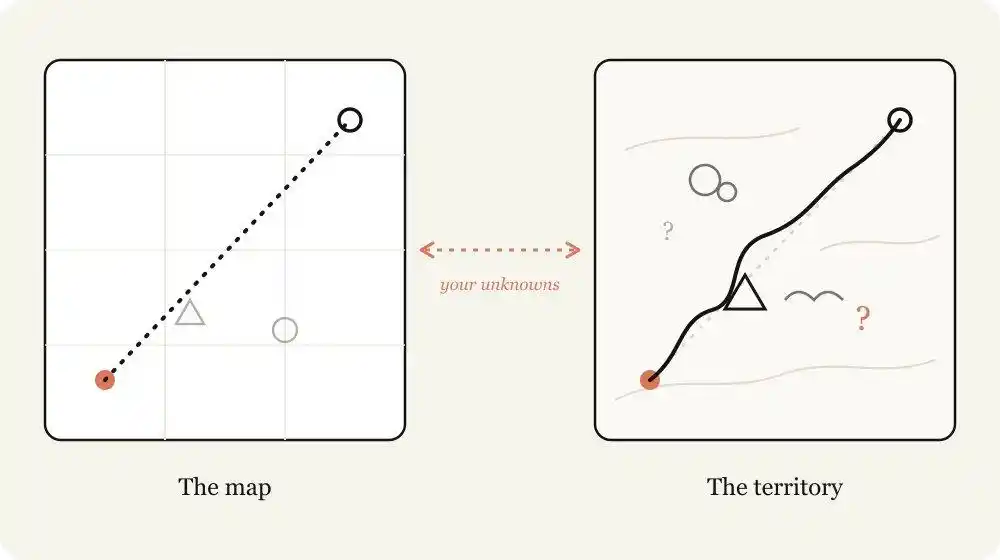
I call the gap between the map and the territory "unknowns." When Claude encounters an unknown, it must make a decision based on its best guess of my intent. The more complex the work, the more unknowns Claude might encounter.

Fable is the first model where I've strongly felt that the bottleneck of work quality depends on my ability to clarify its unknowns.

Importantly, mere upfront planning isn't always enough. You might discover unknowns deep in implementation; you might also find these unknowns point to the fact that you should be solving the problem in a completely different way.

I find that collaborating with Fable is essentially an iterative process of discovering unknowns before, during, and after implementation.

The author provides some examples of discovering "unknowns." Readers are encouraged to review them alongside the full article.
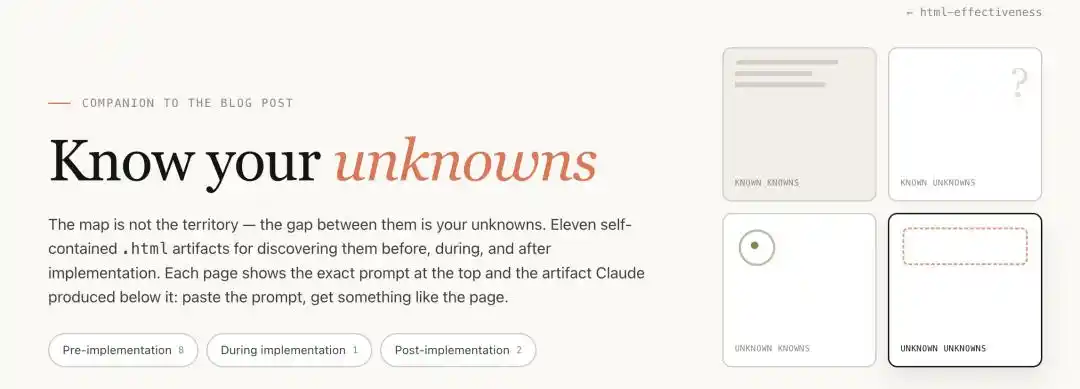
Example Link: https://thariqs.github.io/html-effectiveness/unknowns/

Know Your Unknowns

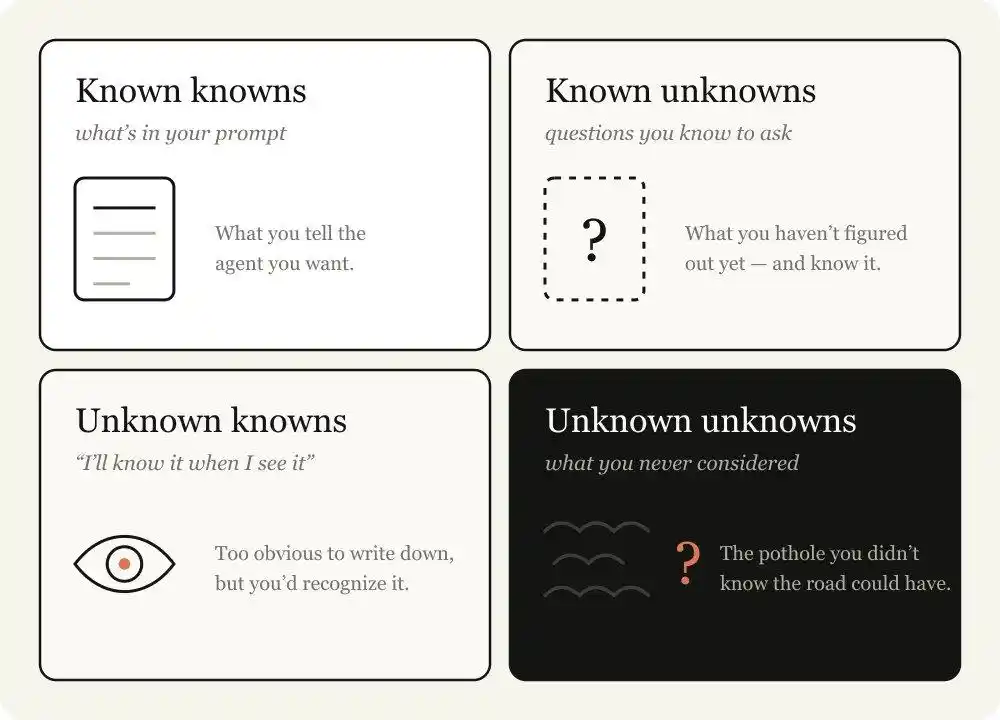
What are unknowns? When I approach Claude with a problem, I typically break it down from four perspectives:

Known knowns: This is basically what I write in the prompt. I tell the agent what I want.

Known unknowns: What things haven't I figured out yet, but I know I haven't figured them out?

Unknown knowns: What things are so obvious to me that I wouldn't even write them down, but I'd recognize them if I saw them?

Unknown unknowns: What things haven't I considered at all? What knowledge do I not yet know I don't know? Do I know how well something can be done?
The most skilled agent-style programmers tend to have relatively fewer unknowns. They know exactly what they want, in great detail. They are highly synchronized with both the codebase and model behavior.

But they also presuppose the existence of unknowns. In many ways, reducing and planning for your unknowns ahead of time is the core skill of agent-style programming. Fortunately, this is a skill that can be honed by collaborating with Claude.

Help Claude Help You
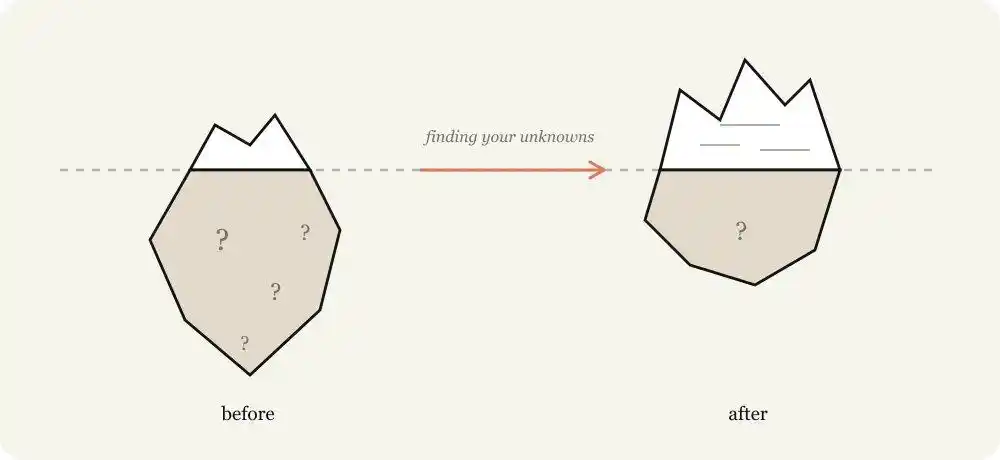
Giving instructions to Claude is a delicate balance. If you're too specific, Claude will follow your instructions strictly, even if pivoting to a different approach might be better. If you're too vague, Claude will often make choices and assumptions based on industry best practices, which may not be right for your task.

Both can fail when you haven't adequately considered your unknowns. You don't know when the road ahead is fraught with obstacles, nor do you know when it's actually smooth, but you still want Claude to make adjustments if necessary.

Claude can help you discover unknowns faster. It can search your codebase and the internet incredibly quickly, and it possesses more general knowledge on most topics than you do. It can also iterate faster from failures.

The most important part of this process is giving Claude enough starting context. For example, tell it what step you're currently thinking about; explain your level of familiarity with the problem and codebase; let it collaborate with you as a thinking partner.

I've previously written about generating HTML with Claude. In almost all those scenarios, the HTML artifact is the best way to visualize and express ideas.

In this article, I'll detail some patterns I use to discover these unknowns. I don't use all these tricks every time, but having them as a toolkit to call upon is incredibly useful.
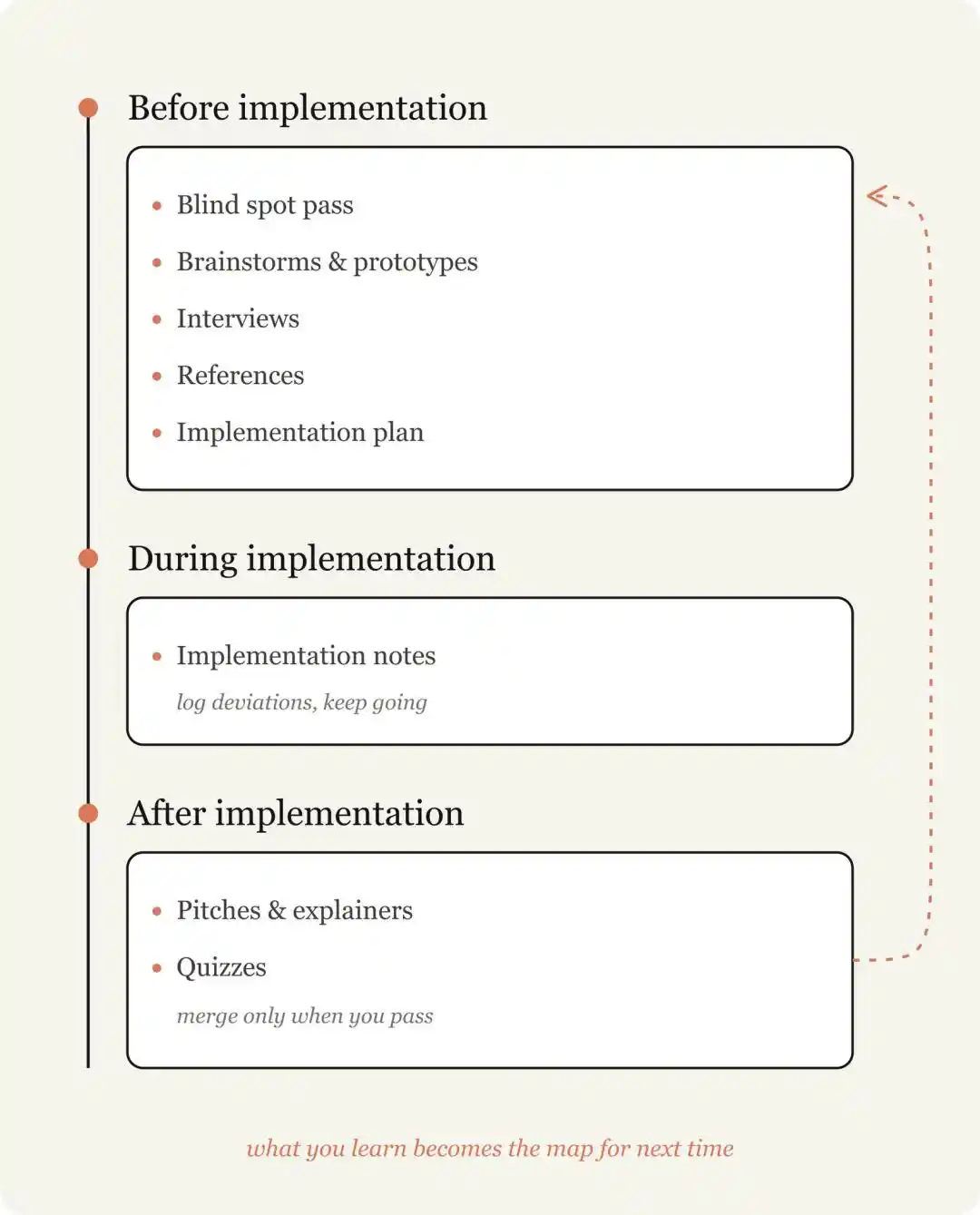
Before Implementation

Blindspot Scan

One of the most useful things when starting work is understanding your blind spots. For example, if you're writing a feature in a new module of the codebase, or having Claude handle a type of work you're unfamiliar with, like iterating on a design, you're likely to have many "unknown unknowns."

You might not know what questions to ask, what constitutes "good," what historical work has been done before, or what pitfalls to avoid.

To do this, you can ask Claude to help find your "unknown unknowns" and explain them. I like to use the terms "blindspot pass" and "unknown unknowns" directly. Usually, it's also important to tell it who you are and what you know.

Example prompts:

"I'm adding a new identity authentication provider, but I know nothing about the auth module in this codebase. Can you do a blindspot pass, help me find relevant unknown unknowns, and assist me in writing better prompts for you?"

"I don't understand color grading, but I need to grade this video. Can you teach me to understand my unknown unknowns about color grading so I can write better prompts?"

Brainstorming & Prototyping

When I'm working in a domain with many "unknown knowns"—things I only know how to define standards for once I see them—I have Claude brainstorm and prototype with me.

Identifying and expressing these "unknown knowns" early in the prototyping stage is valuable because discovering them during implementation often carries a higher relative cost. Small changes in features or specifications can lead to vastly different code implementations, and it's harder to get the agent to backtrack on previous changes.

For example, you might just want to see what adding a button looks like in a certain framework, without actually hooking up the backend routes or maintaining extra frontend state.

Visual design is something I find hard to articulate clearly, but I know what I want when I see it. In such cases, I ask Claude to provide several different design directions for an artifact.

I also start almost every coding session with exploration or brainstorming. This helps me define the project scope with clear intent. Claude often discovers high-value approaches I would have missed, but it can also miss the forest for the trees. Brainstorming prevents me from setting the scope too narrowly or too broadly from the start.

Example prompts:

"I want to make a dashboard for this dataset, but I have no visual taste and don't know what's possible. Help me create an HTML page with 4 vastly different design styles so I can provide feedback based on the results."

"Before wiring anything up, create a standalone HTML file with fake data to simulate the new editor toolbar. I want to give feedback on the layout first before you touch the real app."

"Here's my rough problem: user churn after completing onboarding. Search the codebase and brainstorm 10 places we could intervene, from lowest cost to most ambitious. I'll tell you which directions feel better."

Reverse Interview

After enough brainstorming, I usually still have unknowns.

In such cases, I have Claude interview me around anything unclear or ambiguous. When having Claude interview you, try to provide context about the problem so it can ask more targeted questions. Here are some examples.

Example prompts:

"Please ask me one question at a time, interviewing me around any points of ambiguity. Prioritize questions where my answer would change the architectural design."

Reference Materials

Sometimes, you can't describe in detail what you want. Maybe you lack the language to express it, or it's too complex to describe fully within a reasonable time.

In such cases, the best answer is reference materials. You can provide diagrams, documentation, or images, but the best reference is often source code.

If you have a library that implements a feature in a specific way, or a design component you really like, just point Fable to the corresponding folder and tell it what to look at. Even if the reference code is in another language, that's okay.

This is also how Claude Design works. You don't necessarily have to give it a file, though you can. You can point it to a module on a website you like, and it will read the underlying code, not just a screenshot. This provides richer detail—markup structure, component organization, and how the component is actually built.

Example prompts:

"This Rust crate in vendor/rate-limiter implements exactly the exponential backoff retry behavior I want. Please read it and reimplement the same semantics in our TypeScript API client."

Implementation Plan

When I feel ready to start implementation, I usually have Claude first compile an implementation plan for my review, focusing on parts most likely to change, such as data models, type interfaces, or UX flows. This lets Claude surface areas I might indeed need to adjust ahead of time.

Example prompts:

"Write an implementation plan in HTML, but start by presenting the decision points I'm most likely to change: data model changes, new type interfaces, and any user-facing content. Put mechanical refactoring at the bottom; I trust you can handle that part."

During Implementation

Implementation Notes

When satisfied with the plan, I start a new session and pass the relevant artifacts into the prompt. For example, I might pass a specification file and a prototype, then ask the agent to implement it.

But the truth is, no matter how much you plan, unknown unknowns will always lurk. The agent might discover mid-work that it must take a different approach due to an edge case in the code.

I ask Claude Code to maintain a temporary implementation-notes.md file, or an .html file, to record the decisions it makes, so we can learn from them for the next attempt.

Example prompts:

"Please maintain an implementation-notes.md file. If you encounter an edge case forcing you to deviate from the original plan, choose the conservative option, record the reason under 'Deviations,' and continue."

After Implementation

Pitch & Explanation Documentation
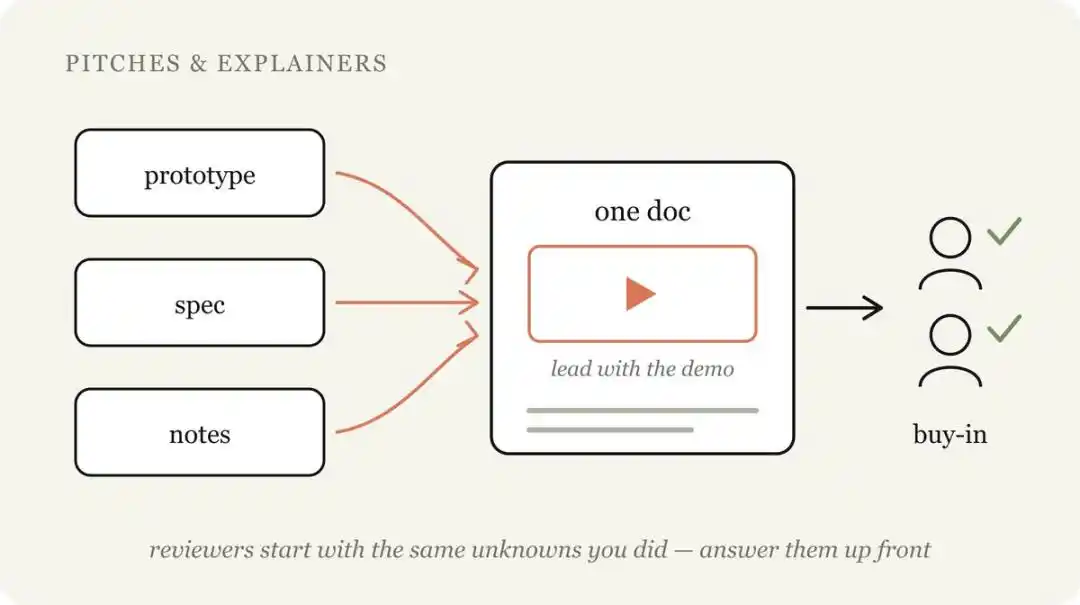
One of the most important things when shipping something is getting others' understanding, support, and approval. Building pitch and explanation artifacts into the final documentation helps:

Accelerate reviewers' understanding when they start with the same unknowns you had.

Accelerate approval from experts when they want to confirm you've considered the unknowns and common failure points they would have foreseen.

Example prompts:

"Package the prototype, spec, and implementation notes into a single document I can directly post on Slack to seek support. Start with a demo GIF."

Quizzes

After a long work session, Claude might have accomplished more than I realize. Just looking at the code diff often gives me only a shallow understanding of what happened, as much behavior depends on existing code paths.

Having Claude test me on the changes after providing substantial context helps me truly understand what occurred. I only merge the code after perfectly passing the quiz.

Example prompts:

"I want to ensure I understand everything that happened in this change. Please give me an HTML report to help me read and understand these changes, including context, intuitive explanations, what was done concretely, etc., and attach a quiz at the bottom that I must pass."

Putting It All Together: The Fable Launch Example

The launch video for Fable was entirely edited by Claude Code. This was a completely new field for me, and I am by no means an expert.

So I started with what I knew. I knew Claude could use code to edit videos and transcribe, but I wasn't sure if its accuracy was sufficient. So I had Claude explain how transcription technologies like Whisper work and whether I could use ffmpeg to accurately cut filler words like "um" or long pauses.

I wanted Claude to create a UI synchronized with my spoken words in time, but I wasn't sure if it could. So I had Claude create a video prototype using Remotion and transcript text to see if the idea was feasible.

Finally, the video itself looked somewhat dark. I knew this was a color grading issue, but I didn't truly understand what color grading was. My first attempt was to have Claude make a few versions for me to choose from, but I realized that when it comes to color grading, I didn't know what "good" was. So, instead of having it generate versions blindly, I had Claude teach me color grading to discover my unknowns.

Matching the Map to the Territory

The more powerful the model, the more you can accomplish with the right approach. When a long-cycle task returns an incorrect result, it likely means you need to spend more time defining your unknowns or creating an implementation plan that allows Claude to navigate these unknowns flexibly.

Every explanation document, brainstorming session, interview, prototype, and reference material is a low-cost way to discover things you didn't know before the cost of fixing them becomes high.

So, when starting your next project, first let Claude help you find your unknowns.

This article is from the WeChat public account "Machine Heart," edited by the Machine Heart Editorial Department.


Trending Cryptos

Related Questions

QWhat is the core issue that prevents AI models like Claude Fable 5 from performing tasks correctly, according to the article?

AAccording to the article, the core issue is the information gap or 'unknowns' between the user (the map) and the actual task execution environment (the territory). This gap exists in the prompts, skills, and context provided versus what is truly needed in the codebase or real world.

QWhat are the four categories of 'unknowns' mentioned in Thariq Shihipar's framework for breaking down a problem?

AThe four categories are: Known Knowns (what is written in the prompt), Known Unknowns (things the user knows they haven't figured out), Unknown Knowns (things obvious to the user that aren't written down but can be recognized), and Unknown Unknowns (things the user hasn't considered or knowledge they don't know they lack).

QWhat is one specific technique recommended for the 'Before Implementation' phase to help identify blind spots?

AOne recommended technique is a 'Blindspot Scan.' The user can ask Claude to help identify 'Unknown Unknowns' by using prompts like, 'Can you do a blindspot pass for me to identify relevant unknown unknowns to help me write better prompts?'

QHow can providing references, especially source code, help when working with Claude Fable 5?

AProviding references, especially source code, helps when the user cannot fully describe what they want. It gives Claude a concrete example of the desired implementation, style, or component structure, even if the reference code is in a different language, allowing for more accurate and detailed task execution.

QWhat practice does the author recommend for the 'After Implementation' phase to ensure a reviewer's understanding and approval?

AThe author recommends creating 'Pitch and Explanation Documentation.' This involves packaging prototypes, specifications, and implementation notes into a single document (often starting with a demo GIF) to quickly bring reviewers up to speed and address potential concerns they might have.

Related Reads

After Close Observation of Wash, Morgan Stanley's Chief Economist Insists: The Fed Will Not Raise Rates This Year

After close observation of Federal Reserve Chair Wash, Seth Carpenter, Morgan Stanley's Chief Global Economist, asserts that the Fed will not raise interest rates this year. Following Wash's speech at the ECB's Sintra forum, Carpenter notes a marginal dovish shift: Wash now more clearly balances the Fed's dual mandate of price stability and maximum employment, rather than focusing nearly exclusively on inflation. Importantly, Wash highlighted that the latest policy meeting (coinciding with falling oil prices) has already lowered market inflation expectations and term premiums, signaling no urgency for a July rate hike. Carpenter's view is supported by data. Recent non-farm payroll figures provide room for the Fed to remain patient. Morgan Stanley's inflation forecasts are below the median FOMC projection, and methodological revisions to PCE inflation could further lower readings. These factors make Carpenter "comfortable" with the call for no hikes in 2024. Carpenter also pushes back against the simplistic narrative that AI will be deflationary and lead to rate cuts. He argues AI investment is currently boosting inflation marginally. More broadly, the business cycle will dictate policy; AI's productivity gains could boost demand and, crucially, raise the equilibrium interest rate (r*), weakening the case for cuts. In contrast, the ECB's path remains more hawkish. Carpenter interprets President Lagarde's Sintra comments as leaving the door open for another 25 basis point hike in September, though softer recent data and falling oil prices provide some flexibility. A July hike or more than one additional hike this year is seen as unlikely.

marsbit1m ago

After Close Observation of Wash, Morgan Stanley's Chief Economist Insists: The Fed Will Not Raise Rates This Year

marsbit1m ago

StarDynamics Secures 2.5 Billion in Two Months, State-Owned Capital Consortium Joins In

Star Era Raises 25 Billion Yuan in Two Months with State Capital Leading the Charge. Chinese humanoid robotics leader Star Era has secured a new 10-billion-yuan funding round led by state-owned capital, including funds like Chengtong Fund under the SASAC, marking 25 billion yuan raised within two months. The company, a spin-off from Tsinghua University, has built a comprehensive capital matrix combining state guidance, top-tier financial backers, and industrial partners. Founded in 2023 by Dr. Chen Jianyu, one of Tsinghua's youngest doctoral supervisors, Star Era stands out for its early and pioneering work on "world models" for embodied AI, notably releasing its PAD world action model ahead of major global players. The company follows an AI-native, full-stack R&D strategy from data and AI brain to control, dexterous hands (XHAND series), and robot bodies (bipedal L7, wheeled Q5). A core innovation is its fully direct-drive dexterous hands, which act as high-fidelity data collectors for training its AI models like the ERA-42 and VLAW, creating a virtuous cycle of data and intelligence. Star Era claims to possess one of the world's largest real-world dexterous hand datasets. Commercially, Star Era has achieved product-market fit, most notably in logistics, with robots operating 24/7 in distribution centers for partners like SF Express and China Post, handling over 1,200 parcels per hour. It is also expanding into high-end manufacturing (Samsung, Geely) and commercial services. Its hardware components are used by nine of the global top ten tech firms and leading research institutions. The article positions 2026 as an inflection point where success shifts from model capabilities to proven, scalable commercial deployment. Star Era's rapid funding and industrial traction highlight its position in this competitive race.

marsbit5m ago

StarDynamics Secures 2.5 Billion in Two Months, State-Owned Capital Consortium Joins In

marsbit5m ago

U.S. Stock Market Trend (July 6th): Gold and Crypto Lead Rebound Ahead of Stocks, Fed Minutes Set Weekly Direction

**U.S. Market Trends (July 6): Gold & Crypto Lead, Fed Minutes to Set Tone** Markets rebounded ahead of the U.S. Independence Day holiday, with Nasdaq 100 futures rising over 1% as AI sector concerns eased. Gold posted its best week in over a month, breaking a four-week losing streak despite ongoing Russia-Ukraine tensions, as Middle East risk premiums faded. Brent crude extended its decline for a fourth week. The week ahead is packed with key events. On Tuesday, SpaceX makes a record-fast entry into the Nasdaq 100 index, forcing passive fund flows, while U.S. tariff hearings and the Sun Valley Conference—notably missing NVIDIA's Jensen Huang and Tesla's Elon Musk—add complexity. OpenAI's scheduled GPT-5.6 release intensifies the AI model rollout race. The main focus is Thursday's release of the first Fed meeting minutes under Chair Wash. With half the FOMC already leaning toward a rate hike this year per the June dot plot, the minutes' tone will be critical for market direction. Hawkish confirmation could reverse recent risk-on sentiment, likely signaled first by a pullback in high-volatility assets like Bitcoin and Ethereum, which significantly outperformed last week. Other events include SK Hynix's large U.S. ADR listing and the start of the Q2 earnings season with reports from PepsiCo and Delta Air Lines. The market's path hinges on whether the liquidity and optimism built during the holiday can withstand the combined tests of Fed policy, trade tensions, and major corporate events.

marsbit6m ago

U.S. Stock Market Trend (July 6th): Gold and Crypto Lead Rebound Ahead of Stocks, Fed Minutes Set Weekly Direction

marsbit6m ago

World's Largest Data Center Project Scrapped

Blackstone Abandons Plans for World's Largest Data Center, Signaling Wider AI Infrastructure Headwinds Blackstone has halted construction of its massive "Digital Gateway" data center campus in Virginia, which was planned to be the world's largest. The project's cancellation follows a five-year battle with local residents concerned about historical preservation, environmental impact, and strain on local resources. A procedural error in the zoning approval process ultimately led a state court to invalidate the project's permits. This move comes shortly after Blackstone sold other mature data center assets, suggesting a strategic pivot by the asset management giant. Industry analysts see this as a potential sign of "peak" investment enthusiasm, mirroring Blackstone's past exits from overheated sectors like office real estate. The cancellation highlights significant bottlenecks facing the AI-driven data center boom across the U.S. Key challenges include severe power grid constraints, with data centers' electricity demand projected to triple nationally by 2035, and mounting grassroots opposition. A report notes over $130 billion worth of U.S. data center projects were delayed in Q1 2026 alone, primarily due to power shortages and community resistance. Local and state governments are also beginning to implement stricter regulations, including new taxes and moratoriums on construction. Blackstone's exit underscores that the breakneck expansion of AI infrastructure is colliding with practical limits, from physical resource caps to social license, forcing a more realistic assessment of costs and feasibility.

marsbit33m ago

World's Largest Data Center Project Scrapped

marsbit33m ago

Trading

Spot

Hot Articles

What is SONIC

Sonic: Pioneering the Future of Gaming in Web3 Introduction to Sonic In the ever-evolving landscape of Web3, the gaming industry stands out as one of the most dynamic and promising sectors. At the forefront of this revolution is Sonic, a project designed to amplify the gaming ecosystem on the Solana blockchain. Leveraging cutting-edge technology, Sonic aims to deliver an unparalleled gaming experience by efficiently processing millions of requests per second, ensuring that players enjoy seamless gameplay while maintaining low transaction costs. This article delves into the intricate details of Sonic, exploring its creators, funding sources, operational mechanics, and the timeline of significant events that have shaped its journey. What is Sonic? Sonic is an innovative layer-2 network that operates atop the Solana blockchain, specifically tailored to enhance the existing Solana gaming ecosystem. It accomplishes this through a customised, VM-agnostic game engine paired with a HyperGrid interpreter, facilitating sovereign game economies that roll up back to the Solana platform. The primary goals of Sonic include: Enhanced Gaming Experiences: Sonic is committed to offering lightning-fast on-chain gameplay, allowing players and developers to engage with games at previously unattainable speeds. Atomic Interoperability: This feature enables transactions to be executed within Sonic without the need to redeploy Solana programmes and accounts. This makes the process more efficient and directly benefits from Solana Layer1 services and liquidity. Seamless Deployment: Sonic allows developers to write for Ethereum Virtual Machine (EVM) based systems and execute them on Solana’s SVM infrastructure. This interoperability is crucial for attracting a broader range of dApps and decentralised applications to the platform. Support for Developers: By offering native composable gaming primitives and extensible data types - dining within the Entity-Component-System (ECS) framework - game creators can craft intricate business logic with ease. Overall, Sonic's unique approach not only caters to players but also provides an accessible and low-cost environment for developers to innovate and thrive. Creator of Sonic The information regarding the creator of Sonic is somewhat ambiguous. However, it is known that Sonic's SVM is owned by the company Mirror World. The absence of detailed information about the individuals behind Sonic reflects a common trend in several Web3 projects, where collective efforts and partnerships often overshadow individual contributions. Investors of Sonic Sonic has garnered considerable attention and support from various investors within the crypto and gaming sectors. Notably, the project raised an impressive $12 million during its Series A funding round. The round was led by BITKRAFT Ventures, with other notable investors including Galaxy, Okx Ventures, Interactive, Big Brain Holdings, and Mirana. This financial backing signifies the confidence that investment foundations have in Sonic’s potential to revolutionise the Web3 gaming landscape, further validating its innovative approaches and technologies. How Does Sonic Work? Sonic utilises the HyperGrid framework, a sophisticated parallel processing mechanism that enhances its scalability and customisability. Here are the core features that set Sonic apart: Lightning Speed at Low Costs: Sonic offers one of the fastest on-chain gaming experiences compared to other Layer-1 solutions, powered by the scalability of Solana’s virtual machine (SVM). Atomic Interoperability: Sonic enables transaction execution without redeployment of Solana programmes and accounts, effectively streamlining the interaction between users and the blockchain. EVM Compatibility: Developers can effortlessly migrate decentralised applications from EVM chains to the Solana environment using Sonic’s HyperGrid interpreter, increasing the accessibility and integration of various dApps. Ecosystem Support for Developers: By exposing native composable gaming primitives, Sonic facilitates a sandbox-like environment where developers can experiment and implement business logic, greatly enhancing the overall development experience. Monetisation Infrastructure: Sonic natively supports growth and monetisation efforts, providing frameworks for traffic generation, payments, and settlements, thereby ensuring that gaming projects are not only viable but also sustainable financially. Timeline of Sonic The evolution of Sonic has been marked by several key milestones. Below is a brief timeline highlighting critical events in the project's history: 2022: The Sonic cryptocurrency was officially launched, marking the beginning of its journey in the Web3 gaming arena. 2024: June: Sonic SVM successfully raised $12 million in a Series A funding round. This investment allowed Sonic to further develop its platform and expand its offerings. August: The launch of the Sonic Odyssey testnet provided users with the first opportunity to engage with the platform, offering interactive activities such as collecting rings—a nod to gaming nostalgia. October: SonicX, an innovative crypto game integrated with Solana, made its debut on TikTok, capturing the attention of over 120,000 users within a short span. This integration illustrated Sonic’s commitment to reaching a broader, global audience and showcased the potential of blockchain gaming. Key Points Sonic SVM is a revolutionary layer-2 network on Solana explicitly designed to enhance the GameFi landscape, demonstrating great potential for future development. HyperGrid Framework empowers Sonic by introducing horizontal scaling capabilities, ensuring that the network can handle the demands of Web3 gaming. Integration with Social Platforms: The successful launch of SonicX on TikTok displays Sonic’s strategy to leverage social media platforms to engage users, exponentially increasing the exposure and reach of its projects. Investment Confidence: The substantial funding from BITKRAFT Ventures, among others, emphasizes the robust backing Sonic has, paving the way for its ambitious future. In conclusion, Sonic encapsulates the essence of Web3 gaming innovation, striking a balance between cutting-edge technology, developer-centric tools, and community engagement. As the project continues to evolve, it is poised to redefine the gaming landscape, making it a notable entity for gamers and developers alike. As Sonic moves forward, it will undoubtedly attract greater interest and participation, solidifying its place within the broader narrative of blockchain gaming.

1.7k Total ViewsPublished 2024.04.04Updated 2024.12.03

What is SONIC

What is $S$

Understanding SPERO: A Comprehensive Overview Introduction to SPERO As the landscape of innovation continues to evolve, the emergence of web3 technologies and cryptocurrency projects plays a pivotal role in shaping the digital future. One project that has garnered attention in this dynamic field is SPERO, denoted as SPERO,$$s$. This article aims to gather and present detailed information about SPERO, to help enthusiasts and investors understand its foundations, objectives, and innovations within the web3 and crypto domains. What is SPERO,$$s$? SPERO,$$s$ is a unique project within the crypto space that seeks to leverage the principles of decentralisation and blockchain technology to create an ecosystem that promotes engagement, utility, and financial inclusion. The project is tailored to facilitate peer-to-peer interactions in new ways, providing users with innovative financial solutions and services. At its core, SPERO,$$s$ aims to empower individuals by providing tools and platforms that enhance user experience in the cryptocurrency space. This includes enabling more flexible transaction methods, fostering community-driven initiatives, and creating pathways for financial opportunities through decentralised applications (dApps). The underlying vision of SPERO,$$s$ revolves around inclusiveness, aiming to bridge gaps within traditional finance while harnessing the benefits of blockchain technology. Who is the Creator of SPERO,$$s$? The identity of the creator of SPERO,$$s$ remains somewhat obscure, as there are limited publicly available resources providing detailed background information on its founder(s). This lack of transparency can stem from the project's commitment to decentralisation—an ethos that many web3 projects share, prioritising collective contributions over individual recognition. By centring discussions around the community and its collective goals, SPERO,$$s$ embodies the essence of empowerment without singling out specific individuals. As such, understanding the ethos and mission of SPERO remains more important than identifying a singular creator. Who are the Investors of SPERO,$$s$? SPERO,$$s$ is supported by a diverse array of investors ranging from venture capitalists to angel investors dedicated to fostering innovation in the crypto sector. The focus of these investors generally aligns with SPERO's mission—prioritising projects that promise societal technological advancement, financial inclusivity, and decentralised governance. These investor foundations are typically interested in projects that not only offer innovative products but also contribute positively to the blockchain community and its ecosystems. The backing from these investors reinforces SPERO,$$s$ as a noteworthy contender in the rapidly evolving domain of crypto projects. How Does SPERO,$$s$ Work? SPERO,$$s$ employs a multi-faceted framework that distinguishes it from conventional cryptocurrency projects. Here are some of the key features that underline its uniqueness and innovation: Decentralised Governance: SPERO,$$s$ integrates decentralised governance models, empowering users to participate actively in decision-making processes regarding the project’s future. This approach fosters a sense of ownership and accountability among community members. Token Utility: SPERO,$$s$ utilises its own cryptocurrency token, designed to serve various functions within the ecosystem. These tokens enable transactions, rewards, and the facilitation of services offered on the platform, enhancing overall engagement and utility. Layered Architecture: The technical architecture of SPERO,$$s$ supports modularity and scalability, allowing for seamless integration of additional features and applications as the project evolves. This adaptability is paramount for sustaining relevance in the ever-changing crypto landscape. Community Engagement: The project emphasises community-driven initiatives, employing mechanisms that incentivise collaboration and feedback. By nurturing a strong community, SPERO,$$s$ can better address user needs and adapt to market trends. Focus on Inclusion: By offering low transaction fees and user-friendly interfaces, SPERO,$$s$ aims to attract a diverse user base, including individuals who may not previously have engaged in the crypto space. This commitment to inclusion aligns with its overarching mission of empowerment through accessibility. Timeline of SPERO,$$s$ Understanding a project's history provides crucial insights into its development trajectory and milestones. Below is a suggested timeline mapping significant events in the evolution of SPERO,$$s$: Conceptualisation and Ideation Phase: The initial ideas forming the basis of SPERO,$$s$ were conceived, aligning closely with the principles of decentralisation and community focus within the blockchain industry. Launch of Project Whitepaper: Following the conceptual phase, a comprehensive whitepaper detailing the vision, goals, and technological infrastructure of SPERO,$$s$ was released to garner community interest and feedback. Community Building and Early Engagements: Active outreach efforts were made to build a community of early adopters and potential investors, facilitating discussions around the project’s goals and garnering support. Token Generation Event: SPERO,$$s$ conducted a token generation event (TGE) to distribute its native tokens to early supporters and establish initial liquidity within the ecosystem. Launch of Initial dApp: The first decentralised application (dApp) associated with SPERO,$$s$ went live, allowing users to engage with the platform's core functionalities. Ongoing Development and Partnerships: Continuous updates and enhancements to the project's offerings, including strategic partnerships with other players in the blockchain space, have shaped SPERO,$$s$ into a competitive and evolving player in the crypto market. Conclusion SPERO,$$s$ stands as a testament to the potential of web3 and cryptocurrency to revolutionise financial systems and empower individuals. With a commitment to decentralised governance, community engagement, and innovatively designed functionalities, it paves the way toward a more inclusive financial landscape. As with any investment in the rapidly evolving crypto space, potential investors and users are encouraged to research thoroughly and engage thoughtfully with the ongoing developments within SPERO,$$s$. The project showcases the innovative spirit of the crypto industry, inviting further exploration into its myriad possibilities. While the journey of SPERO,$$s$ is still unfolding, its foundational principles may indeed influence the future of how we interact with technology, finance, and each other in interconnected digital ecosystems.

93 Total ViewsPublished 2024.12.17Updated 2024.12.17

What is $S$

What is AGENT S

Agent S: The Future of Autonomous Interaction in Web3 Introduction In the ever-evolving landscape of Web3 and cryptocurrency, innovations are constantly redefining how individuals interact with digital platforms. One such pioneering project, Agent S, promises to revolutionise human-computer interaction through its open agentic framework. By paving the way for autonomous interactions, Agent S aims to simplify complex tasks, offering transformative applications in artificial intelligence (AI). This detailed exploration will delve into the project's intricacies, its unique features, and the implications for the cryptocurrency domain. What is Agent S? Agent S stands as a groundbreaking open agentic framework, specifically designed to tackle three fundamental challenges in the automation of computer tasks: Acquiring Domain-Specific Knowledge: The framework intelligently learns from various external knowledge sources and internal experiences. This dual approach empowers it to build a rich repository of domain-specific knowledge, enhancing its performance in task execution. Planning Over Long Task Horizons: Agent S employs experience-augmented hierarchical planning, a strategic approach that facilitates efficient breakdown and execution of intricate tasks. This feature significantly enhances its ability to manage multiple subtasks efficiently and effectively. Handling Dynamic, Non-Uniform Interfaces: The project introduces the Agent-Computer Interface (ACI), an innovative solution that enhances the interaction between agents and users. Utilizing Multimodal Large Language Models (MLLMs), Agent S can navigate and manipulate diverse graphical user interfaces seamlessly. Through these pioneering features, Agent S provides a robust framework that addresses the complexities involved in automating human interaction with machines, setting the stage for myriad applications in AI and beyond. Who is the Creator of Agent S? While the concept of Agent S is fundamentally innovative, specific information about its creator remains elusive. The creator is currently unknown, which highlights either the nascent stage of the project or the strategic choice to keep founding members under wraps. Regardless of anonymity, the focus remains on the framework's capabilities and potential. Who are the Investors of Agent S? As Agent S is relatively new in the cryptographic ecosystem, detailed information regarding its investors and financial backers is not explicitly documented. The lack of publicly available insights into the investment foundations or organisations supporting the project raises questions about its funding structure and development roadmap. Understanding the backing is crucial for gauging the project's sustainability and potential market impact. How Does Agent S Work? At the core of Agent S lies cutting-edge technology that enables it to function effectively in diverse settings. Its operational model is built around several key features: Human-like Computer Interaction: The framework offers advanced AI planning, striving to make interactions with computers more intuitive. By mimicking human behaviour in tasks execution, it promises to elevate user experiences. Narrative Memory: Employed to leverage high-level experiences, Agent S utilises narrative memory to keep track of task histories, thereby enhancing its decision-making processes. Episodic Memory: This feature provides users with step-by-step guidance, allowing the framework to offer contextual support as tasks unfold. Support for OpenACI: With the ability to run locally, Agent S allows users to maintain control over their interactions and workflows, aligning with the decentralised ethos of Web3. Easy Integration with External APIs: Its versatility and compatibility with various AI platforms ensure that Agent S can fit seamlessly into existing technological ecosystems, making it an appealing choice for developers and organisations. These functionalities collectively contribute to Agent S's unique position within the crypto space, as it automates complex, multi-step tasks with minimal human intervention. As the project evolves, its potential applications in Web3 could redefine how digital interactions unfold. Timeline of Agent S The development and milestones of Agent S can be encapsulated in a timeline that highlights its significant events: September 27, 2024: The concept of Agent S was launched in a comprehensive research paper titled “An Open Agentic Framework that Uses Computers Like a Human,” showcasing the groundwork for the project. October 10, 2024: The research paper was made publicly available on arXiv, offering an in-depth exploration of the framework and its performance evaluation based on the OSWorld benchmark. October 12, 2024: A video presentation was released, providing a visual insight into the capabilities and features of Agent S, further engaging potential users and investors. These markers in the timeline not only illustrate the progress of Agent S but also indicate its commitment to transparency and community engagement. Key Points About Agent S As the Agent S framework continues to evolve, several key attributes stand out, underscoring its innovative nature and potential: Innovative Framework: Designed to provide an intuitive use of computers akin to human interaction, Agent S brings a novel approach to task automation. Autonomous Interaction: The ability to interact autonomously with computers through GUI signifies a leap towards more intelligent and efficient computing solutions. Complex Task Automation: With its robust methodology, it can automate complex, multi-step tasks, making processes faster and less error-prone. Continuous Improvement: The learning mechanisms enable Agent S to improve from past experiences, continually enhancing its performance and efficacy. Versatility: Its adaptability across different operating environments like OSWorld and WindowsAgentArena ensures that it can serve a broad range of applications. As Agent S positions itself in the Web3 and crypto landscape, its potential to enhance interaction capabilities and automate processes signifies a significant advancement in AI technologies. Through its innovative framework, Agent S exemplifies the future of digital interactions, promising a more seamless and efficient experience for users across various industries. Conclusion Agent S represents a bold leap forward in the marriage of AI and Web3, with the capacity to redefine how we interact with technology. While still in its early stages, the possibilities for its application are vast and compelling. Through its comprehensive framework addressing critical challenges, Agent S aims to bring autonomous interactions to the forefront of the digital experience. As we move deeper into the realms of cryptocurrency and decentralisation, projects like Agent S will undoubtedly play a crucial role in shaping the future of technology and human-computer collaboration.

763 Total ViewsPublished 2025.01.14Updated 2025.01.14

What is AGENT S

Discussions

Welcome to the HTX Community. Here, you can stay informed about the latest platform developments and gain access to professional market insights. Users' opinions on the price of S (S) are presented below.

活动图片