"Humanity is on the eve of AGI. By joining DeepSeek, you can personally experience the development process of AGI, sit in the front row of the era, and witness the birth of a new epoch." This is how DeepSeek's recruitment post reads.
As the second round of financing kicks off, this vision is equally applicable and stirring for the investors wanting a seat at the table.
In June of this year, DeepSeek completed its first round of financing. Participants included state-owned capital, market-oriented institutions, and internet companies, along with CATL, which invested a hefty 5 billion RMB in one go. Further scrutiny reveals that industrial capital from companies like Andon Health, BYHEALTH, and Septwolves was also present.
However, few have noticed that the reclusive Chinese richest person, Zhong Shanshan, also indirectly invested in DeepSeek through a private equity fund under his control, with an investment scale of approximately 350 million RMB.
Both starting their businesses in Hangzhou, Zhong Shanshan and DeepSeek's Liang Wenfeng have kept a low profile, rarely stepping into the spotlight. This time, they have unusually come together.
A Rare Move: Zhong Shanshan and DeepSeek
It's rare to see Zhong Shanshan's figure in the AI circle.
Looking back at DeepSeek's first round of financing, besides the National Artificial Intelligence Fund, other participants including Tencent, CATL, NetEase, JD.com, IDG Capital, Zhenxingu Capital, Monolith Capital, and Shixiang Technology all invested in DeepSeek through the entity Hangzhou Chengli.
Zhong Shanshan's investment chain extends similarly—first, the partnership Tianjin Huiqi holds about 5% of Hangzhou Chengli's shares; further, Tianjin Huixing holds a 50% stake in Tianjin Huiqi.
Behind Tianjin Huixing, the largest shareholder holding 43.7% is Guanzhi Equity Investment (Lishui) Partnership (Limited Partnership), which belongs to Guanzhi Private Fund Management (Hangzhou) Co., Ltd. (referred to as "Guanzhi Venture Capital"). This is precisely the investment entity controlled by Zhong Shanshan.
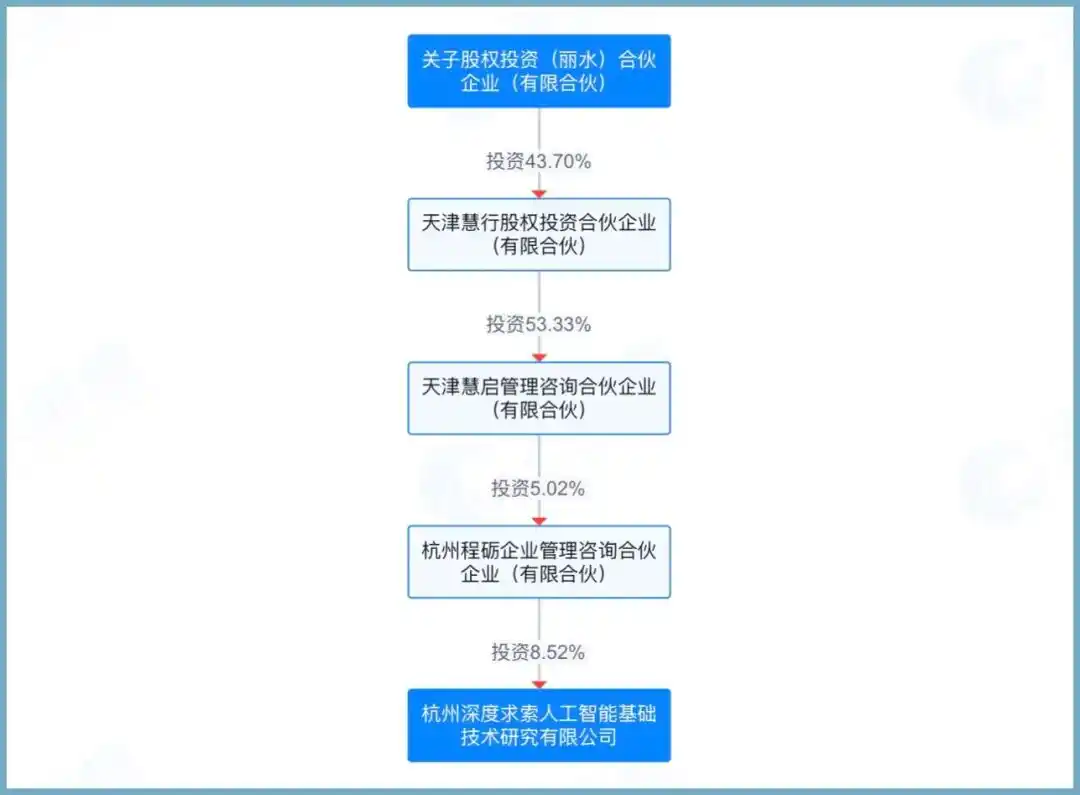
From Tianyancha
Considering Tianjin Huixing's registered capital is 804 million RMB, Guanzhi Venture Capital's investment in this round is approximately 354 million RMB. Both Tianjin Huiqi and Tianjin Huixing were established in May and June of this year respectively. Clearly, Guanzhi Venture Capital was established specifically for DeepSeek's financing round.
As is well known, Zhejiang native Zhong Shanshan started with industry, presiding over Nongfu Spring and Wantai Biological Pharmacy. The former is a leading 30-year-old enterprise in bottled water and beverages, while the latter originated from a successful investment: in 2001, Zhong Shanshan acquired 95% of Wantai Biological for 17.1 million RMB. In 2020, the vaccine leader Wantai Biological successfully listed on the Shanghai Stock Exchange, with its market value once exceeding 100 billion RMB.
Also in 2020, Nongfu Spring had its Hong Kong IPO. With the two listed companies, Zhong Shanshan ascended to the position of China's richest person. The following year, Guanzhi Venture Capital was established in Hangzhou with a registered capital of over 2 billion RMB, wholly owned by Yangshengtang Co., Ltd., which is controlled by Zhong Shanshan.
Quietly, Guanzhi Venture Capital has made several moves in the primary market, investing in companies including Simcere Pharmaceutical, Jiayue Medicine, Leaf Biotech, RuiJian Pharmaceutical, Jiake New Materials, Zhuochen New Materials, and others, most focusing on pharmaceuticals and new materials.
But AI is not entirely uncharted territory for Zhong Shanshan.
According to Lightelligence Technology's Hong Kong stock exchange filing, Guanzhi Venture Capital was a pre-IPO shareholder of this "first AI optical chip stock." This indirect investment in DeepSeek marks Zhong Shanshan's first foray into the red-hot AI large model track.
Gathering in Hangzhou: The Tech Portfolio of the Richest Man
Zhong Shanshan, with his deep literary sentiment, is uniquely referred to by the outside world as the lone wolf of the business world. Extending to his investment moves, his style is similarly low-key yet sharp.
Investment circles have noticed that besides Guanzhi Venture Capital, under the Yangshengtang system controlled by Zhong Shanshan, there are two other active investment entities—Qiantang New Materials Laboratory and Kunshan Gewu Zhizhi Fund.
First, look at the Qiantang New Materials Laboratory established in 2024, with a first-phase planned investment of 1 billion RMB. Under its positioning of "connecting lab technology with industrial application," it favors investing in scientists and industry experts starting businesses. Since its establishment, this entity has quietly invested in over ten companies, almost all placed in the hard tech sector, especially new materials, including Kunhepeng Technology, Jingyuan Hong Technology, Yishengxin Technology, Yanyuan Natan, Supermaterial, Qianyu New Materials Technology, and others.
After 2025, Qiantang New Materials Laboratory's moves have noticeably become more open: in August 2025, it invested in photonic chip company Qiming Photonics; in June this year, it invested in high-temperature superconducting thin film equipment company Shanghai Superconductor; in July, it made its first investment in embodied AI company Oak Nut Robotics.
Quite interestingly, Qiantang New Materials Laboratory often acquires a significant share percentage in a single move, becoming a core shareholder. This leads to a highly similar scene—many of the invested projects have relocated their registered addresses to Yunpu Street, Shuangpu Town, Xihu District, Hangzhou. This southernmost area of Xihu District, Hangzhou, is precisely where Yangshengtang Co., Ltd. is located.
The other investment entity, Kunshan Gewu Zhizhi Fund, has also deployed numerous early-stage tech projects. A recent move that caught outside attention was its investment in Zhibang Lithium Battery New Materials from Quzhou, Zhejiang. In this solid-state battery company's Series A funding, Kunshan Gezhi Yichuang Venture Capital Partnership invested 500 million RMB for a 10% stake. Earlier, Kunshan Gewu Zhizhi Fund also invested in space computing company Zhongke Tiansuan, as well as hard tech companies like Zhongke Jingyi, Saicun Biology, Huake Lengxin, Hongrun Qingyuan, Tongya Electronics, and others.
Thus, under the Yangshengtang system, the three investment entities of the richest man operate respectively, outlining a distinct and well-defined tech investment map.
Old Money Investing Across China's Tech Circle
Over the more than 20 years since the turn of the millennium, industrial feasts have followed one after another, each with its own landscape.
The waves of consumption, real estate, internet, new energy, innovative drugs, and other booms have allowed typical entrepreneurs who caught each cycle to accumulate substantial wealth. Many investors also made their names during this period: such as the well-known Duan Yongping, Masayoshi Son, Zhang Lei, and Shen Nanpeng, dubbed "the man who bought half of China's internet."
The era's successful entrepreneurs were all once those who stood at the forefront of the trends.
Now, as trends shift and the industries they once cultivated move past periods of high-speed growth, the tech era brings similar winds of change. Holding ample cash flow and possessing mature business vision, they have no reason to miss opportunities they see.
In DeepSeek's first round of financing, a group of "old money" had already gathered. Besides CATL's system investing 5 billion RMB, industrial capital figures from Andon Health and BYHEALTH also emerged:
Andon Health's subsidiary Jiuan Hong Kong invested 750 million RMB, indirectly participating in DeepSeek through Tianjin Shixiang Industrial Fund. Statistics show Andon Health also invested in Moonshot AI, MetaX Integrated Circuits, StepFun, and Zhiyuan Robotics. BYHEALTH invested 130 million RMB to subscribe to Monolith Capital's Lisi Xingling Venture Capital Fund, indirectly holding 0.04% of DeepSeek. Similarly, BYHEALTH also invested in AI industry companies like Moonshot AI and StepFun.
Then there is Zhou Shaoxiong of Septwolves. Like Zhong Shanshan's Guanzhi Venture Capital, Zhou Shaoxiong, through the controlled partnership Ningbo Yishang, invested approximately 150 million RMB in Tianjin Huixing, thereby indirectly investing in DeepSeek. At the Septwolves Holding Group level, investments have been made in hot targets like Moore Threads and Unitree Robotics.
"There are no successful enterprises, only enterprises of the era," once said the founder of Haier Group. The implication is that a company's success is inseparable from the opportunities of its time and cannot rest on its past laurels.
When the names of "old money" densely appear at the AI and hard tech table, vast wealth and resources are also seeking new coordinates in the era.
This article is from the WeChat public account "Investment界" (ID: pedaily2012), author: Feng Yuchen