Circle and Bybit deepen USDC partnership as stablecoin nears $80B

cointelegraphPublished on 2025-12-08Last updated on 2025-12-08

Abstract

Circle, the issuer of the USDC stablecoin, has entered a strategic partnership with cryptocurrency exchange Bybit to expand the liquidity and utility of USDC across its global ecosystem. The collaboration aims to enhance USDC integration in spot and derivatives trading, payment channels, and cross-chain support, while strengthening regulatory compliance, particularly in the EEA under MiCA. This move comes as USDC’s market capitalization has surged 77% since the start of 2025, reaching nearly $80 billion. Bybit emphasized that the partnership reflects its commitment to transparency and user choice, rather than exclusivity, as the stablecoin market continues to grow.

Circle, the publicly-listed issuer of one of the largest US dollar stablecoins globally, has entered into a strategic partnership with cryptocurrency exchange Bybit.

Bybit has entered a strategic partnership with an affiliate of Circle to expand liquidity and usability of its USDC (USDC) stablecoin, according to a joint announcement on Monday.

“The partnership aims to expand USDC access across Bybit’s global ecosystem, strengthen liquidity of the world’s largest regulated stablecoin, and reinforce Bybit’s position as a regulatory-compliant platform committed to transparency and trust,” the companies said.

The partnership comes as USDC is gaining momentum, with its market capitalization surging to historic records and nearing $80 billion.

Bybit to deepen USDC integration across spot, derivatives and payment channels

“Bybit’s partnership with Circle allows us to deepen USDC integration across spot, derivatives, and payment channels within a transparent and compliant framework,” a spokesperson for Bybit told Cointelegraph.

The crypto exchange is working closely with Circle to enhance liquidity provisioning, strengthen fiat on-ramps and off-ramps, as well as expand crosschain support, the representative said, adding:

“This collaboration is just the beginning — especially in the EEA region, where Circle has a strong regulatory presence under MiCA. We see meaningful opportunities to expand USDC’s utility and deliver even more reliable settlement options for global users.”

Bybit’s spokesperson mentioned that the exchange started to integrate USDC several years ago, starting with spot and perpetual trading pairs and expanding it to savings products, institutional settlement, conversion tools and fiat payment channels.

Related: Ethena’s synthetic USDe contracts sharply as dollar-backed stablecoins expand

“Today, USDC is already embedded across our ecosystem, and this new strategic partnership strengthens the underlying infrastructure with better liquidity, faster settlement and broader use cases,” Bybit said.

USDC market cap nearing $80 billion

The Bybit–Circle partnership caps a year of strong growth for USDC, with the stablecoin nearly doubling its market cap since the beginning of 2025.

Since Jan. 1, 2025, USDC market capitalization has surged by 77% from around $44 billion to $78 billion as of Dec. 7, according to data from CoinGecko.

The growth aligns with Circle increasingly pushing partnerships in traditional finance, including collaborations with the global exchange organization Deutsche Börse, payment giant Mastercard and more.
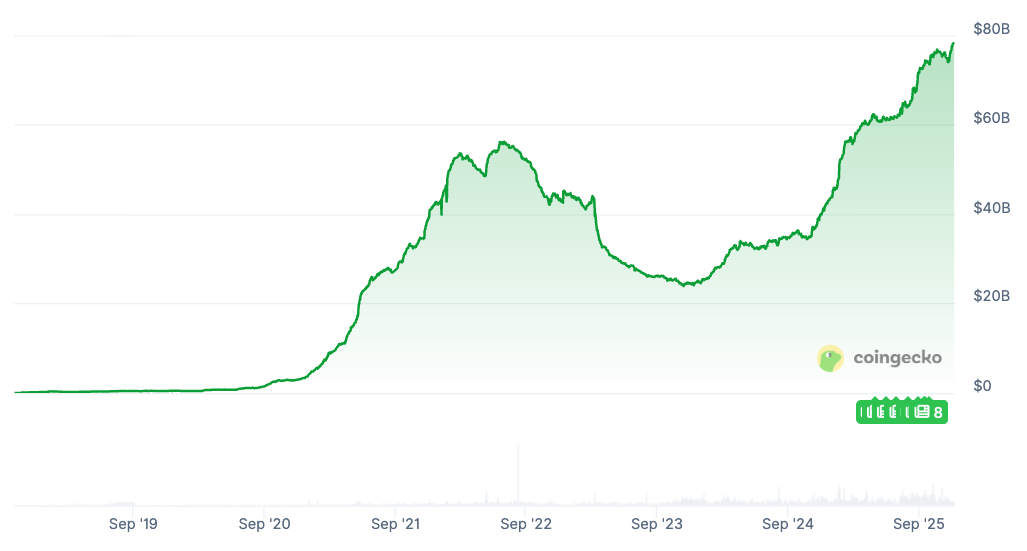
USDC market capitalization chart since launch. Source: CoinGecko

By comparison, Tether, the world’s largest stablecoin by market capitalization, has seen its market cap rise about 36% since the start of the year, climbing from roughly $137 billion to $186 billion.

“Bybit supports multiple stablecoins and remains committed to giving users choice. Our collaboration with Circle is not about exclusivity,” a spokesperson for Bybit said, adding: “It reflects our focus on transparency and regulatory clarity as the industry matures.”

Magazine: Animoca’s bet on altcoin upside, analyst eyes $100K Bitcoin: Hodler’s Digest, Nov. 23 – 29


Related Questions

QWhat is the main focus of the strategic partnership between Circle and Bybit?

AThe partnership aims to expand USDC access across Bybit's global ecosystem, strengthen liquidity of the regulated stablecoin, and reinforce Bybit's position as a regulatory-compliant platform.

QHow has USDC's market capitalization changed since the beginning of 2025?

AUSDC's market capitalization has surged by 77% from around $44 billion on January 1, 2025, to $78 billion as of December 7.

QIn which specific areas of Bybit's platform will USDC integration be deepened?

AUSDC integration will be deepened across spot trading, derivatives, payment channels, savings products, institutional settlement, conversion tools, and fiat payment channels.

QHow does Bybit's spokesperson characterize the partnership with Circle regarding exclusivity?

AThe spokesperson stated that the collaboration is not about exclusivity, as Bybit supports multiple stablecoins, but reflects their focus on transparency and regulatory clarity.

QWhat regulatory framework in the EEA region makes Circle's presence particularly significant for this partnership?

ACircle has a strong regulatory presence under the Markets in Crypto-Assets (MiCA) regulation in the European Economic Area (EEA).

Related Reads

Gary Yang: Agent Economy and AI Submicroeconomics

**Title:** Agent Economy and AI Sub-Microeconomics - Gary Yang **Summary:** Following the AI singularity, the pace of evolution has accelerated rapidly, creating new generational disparities in technological advancement globally. While many regions are still grappling with single-agent bottlenecks, Silicon Valley has moved ahead into the next dimension: the Agent Economy and A2A ecosystems. The article outlines six key areas of this emerging paradigm: 1. **AI Payment Competition & H2A Bottlenecks:** A fierce battle for AI Agent payment protocol standards is underway (e.g., MPP, x402). However, most current efforts remain Human-to-Agent (H2A), essentially grafting AI onto traditional human-centric commerce, which creates a non-AI-native bottleneck. The true potential lies in Agent-to-Agent (A2A) autonomous economies. 2. **Agent Economy & the Inevitable A2A Trend:** The Agent Economy is defined by autonomous AI Agents creating, exchanging, and capitalizing value as independent economic actors. The A2A ecosystem describes their interactions. This represents the next major investment frontier, akin to the early days of e-commerce or DeFi, but with faster iteration and an AI-native, efficiency-first perspective that often diverges from human needs. 3. **AI Protocol vs. Crypto Protocol:** AI Protocols are the foundational rules for Agent interaction in an open network (communication, discovery, collaboration), akin to the governance and economic laws of the AI world. Currently, they focus on communication and weak boundaries, unlike Crypto Protocols which emphasize asset rights and clear ownership. While they appear different due to political-economic factors and legacy system constraints, their eventual convergence into a unified Digital Protocol system is seen as inevitable, driven by first principles. 4. **AI Agent Sub-Microeconomics & Biological Analogy:** AI Agent economics differ fundamentally from human economics: higher frequency/lower value transactions, energy/value direct correlation, efficiency-driven (not emotional) decisions, task-oriented (not consumption-oriented) behavior, and near-zero organizational/communication costs. A powerful analogy frames the Agent economy as a biological system: the LLM is the nucleus, the Agent harness is the cytoplasm, the Agent itself is a cell, its communication protocol is the cell membrane, and external tools (Skills, Prompts) are the extracellular environment. 5. **The Inevitability of AIFi & FinChip:** AIFi (AI Finance) represents the financial system where AI-native value within the Agent economy is tokenized and exchanged. Unlike TradFi/DeFi where value resides *in* finance, in AIFi, value originates *in* AI, and finance becomes its form. This shift is enabled by Agents taking over value discovery. FinChip (Financial Chip) is introduced as a key infrastructure—a fusion of AI autonomy and crypto smart contracts—forming intelligent financial assets to power the future A2A economy. 6. **AI-Native as a Paradigm Shift:** Adopting AI is not akin to "Internet+". It requires AI-Native thinking—designing systems based on first principles, the shortest energy-value path, and maximum efficiency. This abstract, counter-intuitive logic poses a significant, ongoing challenge for all practitioners, as effective, generalized upgrade methodologies will be slow to emerge in this rapidly evolving landscape.

链捕手41m ago

Gary Yang: Agent Economy and AI Submicroeconomics

链捕手41m ago

From 'The Big Short' to San Francisco: The Revelry and Dizziness Within the AI Bubble

From "The Big Short" to San Francisco: The Frenzy and Dizziness in the AI Bubble The article captures the intense, frenetic atmosphere in San Francisco, the epicenter of the current AI boom. Drawing a parallel to the "smell of money" from *The Big Short*, the author observes a city gripped by a singular status game centered entirely on AI and technology. This manifests in a palpable, caffeine-fueled anxiety ("people are shaking"), rampant comparison using vanity metrics like funding rounds, and pervasive "Big Bubble Behavior." The piece explores the city's stark contrasts: its dystopian streets versus beautiful vistas, and the disconnect between the doomsday concerns of some AI researchers and the optimistic, growth-focused "GTM" teams. It critiques the obsession with "math genius" founders as the new ticket to outsized returns, akin to scouting sports prodigies. Referencing economic historian Carlota Perez's "frenzy phase" and Karl Polanyi's "double movement," the author frames the boom as a period where financial speculation detaches from fundamentals, with society potentially becoming subordinate to a new economic force driven by "geniuses in data centers." Ultimately, while acknowledging the unprecedented wealth creation and party-like energy, the article concludes with cautionary advice: when the music is playing, you should dance, but don't get drunk. The core reminder is to stay grounded, avoid distorted judgment, and maintain perspective amidst the euphoria.

marsbit42m ago

From 'The Big Short' to San Francisco: The Revelry and Dizziness Within the AI Bubble

marsbit42m ago

Is AI Creating a New Class of 'Information Poor'?

AI is generating a new kind of "information poverty." The core issue isn't that AI denies answers to the poor; it's that it provides abundant, cheap, and plausible-sounding answers to everyone. This availability shifts the true scarcity from obtaining answers to possessing the **judgment to evaluate them** and the access to turn them into real-world opportunities. New information poverty thus describes those who have AI tools and outputs, but lack the complementary skills, authorization, and contextual experience to critically assess and act on them. Research reveals a multi-layered divide: access to AI is stratified by income and platform design (e.g., premium vs. free, embedded tools). In workplaces, usage heavily favors higher-paid, more experienced, or formally trained employees, with AI often automating entry-level tasks that were traditional stepping stones. Crucially, the heaviest users are often mid-career professionals whose existing expertise allows them to effectively judge and leverage AI outputs, while novices risk over-relying on them without building judgment. While controlled experiments show AI can significantly boost low-skilled workers' performance, real-world adoption and benefit are constrained by unequal social and organizational structures. Historically, general-purpose technologies first reward those with existing complementary capital. AI, by affecting judgment-based work, may accelerate and deepen this initial inequality gap, even if it narrows over decades. The danger lies in the illusion of competence it creates, potentially stunting the very critical thinking needed in an era where judgment is paramount.

marsbit1h ago

Is AI Creating a New Class of 'Information Poor'?

marsbit1h ago

Jensen Huang 'Saves' South Korean Stock Market: Locks In SK Hynix Memory, Chip Shortage to Continue

On June 5th, South Korea's stock market experienced a sharp decline, with major chipmakers like Samsung and SK Hynix dropping nearly 10%. Amidst the turmoil, NVIDIA CEO Jensen Huang's visit to Seoul played a dramatic role in boosting market sentiment. Following a dinner meeting with SK Group Chairman Chey Tae-won and SK Hynix CEO Kwak Noh-Jung, Huang confirmed that NVIDIA's new Vera CPU will utilize SK Hynix DRAM. The companies announced a multi-year technical partnership to co-develop next-generation memory for NVIDIA's AI infrastructure, covering products from data centers to personal AI and robotics. This collaboration extends beyond memory supply. SK Hynix is integrating NVIDIA's AI and Omniverse platform into its own semiconductor design and manufacturing processes, including computational lithography and creating digital twins of its fabrication plants for autonomous operation. While strengthening ties with SK Hynix, NVIDIA is diversifying its supply chain for the upcoming HBM4 memory, with Samsung, SK Hynix, and Micron all certified as suppliers for its Vera Rubin platform. Despite this, Huang warned that the global chip shortage, driven by relentless demand from AI factory construction, is expected to persist for several years across the entire supply chain. His visit underscores NVIDIA's systematic effort to deepen integration with South Korea's broader tech industry.

marsbit2h ago

Jensen Huang 'Saves' South Korean Stock Market: Locks In SK Hynix Memory, Chip Shortage to Continue

marsbit2h ago

Nasdaq Plunges 4.2% in a Single Day: Does "Black Friday" Burst the U.S. Stock Market Bubble?

The Nasdaq plunged 4.18% on June 5, 2026, its worst single-day drop in over a year, as a much stronger-than-expected US jobs report triggered fears of economic overheating and delayed Federal Reserve interest rate cuts. The selloff, centered on high-valuation tech and AI stocks like Nvidia and Broadcom, spread across major indices. The article examines whether this signals a market top. The strong May non-farm payrolls data, nearly double expectations, pushed bond yields higher, directly hurting rate-sensitive tech stocks. This exposed vulnerabilities in the crowded AI trade, where valuations had soared on narratives of infinite growth, despite emerging signs of slowing order momentum and corporate AI monetization challenges. Prior to the drop, market indicators flashed warning signs: historically high valuations (e.g., Shiller CAPE ratio near 39.5), extreme bullish sentiment, and high levels of leverage. Technical charts showed key support levels being breached. Wall Street is divided on the outlook. Bears, citing risks of "stagflation" and AI bubble comparisons to the dot-com era, warn of a potential significant correction. Bulls view the drop as a healthy correction within a bull market, underpinned by a strong economy and expected corporate earnings growth of around 7% in 2026. The immediate future hinges on upcoming key events: the May CPI inflation data and the mid-June FOMC meeting. Their outcomes will critically shape market expectations for the Fed's rate path. The article concludes that conditions for a major market top are aligning, marking a fragile transition from narrative-driven gains to a phase demanding validation from macroeconomic data and corporate fundamentals. Caution is advised.

marsbit2h ago

Nasdaq Plunges 4.2% in a Single Day: Does "Black Friday" Burst the U.S. Stock Market Bubble?

marsbit2h ago

Trading

Spot
Futures

Hot Articles

What is USDC(WORMHOLE)

USD Coin (Wormhole): A Comprehensive Overview Introduction In the rapidly evolving world of cryptocurrencies, USD Coin (Wormhole), referred to as $USDC(Wormhole), stands out as a pioneering solution within the DeFi (Decentralized Finance) landscape. Operating on several blockchain platforms, including Solana, USD Coin (Wormhole) is more than just a digital representation of the United States dollar. It embodies the innovative spirit of modern finance, enabling seamless cross-chain transactions and enhanced interoperability among diverse blockchain ecosystems through the advanced Wormhole protocol. What is USD Coin (Wormhole)? USD Coin (Wormhole) is a tokenized version of the US dollar designed to facilitate frictionless transactions across different blockchain networks. Its primary aim is to bolster liquidity and enhance the functionality of the DeFi ecosystem. By leveraging the Wormhole protocol, which establishes a robust cross-chain communication network, users can effortlessly transfer USDC tokens across various platforms. This cross-chain capability marks a significant advancement in cryptocurrency use, promoting a more interconnected and efficient ecosystem where assets can flow freely between different blockchains. The value proposition of USD Coin (Wormhole) lies not only in its stability, being pegged to the US dollar, but also in its ability to bridge gaps between disparate blockchain environments. This innovative approach fosters a greater level of participation among users and developers, paving the way for new and exciting applications within decentralized finance. Who is the creator of USD Coin (Wormhole)? The origins of USD Coin (Wormhole) are intricately tied to the Wormhole network, which was developed by Jump Crypto. While specific individual creators are not prominently documented, Jump Crypto is notable for its involvement in advancing blockchain technology and supporting its applications in finance. By creating the Wormhole network, Jump Crypto has played a vital role in promoting cross-chain asset transfers, enhancing the efficiency and diversity of cryptocurrency usage. Who are the investors of USD Coin (Wormhole)? The success of USD Coin (Wormhole) is supported by investments from several notable funds and organizations within the cryptocurrency realm. Key investors include: Coinbase Ventures: A prominent venture capital arm backed by one of the leading cryptocurrency exchanges in the industry, Coinbase Ventures provides essential capital and strategic support to promising blockchain projects. Arrington XRP Capital: Specializing in digital assets, Arrington XRP Capital recognizes the potential of innovative projects like USD Coin (Wormhole) and has invested accordingly to back its development. Jump Trading: As the parent organization of Jump Crypto, Jump Trading brings not only investment but a wealth of expertise in trading technology and market dynamics to bolster the Wormhole project. How Does USD Coin (Wormhole) Work? The operational framework of USD Coin (Wormhole) is intricately designed to facilitate effective cross-chain transactions, maximizing security and efficiency. Here’s a simplified overview of how it functions: Asset Locking: When a user wishes to transfer USDC from one blockchain to another, they first lock their tokens on the source blockchain. This process ensures that the assets are secure and are set to be either burned or moved later. Token Minting: After the tokens are locked, an equivalent amount of USDC is minted on the destination blockchain. This provides the user with access to their funds on a new platform, reflecting the flexibility that the Wormhole protocol enables. Cross-Chain Transfer: The Wormhole protocol efficiently facilitates the entire transfer process. It ensures that once the USDC is minted on the destination chain, the equivalent tokens are burned on the source chain. The result is a seamless transfer of value between two distinct blockchain environments. This cross-chain methodology ensures that transactions remain secure and transparent, significantly enhancing liquidity within the different DeFi ecosystems. Timeline of USD Coin (Wormhole) Understanding the evolution of USD Coin (Wormhole) provides vital context for its significance in the cryptocurrency arena. Here’s a timeline highlighting important milestones in the project’s history: 2021: The Wormhole project is launched, establishing a framework for cross-chain asset transfers and setting the stage for the development of USD Coin (Wormhole). 2022: The Wormhole network experiences a significant challenge with a security breach that results in a $325 million theft. However, the incident is later addressed and refunded by Jump Crypto, showcasing the project’s commitment to security and transparency. 2023: USD Coin (Wormhole) integrates with Circle’s Cross-Chain Transfer Protocol (CCTP), enhancing its capabilities for cross-chain transfers and further solidifying its place within the DeFi ecosystem. 2024: Ongoing development and expansion of the Wormhole network continue, aimed at increasing the utility and reach of USD Coin (Wormhole) as well as enhancing its operational framework. Key Features The success of USD Coin (Wormhole) can be attributed to several key features that differentiate it from other cryptocurrency offerings: Cross-Chain Interoperability At the core of USD Coin (Wormhole) is its ability to facilitate seamless transfers across multiple blockchain networks. This interoperability serves as a cornerstone for decentralized finance, allowing various platforms to interact with each other, thereby accelerating the evolution of financial services. Security Wormhole employs a well-designed Guardian Network comprised of node validators that ensure secure cross-chain transactions. This collective oversight minimizes the risk of fraud and provides users with confidence that their assets are protected during cross-chain transfers. Liquidity Enhancement By enabling USDC to circulate freely across different blockchains, USD Coin (Wormhole) enhances liquidity in the DeFi ecosystem. This increased liquidity can foster more efficient trading, contribute to better pricing strategies, and improve the overall market dynamics encompassing various digital assets. Conclusion USD Coin (Wormhole) is a pivotal innovation in the blockchain space, reinforcing the capabilities of decentralized finance (DeFi) and establishing a more connected financial ecosystem. With its robust framework for cross-chain transactions, security features, and strong backing from reputable investors, USD Coin (Wormhole) is positioned to play a key role in the future of cryptocurrency. As the digital finance landscape continues to evolve, USD Coin (Wormhole) not only embraces the future of interconnectivity among blockchain networks but also reaffirms the power of tokenization and blockchain technology in transforming how we perceive and utilize value in a digital world. By navigating the complexities of cross-chain functionality, it demonstrates a sophisticated approach to enabling financial inclusivity and innovation in the world of cryptocurrencies.

1.2k Total ViewsPublished 2024.04.01Updated 2024.12.03

What is USDC(WORMHOLE)

What is $USDC

Classic USDC: A Comprehensive Overview Introduction to Classic USDC In the rapidly evolving landscape of the cryptocurrency market, stablecoins have emerged as critical components, particularly in providing stability amid the volatility that characterizes digital assets. One such project is Classic USDC, a digital currency initiative that aims to deliver a stable and reliable medium of exchange. By maintaining a 1:1 peg with the US dollar, Classic USDC strives to offer users a dependable digital asset, equipped for various applications within the web3 and cryptocurrency ecosystems. What is Classic USDC? Classic USDC is fundamentally a stablecoin, which is a type of cryptocurrency designed to minimize the price volatility typically seen in the digital asset market. Specifically, Classic USDC aspires to represent the value of the US dollar closely, ensuring that users can leverage this digital currency for transactions, savings, and other financial activities without the fear of sudden price fluctuations that can otherwise plague many cryptocurrencies. The primary aim of Classic USDC is to provide a reliable and trustworthy digital equivalent of the US dollar, designed for seamless integration into a wide range of web3 applications, decentralized finance (DeFi) platforms, and other crypto-related financial systems. By delivering a stable digital currency, Classic USDC seeks to facilitate everyday commerce, make blockchain technology more user-friendly, and encourage the adoption of cryptocurrencies for mainstream usage. Creator of Classic USDC The identity of the creator or the development team behind Classic USDC remains largely unknown, and the lack of transparency has led to a degree of uncertainty regarding the project’s origins. While many cryptocurrency initiatives prominently showcase their founders and development teams, Classic USDC does not provide clear information about its creators, which poses challenges for potential users or investors weighing the project's credibility and reliability. Investors of Classic USDC Alongside the ambiguity surrounding its creators, Classic USDC also lacks specificity with regards to its investors. The financial backing of a project can often lend it credibility and stabilize its operations; however, the absence of documented investment foundations or organizations supporting Classic USDC raises questions about its funding structure. This lack of clarity could potentially hinder stakeholder confidence in the project. How Does Classic USDC Work? The operational mechanics of Classic USDC rely heavily on its reserve system, which is fundamental to the underpinnings of any stablecoin. Classic USDC undertakes to maintain a reserve of assets that directly correspond to the value of the digital currency in circulation. Specifically, for every Classic USDC token issued, an equivalent amount of backing assets is retained in reserve, whether in cash or near-cash equivalents. This strategy is designed to uphold the value of Classic USDC, offering reassurance to users that redeeming their tokens for US dollars is feasible at any time. This reserve structure aims to enhance the stability and reliability of Classic USDC, positioning it as a secure alternative in the cryptocurrency market. By ensuring that the value of Classic USDC is consistently correlated with the US dollar, the project aspires to engender trust among users who may be wary of the broader market dynamics. Timeline of Classic USDC The history of Classic USDC is marked by several key milestones that reflect its journey and evolution within the cryptocurrency ecosystem: 2021: The inception of Classic USDC is noted, introducing a new digital currency option designed for stability. During this year, the first records of the token’s activity surfaced and its initial price levels were established. 2024: Classic USDC begins to experience notable price fluctuations, as the crypto market overall grapples with various trends and user sentiment. Predictions regarding its future potential emerge, indicating a strong interest from market observers and analysts who foresee growth opportunities. Future Projections Experts speculate that Classic USDC may reach higher levels of adoption and stability in the years to come, with potential further developments anticipated around 2025 and 2026. However, these projections should be approached with cautious optimism, as the cryptocurrency market is inherently unpredictable, and various external factors may influence the trajectory of Classic USDC. Key Points About Classic USDC Stability: Classic USDC’s core proposition revolves around providing a digital currency that parallels the value of the US dollar, thereby ensuring stability in an often volatile marketplace. Reserve System: The project’s commitment to maintaining a reserve of assets to back its value underscores its reliability and operational soundness. Web3 and Crypto Integration: Classic USDC is engineered to facilitate easy integration within various applications, aiming to enhance the user experience and broaden the acceptance of cryptocurrency in everyday transactions. Future Growth Potential: While still emerging, Classic USDC holds prospective avenues for growth as awareness and utilization of stablecoins increases in the web3 and crypto contexts. Conclusion Classic USDC presents itself as a notable stablecoin initiative within the cryptocurrency sphere, striving to provide users with a reliable digital currency that embodies the stability of the US dollar. Despite uncertainties regarding its creators and financial backing, the underpinning principles of Classic USDC—centered on reserve-backed assurances—endeavour to position it as a trustworthy option for individuals and businesses navigating the digital economy. With an eye towards the future, market analysts are keen to observe how Classic USDC evolves in response to the shifting dynamics of the cryptocurrency landscape, potentially establishing itself as a significant player in the realm of stablecoins.

623 Total ViewsPublished 2024.05.01Updated 2024.12.03

What is $USDC

Discussions

Welcome to the HTX Community. Here, you can stay informed about the latest platform developments and gain access to professional market insights. Users' opinions on the price of USDC (USDC) are presented below.

活动图片