Chain Reaction After Credential Theft Case: AI Gateway Giant LiteLLM Cuts Ties with Delve, Mired in Compliance Fraud Scandal

marsbitPublished on 2026-03-31Last updated on 2026-03-31

Abstract

A major security and compliance crisis has unfolded in the AI infrastructure sector. Popular AI gateway developer LiteLLM has officially announced the termination of all cooperation with compliance startup Delve and plans to redo its security certification through a competitor, Vanta. The rupture was triggered by a recent severe credential-stealing malware attack on LiteLLM's open-source version. Prior to the attack, LiteLLM had relied on Delve's services to obtain two key security certifications. However, Delve is now facing serious integrity allegations, accused of misleading clients by fabricating data and employing auditors who provided rushed certifications, creating a false sense of compliance. Despite public denials from Delve's founder, the release of evidence by an anonymous whistleblower has intensified scrutiny. In response, LiteLLM's CTO, Ishaan Jaffer, outlined the company's stance: immediately cutting ties with Delve, recommencing certification with Vanta, and engaging an independent third-party auditor for a thorough review of its compliance controls. As a leading AI gateway with millions of developers, LiteLLM's decisive action highlights the industry's heightened sensitivity to authentic compliance. In the wake of the attack, companies are shifting focus from mere paper-based compliance to seeking genuine technical security verification.

The "security and compliance crisis" that has sent shockwaves through the artificial intelligence infrastructure sector saw the latest developments today. Popular global AI gateway developer LiteLLM officially announced the termination of all cooperation with compliance startup Delve , and plans to re-undergo security certification through a competitor.

Core Event Recap

The trigger for this split was the severe credential-stealing malware attack suffered by the LiteLLM open-source version last week. Prior to the attack, LiteLLM had relied on Delve's compliance services to obtain two key security certifications. However, Delve has recently been embroiled in a serious integrity crisis, accused of misleading clients into a false sense of compliance with weak security protections by fabricating data and hiring auditors who provided "cursory sign-offs".

Positions and Developments

Although the founder of Delve publicly **denied the allegations** and promised to provide free re-inspections, evidence subsequently released by an anonymous whistleblower further fueled public discourse.

Faced with this dual blow to security and trust, LiteLLM's Chief Technology Officer Ishaan Jaffer clarified the company's stance today via a social platform:

  • Immediate Severance: Completely halt all cooperation with Delve.

  • Re-certification: Commission Delve's main competitor, Vanta , to restart the certification process.

  • Enhanced Auditing: Hire an independent third-party auditing firm to conduct in-depth validation of compliance controls.

Industry Impact

As a benchmark AI gateway with millions of developers, LiteLLM's "drastic move to save itself" reflects the AI industry's high sensitivity to the authenticity of compliance. Under the shadow of the credential theft attack, companies are shifting from merely pursuing "paper compliance" to seeking genuine technical security verification.

Related Questions

QWhat was the main reason for LiteLLM terminating its partnership with Delve?

ALiteLLM terminated its partnership with Delve due to a severe security compliance crisis, where Delve was accused of misleading clients by fabricating data and employing auditors who provided hasty, unreliable certifications, which left LiteLLM vulnerable to a credential-stealing malware incident.

QWhat specific actions did LiteLLM's CTO announce in response to the security incident and compliance issues?

ALiteLLM's CTO, Ishaan Jaffer, announced three key actions: immediately cutting all ties with Delve, recommencing the certification process with Delve's competitor Vanta, and engaging an independent third-party auditor to conduct a deep validation of compliance controls.

QWhat industry shift does the LiteLLM incident reflect regarding compliance and security?

AThe incident reflects a shift in the AI industry from pursuing mere 'paper compliance' to seeking genuine technical security verification, emphasizing real safety over certifications that may not reflect actual security posture.

QHow did Delve respond to the allegations of compliance fraud?

ADelve's founder publicly denied the allegations and offered free re-inspections to clients, but anonymous whistleblowers later released evidence that further fueled the controversy.

QWhat was the initial event that triggered the scrutiny of Delve's compliance certifications for LiteLLM?

AThe initial trigger was a severe credential-stealing malware attack on LiteLLM's open-source version, which occurred after LiteLLM had obtained security certifications through Delve, raising questions about the effectiveness and legitimacy of those certifications.

Related Reads

Only a 50% Chance of Passing This Year, Can the CLARITY Bill Succeed Before the Midterm Elections?

The CLARITY Act, which passed the House in July 2025 with strong bipartisan support (294-134), faces a critical juncture in the Senate. The Senate Banking Committee is expected to hold a markup soon, but key issues remain unresolved, including stablecoin yield provisions, DeFi regulations, and securing full Republican committee support. Other contentious points involve the Blockchain Regulatory Certainty Act (BRCA), ethics amendments for government officials, and SEC-related matters. The legislative calendar is tight, with limited time before the midterm elections. If the committee markup is delayed beyond mid-May, the chances of passage in 2026 drop significantly. Senator Cynthia Lummis has warned that failure this year could delay comprehensive crypto market structure legislation until 2030 or later. Galaxy estimates the probability of the CLARITY Act becoming law in 2026 is only about 50%. The bill provides crucial regulatory clarity by defining jurisdictional boundaries between the SEC and CFTC, establishing a path for decentralization, and bringing digital commodity intermediaries under federal regulation. Its passage is seen as vital before potential power shifts in the next Congress, which could bring less favorable leadership to key committees. The timeline is compressed, and the bill must compete for floor time with other priorities like Iran authorization and DHS appropriations. Key hurdles include finalizing the stablecoin yield compromise text, addressing law enforcement concerns about BRCA, and navigating political dynamics around SEC nominations. The outcome of the Banking Committee markup and the level of bipartisan support will be critical indicators of its future success.

marsbit4m ago

Only a 50% Chance of Passing This Year, Can the CLARITY Bill Succeed Before the Midterm Elections?

marsbit4m ago

Only a 50% Chance of Passing This Year, Can the CLARITY Bill Succeed Before the Midterm Elections?

The CLARITY Act, which passed the U.S. House in July 2025 with strong bipartisan support (294-134), faces a critical juncture in the Senate. The Senate Banking Committee is expected to hold a markup soon, but key issues remain unresolved, including stablecoin yield provisions, DeFi regulations, and securing full Republican committee support. Additional challenges involve the Blockchain Regulatory Certainty Act (BRCA), ethics amendments for government officials, and SEC-related concerns. Galaxy estimates only a 50% chance of the bill becoming law in 2026. The tight legislative calendar, competing priorities like Iran military authorization and DHS appropriations, and the impending midterm elections create significant time pressure. If the bill is not passed before the new Congress convenes in 2027, comprehensive crypto market structure legislation could be delayed until 2030 or later, especially if leadership changes result in less favorable committee chairs. The act provides crucial regulatory clarity by defining the jurisdictional boundaries between the SEC and CFTC, establishing a path for decentralized networks to be classified as non-securities, and bringing digital commodity intermediaries under federal regulation. The outcome of ongoing Senate negotiations, particularly the release of revised text on stablecoin yields, will be a key indicator of its future prospects.

Odaily星球日报14m ago

Only a 50% Chance of Passing This Year, Can the CLARITY Bill Succeed Before the Midterm Elections?

Odaily星球日报14m ago

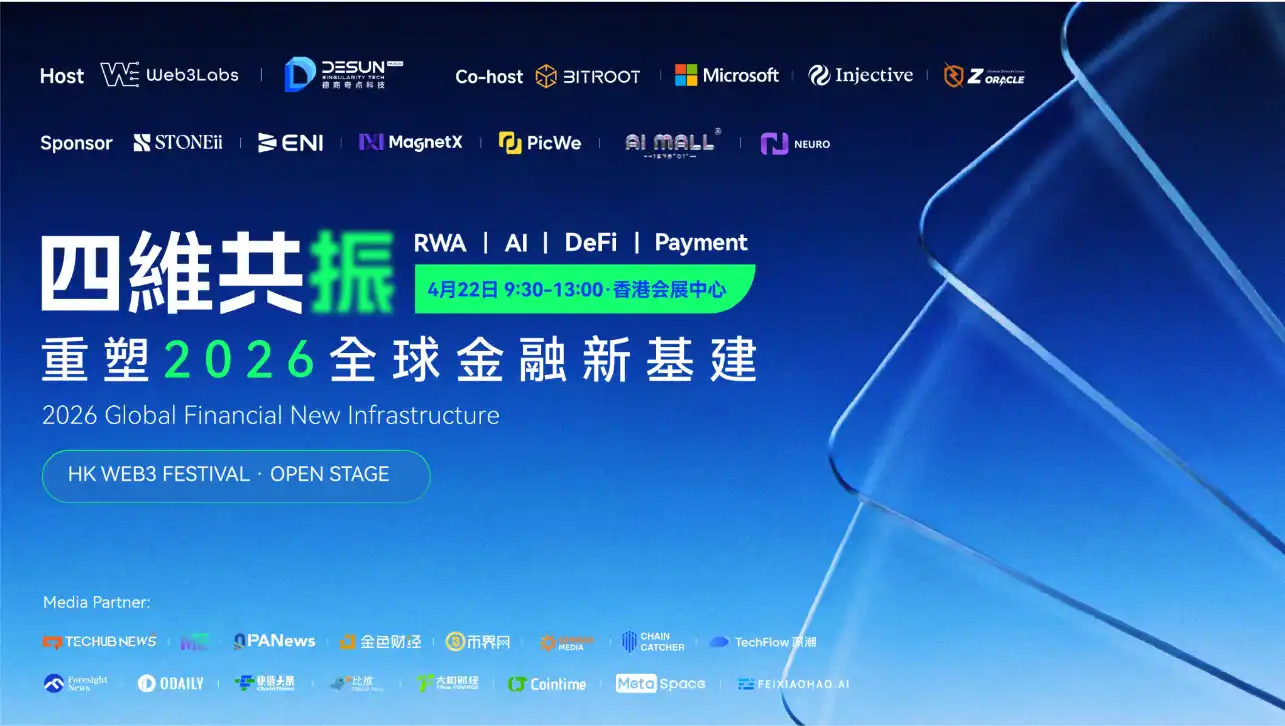
Four-Dimensional Resonance: Hong Kong Web3 Carnival Sub-Forum Co-Creates Blueprint for Global Financial New Infrastructure

The "Four-Dimensional Resonance: 2026 Global Financial New Infrastructure" forum, a core event of the Hong Kong Web3 Festival, was successfully held at the Hong Kong Convention and Exhibition Centre. Co-hosted by Web3Labs and DeShang Singularity Tech, with joint support from Bitroot, Injective, Microsoft, and Z Oracle, the event gathered policymakers, industry leaders, and investors to explore the integration and innovation of global financial infrastructure, focusing on RWA, AI, DeFi, and compliant payments. Policy speakers, including Hong Kong Legislative Council Member Mr. Wu Jiezhuang, South Korean National Assembly Member Mr. Min Byung-duk, and ACED Chairman Mr. Yun Seok-hun, emphasized the importance of cross-border regulatory collaboration and an open policy environment for fintech innovation. Web3Labs CEO Caspar and DeShang Singularity Tech CEO Chang Shuai highlighted Hong Kong’s role as a financial innovation center and the approaching "singularity moment" for global financial infrastructure. Technical insights were shared by MagnetX, Bitroot, Microsoft, and Injective on topics including AI Agent economies, the evolution of public blockchains, and AI’s transformative role in finance. Key partnerships and initiatives were launched: - GWDC 2026 Korea collaboration between Hong Kong and South Korea. - A strategic agreement between Web3Labs and Microsoft. - The launch of a public anti-fraud alliance by Z Oracle and partners. - The "Injective Rising Star" program to support AI and Web3 projects. Panel discussions delved into AI-driven smart payments, compliant cross-border transactions, and the fusion of RWA and DeFi. Participants agreed that integrating RWA with DeFi is crucial for the next stage of financial infrastructure, enabling a shift from physical to digital finance. The forum underscored Hong Kong’s pivotal role in advancing a globalized and sustainable Asian fintech ecosystem.

marsbit22m ago

Four-Dimensional Resonance: Hong Kong Web3 Carnival Sub-Forum Co-Creates Blueprint for Global Financial New Infrastructure

marsbit22m ago

Trading

Spot
Futures

Hot Articles

Discussions

Welcome to the HTX Community. Here, you can stay informed about the latest platform developments and gain access to professional market insights. Users' opinions on the price of AI (AI) are presented below.

活动图片