Cardano Founder To Leave X Permanently, Details Next Steps

bitcoinistPublished on 2025-12-29Last updated on 2025-12-29

Abstract

Cardano founder Charles Hoskinson has announced he will permanently leave X (formerly Twitter) by the end of December, with a "digital twin" set to take over his account in January. He plans to shift his communication to platforms like Discord for weekly AMAs, YouTube for livestreams, and long-form writing on his personal blog. Hoskinson cited X's tendency to "reward outrage" as a key reason for leaving, emphasizing that his focus will remain on building meaningful projects like Cardano's development, Africa initiatives, and Midnight. He also hinted at past conflicts on the platform, thanking supportive followers while dismissing critics. Further details about the digital twin will be explained in his first YouTube stream of the new year. At the time of writing, ADA was trading at $0.3779.

Cardano founder Charles Hoskinson says he will stop using X at the end of December, with a “digital twin” set to take over his account in January, an unusual handoff that reshapes how one of crypto’s most visible founders communicates with the Cardano community. “Five more days on X,” Hoskinson wrote in a Dec. 27 post. “Come January, a digital twin takes over this account—I’ll explain what that means on the first YouTube stream of the new year.”

Here’s Why The Cardano Founder Will Leave X

Hoskinson pointed followers to where he intends to be active next. “Where to find me: Midnight Discord for weekly AMAs, YouTube for livestreams, and the long-form writing I’ve owed myself for a decade,” he wrote, tying the shift to Midnight and to a renewed emphasis on longer-form communication.

The motivation, he said, is incentive design. “Why leave? X rewards outrage,” Hoskinson wrote, adding that “the work that matters—Africa, Basho, Midnight 1.0, Cardano governance—rewards building.” He framed it as a conclusion drawn from a full decade on the platform: “Ten years taught me which game is worth playing.”

The farewell also carried a sharper edge that nodded to the disputes he has been drawn into on X. “To everyone who made this decade worthwhile: thank you. To the rest: I won’t miss you,” he wrote. Hoskinson has been a prolific and often combative presence on the platform, frequently engaging critics directly and weighing in on Cardano’s technical direction, governance arguments, and broader industry controversies.

Hoskinson’s writing pivot is already underway. On Dec. 25, he published a long post titled “What the Horizon Kept” on his personal Blogger site, opening with a vignette in which “The old fisherman said, ‘The ocean’s too quiet,’” before moving into a surreal narrative about instruments failing, maps not matching reality, and an island appearing where none was marked. The site’s profile bio describes him, bluntly, as a “Guy who writes stuff that makes people angry.”

He also continued posting in a more typically terse mode in recent days. In one message, Hoskinson wrote: “Before Crypto and After Crypto. Friends don’t let friends do crypto.”

Hoskinson has not provided details about the “digital twin” beyond promising an explanation in his first YouTube livestream of the year. For Cardano and Midnight followers, the near-term question is how that handoff works in practice, and whether the conversation he has historically driven on X consolidates on Discord, YouTube, and whatever long-form writing comes next.

At press time, ADA traded at $0.3779.
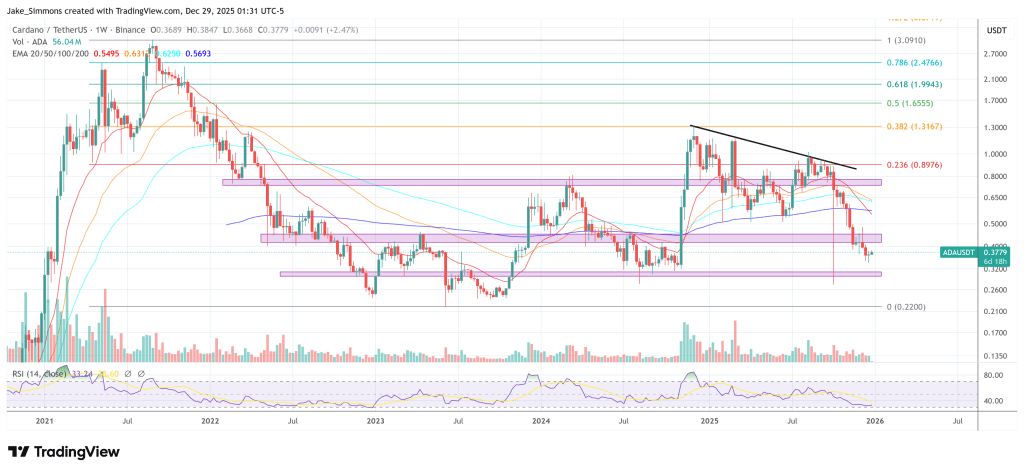
ADA falls below key support, 1-week chart | Source: ADAUSDT on TradingView.com

Related Questions

QWhy is Cardano founder Charles Hoskinson leaving X (formerly Twitter)?

ACharles Hoskinson is leaving X because he believes the platform rewards outrage, while the work that matters, such as the development of Africa, Basho, Midnight 1.0, and Cardano governance, rewards building. He concluded from his ten years on the platform that building is the game worth playing.

QWhat is the 'digital twin' that Charles Hoskinson mentioned?

AHoskinson has not provided specific details about the 'digital twin' yet. He has only promised to explain what it means during his first YouTube livestream of the new year in January.

QWhere does Charles Hoskinson plan to be active after leaving X?

AAfter leaving X, Hoskinson plans to be active on the Midnight Discord for weekly AMAs, on YouTube for livestreams, and he will focus on long-form writing that he has wanted to do for a decade.

QWhat was the tone of Hoskinson's farewell message on X?

AHis farewell message had a sharp edge. He thanked those who made his decade on the platform worthwhile but also stated, 'To the rest: I won’t miss you,' nodding to the many disputes he has been involved in on the platform.

QWhat is the trading price of ADA (Cardano's token) mentioned at the end of the article?

AAt the time the article was written, ADA was trading at $0.3779.

Related Reads

AI Agent Completely Transforms Web3 Gaming: From the Rugpull Bakery Bot Controversy to the New 2026 Agent Paradigm

This article explores how the AI Agent paradigm is fundamentally transforming Web3 gaming, moving from a disruptive force to a core, legitimized element. It begins with the controversy in the competitive baking game Rugpull Bakery, where automated scripts caused fairness issues. Instead of banning them, the developers integrated AI Agents into the official gameplay by providing technical documentation (skill.md, agent.json), marking a shift towards "Agentic Gaming." The piece outlines three primary implementation models for AI Agents in Web3 games by 2026: 1. **Autonomous Competitors & Economic Entities:** AI Agents act as independent players with unique strategies. Examples include TEN Protocol's poker agents, AI Arena's trainable NFT fighters, and Satoshi Strike Force's "Digital Athletes" trained on player data. The Somnia blockchain is highlighted as a dedicated "Agentic L1" infrastructure supporting this model at scale. 2. **Modular Infrastructure & Programmable Environments:** This model, exemplified by EVE Frontier, allows AI Agents to program game world logic itself. Using "Smart Assemblies" (e.g., Smart Turrets, Smart Gates), Agents can modify shared economic and physical rules on-chain, creating dynamic, player/AI-built worlds. The ERC-8183 standard further enables these automated entities to hire other AI services for complex tasks. 3. **Hybrid Companions & Dynamic Adaptation:** Here, AI serves as a collaborative partner. In Parallel Colony, highly autonomous AI Avatars work alongside human players who provide high-level guidance. Illuvium plans to use AI to make NPCs dynamic and responsive, creating personalized, emergent narratives for each player. The conclusion posits that Web3 gaming has reached a "post-human" inflection point. Blockchains' transparency and programmability, combined with new standards and infrastructure like Somnia, make integrating and governing AI Agents not just viable but essential. The future lies in a symbiotic digital order where players transition from manual laborers to commanders and partners of algorithmic intelligence.

marsbit3m ago

AI Agent Completely Transforms Web3 Gaming: From the Rugpull Bakery Bot Controversy to the New 2026 Agent Paradigm

marsbit3m ago

Saylor's Purchase of 1550 Bitcoin Is a Bad Trade

**Title: Saylor's Purchase of 1,550 Bitcoins Was a Bad Trade** The article critically analyzes Strategy's recent move of selling 32 bitcoins followed by a much larger purchase of 1,550 bitcoins. While appearing bullish, the author argues this trade is detrimental to MSTR shareholders. The core argument revolves around the concept of "breakeven modified Net Asset Value (mNAV)," a key metric for Strategy. To increase Bitcoin per share (BPS) for MSTR holders, Strategy must issue new shares at a premium high enough that the funds raised can buy more bitcoin than the bitcoin backing each existing share. Currently, this breakeven mNAV is estimated at 1.30. The recent trade failed on two counts: 1. The shares for the $181 million raise were issued at an mNAV *below* the 1.30 breakeven point. Selling "cheap" shares to buy bitcoin actually *reduces* BPS. 2. Only $101.3 million of the raised funds were used to buy bitcoin; the rest went to boost the company's dollar reserves. The breakeven mNAV calculation assumes *100%* of proceeds are used for bitcoin purchases. Diverting funds, even if mNAV were high, dilutes BPS. The result is an estimated 0.19% decrease in Bitcoin per share for MSTR holders. In exchange, Strategy merely extended its operational runway for its dollar reserves from ~6.3 months to 7 months. The author interprets this as Strategy prioritizing the survival and development of its STRC business over its stated core goal of increasing MSTR's BPS. This constitutes a gamble: if sacrificing MSTR value leads to improved market sentiment and a recovery in STRC's price (and thus mNAV), the whole system could work. If not, Strategy may be forced into a cycle of further diluting MSTR to stay afloat, potentially leading to deferred STRC dividends or corporate decline. The article concludes with a hope for price recovery for Bitcoin, MSTR, and STRC.

Foresight News14m ago

Saylor's Purchase of 1550 Bitcoin Is a Bad Trade

Foresight News14m ago

The AI Bear Market Lasting Two Days Is Over; Why Did Funds Buy Back Storage Stocks First?

After a severe two-day selloff in early June that erased over $1 trillion from U.S. chip stock market value, capital is flowing back first to the memory sector. The correction was not driven by a collapse in AI demand but rather a market reassessment of high expectations. Stocks like Broadcom faced selling pressure despite strong AI revenue guidance, signaling a shift in focus from who has an "AI story" to who can most rapidly translate AI demand into verifiable profits and earnings per share (EPS). Memory companies, such as Micron and SK Hynix, are leading the recovery because their EPS growth is more immediately verifiable. The AI server boom directly increases demand for high-bandwidth memory (HBM) and high-capacity server DRAM, tightening supply and driving up contract prices for conventional DRAM and NAND Flash. This price increase, coupled with a shift to higher-margin products, flows directly into near-term revenue and profitability, as evidenced in recent earnings reports. In contrast, other AI semiconductor segments like GPUs, ASICs, and optical modules, while central to the long-term AI infrastructure story, face longer and less certain paths to EPS validation. Their growth depends more on future product cycles, customer adoption timelines, and capital expenditure plans. The rebound in memory stocks highlights a market preference for assets with shorter, more transparent EPS conversion cycles following the recent de-risking phase. However, this does not negate the potential of other AI hardware segments should they provide clearer near-term order visibility. The episode has raised the validation bar for all AI-related investments.

marsbit14m ago

The AI Bear Market Lasting Two Days Is Over; Why Did Funds Buy Back Storage Stocks First?

marsbit14m ago

Trading

Spot
Futures

Hot Articles

Discussions

Welcome to the HTX Community. Here, you can stay informed about the latest platform developments and gain access to professional market insights. Users' opinions on the price of ADA (ADA) are presented below.

活动图片