Cardano Founder Calls For Simpler, Safer Crypto Across All Chains

bitcoinistPublished on 2026-05-08Last updated on 2026-05-08

Abstract

Cardano founder Charles Hoskinson argued at Consensus 2026 that the crypto industry must overcome its complex and intimidating user experience to achieve mainstream adoption. He highlighted the burdens of managing seed phrases, navigating exchanges, and understanding DeFi risks as major barriers. Hoskinson's solution involves simplifying self-custody, identity, privacy, and multi-chain access without reverting to centralized control. He praised efforts like Ethereum's account abstraction but warned that abstraction must be paired with privacy to avoid recreating Web2's surveillance model. Hoskinson introduced Midnight Passport as a framework designed to offer secure, mobile-native management across multiple blockchains. He also discussed the future role of AI agents in handling transactions, emphasizing that privacy will be critical as these agents require deep personal context to operate effectively.

Cardano founder Charles Hoskinson used a Wednesday keynote at Consensus 2026 in Miami to argue that crypto’s next phase will not be won by another isolated chain, token or wallet. The Cardano founder said the industry must make self-custody, identity, privacy and multi-chain access simple enough for mainstream users without handing control back to centralized intermediaries.

Hoskinson framed the problem bluntly: crypto still asks users to manage seed phrases, navigate exchanges, wait for withdrawals, choose between networks, avoid fake apps and understand DeFi risk before they can do anything useful. That, he said, remains the core barrier to bringing “the next few billion people” into the industry.

“The number one problem that people say again and again and again when they think about cryptocurrencies, whether you’re an experienced user and you’ve been in the industry a long time or you’re a completely new person, you’ve heard about the industry is, I’m gonna fuck it up. The safety side,” Hoskinson said. “That is the user experience in 2026. That make any sense to you? Is this like a product you wanna use?”

Cardano Founder Targets Crypto’s UX Problem

His answer was not to abandon crypto’s original principles, but to make them usable. Hoskinson contrasted crypto’s current experience with Web2 products such as Google Wallet, which he said has around 1.5 billion users and trains consumers to expect one-click setup, recovery and seamless mobile access. Crypto, in his view, cannot keep insisting it is “different” if the product experience remains too punishing for ordinary users.

A central theme of the keynote was abstraction. Hoskinson credited Ethereum with advancing account abstraction and chain abstraction standards, arguing that these efforts became necessary as fragmented layer-2 environments created a poor user experience. He also pointed to Near Protocol as an example of embedding those ideas at the protocol level, citing $71 million in transaction fees in a year and billions of dollars traded through Near intents.

But Hoskinson warned that abstraction carries a tradeoff. When users delegate complexity to third parties, those parties often gain visibility into assets, transactions, preferences, identity and business data. For crypto to scale without repeating the surveillance model of Web2, he argued, abstraction must be paired with privacy.

“When you abstract things, you delegate to people. You trust people. You give them something to do that on your behalf somewhere else,” he said. “You don’t worry about the doing, but when they do the doing, they know you. They know what you’re buying. They know where you’re at.”

That argument led into Hoskinson’s pitch for Midnight Passport, a framework he described as combining mobile-native key management, recovery, self-sovereign identity, selective disclosure, wallet credentials, name services and multi-chain signatures. The idea, according to Hoskinson, is to let users scan a QR code, rely on trusted execution hardware already built into phones, encrypt off-chain data client-side and create wallets across networks such as Bitcoin, Ethereum, Solana and XRP.

“I don’t care what networks you want to use. I don’t care what assets you want to have,” Hoskinson said. “I want you to have control of those assets. I want you to custody those assets. I want you to be in control of your identity and your data.”

The keynote also expanded into AI agents, which Hoskinson described as an incoming force that could reshape internet commerce and crypto usage. He argued that agents may eventually handle most searches, transactions and online activity, while humans interact with a smaller “human internet.” For crypto, that raises a practical question: if users cannot safely evaluate DeFi protocols, counterparties or risks themselves, AI systems may become the layer that performs diligence and execution.

Hoskinson said this makes privacy even more important, because effective agents require deep personal context. Midnight Passport, he said, is being developed not only for people but also for agents, allowing rules to be set around identity, data access and execution.

At press time, Cardano traded at $0.2689.
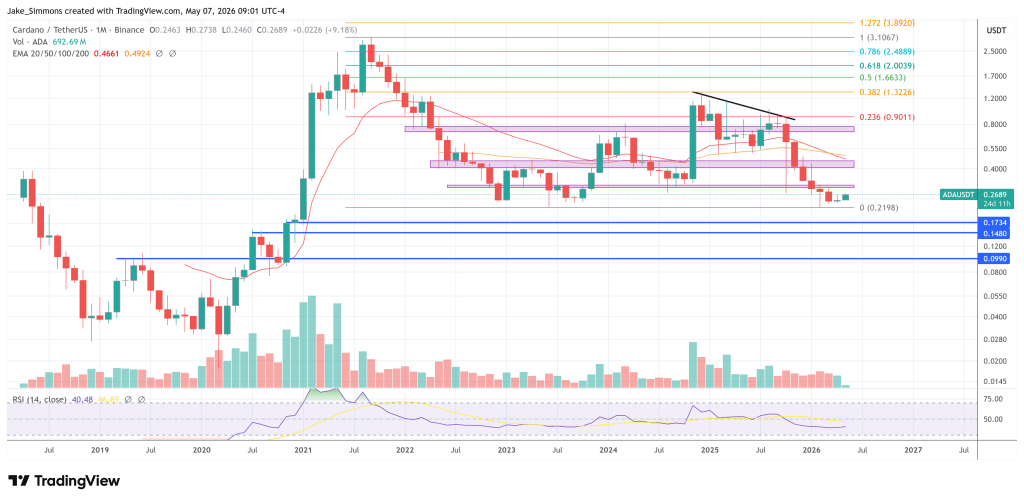
Cardano remains below key resistance, 1-monthly chart | Source: ADAUSDT on TradingView.com

Trending Cryptos

Related Questions

QWhat is the main barrier to bringing mainstream users into crypto, according to Charles Hoskinson?

AAccording to Hoskinson, the main barrier is the poor user experience, which asks users to manage seed phrases, navigate exchanges, wait for withdrawals, choose between networks, avoid fake apps, and understand DeFi risks before they can do anything useful.

QWhat does Hoskinson identify as a necessary tradeoff that comes with simplifying crypto through abstraction?

AHoskinson identifies that the tradeoff with abstraction is often a loss of privacy. When users delegate complexity to third parties, those parties gain visibility into their assets, transactions, preferences, identity, and business data.

QWhat is the proposed solution, Midnight Passport, designed to combine?

AMidnight Passport is designed to combine mobile-native key management, recovery, self-sovereign identity, selective disclosure, wallet credentials, name services, and multi-chain signatures to simplify user experience across different blockchains.

QAccording to the keynote, why will privacy become even more critical with the rise of AI agents?

APrivacy will become more critical because effective AI agents require deep personal context to operate. Therefore, systems are needed to set rules around identity, data access, and execution for these agents, protecting user data.

QHow did Hoskinson contrast the current crypto user experience with that of successful Web2 products?

AHe contrasted it with products like Google Wallet, which trains consumers to expect one-click setup, recovery, and seamless mobile access. He argued crypto cannot insist it is 'different' if its product experience remains too punishing compared to these seamless mainstream options.

Related Reads

After Tokenized U.S. Treasury Bonds, Tokenized Stocks Are Becoming the New Battleground for RWA

**Tokenized Stocks Emerge as the New RWA Battleground** Following the initial surge of tokenized U.S. Treasuries, the tokenized stock market is rapidly expanding in both scale and quality. Unlike the currently stagnating treasury tokenization market, tokenized stock offerings are seeing significant growth and attracting major players from traditional finance, fintech, crypto exchanges, and native Web3 platforms. The U.S. SEC has outlined a framework for tokenized securities, which applies to stocks: **Issuer-Sponsored Tokenized Securities** (direct tokenization by the issuer, inheriting all shareholder rights but with strict compliance, e.g., Securitize); **Custodial Tokenized Securities** (tokenization of custodied interests, e.g., DTCC, Ondo's recent IVV/MU tokens); **Linked Securities** (tokenized debt notes backed by the stock, offering price exposure and greater on-chain utility, e.g., Ondo, xStocks, Robinhood's new Stock Tokens); and **Security-Based Swaps** (tokenized derivatives contracts, e.g., Robinhood's earlier Classic Stock Tokens). Key platforms are pursuing different strategies: * **Securitize** leads with an issuer-sponsored model, ensuring full rights but limiting on-chain interactions via its compliance-enforcing DS Protocol. * **Ondo** and **xStocks** use the linked security structure for broad accessibility on CEXs and DeFi, though this fragments liquidity and excludes U.S. users. * **Robinhood** recently launched linked security-based Stock Tokens, leveraging its user base and new Robinhood Chain. * Traditional infrastructure giants like **DTCC**, the **NYSE**, and **Nasdaq** are actively developing pilots and platforms for tokenized settlement and trading. * **Coinbase** has announced plans for tokenized stocks, likely using a structure that offers on-chain utility while excluding U.S. customers. Despite different approaches, all players are converging on tokenized stocks as the next major catalyst for the RWA sector. The evolving regulatory landscape and market adoption will shape this competitive new battlefield.

marsbit11m ago

After Tokenized U.S. Treasury Bonds, Tokenized Stocks Are Becoming the New Battleground for RWA

marsbit11m ago

Nvidia Faces Collective Selling by Funds: What Are Private Equity Firms Sniffing Out?

Several prominent Chinese private equity funds, including Gaoyi Asset and Dantoo's Orient Harbor, made significant portfolio adjustments in Q2 2024, as revealed in their latest SEC 13F filings. The most notable move was a collective retreat from AI chip leader NVIDIA, with Gaoyi reducing its stake by over 70%, Jilin Asset selling out completely, and Orient Harbor trimming its holdings. This shift does not signal a loss of faith in the AI trend, but rather a change in investment focus from "expectation-driven" to "realization-driven" valuation. Capital is flowing from crowded, high-valuation names towards segments with clearer profitability visibility and better risk-reward profiles. The funds' new major conviction is Taiwan Semiconductor Manufacturing Company (TSMC), which Gaoyi built into its top holding. The thesis centers on TSMC's role as a critical bottleneck in the AI supply chain due to its dominance in advanced semiconductor manufacturing and, crucially, advanced CoWoS packaging capacity. As demand for AI chips explodes, TSMC's "must-pass" foundry services grant it significant pricing power, suggesting a potential migration of profits from chip designers to manufacturers. Simultaneously, both Gaoyi and Orient Harbor substantially increased positions in memory chip companies like Micron and SanDisk. The investment logic here is twofold: a cyclical recovery in the memory market combined with a new, structural growth driver from AI. High Bandwidth Memory (HBM), essential for AI processor performance, is supply-constrained and its production diverts capacity from standard DRAM and NAND, creating a broad-based pricing tailwind for the memory sector. The collective reduction in NVIDIA reflects a view that its massive prior gains have compressed its future upside potential ("lowered赔率"). The market now demands flawless execution and faces new risks like rising costs from TSMC and HBM suppliers, as well as competition from cloud companies' custom chips. The funds' reallocation highlights a broader thematic: as the AI boom matures, investment opportunities and excess profits are shifting along the supply chain—from design to the physical constraints of manufacturing and memory. The next phase of AI investing may be defined by pricing power derived from tangible bottlenecks like advanced packaging and HBM capacity.

marsbit44m ago

Nvidia Faces Collective Selling by Funds: What Are Private Equity Firms Sniffing Out?

marsbit44m ago

Reverse Turing Test: This 'Pure Handcrafted Large Model' Is Driving Netizens Crazy

An art project called ChatTJB, humorously billed as a "next-generation, single-operator Large Language Experience" (LLE), gained viral attention in San Francisco. Promoted via a billboard, its website mimicked a genuine AI service with a chat interface, documentation, and even a "Pro" subscription. The twist? It was entirely manual. A single person, named Tucker, personally read, thought about, and typed replies to thousands of user queries using his thumbs, even hand-drawing images. He coined terms like "human-powered reasoning layer" to describe this process, highlighting its inherent human limitations: speed depended on his alertness, capacity was strictly one conversation at a time, and errors were traceable to a specific individual. The project's popularity overwhelmed Tucker, forcing a pause on new users and leading to plans for a community version with volunteer "AIs" (Average Individuals). While initially a source of amusement, Tucker noted that some users began sharing genuine personal concerns, valuing the knowledge that a real person was attentively listening and responding. The project satirizes AI hype while underscoring the irreplaceable value of human connection and attention in an age of automated, scalable interactions. A similar platform, "Your AI Slop Bores Me," was mentioned, where users either submit requests or role-play as the "AI" to fulfill others' text or drawing prompts, further emphasizing the human element behind the interface. The core message: sometimes, knowing there's a real person on the other end is what truly matters.

marsbit47m ago

Reverse Turing Test: This 'Pure Handcrafted Large Model' Is Driving Netizens Crazy

marsbit47m ago

Overnight, GPT-5.6 Sol Was Accelerated 14x by OpenAI

OpenAI, in collaboration with chipmaker Cerebras, has unveiled a limited preview of an "Ultrafast Mode" for its flagship GPT-5.6 Sol model. This new service tier reportedly achieves output speeds of up to 750 tokens per second—a 14x increase over the standard mode's baseline of ~53 tokens/s—without any loss in quality. Key to this acceleration is Cerebras's wafer-scale architecture (WSE-3), which houses model parameters entirely in on-chip SRAM to eliminate the memory bandwidth bottlenecks typical of traditional GPU clusters. In benchmark testing on the challenging "Humanity's Last Exam" (HLE), GPT-5.6 Sol in Ultrafast Mode answered all 2500 questions in 11 hours and 11 minutes, compared to over 78 hours for a competitor model, while maintaining similar accuracy. The speed boost also translated to a 5.6x faster end-to-end performance on the GDP-Val benchmark for economically valuable knowledge work. OpenAI highlights several potential applications for such rapid inference, including real-time event response and reliability analysis, dynamic financial research and security, complex customer support, interactive shopping assistance, and accelerated research and experimentation workflows that enable multiple iterative cycles within a single workday. This advancement may allow users to deploy the highest-tier models for tasks previously requiring slower secondary models, significantly compressing multi-step agent workflows from hours to minutes.

marsbit51m ago

Overnight, GPT-5.6 Sol Was Accelerated 14x by OpenAI

marsbit51m ago

Trading

Spot

Hot Articles

Discussions

Welcome to the HTX Community. Here, you can stay informed about the latest platform developments and gain access to professional market insights. Users' opinions on the price of ADA (ADA) are presented below.

活动图片