Cardano Foundation Reaches First Milestone In New Governance Roadmap

bitcoinistPublished on 2026-01-22Last updated on 2026-01-22

Abstract

Cardano Foundation has reached the first milestone in its updated governance roadmap by delegating an additional 220 million ADA to 11 community representatives (DReps) focused on Adoption and Operations. This brings the Foundation’s total delegation to community DReps to 360 million ADA. The move aims to decentralize governance by shifting voting power toward representatives with expertise in real-world adoption, business acumen, and network operations—not just technical development. The Foundation also announced it will self-delegate its remaining 171 million ADA stake instead of leaving it passive, reducing its overall voting power by 43 million ADA. The delegations were made without conditions or voting instructions, emphasizing trust in the DReps' decision-making and encouraging healthy dissent as a feature of decentralized governance.

The Cardano Foundation said it has hit the first milestone in its updated governance roadmap, expanding delegation to a new set of community representatives as the ecosystem leans further into on-chain decision-making. The move matters because it shifts meaningful voting weight toward delegated representatives (DReps) whose mandates emphasize adoption and day-to-day network operations rather than purely technical development.

Cardano Foundation Expands DRep Delegation

In a post on X and an accompanying blog update, the Foundation said it has delegated an additional 220 million ADA to 11 selected DReps, roughly 20 million ADA each, focused on the pillars of Adoption and Operations. The Foundation framed the step as a continuation of earlier delegations to “Developer & Builder DReps,” and said the new allocation brings total delegation to community DReps to 360 million ADA.

Alongside the additional community delegation, the Foundation said it is revising how it handles its remaining stake in governance. “Rather than leaving a portion of our funds on auto-abstain as initially planned, we will self-delegate the remaining balance (approximately 171 million ADA),” the Foundation wrote. “While this exceeds our initial estimate, it ensures no ADA remains passive and still results in a net reduction of our overall voting power by approximately 43 million ADA, with the clear majority of our holdings now empowering community DReps.”

The Foundation emphasized that the delegations are intended to distribute voting power without imposing direction. “This delegation is not a blind bet, rather it’s a show of trust in a proven history of sound decision-making,” it said. “As always, it’s also a show of good faith: These new delegations come without any expectation regarding voting outcomes. We will not direct these DReps on how to vote, nor will we provide a voting manual.”

That posture, explicitly accepting dissent from its own views, was positioned as a feature rather than a risk. The Foundation said it expects “differing opinions” between the newly selected DReps and the Foundation itself, describing that divergence as evidence of “a healthy, decentralized governance system.”

The Foundation’s rationale for targeting adoption and operations reads as a governance design choice: broaden the expertise mix beyond protocol engineering. “To build a resilient governance system, we need more than just technical expertise—We need business acumen and operational stability,” it wrote, arguing that Adoption DReps can represent real-world utility, onboarding, and enterprise needs, while Operations DReps reflect the practical constraints faced by stake pool operators, toolmakers, and infrastructure providers.

In the published list, the Adoption cohort includes figures tied to community growth and product-building across the ecosystem, from regional community leadership to DeFi and stablecoin infrastructure, while the Operations cohort highlights long-running infrastructure roles such as block explorer analytics, stake pool operations, and SPO tooling.

The Foundation said all eleven delegations were completed in a single on-chain transaction, linking to the Cardano Explorer entry, and noted the delegations are effective immediately. It also encouraged the broader community to “follow and interact with these DReps,” including engaging with their voting rationales and participating in governance actions.

At press time, Cardano traded at $0.3549.
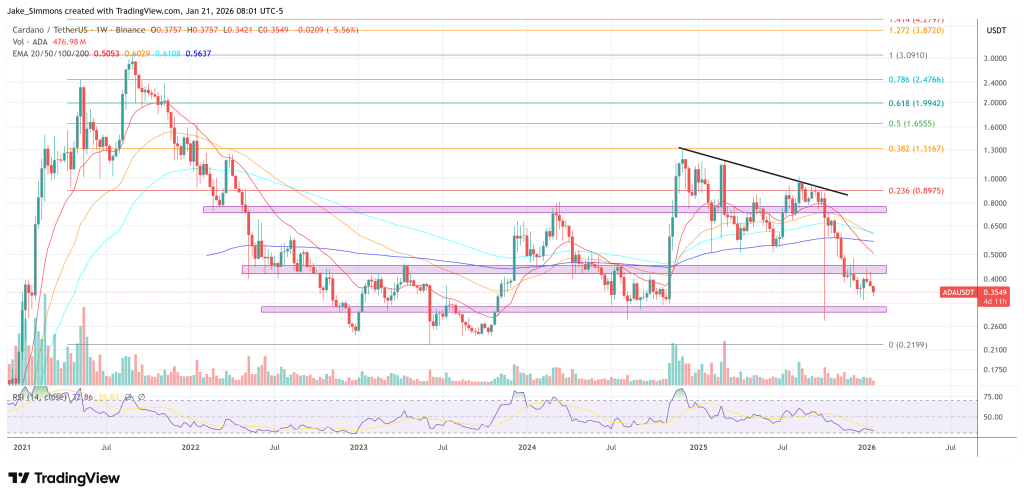
Cardano hovers below key resistance, 1-week chart | Source: ADAUSDT on TradingView.com

Trending Cryptos

Related Questions

QWhat is the first milestone achieved by the Cardano Foundation in its updated governance roadmap?

AThe Cardano Foundation has expanded delegation to a new set of community representatives (DReps) focused on Adoption and Operations, shifting meaningful voting weight towards them.

QHow much ADA was delegated to the 11 selected DReps, and what was the focus of these DReps?

AThe Foundation delegated an additional 220 million ADA, roughly 20 million ADA each, to 11 DReps focused on the pillars of Adoption and Operations.

QWhat change did the Foundation make regarding its remaining stake in governance, and what was the result?

ARather than leaving a portion of funds on auto-abstain, the Foundation self-delegated its remaining balance of approximately 171 million ADA, resulting in a net reduction of its overall voting power by about 43 million ADA.

QHow does the Foundation view differing opinions between itself and the newly selected DReps?

AThe Foundation views differing opinions as evidence of a healthy, decentralized governance system, considering it a feature rather than a risk.

QWhat rationale did the Foundation provide for targeting Adoption and Operations DReps specifically?

AThe Foundation stated that building a resilient governance system requires more than technical expertise; it needs business acumen and operational stability, with Adoption DReps representing real-world utility and enterprise needs, and Operations DReps reflecting practical constraints of stake pool operators and infrastructure providers.

Related Reads

When the World Cup Collides with Agents: From Web2 to Web3, How Are Wallets Evolving into Agentic Wallets?

World Cup as a Catalyst for Agentic Wallets: From Web2 to Web3 This article explores how the World Cup provides a real-world scenario for observing the evolution of digital wallets from simple asset managers towards "Agentic Wallets"—intelligent, AI-powered interfaces. Using the example of prediction markets like Polymarket, it illustrates how AI Agents can lower the barrier to Web3 interaction. Instead of navigating complex DApps, users can express intent in natural language (e.g., "I think Portugal will win") within platforms like Discord or web pages. The Agent then interprets this intent, finds the relevant market, and seamlessly guides the user through the on-chain transaction via their wallet. The core shift is from wallets as mere "function menus" for signing transactions to "intent interpreters" that understand user goals. The article highlights parallel developments in traditional finance, such as Mastercard's "Agent Pay" and WeChat Pay's AI tests, which focus on granting AI controlled, authorized, and auditable payment capabilities. This underscores a broader trend of AI entering the financial layer. However, the article emphasizes that the primary challenge for Agentic Wallets in Web3 is not automation but establishing clear security boundaries. Unlike traditional systems with chargebacks, on-chain transactions are often irreversible. Therefore, future wallets must ensure users retain ultimate control and comprehension. They need to transparently communicate an Agent's permissions, spending limits, authorized durations, and provide easy ways to pause or revoke access. The World Cup experiments represent early steps toward wallets that are not just applications but ubiquitous, intelligent interfaces that simplify Web3 while keeping users securely in control.

marsbit1h ago

When the World Cup Collides with Agents: From Web2 to Web3, How Are Wallets Evolving into Agentic Wallets?

marsbit1h ago

Options Don't Work in DeFi? Vitalik Might Not Agree

For years, the prevailing view has been that options struggle to gain traction in DeFi due to complexity, fragmented liquidity, and lack of natural demand compared to products like perpetual futures. However, a recent algorithmic stablecoin design proposed by Vitalik Buterin presents a different perspective, using options not as a standalone trading product, but as foundational infrastructure for other financial instruments. In this design, one unit of ETH is split into two components: a "stable" side (P) that retains value up to a specified strike price, and an "upside" side (N) that captures all appreciation above that strike. Combined, they always equal one ETH, eliminating debt, margin, and liquidation risks inherent in typical collateralized debt position (CDP) stablecoins. The stable component essentially mimics the payoff of a covered call option. To function as a stablecoin, this structure requires continuously rolling deep in-the-money calls, which introduces challenges like rollover slippage, predictable transaction flow vulnerable to front-running, and persistent liquidity needs. A core hurdle is finding consistent buyers for the leveraged ETH upside exposure (N). While it offers leverage without funding rates or liquidation, it must compete with simpler alternatives like direct call options or perpetuals. The system's scalability depends on a sustained demand for this specific form of leverage. The author draws parallels to their experience with Rysk, where earlier versions of DeFi options protocols struggled. The breakthrough came with Rysk V12, which aligns incentives: asset holders generate yield by selling covered calls against their holdings, while market makers efficiently acquire the desired option exposure. This demonstrates that options can find product-market fit when embedded as a risk distribution and pricing engine within structured products, stablecoins, or yield-generating assets, rather than marketed as a complex direct trading instrument. Vitalik's proposal reinforces this architectural approach—using fully collateralized, non-custodial, and physically settled options as a fundamental building block. The real opportunity for options in DeFi may lie not in becoming the next perpetual swap, but in powering the next generation of on-chain financial products.

marsbit1h ago

Options Don't Work in DeFi? Vitalik Might Not Agree

marsbit1h ago

Conversation with Investor Zheng Di: MicroStrategy's Coin Sale Experiment, AI Economy, and Opportunities in US Stocks

Frontier tech investor Zheng "Didier" Di discusses the recent Bitcoin price drop, the financial strategy shift at MicroStrategy, the AI-driven surge in U.S. stocks, and the evolving role of crypto exchanges. Didier posits that the recent BTC decline stems less from macro factors or ETF outflows, and more from market repricing due to MicroStrategy's new financial structure. Following a wave of preferred stock and debt issuance (STRC, STRZ, etc.), MicroStrategy must now manage cash flow to pay dividends, potentially leading to a market expectation of sustained, small-scale BTC sales to maintain its "per-share bitcoin neutral" principle. Didier views this as a financial "experiment" testing market capacity for such recurring sell pressure, which, while creating near-term structural headwinds, likely avoids a true "death spiral" absent major new external shocks. Shifting to AI, Didier argues that tokens are becoming the new form of labor, with AI models and compute (tokenized inputs) increasingly replacing human roles in execution and middle-management. This drives enterprise efficiency and higher margins, fueling the sustained rally in U.S. semiconductor, data center, and infrastructure stocks. He foresees an emerging "machine economy" where automated agents transact and collaborate on-chain. Regarding crypto exchanges offering U.S. equities, Didier sees this as a natural evolution. With few crypto-native assets generating lasting value, exchanges are pivoting towards real-world assets (RWAs) like stocks and bonds. This doesn't necessarily cannibalize crypto but reflects a maturing industry focusing on blockchain's core utilities: decentralized choice and efficient settlement. He notes that trading logic for crypto natives doesn't need to drastically change, as meme-driven and fundamentalist strategies find analogs in U.S. markets. The "1011 event" (likely referring to a major market crash) severely damaged crypto market liquidity, marking a probable end to the altcoin speculative cycle, with capital flowing towards the deeper liquidity of U.S. markets. For the macro outlook, Didier is cautious about near-term market pressure from potential mega-IPOs (e.g., SpaceX) and the U.S. midterm elections, which could bring more regulatory scrutiny. Long-term, he remains bullish on AI's productivity gains and its convergence with blockchain/Web3, predicting a shift from speculative frenzy to a more institutionalized, industrial phase for the crypto sector.

marsbit2h ago

Conversation with Investor Zheng Di: MicroStrategy's Coin Sale Experiment, AI Economy, and Opportunities in US Stocks

marsbit2h ago

Playnance’s $GCOIN Lists on KoinBX Amid Rapid Growth in India

Playnance's native token, $GCOIN, has been listed on the cryptocurrency exchange KoinBX as of June 18. This move aims to enhance accessibility for its rapidly growing community, particularly in India, where the blockchain-powered Web3 iGaming ecosystem has gained significant traction. Over 130 partners in Playnance's "Be the Boss" program have built communities engaging thousands of active players in the region. The "Be the Boss" model allows participants to create and manage their own gaming communities, earning rewards tied to community activity. CEO Pini Peter noted India's high engagement, with community leaders successfully building player networks. One partner, Dr. Nicolas, reported earning over $57,000 through the program in recent months, highlighting both the financial rewards and the opportunity to grow an engaged community. $GCOIN serves as the ecosystem's core utility token, incentivizing participation and aligning the interests of players and community leaders ("Bosses"). The listing on KoinBX is part of Playnance's strategy to expand globally, increasing the token's utility and accessibility by combining community ownership, gamified engagement, and blockchain-based incentives. Founded in 2020, Playnance is a Web3 iGaming infrastructure company focused on creating live, non-custodial, on-chain products to onboard mainstream users. It currently processes approximately one million transactions daily, aiming to simplify the user experience while maintaining full on-chain transparency.

TheNewsCrypto3h ago

Playnance’s $GCOIN Lists on KoinBX Amid Rapid Growth in India

TheNewsCrypto3h ago

Trading

Spot
Futures

Hot Articles

Discussions

Welcome to the HTX Community. Here, you can stay informed about the latest platform developments and gain access to professional market insights. Users' opinions on the price of ADA (ADA) are presented below.

活动图片