Cango sells 2,000 BTC in ‘strategic deleveraging’ as Bitcoin miners pivot to AI

ambcryptoPublished on 2026-04-10Last updated on 2026-04-10

Abstract

Cango, a publicly traded Bitcoin mining company, has sold 2,000 BTC in a strategic move to pay off its BTC-backed loans and reduce debt. The firm raised $75 million from the sale, with some funds allocated to support its diversification into energy and AI infrastructure. This pivot is part of a broader trend among major miners, including Marathon Digital and Core Scientific, who are repurposing their computing resources towards AI ventures. As a result, Bitcoin's global hashrate has declined by 17.4%, potentially lowering network security but creating opportunities for smaller miners to benefit from reduced competition and lower production costs. Despite improving its own mining efficiency, Cango remains vulnerable if Bitcoin's price falls below its production cost of $68.2K.

Publicly traded Bitcoin mining firm Cango (NYSE: CANG) has joined the list of major players using their BTC holdings to manage debt and pivot to AI investments.

On Wednesday, the firm announced that it sold 2000 BTC in March, calling it a “strategic de-leveraging” to retire its BTC-backed loans.

The firm added that it raised $75 million and that some of the proceeds from the “strategic de-leveraging” will help drive its diversification.

This de-leveraging, combined with recent capital infusions, strengthens Cango’s balance sheet to support its planned transition into energy and AI infrastructure.

Bitcoin hashrate drops as Cango, other miners pivot to AI

Now, the firm holds 1,025.69 BTC. Interestingly, Cango said that its aggressive lean operations have helped reduce its BTC production costs by 19% in Q1. For perspective, in Q4 2025, its cost of production for 1 unit of BTC was $84.5K. By March 2026, this dropped to $68.2K.

While this is a great improvement, the miner would still be in distress if BTC’s price falls below $68K. In such a scenario, it could be forced to liquidate more of its BTC holdings to stay afloat.

From this backdrop, the growing trend of public miners rushing to AI infrastructure ventures to maximize their compute power for extra revenues makes sense.

Cango now joins the growing list of public miners pivoting to AI, including MARA, Bit Digital, Core Scientific, IREN, Bitfarms, TerraWulf, and Cipher Mining.

With some dedicating part of their BTC energy and computing power to AI, BTC’s global hashrate has declined too. In fact, according to Glassnode, the global hashrate declined from a record high of 1.115 Zetahash/s to 950 Exahashes/s – A 17.4% fall in BTC overall computational power.
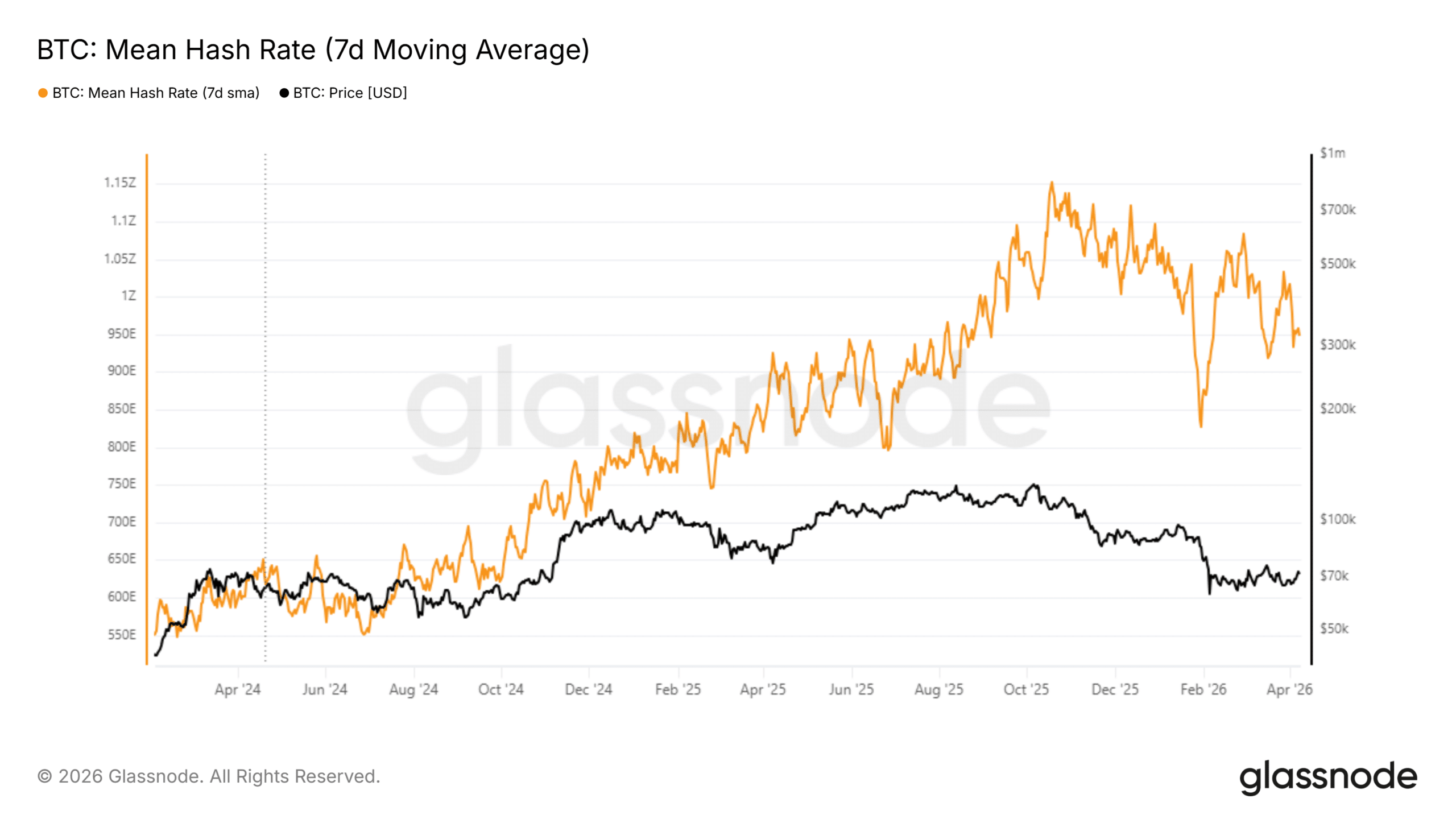
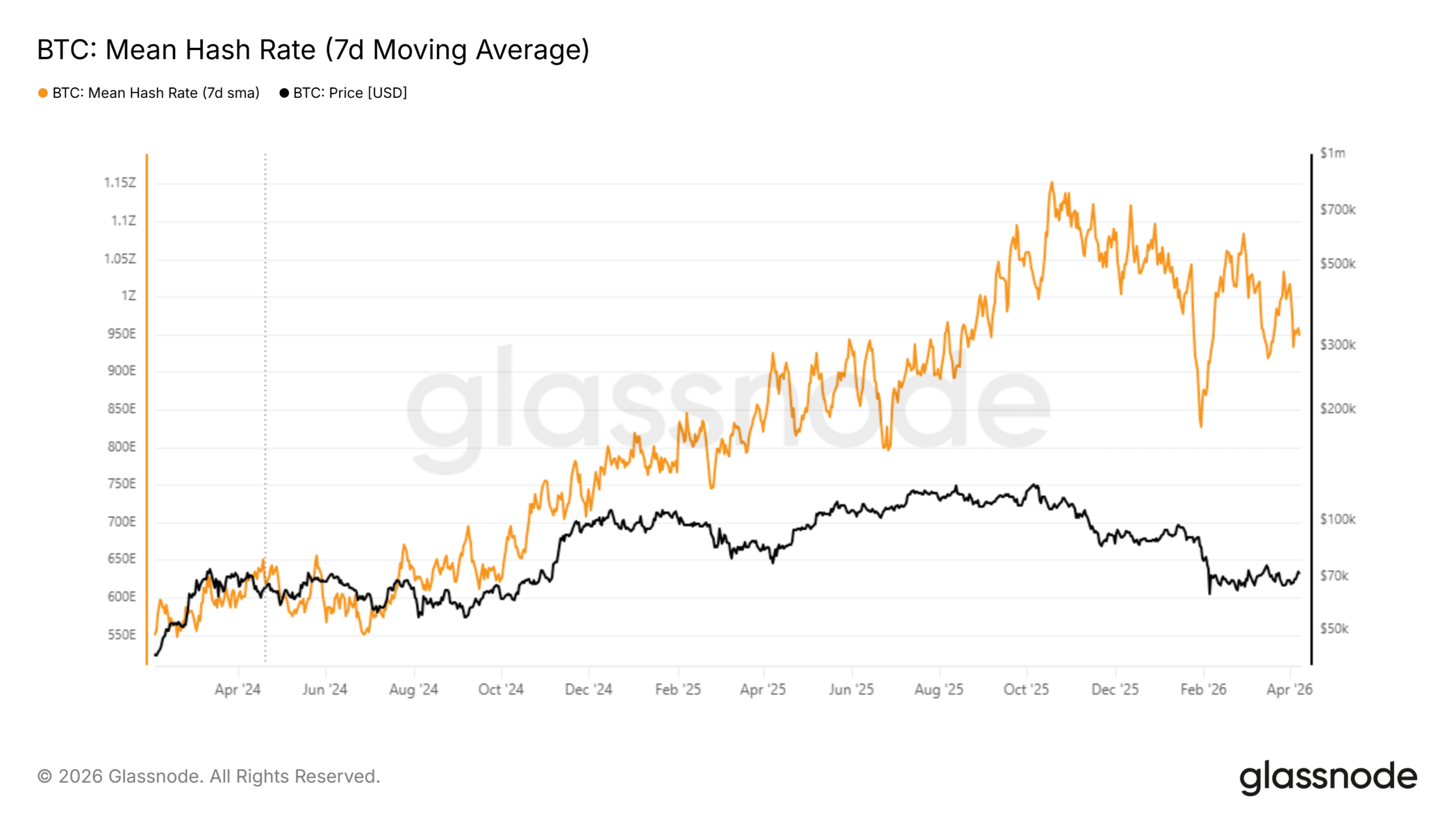
Source: Glassnode

The dropping hashrate is an opportunity and risk at the same time. The decreasing hashrate and AI pivots imply that the overall Bitcoin network security has been lowered and could expose it to attacks if the trend continues.

On the other hand, it offers small and medium miners a rare chance to step into the void left by public miners diversifying into AI. As the hashrate drops, network difficulty and overall costs of production fall too, allowing the remaining BTC miners to enjoy higher margins.


Final Summary

  • Cango dumped 2000 BTC to cover debt obligations and doubled down on its AI shift after raising an extra $75M.
  • Ongoing public miners’ pivot to AI has partly driven the 17% drop in global Bitcoin hashrate.

Related Questions

QWhy did Cango sell 2,000 BTC in March?

ACango sold 2,000 BTC as part of a 'strategic de-leveraging' to retire its BTC-backed loans and strengthen its balance sheet to support its planned transition into energy and AI infrastructure.

QWhat is the current amount of BTC that Cango holds after the sale?

AAfter the sale, Cango currently holds 1,025.69 BTC.

QHow has the pivot to AI by public miners like Cango affected the Bitcoin network's hashrate?

AThe pivot to AI by public miners has contributed to a 17.4% decline in Bitcoin global hashrate, from a record high of 1.115 Zetahash/s to 950 Exahashes/s.

QWhat are the potential risks and opportunities associated with the dropping Bitcoin hashrate?

AThe dropping hashrate lowers overall Bitcoin network security and could expose it to attacks if the trend continues. However, it also offers an opportunity for small and medium miners to fill the void, as the decrease in network difficulty and production costs allows them to enjoy higher margins.

QWhich other public Bitcoin mining companies are also pivoting to AI, according to the article?

AOther public Bitcoin mining companies pivoting to AI include MARA, Bit Digital, Core Scientific, IREN, Bitfarms, TerraWulf, and Cipher Mining.

Related Reads

Codex Goal Mode Usage Guide: How to Make AI Continuously Pursue a Specific Objective

"Codex Goal Mode: How to Make AI Work Continuously Toward a Specific Goal" OpenAI's Codex "goal mode" (/goal) transforms the AI from a reactive code assistant into a proactive execution agent capable of working autonomously for hours or even days to achieve a defined objective. To maximize its effectiveness, follow these key principles: 1. **Define Clear, Verifiable Exit Criteria:** The goal prompt should be a concise, measurable success condition, not a lengthy specification. Use quantifiable metrics like "reduce build time by 30%" or "achieve 100% test parity." 2. **Provide Initial Guidance and Tools:** Direct Codex toward likely problem areas and specify available tools (e.g., browsers, testing environments) to prevent it from exploring unproductive paths. 3. **Enable Progress Measurement:** Equip Codex with ways to track advancement, such as creating comparison tools for visual tasks or evaluation sets, ensuring it can gauge its own progress. 4. **Use a Realistic Execution Environment:** For tasks like performance optimization, provide access to environments that closely mimic production (e.g., similar configs, databases) to yield valid results. 5. **Be Cautious with Visual Goals:** Avoid vague "pixel-perfect" instructions. Instead, supplement visual references with functional checklists or design system specifications to prevent Codex from obsessing over minor details. 6. **Implement Progress Tracking:** For long-running tasks, have Codex commit code to draft PRs, update progress documents, or send Slack updates to maintain visibility into its work. 7. **Review and Consolidate Results:** Once the goal is met, instruct Codex to review its work, clean up ineffective experimental code, and reflect on what strategies succeeded or failed. Ultimately, using goal mode shifts the developer's role from writing prompts to managing a persistent engineering agent—defining objectives, establishing metrics, configuring environments, and conducting final reviews.

marsbit55m ago

Codex Goal Mode Usage Guide: How to Make AI Continuously Pursue a Specific Objective

marsbit55m ago

From Ethereum to AI's 'CROPS': What Exactly Is This 'Slow Variable' That Vitalik Has Repeatedly Emphasized?

Recently, Vitalik Buterin has frequently emphasized the concept of "CROPS," first outlined in the Ethereum Foundation's March mandate as core principles guiding its focus: Censorship Resistance, Capture Resistance, Open Source, Privacy, and Security. CROPS represents Ethereum's commitment to providing foundational capabilities for user sovereignty—enabling asset ownership, identity expression, and coordination without reliance on centralized platforms or surrendering ultimate control. This framework is gaining new urgency with the rise of AI, particularly AI agents managing digital assets and automating transactions. While AI offers convenience, it risks centralizing user data, intent, and control if dependent on opaque, centralized services. Vitalik argues for "CROPS AI"—AI that is open, privacy-preserving, secure, and capable of local execution to maintain user agency. He highlights convergence between "CROPS Ethereum access layers" and "CROPS AI," such as using zero-knowledge proofs for private remote LLM calls and Ethereum RPC reads, ensuring users can access services without exposing sensitive information. Ultimately, CROPS is not just an abstract ideal but a practical guide for Ethereum's development and AI integration. It addresses the critical long-term question: as digital systems grow more powerful, how can users retain control over their privacy, assets, and autonomy? In an AI-driven era, these principles may define Ethereum's enduring value—prioritizing verifiable, secure, and user-centric design over short-term optimizations like speed and cost alone.

marsbit1h ago

From Ethereum to AI's 'CROPS': What Exactly Is This 'Slow Variable' That Vitalik Has Repeatedly Emphasized?

marsbit1h ago

Trading

Spot
Futures

Hot Articles

What is $BITCOIN

DIGITAL GOLD ($BITCOIN): A Comprehensive Analysis Introduction to DIGITAL GOLD ($BITCOIN) DIGITAL GOLD ($BITCOIN) is a blockchain-based project operating on the Solana network, which aims to combine the characteristics of traditional precious metals with the innovation of decentralized technologies. While it shares a name with Bitcoin, often referred to as “digital gold” due to its perception as a store of value, DIGITAL GOLD is a separate token designed to create a unique ecosystem within the Web3 landscape. Its goal is to position itself as a viable alternative digital asset, although specifics regarding its applications and functionalities are still developing. What is DIGITAL GOLD ($BITCOIN)? DIGITAL GOLD ($BITCOIN) is a cryptocurrency token explicitly designed for use on the Solana blockchain. In contrast to Bitcoin, which provides a widely recognized value storage role, this token appears to focus on broader applications and characteristics. Notable aspects include: Blockchain Infrastructure: The token is built on the Solana blockchain, known for its capacity to handle high-speed and low-cost transactions. Supply Dynamics: DIGITAL GOLD has a maximum supply capped at 100 quadrillion tokens (100P $BITCOIN), although details regarding its circulating supply are currently undisclosed. Utility: While precise functionalities are not explicitly outlined, there are indications that the token could be utilized for various applications, potentially involving decentralized applications (dApps) or asset tokenization strategies. Who is the Creator of DIGITAL GOLD ($BITCOIN)? At present, the identity of the creators and development team behind DIGITAL GOLD ($BITCOIN) remains unknown. This situation is typical among many innovative projects within the blockchain space, particularly those aligning with decentralized finance and meme coin phenomena. While such anonymity may foster a community-driven culture, it intensifies concerns about governance and accountability. Who are the Investors of DIGITAL GOLD ($BITCOIN)? The available information indicates that DIGITAL GOLD ($BITCOIN) does not have any known institutional backers or prominent venture capital investments. The project seems to operate on a peer-to-peer model focused on community support and adoption rather than traditional funding routes. Its activity and liquidity are primarily situated on decentralized exchanges (DEXs), such as PumpSwap, rather than established centralized trading platforms, further highlighting its grassroots approach. How DIGITAL GOLD ($BITCOIN) Works The operational mechanics of DIGITAL GOLD ($BITCOIN) can be elaborated on based on its blockchain design and network attributes: Consensus Mechanism: By leveraging Solana’s unique proof-of-history (PoH) combined with a proof-of-stake (PoS) model, the project ensures efficient transaction validation contributing to the network's high performance. Tokenomics: While specific deflationary mechanisms have not been extensively detailed, the vast maximum token supply implies that it may cater to microtransactions or niche use cases that are still to be defined. Interoperability: There exists the potential for integration with Solana’s broader ecosystem, including various decentralized finance (DeFi) platforms. However, the details regarding specific integrations remain unspecified. Timeline of Key Events Here is a timeline that highlights significant milestones concerning DIGITAL GOLD ($BITCOIN): 2023: The initial deployment of the token occurs on the Solana blockchain, marked by its contract address. 2024: DIGITAL GOLD gains visibility as it becomes available for trading on decentralized exchanges like PumpSwap, allowing users to trade it against SOL. 2025: The project witnesses sporadic trading activity and potential interest in community-led engagements, although no noteworthy partnerships or technical advancements have been documented as of yet. Critical Analysis Strengths Scalability: The underlying Solana infrastructure supports high transaction volumes, which could enhance the utility of $BITCOIN in various transaction scenarios. Accessibility: The potential low trading price per token could attract retail investors, facilitating wider participation due to fractional ownership opportunities. Risks Lack of Transparency: The absence of publicly known backers, developers, or an audit process may yield skepticism regarding the project's sustainability and trustworthiness. Market Volatility: The trading activity is heavily reliant on speculative behavior, which can result in significant price volatility and uncertainty for investors. Conclusion DIGITAL GOLD ($BITCOIN) emerges as an intriguing yet ambiguous project within the rapidly evolving Solana ecosystem. While it attempts to leverage the “digital gold” narrative, its departure from Bitcoin's established role as a store of value underscores the need for a clearer differentiation of its intended utility and governance structure. Future acceptance and adoption will likely depend on addressing the current opacity and defining its operational and economic strategies more explicitly. Note: This report encompasses synthesised information available as of October 2023, and developments may have transpired beyond the research period.

363 Total ViewsPublished 2025.05.13Updated 2025.05.13

What is $BITCOIN

Discussions

Welcome to the HTX Community. Here, you can stay informed about the latest platform developments and gain access to professional market insights. Users' opinions on the price of BTC (BTC) are presented below.

活动图片