Can Solana reverse its ‘worst quarter’ since 2023 as fees drop 78%?

ambcryptoPublished on 2026-07-11Last updated on 2026-07-11

Abstract

Solana's on-chain activity has hit its lowest point since late 2023, with network fees plummeting 78% year-over-year to $51 million in Q2 2026. This dramatic drop in user-paid fees signals a severe contraction in network usage, coinciding with a broader crypto market downturn that has diminished Solana's role as a speculative hub. Despite a projected market bottom and emerging positive signs in areas like stablecoins and tokenization, capital inflows into SOL remain weak. SOL's Realized Cap has fallen to $73 billion, indicating $24 billion in outflows since last year. While SOL's price recently recovered to $84, reclaiming a key support level of $75, its upside is capped near $92. A potential sell-off from $14.2 million in stolen SOL could further test this crucial support.

Solana on-chain activity has dropped to a level never seen since late 2023, further underscoring the structural factor that could derail a strong price recovery.

According to a recent DeFi Report, the Solana network did $51M in total fees in Q2 2026, marking a 43% drop from Q1 and 78% on a year-on-year (YoY) basis. Compared to past quarters, this was the lowest fees since Q4 2024.
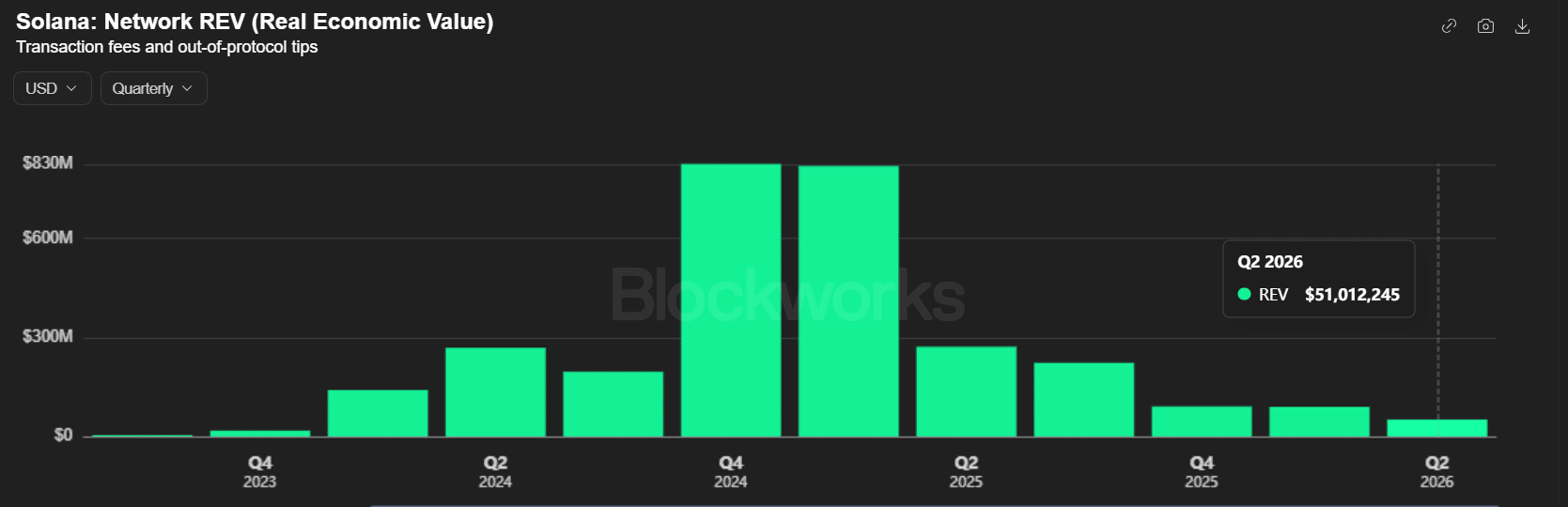
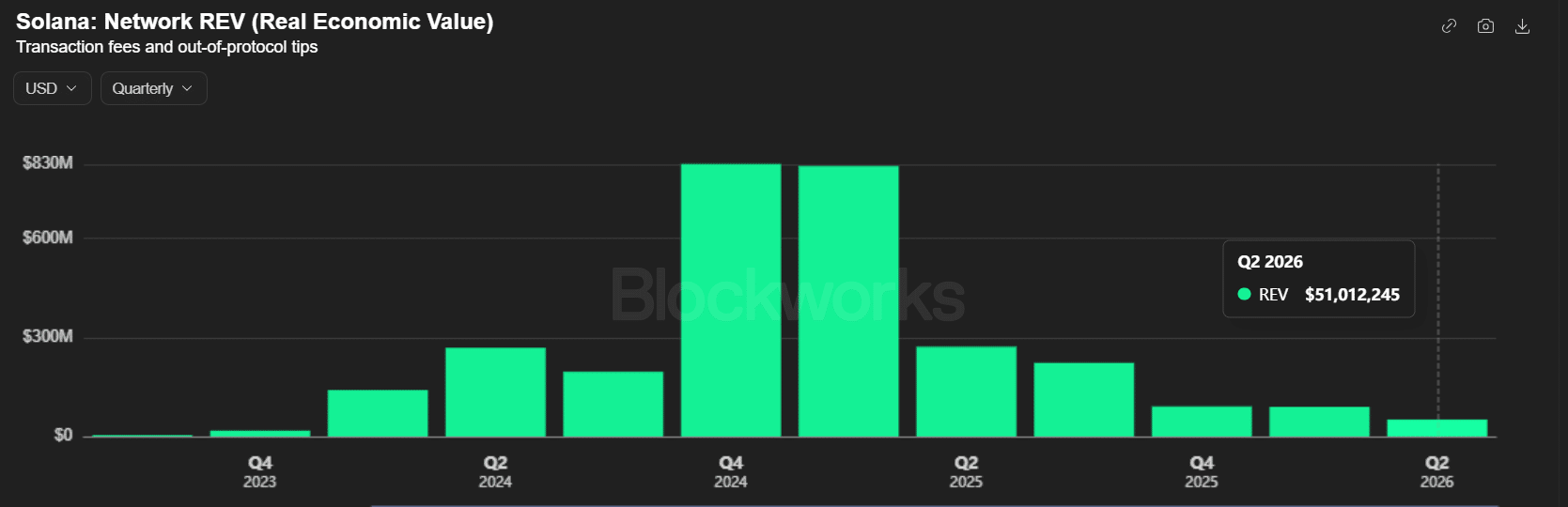
Source: Blockworks

Since fees track the value paid by users transacting on the chain, it meant the network activity had dropped too. This was not surprising given the broader crypto market downturn since last October.

With the downturn, Solana’s traction as a ‘homebase for speculation’ also contracted over the period. But the report projected that the bear market bottom may have bottomed out in Q2, citing stablecoin growth, tokenization, and perpetual volume surge.

However, it looks like this may have bottomed in Q2. We’re now beginning to see some green shoots within the ‘trenches.’

Despite the said recovery in new narratives, capital inflows into the SOL token were still at a two-year low.

Solana: Assessing SOL’s price recovery

According to Glassnode, SOL’s Realized Cap, which tracks on-chain capital inflows into the SOL market, has dropped from a record $97B last year to $73B in 2026. This was the lowest level the metric has dropped since late 2024.
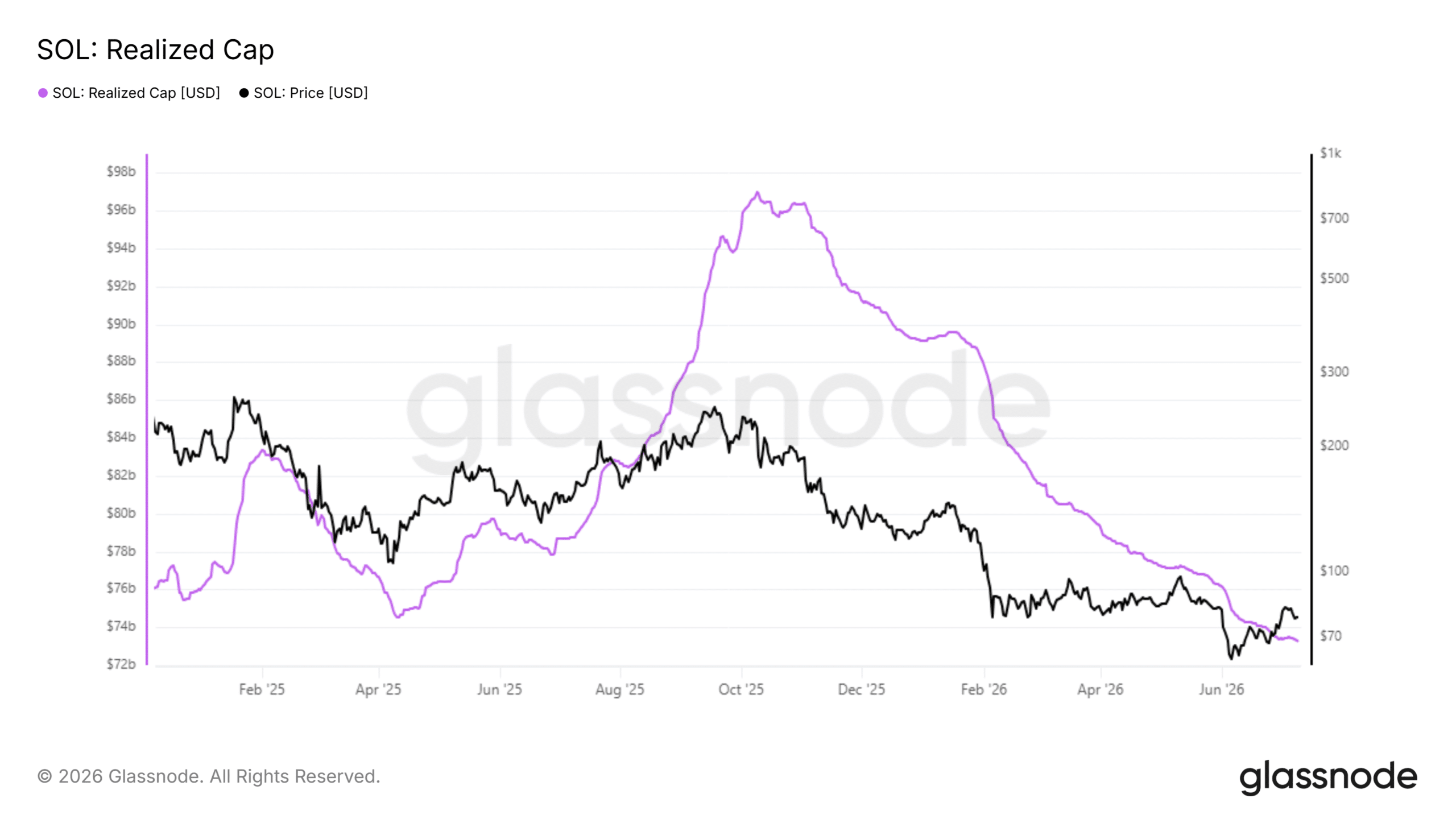
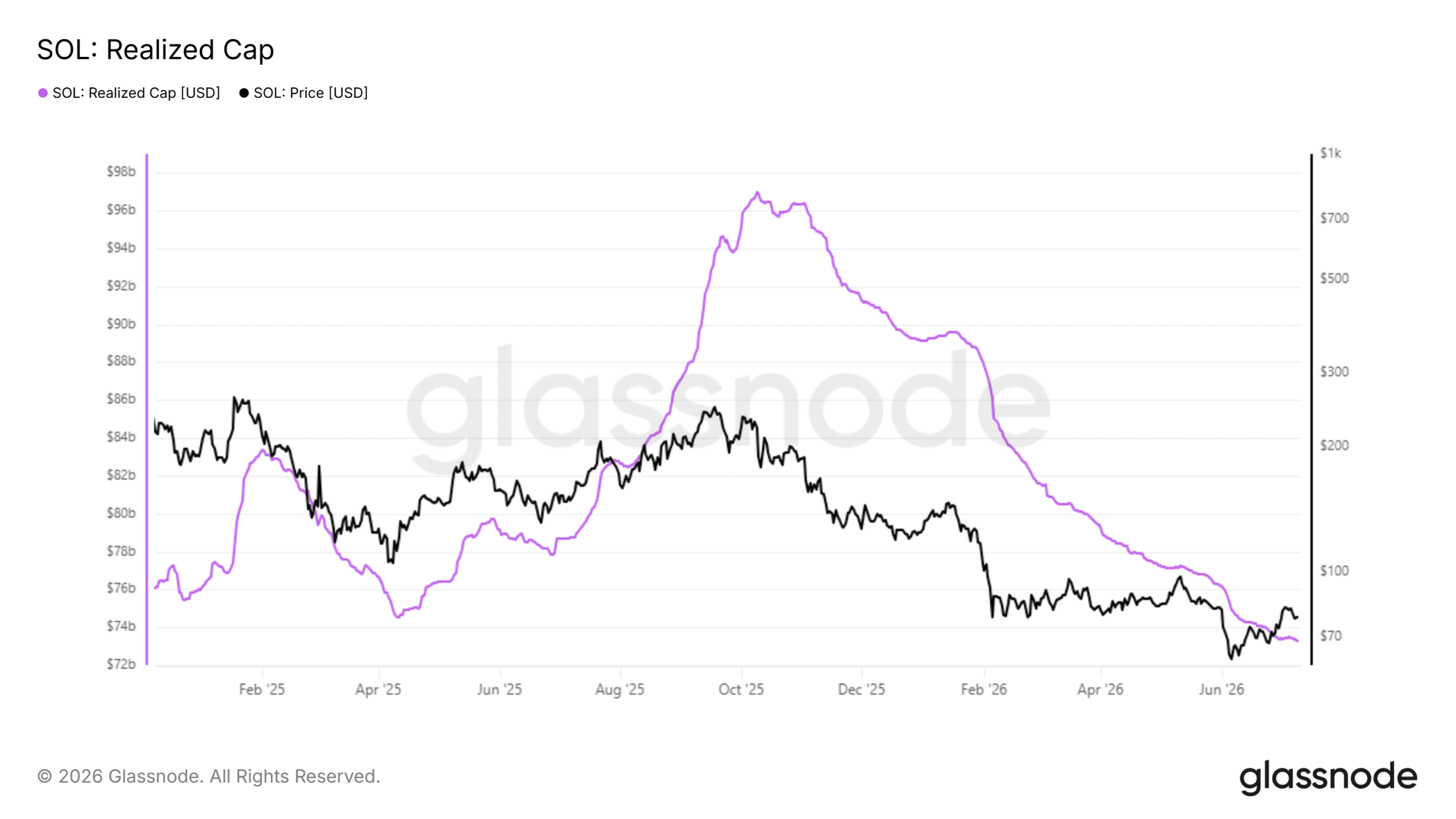
Source: Glassnode

In other words, SOL saw $24B in capital outflows in the past few months. The bearish trend is yet to reverse despite the recent 28% relief recovery.

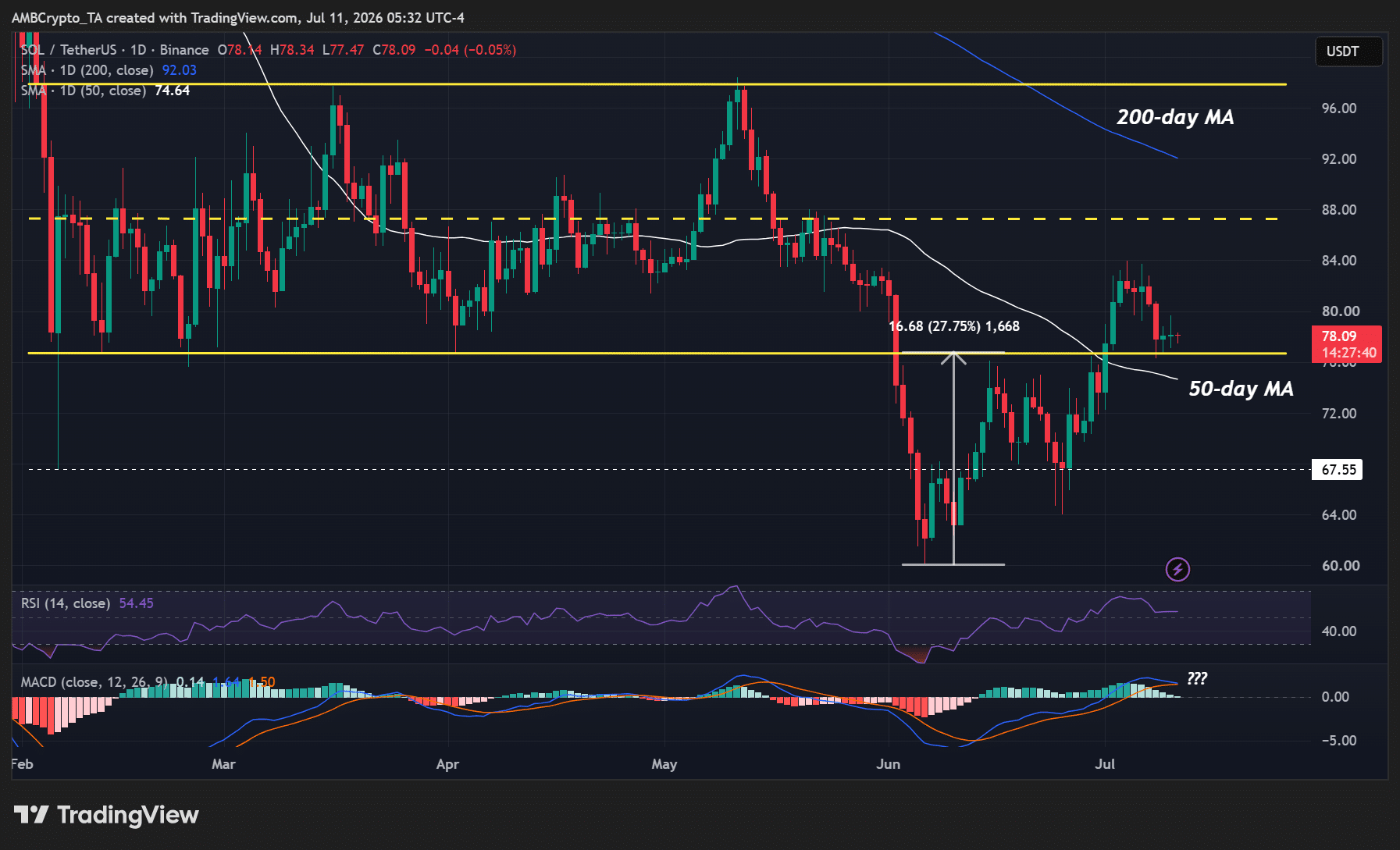
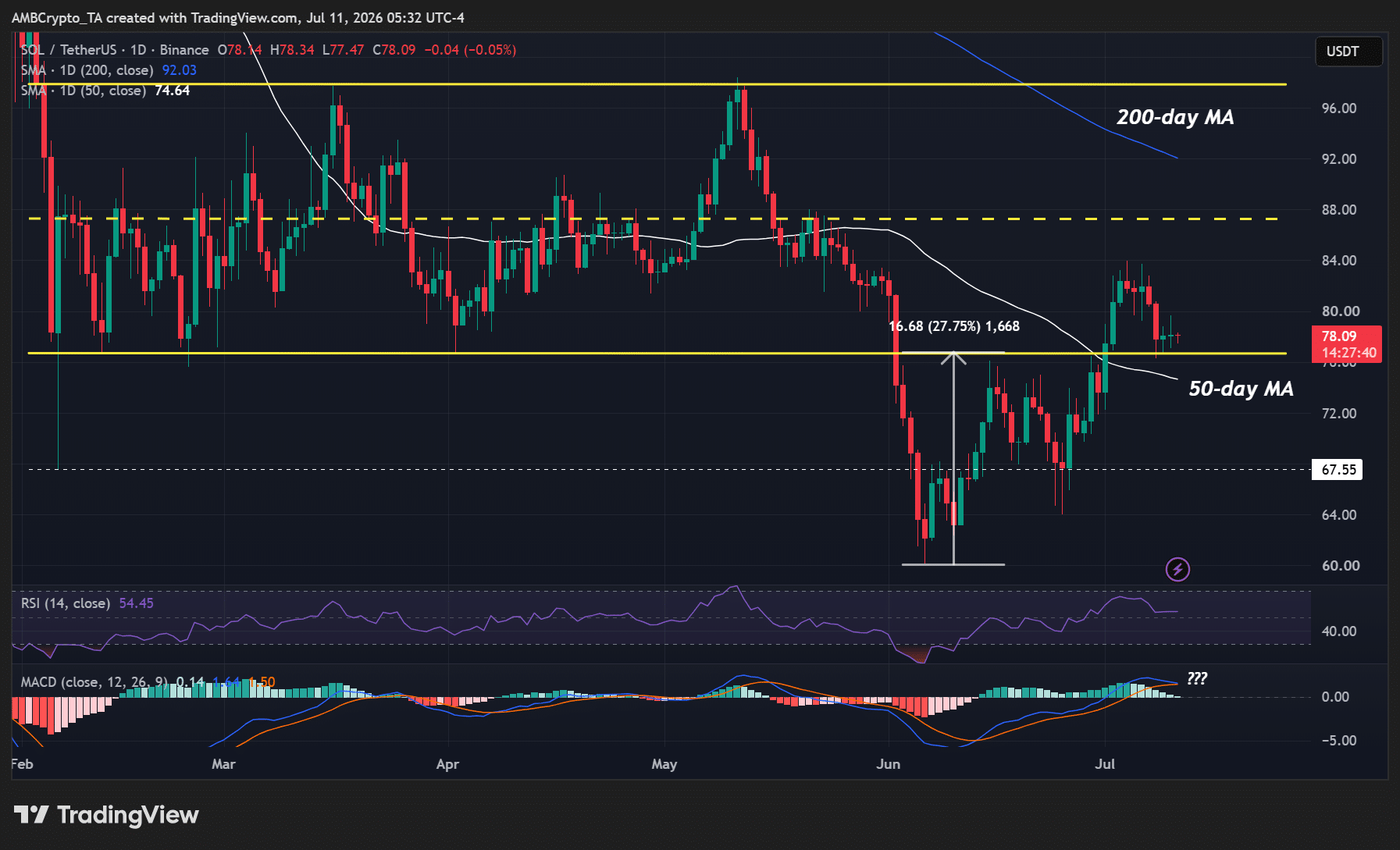
During the broader recovery in early June, SOL bounced from $60 to $84, effectively reclaiming its 2026 range-low of $75 (orange channel). Since February, SOL has been range-bound between $98 and $75.
Source: SOL/USDT, TradingView

It broke below the range after broader market risk-off triggered by Strategy’s BTC sale in early June. If the recent momentum holds, bulls could defend $75 and eye the mid-range level at $88 or the upside target at $92 (200-day Moving Average, blue line).

If so, that would imply a 13% to 20% upside potential assuming BTC does not post more losses in early Q3.

Separately, Web3 researcher Zach XBT reported that an early Solana whale has been exploited and 180.9K SOL ($14.2M) stolen. Should the hacker cash out the funds, it could trigger a short-term sell-off and test the $75 support.


Final Summary

  • Solana fees plunged 78% YoY to $51M, the worst since late 2023
  • SOL reclaimed the 2026 price range, but $75 support could be tested if $14M stolen funds hit the market


Trending Cryptos

Related Questions

QWhat was the percentage decrease in Solana's total fees in Q2 2026 compared to the previous year?

ASolana's total fees decreased by 78% year-on-year (YoY) in Q2 2026.

QWhat is the significance of the drop in Solana's fees according to the article?

AThe drop in fees indicates a significant decrease in on-chain network activity, as fees track the value paid by users for transactions. This is a structural factor that could hinder a strong price recovery for SOL.

QWhat is the 'Realized Cap' for SOL as mentioned in the article, and what does its drop signify?

AThe 'Realized Cap' tracks on-chain capital inflows into the SOL market. It dropped from a record $97B last year to $73B in 2026, signifying approximately $24B in capital outflows and indicating bearish sentiment that has not yet reversed.

QWhat are the potential upside price targets for SOL mentioned in the article, assuming recent momentum holds?

AIf the recent momentum holds, the article suggests bulls could defend the $75 support and target the mid-range level at $88 or the upside target at the 200-day Moving Average around $92, implying a 13% to 20% upside potential.

QWhat event does the article mention that could potentially test the $75 support level for SOL?

AThe article mentions that a hack resulted in 180.9K SOL ($14.2M) being stolen. If the hacker cashes out these funds, it could trigger a short-term sell-off and test the $75 support level.

Related Reads

Pantera Capital: As Perpetual Contracts Move Towards the Financial Center, Hyperliquid Aims to Be All-Encompassing

Perpetual futures ("perps"), once a crypto-native phenomenon, are becoming a dominant global financial instrument, evolving into a fundamental market structure shift that traditional finance can no longer ignore. This article outlines the advantages of perpetual contracts over traditional futures, highlighting their simplicity (no expiry/rollover), easier risk management, and native 24/7 operation. While the concept is not new, digital assets provided the ideal environment for its explosive growth. Initially dominated by centralized exchanges (CEX), perps have recently migrated significantly to decentralized exchanges (DEX), with Hyperliquid emerging as the leading DEX for perps, capturing ~40% of the on-chain volume. Hyperliquid, built on its own purpose-built L1 blockchain, has successfully expanded beyond crypto into traditional assets like stocks, commodities, and indices, driven by its permissionless listing framework (HIP-3) and 24/7 availability. It has become a crucial price discovery venue during off-hours and for pre-IPO companies, attracting attention from traditional hedge funds and major exchanges like ICE, which now views it as serious competition. The investment thesis for Hyperliquid's token, HYPE, rests on its large and growing total addressable market (TAM) across all finance, strong execution, superior user experience, and direct value accrual via aggressive token buybacks using 99% of protocol revenue. Key risks remain, primarily regulatory uncertainty in the U.S., though recent CFTC actions approving certain regulated crypto perp contracts signal a potential shift toward broader acceptance. The core question is no longer if perpetuals matter beyond crypto, but whether blockchain-based infrastructure like Hyperliquid can become the primary venue for pricing, trading, and discovering risk across all financial domains.

marsbit7h ago

Pantera Capital: As Perpetual Contracts Move Towards the Financial Center, Hyperliquid Aims to Be All-Encompassing

marsbit7h ago

Trading

Spot

Hot Articles

Discussions

Welcome to the HTX Community. Here, you can stay informed about the latest platform developments and gain access to professional market insights. Users' opinions on the price of SOL (SOL) are presented below.

活动图片