BTC Needs to Soar 92% to Rescue Buyers from Last Year's $120k Entry; First Escape Exit at $72k

marsbitPublished on 2026-07-17Last updated on 2026-07-17

Abstract

Bitcoin's price hovers around $64,000, leaving buyers who entered near the $123,000 peak in July 2025 down nearly 48%. These investors require a 92.2% rally just to break even. On-chain data from Glassnode highlights key resistance levels that will test the market's strength on any potential recovery path. The Short-Term Holder cost basis sits at approximately $72,200, while the Realized Market Mean is around $76,600. These levels represent the first major supply tests, as some holders may look to exit once losses narrow or profits are restored. BTC has traded below these benchmarks for about five months. Glassnode reports that while long-term holder capitulation is cooling and buyers absorbed the June lows, a definitive market bottom remains unconfirmed. Downside risk still exists, with the bear market lower bound near $53,000 identified as residual risk. For a sustainable recovery, stronger demand must first absorb potential selling pressure at the $72,200 and $76,600 levels. Only after reclaiming these cost bases would targets like $100,000 or the $123,000 breakeven for last year's peak buyers become relevant. The market's ability to handle supply at these initial checkpoints will be crucial for any further upward movement.

Author: Liam "Akiba" Wright, CryptoSlate

Compiled by: TechFlow

TechFlow Insight: With BTC's current price around $64,000, buyers who entered last July at $120,000 are facing a loss of nearly 48%, requiring a 92.2% rally to break even. Glassnode on-chain data reveals the Short-Term Holder cost basis sits at approximately $72,200, and the Realized Market Mean is around $76,600 – these levels will be the first pressure tests on the rebound path, as some holders might choose to sell when losses narrow.

Buyers from Last Year's $120k Peak Remain Deep Underwater

With BTC currently priced around $64,000, a $1,000 investment made last July when BTC first breached $120,000 is now worth only about $520 – a loss of 47.98%, necessitating a 92.2% rally to recover the initial capital (excluding fees).

In July 2025, BTC first surpassed $120,000, setting a new all-time high of $123,165; on October 6 of the same year, it climbed further to a higher record of $126,198. Currently, however, the price remains far below either of these milestones.

The First Pressure Test on the Road to Break-Even

According to Glassnode's Week 27 research report, the Short-Term Holder cost basis (the aggregate break-even point for recent buyers) is around $72,200; the Realized Market Mean (a broader cost baseline for active investors) is approximately $76,600. BTC has been trading below these two metrics for about 5 months.

As the price approaches these two cost bases, losses for high-entry buyers will shrink, while other holders will gain earlier exit opportunities. Some may continue holding upon returning to profit, while others might reduce their positions after prolonged losses – the strength of demand at these levels will determine whether the potential supply can be absorbed.
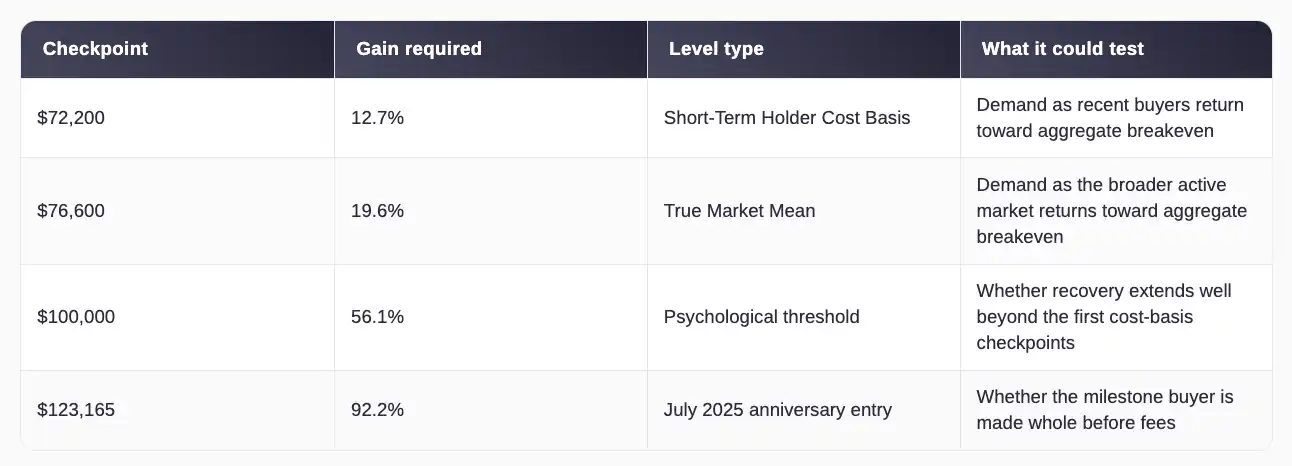
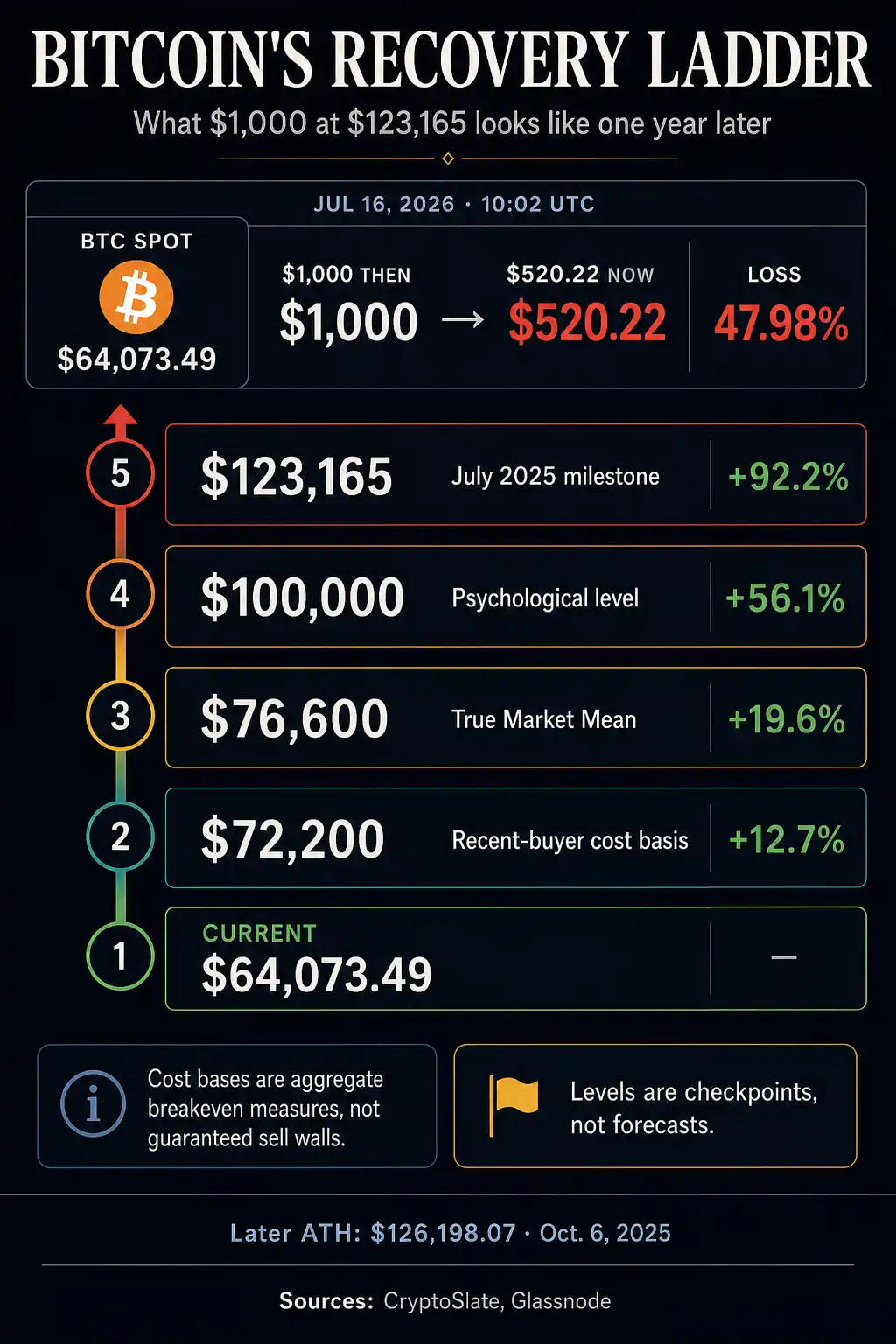
Key Level Overview:

  • $72,200 (Requires a 12.7% increase): Short-Term Holder cost basis – a test of demand as recent buyers return to break-even.
  • $76,600 (Requires a 19.6% increase): Realized Market Mean – a test of demand as the broader active market returns to break-even.
  • $100,000 (Requires a 56.1% increase): A psychological threshold, testing whether recovery extends well beyond the first cost basis checkpoints.
  • $123,000 (Requires a 92.2% increase): The July 2025 entry price – whether last year's peak buyers can break even.

Bottom Still Not Confirmed

In a July 13th update, Glassnode noted that BTC's movement towards $64,000 lacked broad consensus, with weak spot market participation and on-chain activity. On July 15th, Glassnode stated that the Long-Term Holder capitulation was cooling, with buyers absorbing the June lows, but the bottom remains "a work in progress."

These two updates point towards gradual improvement – but stronger demand is still required to break through the aforementioned cost bases. At the two key levels of $72,200 and $76,600, the core question is: how much potential selling pressure emerges, and can buyers absorb it.

Glassnode also maintains exposure to downside risks – a July 8th report noted that the bear market lower bound, the Realized Price around $53,000, could still be tested. Glassnode views $53,000 as a residual risk and continues to characterize the bottom as unconfirmed.

BTC must first recapture the two cost bases at $72,200 and $76,600 before $100,000 and $123,000 become meaningful. A stronger recovery first depends on whether demand can absorb potential risk release around $72,200, followed by $76,600. Until these checkpoints are reclaimed and confirmed by broader participation, last year's peak buyers face the presence of holders who can exit much earlier.


Trending Cryptos

Related Questions

QAccording to the article, what is the current price of Bitcoin mentioned and how much loss do buyers from last July face?

AThe current price of Bitcoin is approximately $64,000. Buyers who entered at the peak of $120,000 last July are facing a loss of nearly 48%, as a $1,000 investment is now worth about $520.

QWhat is the first key cost basis level that Bitcoin needs to reclaim according to Glassnode's data, and what does it represent?

AThe first key cost basis level is $72,200, which represents the Short-Term Holder Cost Basis. It is the aggregate break-even point for recent buyers and will be an initial test of demand as sellers may look to exit when their losses narrow at this level.

QWhat percentage increase is required for Bitcoin to reach the $72,200 Short-Term Holder Cost Basis level from the current price?

AA 12.7% increase from the current price of approximately $64,000 is required for Bitcoin to reach the $72,200 Short-Term Holder Cost Basis level.

QWhat is the second, broader cost basis level mentioned, and what is it called?

AThe second, broader cost basis level mentioned is $76,600. It is called the Realized Price, which serves as a cost benchmark for the wider active investor market.

QAccording to the article, what is identified as a residual downside risk for Bitcoin?

AA downside risk level of approximately $53,000 is identified as a residual risk. This is mentioned as the bear market lower bound and the Realized Price, which could still be tested.

Related Reads

Who Is Shaping Ethereum's Future: The Takeover by Token-Holding Companies Could Be the Best Thing for ETH in Years

**Title: Who is Building Ethereum's Future? Corporate ETH Holders Take Over Funding, Possibly the Best Thing for ETH in Years.** **Summary:** The Ethereum Foundation is scaling back due to fiscal concerns, but publicly traded companies holding large amounts of ETH, like Bitmine and SharpLink, are stepping in to fund protocol development. These firms collectively hold nearly 5% of ETH's circulating supply and are using their staking yields to pay for R&D. Unlike MicroStrategy, which merely accumulates Bitcoin, these ETH treasury companies are reinvesting profits directly into the protocol's development—potentially allowing all ETH holders to benefit from this free "spillover." Key drivers for this shift include these companies' stalled business model. Their "flywheel" of issuing stock to buy more ETH broke as their stock prices fell below the net value of their crypto holdings (mNAV < 1). With their ETH holdings also deeply underwater, simply waiting for price appreciation failed. By funding Ethereum's roadmap—through new non-profits like ETH Labs and Ethereum Institutional—they aim to increase the utility and value of the underlying asset that dominates their balance sheets. This creates a new alignment of interests: these companies are highly incentivized to see Ethereum succeed and are less likely to sell en masse. However, risks remain. The exact funding amounts are undisclosed, and these treasury firms themselves are vulnerable if ETH prices fall further, which could halt their contributions. **Additional Context:** The article also contrasts Jito's new "token-centric" proposal (JIP-38), which credibly directs platform fees to token buybacks, with Venice's less concrete promises, highlighting the importance of where revenue legally lands and who controls the mechanisms. Other notable industry updates include the rise of TradFi perpetuals on Hyperliquid, new Bitcoin staking via Stacks, and various DeFi product launches.

marsbit15m ago

Who Is Shaping Ethereum's Future: The Takeover by Token-Holding Companies Could Be the Best Thing for ETH in Years

marsbit15m ago

Opening Claude's Brain Is Useless; The True Key to the AI Black Box Lies in Ontology Engineering

"Dissecting Claude's Brain Is Futile: The Real Key to the AI Black Box Lies in Ontology Engineering" This article critiques the limitations of Anthropic's "J-Space" research, which attempts to explain AI models by observing their internal neural activation patterns, akin to fMRI brain scans. While this "internalist" approach offers unprecedented visibility into model states, it fundamentally conflates observability with true explainability. The core issue is that understanding a model's output requires more than tracing neural activity; it necessitates examining the meaning of the information it processes—its relationship to the world, semantic norms, and human cognitive frameworks. The author proposes a paradigm shift: moving from a neuroscience-inspired focus on the model itself to an "information ontology" approach centered on the knowledge the model handles. Drawing from Kant's philosophical categories, the argument posits that true explainability lies in structuring and understanding information within a formal conceptual framework, not in peering into the "black box." The practical application of this theory is ontology engineering. Ontologies provide a structured, computable framework for knowledge, serving as a semantic anchor for model outputs. The article details a bidirectional synergy: Large Language Models (LLMs) can automate and scale ontology construction, while ontologies, in turn, enhance AI explainability. They act as a verification framework, allowing model reasoning to be traced back to defined concepts, properties, and relationships. This transforms explainability from the impossible task of making neural networks transparent into the achievable engineering goal of making their outputs and impacts understandable, traceable, and accountable. The future of AI explainability, therefore, lies not in explaining the model's internal mechanics but in explaining and governing the knowledge structures and real-world effects of its outputs.

marsbit24m ago

Opening Claude's Brain Is Useless; The True Key to the AI Black Box Lies in Ontology Engineering

marsbit24m ago

Trading

Spot

Hot Articles

What is $BITCOIN

DIGITAL GOLD ($BITCOIN): A Comprehensive Analysis Introduction to DIGITAL GOLD ($BITCOIN) DIGITAL GOLD ($BITCOIN) is a blockchain-based project operating on the Solana network, which aims to combine the characteristics of traditional precious metals with the innovation of decentralized technologies. While it shares a name with Bitcoin, often referred to as “digital gold” due to its perception as a store of value, DIGITAL GOLD is a separate token designed to create a unique ecosystem within the Web3 landscape. Its goal is to position itself as a viable alternative digital asset, although specifics regarding its applications and functionalities are still developing. What is DIGITAL GOLD ($BITCOIN)? DIGITAL GOLD ($BITCOIN) is a cryptocurrency token explicitly designed for use on the Solana blockchain. In contrast to Bitcoin, which provides a widely recognized value storage role, this token appears to focus on broader applications and characteristics. Notable aspects include: Blockchain Infrastructure: The token is built on the Solana blockchain, known for its capacity to handle high-speed and low-cost transactions. Supply Dynamics: DIGITAL GOLD has a maximum supply capped at 100 quadrillion tokens (100P $BITCOIN), although details regarding its circulating supply are currently undisclosed. Utility: While precise functionalities are not explicitly outlined, there are indications that the token could be utilized for various applications, potentially involving decentralized applications (dApps) or asset tokenization strategies. Who is the Creator of DIGITAL GOLD ($BITCOIN)? At present, the identity of the creators and development team behind DIGITAL GOLD ($BITCOIN) remains unknown. This situation is typical among many innovative projects within the blockchain space, particularly those aligning with decentralized finance and meme coin phenomena. While such anonymity may foster a community-driven culture, it intensifies concerns about governance and accountability. Who are the Investors of DIGITAL GOLD ($BITCOIN)? The available information indicates that DIGITAL GOLD ($BITCOIN) does not have any known institutional backers or prominent venture capital investments. The project seems to operate on a peer-to-peer model focused on community support and adoption rather than traditional funding routes. Its activity and liquidity are primarily situated on decentralized exchanges (DEXs), such as PumpSwap, rather than established centralized trading platforms, further highlighting its grassroots approach. How DIGITAL GOLD ($BITCOIN) Works The operational mechanics of DIGITAL GOLD ($BITCOIN) can be elaborated on based on its blockchain design and network attributes: Consensus Mechanism: By leveraging Solana’s unique proof-of-history (PoH) combined with a proof-of-stake (PoS) model, the project ensures efficient transaction validation contributing to the network's high performance. Tokenomics: While specific deflationary mechanisms have not been extensively detailed, the vast maximum token supply implies that it may cater to microtransactions or niche use cases that are still to be defined. Interoperability: There exists the potential for integration with Solana’s broader ecosystem, including various decentralized finance (DeFi) platforms. However, the details regarding specific integrations remain unspecified. Timeline of Key Events Here is a timeline that highlights significant milestones concerning DIGITAL GOLD ($BITCOIN): 2023: The initial deployment of the token occurs on the Solana blockchain, marked by its contract address. 2024: DIGITAL GOLD gains visibility as it becomes available for trading on decentralized exchanges like PumpSwap, allowing users to trade it against SOL. 2025: The project witnesses sporadic trading activity and potential interest in community-led engagements, although no noteworthy partnerships or technical advancements have been documented as of yet. Critical Analysis Strengths Scalability: The underlying Solana infrastructure supports high transaction volumes, which could enhance the utility of $BITCOIN in various transaction scenarios. Accessibility: The potential low trading price per token could attract retail investors, facilitating wider participation due to fractional ownership opportunities. Risks Lack of Transparency: The absence of publicly known backers, developers, or an audit process may yield skepticism regarding the project's sustainability and trustworthiness. Market Volatility: The trading activity is heavily reliant on speculative behavior, which can result in significant price volatility and uncertainty for investors. Conclusion DIGITAL GOLD ($BITCOIN) emerges as an intriguing yet ambiguous project within the rapidly evolving Solana ecosystem. While it attempts to leverage the “digital gold” narrative, its departure from Bitcoin's established role as a store of value underscores the need for a clearer differentiation of its intended utility and governance structure. Future acceptance and adoption will likely depend on addressing the current opacity and defining its operational and economic strategies more explicitly. Note: This report encompasses synthesised information available as of October 2023, and developments may have transpired beyond the research period.

849 Total ViewsPublished 2025.05.13Updated 2025.05.13

What is $BITCOIN

Discussions

Welcome to the HTX Community. Here, you can stay informed about the latest platform developments and gain access to professional market insights. Users' opinions on the price of BTC (BTC) are presented below.

活动图片