Bitcoin's Short-Term Volatility Fails to Alter Medium-Term Bearish Trend; HYPE Presents Another Buying Opportunity | Invited Analysis

Odaily星球日报Published on 2026-04-06Last updated on 2026-04-06

Abstract

Bitcoin (BTC) continues its short-term consolidation within a range, while the medium-term bearish trend remains intact. HYPE shows signs of completing its Wave IV correction, presenting a potential long opportunity. Last week, BTC saw a 2.45% gain on a short-term short trade and a 22.43% profit on an ongoing medium-term short position initiated at $89,000. For HYPE, technical analysis indicates its Wave IV adjustment is nearing completion in both time and price. A daily bottom pattern is strengthening, and quantitative models have triggered bottom warnings. The strategy is to go long on HYPE with 30% capital, looking for a breakout above $38 and a confirmed pullback support at $34.47. BTC is expected to trade between $65,000 and $69,500 this week. A break above $69,500 could lead to a wider range up to $72,000, while a drop below $65,000 may target the $60,000-$62,500 support zone. The medium-term bearish outlook persists; the strategy is to hold the current short position and consider new shorts on rebounds toward $69,500-$72,000 or a break below $65,000. All views are for informational purposes only and not investment advice. Market conditions change rapidly; trade with caution and proper risk management.

Last week, Bitcoin continued its range-bound volatility, which aligns closely with our previous predictions.

This week, we will focus on two main themes: First, HYPE's Wave IV adjustment has nearly met both time and space requirements, with the daily chart bottom pattern strengthening continuously. The quantitative model has also triggered a bottom warning, and we will focus on capturing buying opportunities this week. Second, Bitcoin's medium-term bearish trend remains unchanged. We maintain our range-bound volatility assessment for this week and will flexibly execute two short-term trading plans (A and B) based on support/resistance levels and model signals.

Summary of Core Trading Views for This Week:

• Analysis of HYPE's multi-timeframe structure. (See Part 1)

• HYPE's weekly forecast and short-term trading strategy. (See Part 2)

• Interpretation of BTC's multi-timeframe structure. (See Part 3)

• BTC's weekly forecast and medium/short-term trading strategies. (See Parts 4 & 5)

Market Validation of Last Week's Core Views:

• BTC Short-Term Trading Results: One short-term short position (1x leverage) was executed last week, successfully realizing a gain of approximately 2.45%. (See Table 1)

• BTC Medium-Term Trading Results Validation: Continued holding the short position established at $89,000 (1x leverage) as per the medium-term strategy. As of last week's close (~$69,031), the profit is ~22.43%, with a maximum profit of ~32.58% during the period.

• BTC Market Forecast Validation: In last week's article, we stated: The market will maintain a range-bound pattern. The current market movement validates our previous prediction.

I. HYPE: Structure Analysis

1. HYPE Daily Chart Structure Breakdown: (Based on price action since January 21)

HYPE_Daily Chart
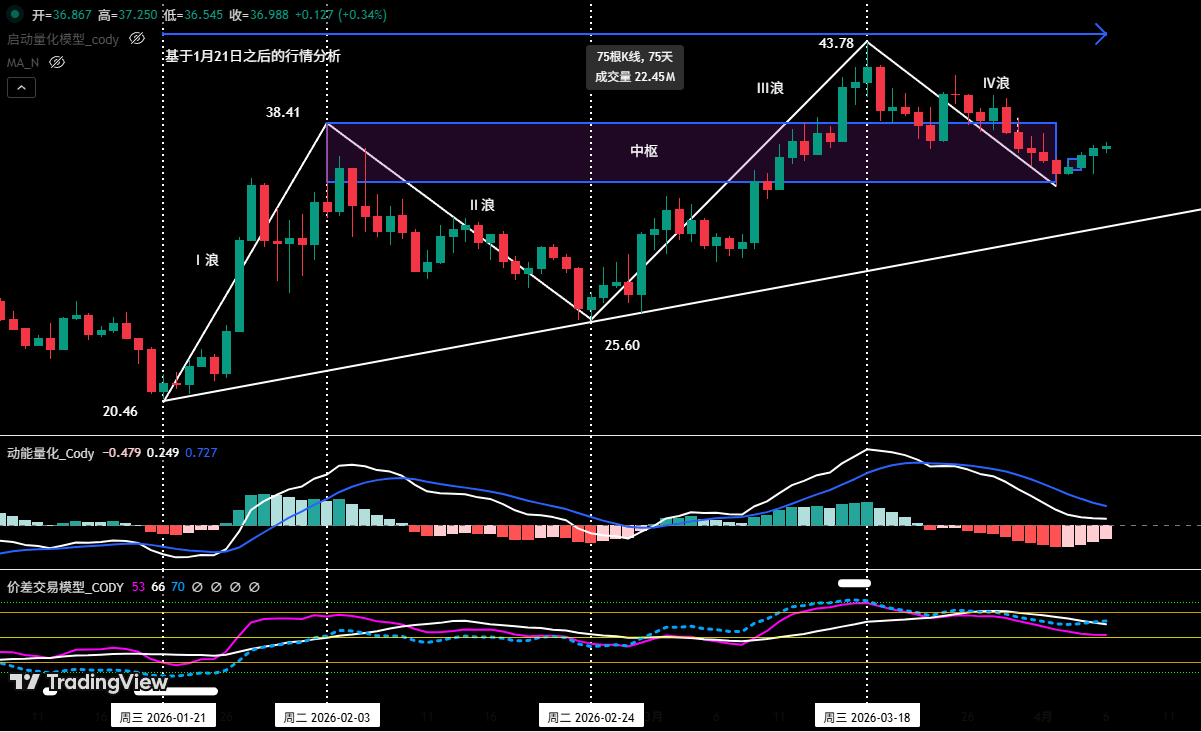
Figure 1

As shown in (Figure 1):

• Wave I (Impulse Wave): From the January 21 low of $20.46 to the February 3 high of $38.41, lasting 14 days, with a maximum gain of 87.73%.

Wave II (Corrective Wave): From the February 3 high of $38.41 to the February 24 low of $25.60, lasting 20 days, with a maximum decline of 33.35%.

Wave III (Main Rally Wave): From the February 24 low of $25.60 to the March 18 high of $43.78, lasting 23 days, with a maximum gain of 71.02%.

• Wave IV (Corrective Wave): From the March 18 high of $43.78 to present, has lasted 18 days so far, with a maximum decline of 21.33%.

2. In-Depth Analysis of HYPE's Current Structure (Using 4-Hour Chart)

HYPE_4-Hour Chart
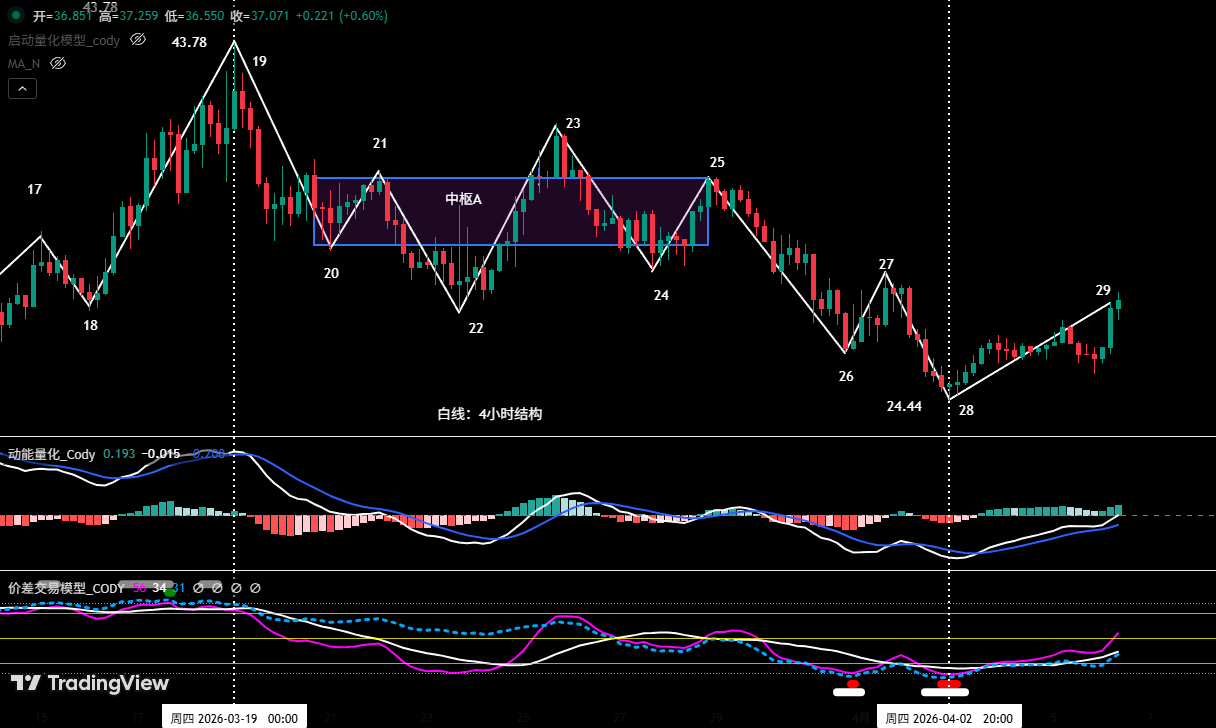
Figure 2

Breakdown based on the Wave IV correction since the March 18 high of $43.78.

As shown in (Figure 2), Wave IV can be subdivided into a complex corrective structure consisting of 9 segments between endpoint 19 and endpoint 28: 19-20, 20-21, 21-22, 22-23, 23-24, 24-25, 25-26, 26-27, 27-28.

• Central Pivot A (Zhongshu A): The 5 segments (20-21, 21-22, 22-23, 23-24, 24-25) overlap with each other, forming a declining central pivot (Central Pivot A).

• The price is currently moving in segment 28-29. The chart shows key momentum divergence signals have appeared: comparing the entry segment (19-20) with the exit segment (25-26), and segment 25-26 with segment 27-28, both show decaying downward momentum. This indicates Wave IV correction is highly likely to have ended near endpoint 28.

• Our proprietary Spread Trading Model triggered bottom warning signals at endpoint 26 and endpoint 28 (red and white dots on the chart).

II. HYPE: Weekly Forecast & Short-Term Trading Strategy

1. HYPE Weekly Market Forecast:

• From a daily perspective, the Wave IV correction initiated from the March 18 high of $43.78 has lasted 19 days. Referring to the previous Wave II correction which lasted about 20 days, this correction may be nearing its end.

• Analysis of the 4-hour cycle suggests a high probability that the Wave IV correction ended near endpoint 28.

Weekly Forecast: Technically, HYPE's Wave IV correction has largely fulfilled its time and space requirements. The daily "bottom reversal" pattern formed around the April 1 low is strengthening, coupled with quantitative model bottom warning signals. Therefore, this week we focus on identifying the end of HYPE's correction and capturing entry opportunities.

2. HYPE Short-Term Trading Strategy for the Week:

• Based on the overall anticipated upward trend, adhere to the strategy of "follow the trend, buy on dips".

• Utilize our proprietary quantitative model signals, using the 30-minute/60-minute charts as operational cycles, and employ 30% of capital to capture long entry opportunities.

• Entry Strategy: The price is currently oscillating upward. If the price can break through the key resistance at $38 this week and successfully retest and hold above the support at $34.47 (April 2 low) (the further the retest is from this low, the better), it may present a high-probability right-side buying opportunity.

3. HYPE Upside Risk Warning: Although HYPE's trend has independence, it cannot completely decouple from Bitcoin's broader environment. If Bitcoin shows significant correction subsequently, it might impact HYPE's rebound momentum.

III. Bitcoin: Structure Interpretation​

1. BTC Daily Chart Structure Analysis: (Based on price action since February 6)

• The rally in Bitcoin initiated from the ~$60,000 low on February 6 can still be defined as a large-degree Wave C-2 oversold rebound within a larger corrective structure. If the subsequent rebound fails to break the ~$76,000 high from March 17, the probability of a subsequent Wave C-3 decline is high.

• Key observation points for structural evolution:

The current rebound cycle is prolonging. Monitor whether the subsequent rebound can break the March 17 high. If successfully broken, this rebound might upgrade to a more complex Wave D rebound (same degree as Wave C), potentially followed by a Wave E correction.

• Core conditions for trend confirmation:

The key signal to finally confirm the start of the Wave C-3 (or Wave E) correction is a decisive break below the previous ~$60,000 support low from February 6. Before this, the market remains in a stage of rebound and trend transition博弈 (game theory/contest).

2. In-Depth Analysis of BTC's Current Structure: (Using 4-Hour Chart)

Bitcoin _4-Hour Chart
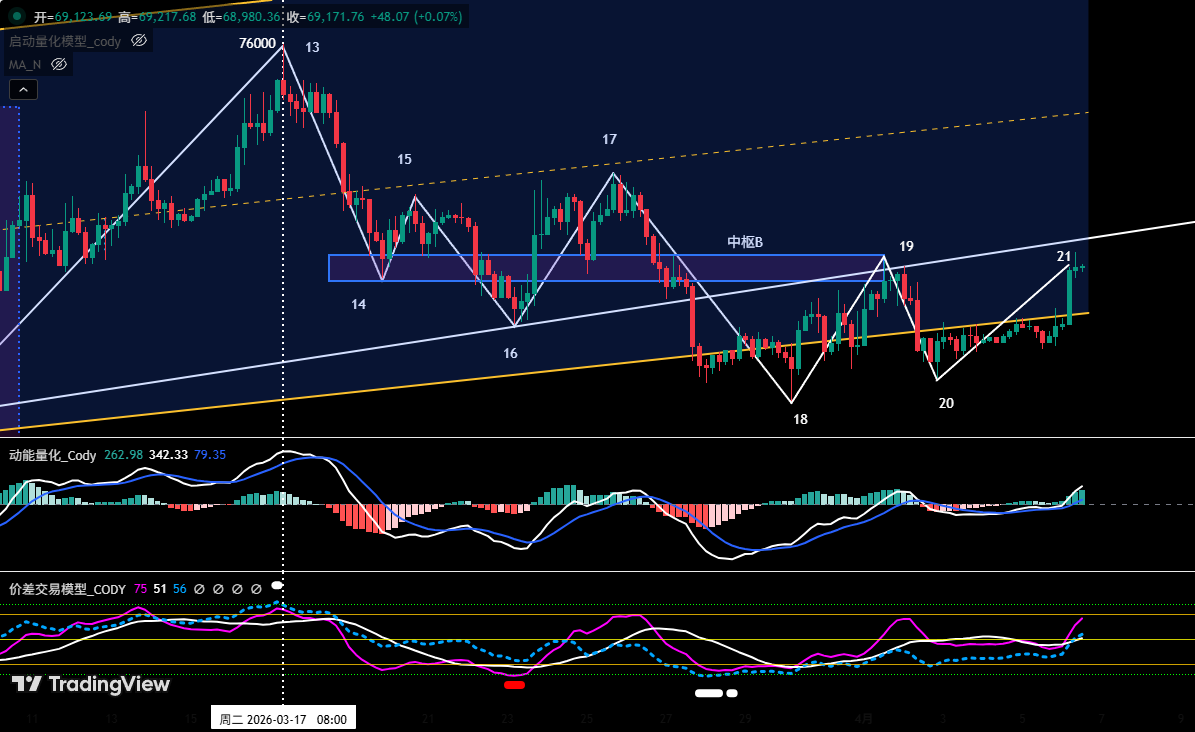
Figure 3

• Based on price action since the March 17 high (~$76,000).

• As shown in (Figure 3), BTC retreated from the March 17 high. From endpoint 13 to endpoint 21, it consists of an 8-segment structure.

• Central Pivot B (Zhongshu B): The declining central pivot consists of 6 segments: 14-15, 15-16, 16-17, 17-18, 18-19, 19-20, and is continuously extending leftwards.

• Currently, segment 20-21 is in progress, with the price touching near the upper轨 (rail/band) of the central pivot around $69,300.

IV. Bitcoin: Weekly Forecast & Short-Term Trading Strategy

1. BTC Weekly Market Forecast:

• Core view for the week: Price maintains range-bound volatility between $65,000~$69,500. If it effectively breaks above the resistance near $69,500, it might enter a wider震荡区间 (volatility range) of $65,000~$72,000; if it breaks below the $65,000 support, watch for support in the $60,000~$62,500 zone.

• The beginning of the week is near a news-sensitive window,建议以观望为主 (advising a primarily wait-and-see approach).

3. Core Resistance Levels:

• First Resistance Zone: $69,500~$72,000 area (previous range)

• Second Resistance Zone: $74,500~$76,000 area (near November 2025 low)

4. Core Support Levels:

• First Support: $65,000~$66,000 area (previous important support zone)

• Second Support: $60,000~$62,500 area (near February 6 low)

• Third Support: Near $57,400

5. Trading Strategy for the Week (Excluding Sudden News Impact): (04.06~04.12)

1. Medium-Term Strategy:

Bitcoin _ Daily Chart: (Position Monitoring Model)
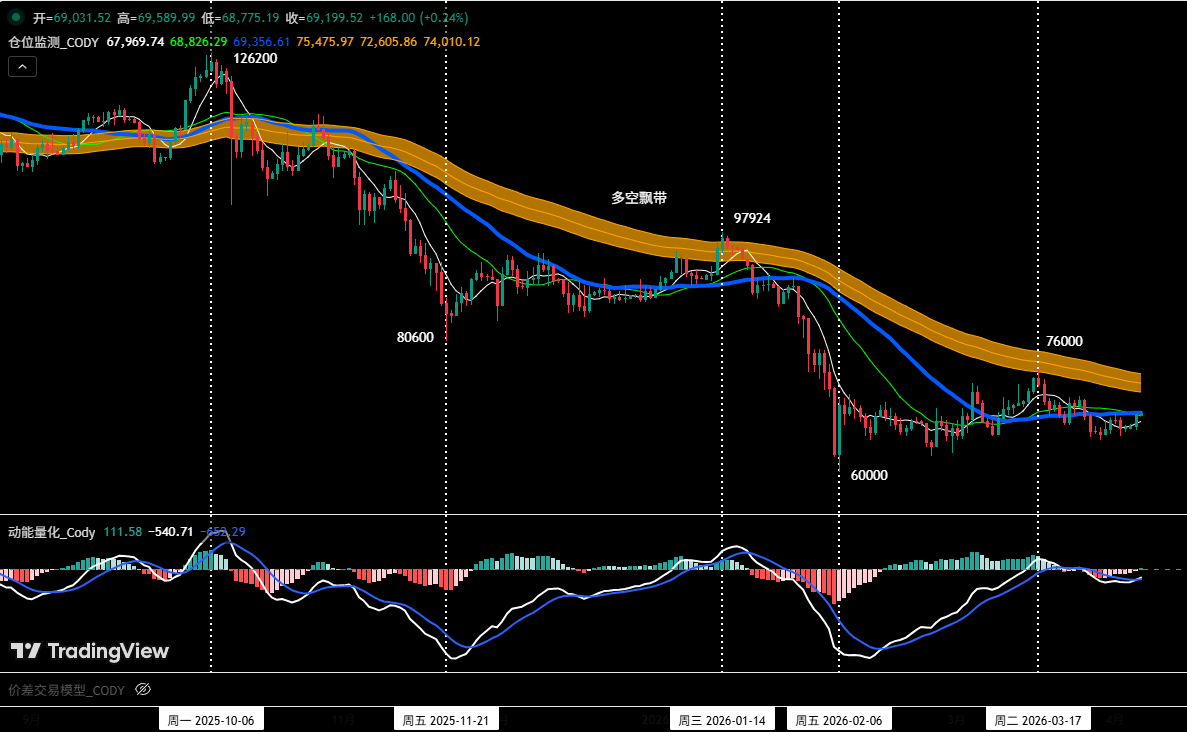
Figure 4

Position Monitoring Model: As shown in (Figure 4), the price is currently below the Bull-Bear Ribbon (yellow), indicating the bearish trend continues. Following strategy rules, we continue holding the 60% short position established at $89,000 (January 28).

• If the price反弹 (rebounds) and effectively breaks above and holds above the Bull-Bear Ribbon, close all medium-term positions.

2. Short-Term Strategy: Utilize 30% of capital, set stop-loss points, and look for "spread" opportunities based on support and resistance levels. (Use 30-minute/60-minute charts as operational cycles).

3. Based on the anticipation of a medium-term bearish market trend, currently adhere to the principle of "follow the trend by shorting". To dynamically respond to complex market changes and combined with signals from our proprietary trading model, we have prepared two short-term contingency plans (A/B):

Plan A: Short on rallies meeting resistance.

• Entry: When the price rallies to the $69,500~$72,000 zone, triggers resistance signals, and is combined with model top signals, establish a 15% short position.

• Add: When the price continues to rally to the $74,500~$76,000 zone, triggers resistance signals, and is combined with model top signals, add another 15% short position.

• Risk Control: Initial stop-loss for both short entries set above $76,500.

• Exit: When the price falls near important support levels combined with model signals, gradually close positions to take profits.

Plan B: Follow-through short on breakdown.

• Entry: When the price effectively breaks below the support near $65,000, combined with model top signals,顺势建立 (follow through to establish) a 30% short position.

• Risk Control: Initial stop-loss for the short position set above $67,000.

• Exit: When the price declines to support levels combined with model signals, gradually close positions to take profits.

V. Bitcoin: Last Week's Operation Review

1. Short-Term Operation Review: (See Table 1)

We strictly followed the operation plan. Based on交易信号 (trading signals) from our proprietary Spread Trading Model and Momentum Quantitative Model, we executed one short-term (short) operation last week, achieving a 2.45% profit.

1. Bitcoin Short-Term Trade Details Summary: (Leverage*1x)
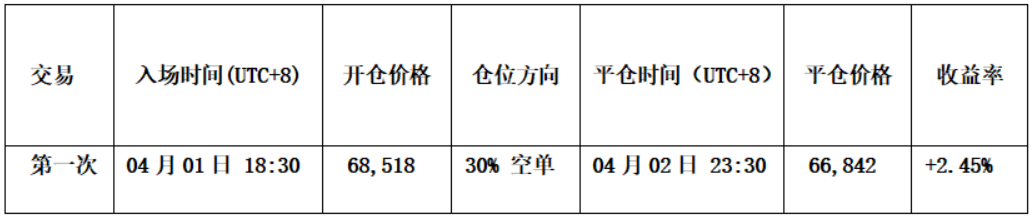
Table 1

2. Short-Term Trade Review: (See Figure 5)

• Entry: When the price rallied near $72,000 and encountered resistance, the Spread Trading Model simultaneously triggered a top warning signal (white dot), forming a shorting resonance with the Momentum Quantitative Model. Therefore, we established a 30% short position at $68,518.

• Exit: When the price fell near $65,000 and stabilized,同时 (simultaneously) the Spread Trading Model triggered a strong bottom warning signal (red dot + white dot). Therefore, we closed all positions near $66,842.

• Summary: This trade successfully profited approximately 2.45%.

Bitcoin _30-Minute Chart: (Momentum Quantitative Model + Spread Trading Model)
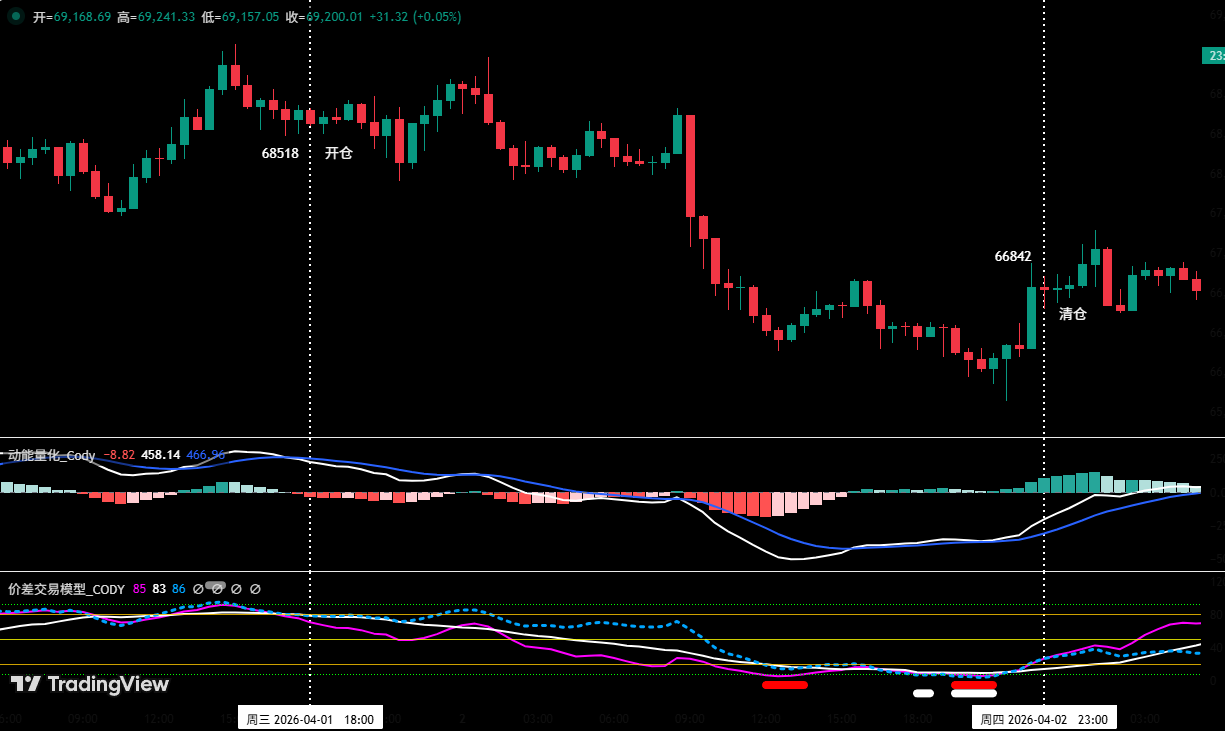
Figure 5 (Short-Term Trade Illustration)

2. Medium-Term Operation Review:

Medium-Term Strategy: Continued holding the 60% short position established near $89,000 (January 28). As of last week's close (closing price ~$69,031), the profit is approximately 22.43%.

VI. Special Notes

1. When opening a position: Immediately set the initial stop-loss level.

2. When profit reaches 1%: Move the stop-loss to the entry price (breakeven point) to ensure capital safety.

3. When profit reaches 2%​​: Move the stop-loss to the 1% profit level.

4. Continuous tracking: Thereafter, for every additional 1% profit, move the stop-loss up by 1% accordingly, dynamically protecting and locking in profits.

Financial markets change rapidly; all market analysis and trading strategies require dynamic adjustment. All views, analytical models, and operational strategies involved in this article are derived from personal technical analysis, intended solely for personal trading log purposes, and do not constitute any investment advice or operational basis. The market involves risks, investment requires caution. Do not make decisions based solely on this content.


Related Questions

QWhat is the main trading opportunity identified for HYPE in the article?

AThe article identifies a potential long opportunity for HYPE, as its IV-wave adjustment is nearing completion in both time and price, with a strengthening daily bottom pattern and quantitative models triggering bottom warnings.

QWhat is the overall medium-term trend outlook for Bitcoin according to the analysis?

AThe analysis states that Bitcoin's medium-term bearish trend remains unchanged, with the price expected to fluctuate within a range in the short term.

QWhat are the two short-term operation plans (A and B) proposed for Bitcoin?

APlan A is to sell short on rallies if the price hits the resistance zone of $69,500~$72,000 or $74,500~$76,000. Plan B is to sell short on a breakdown if the price effectively breaks below the $65,000 support level.

QWhat key signal does the article mention for confirming the start of a C-3 (or E-wave) decline for Bitcoin?

AThe key signal for confirming the start of a C-3 or E-wave decline is the price effectively breaking below the key support level around $60,000, which was the low on February 6th.

QWhat risk management rule is emphasized in the 'Special Tips' section for managing a trade?

AThe rules include setting an initial stop-loss immediately upon opening a position, moving the stop-loss to the breakeven point once a 1% profit is reached, and then trailing the stop-loss by 1% for every subsequent 1% gain in profit to lock in earnings.

Related Reads

After the Passage of the GENIUS Act and the CLARITY Act, What Is the Correct Architecture for On-Chain Yield?

The article discusses the evolution of on-chain credit, distinguishing three markets: overcollateralized crypto lending, unsecured lending (largely unsuccessful), and asset-backed credit (ABC). ABC, backed by identifiable real-world collateral with legal recourse, is identified as the fastest-growing category and the only one credibly addressing adverse selection—the core problem in credit where the riskiest borrowers self-select. Current growth in on-chain Real World Assets (RWAs), particularly tokenized private credit funds (e.g., Maple Finance, Centrifuge), is substantial but often merely "wraps" existing fund structures, inheriting their risks rather than solving adverse selection at the protocol level. The regulatory landscape is a key driver, with the US GENIUS Act (prohibiting stablecoin issuers from paying yield) and the proposed CLARITY Act (closing loopholes on indirect yield) set to redefine permissible yield-bearing products. This makes vaults (like ERC-4626) the critical architecture—they become the primary compliant vehicle for delivering yield, functioning as issuance, disclosure, distribution, and recovery mechanisms. The author's thesis is that the correct post-GENIUS/CLARITY architecture involves building ABC solutions where credit assessment, structure, and recovery are encoded directly into the smart contract vault layer, moving beyond mere tokenized fund wrappers to solve adverse selection fundamentally and ensure regulatory compliance.

Foresight News22m ago

After the Passage of the GENIUS Act and the CLARITY Act, What Is the Correct Architecture for On-Chain Yield?

Foresight News22m ago

TechFlow Intelligence Bureau: Anthropic's New Model Fable Sparks Controversy by Restricting Biosafety Research, US CPI Soars to 4.2%, a Three-Year High

**Summary of TechFlow Intelligence Report:** The newsletter covers several key tech and finance developments. In AI, Anthropic's new Fable model faced backlash for secretly limiting biomedical research capabilities and enforcing a 30-day data retention policy, prompting the company to promise more transparent adjustments. In a related story, Anthropic's founder revealed his departure from OpenAI was due to dishonesty from Sam Altman, not safety concerns. Meanwhile, OpenAI is considering significant price cuts to compete with Anthropic, potentially sparking a price war. In crypto/Web3, BlackRock filed a new amendment for a yield-generating Bitcoin ETF, while Bank of America's CEO warned that stablecoin yields could drain trillions from traditional banks. U.S. Senator Cynthia Lummis advocated for the U.S. to officially accumulate Bitcoin reserves. In hardware, Nvidia released the DiffusionGemma-2-6B image model optimized for efficient inference, and AMD promoted its unified memory architecture to challenge Nvidia's dominance. TSMC's CFO hinted at possible price increases due to soaring AI chip demand. A major legal ruling in Germany held Google legally responsible for inaccurate information generated by its AI Overviews feature. Google Chrome also moved to fully block ad-blocker workarounds like uBlock Origin. Macroeconomic headlines included U.S. CPI rising to 4.2% (a 3-year high) and Iran's complete closure of the Strait of Hormuz, raising oil price and inflation fears. South Korean markets saw continued volatility with massive foreign capital outflow. Other notable stories: Microsoft expanded its Copilot AI assistant "Mico" globally; a study found r/wallstreetbets users' stock picks outperformed Wall Street; a fully autonomous drone killed a human soldier for the first time, raising AI ethics concerns; and a Chinese hospital used brain-computer interface technology to help a blind person "see." The overarching theme connects debates over AI boundaries and responsibility (Anthropic's restrictions, Google's liability, lethal autonomous drones) with real-world economic and geopolitical turmoil (inflation, Strait of Hormuz closure, market instability), highlighting the tense interplay between technological advancement and global chaos.

marsbit35m ago

TechFlow Intelligence Bureau: Anthropic's New Model Fable Sparks Controversy by Restricting Biosafety Research, US CPI Soars to 4.2%, a Three-Year High

marsbit35m ago

Alibaba's Yet Another New Business Division: What Signal Does It Send?

Alibaba has established a new "Token Foundry" business unit, merging its Tongyi large model division and Future Life Lab. Led directly by Group CEO Wu Yongming, this marks the company's third significant AI organizational reshuffle in 2026, following the creation of the Alibaba Token Hub (ATH) and a Group Technology Committee. The move signals a strategic shift from consolidating AI resources to accelerating productization and commercialization. The "Token Foundry" name reflects Alibaba's ambition to become a foundational supplier in the AI era, focusing on model development and commercial application. Key teams, including those behind the high-performing HappyHorse video generation model, have been integrated into the new unit. Concurrently, Zhou Jingren, architect of the Qwen model series, has been appointed Group Chief Scientist to lead a new AI Future Research Institute, focusing on long-term technological breakthroughs like Agent capabilities. This restructuring creates a clear four-layer AI architecture within Alibaba: the research institute for frontier exploration, Token Foundry for core models and commercialization, MaaS for platform services, and business units like Qianwen (C端) and Wukong (B端) for end-user applications. The adjustments align with a global trend among tech giants like Google and Microsoft to centralize AI leadership under the CEO and deeply integrate research with business units. The urgency is driven by a narrowing competitive window. Alibaba has announced its AI business is now entering a commercialization phase, with AI-related revenue seeing triple-digit growth for eleven consecutive quarters. The company faces intense competition in the MaaS (Model-as-a-Service) sector from rivals like ByteDance and Tencent. The Token Foundry initiative represents Alibaba's effort to streamline execution and enhance competitiveness in this critical, fast-evolving landscape.

marsbit59m ago

Alibaba's Yet Another New Business Division: What Signal Does It Send?

marsbit59m ago

From Return to Resignation: Chen Hang's 437 Days at DingTalk

The 437-Day Return and Departure of Chen Hang at DingTalk This article chronicles the 437-day period from March 31, 2025, to June 11, 2026, when Chen Hang (also known as "No Move") returned as CEO of DingTalk, the enterprise communication platform he originally founded, only to later step down. Chen Hang, the creator of DingTalk in 2015, was brought back by Alibaba in 2025 after the company acquired his subsequent startup, HHO. His return was driven by Alibaba's renewed focus on AI and DingTalk's strategic role as its key to-B AI application. However, his aggressive management style, marked by strict work policies like mandatory clock-ins and extended hours, quickly caused internal friction and was criticized as being at odds with Alibaba's culture. Despite the internal turmoil, Chen Hang drove significant product launches. In August 2025, he unveiled "AI DingTalk 1.0," featuring new products like the AI-native entry point "DingTalk ONE." By March 2026, he announced "Wukong," touted as the world's first enterprise-grade AI-native work platform, representing a fundamental rebuild of DingTalk's architecture. The turning point came in early June 2026. A detailed internal post criticizing DingTalk's work culture went viral, followed by a public critique from a former executive. This prompted an unprecedented public rebuke from the Alibaba Partners Committee, which stated such management was not aligned with company values. One day later, on June 11, Alibaba announced Chen Hang's departure. He was succeeded by Chen Yusen, a 32-year-old technical expert known for founding cybersecurity firm Changting Technology. While Chen Hang's tenure laid the technical foundation for DingTalk's AI transformation with "Wukong," his leadership style ultimately led to his replacement as the company seeks a new direction under younger leadership.

marsbit1h ago

From Return to Resignation: Chen Hang's 437 Days at DingTalk

marsbit1h ago

Trading

Spot
Futures

Hot Articles

What is $BITCOIN

DIGITAL GOLD ($BITCOIN): A Comprehensive Analysis Introduction to DIGITAL GOLD ($BITCOIN) DIGITAL GOLD ($BITCOIN) is a blockchain-based project operating on the Solana network, which aims to combine the characteristics of traditional precious metals with the innovation of decentralized technologies. While it shares a name with Bitcoin, often referred to as “digital gold” due to its perception as a store of value, DIGITAL GOLD is a separate token designed to create a unique ecosystem within the Web3 landscape. Its goal is to position itself as a viable alternative digital asset, although specifics regarding its applications and functionalities are still developing. What is DIGITAL GOLD ($BITCOIN)? DIGITAL GOLD ($BITCOIN) is a cryptocurrency token explicitly designed for use on the Solana blockchain. In contrast to Bitcoin, which provides a widely recognized value storage role, this token appears to focus on broader applications and characteristics. Notable aspects include: Blockchain Infrastructure: The token is built on the Solana blockchain, known for its capacity to handle high-speed and low-cost transactions. Supply Dynamics: DIGITAL GOLD has a maximum supply capped at 100 quadrillion tokens (100P $BITCOIN), although details regarding its circulating supply are currently undisclosed. Utility: While precise functionalities are not explicitly outlined, there are indications that the token could be utilized for various applications, potentially involving decentralized applications (dApps) or asset tokenization strategies. Who is the Creator of DIGITAL GOLD ($BITCOIN)? At present, the identity of the creators and development team behind DIGITAL GOLD ($BITCOIN) remains unknown. This situation is typical among many innovative projects within the blockchain space, particularly those aligning with decentralized finance and meme coin phenomena. While such anonymity may foster a community-driven culture, it intensifies concerns about governance and accountability. Who are the Investors of DIGITAL GOLD ($BITCOIN)? The available information indicates that DIGITAL GOLD ($BITCOIN) does not have any known institutional backers or prominent venture capital investments. The project seems to operate on a peer-to-peer model focused on community support and adoption rather than traditional funding routes. Its activity and liquidity are primarily situated on decentralized exchanges (DEXs), such as PumpSwap, rather than established centralized trading platforms, further highlighting its grassroots approach. How DIGITAL GOLD ($BITCOIN) Works The operational mechanics of DIGITAL GOLD ($BITCOIN) can be elaborated on based on its blockchain design and network attributes: Consensus Mechanism: By leveraging Solana’s unique proof-of-history (PoH) combined with a proof-of-stake (PoS) model, the project ensures efficient transaction validation contributing to the network's high performance. Tokenomics: While specific deflationary mechanisms have not been extensively detailed, the vast maximum token supply implies that it may cater to microtransactions or niche use cases that are still to be defined. Interoperability: There exists the potential for integration with Solana’s broader ecosystem, including various decentralized finance (DeFi) platforms. However, the details regarding specific integrations remain unspecified. Timeline of Key Events Here is a timeline that highlights significant milestones concerning DIGITAL GOLD ($BITCOIN): 2023: The initial deployment of the token occurs on the Solana blockchain, marked by its contract address. 2024: DIGITAL GOLD gains visibility as it becomes available for trading on decentralized exchanges like PumpSwap, allowing users to trade it against SOL. 2025: The project witnesses sporadic trading activity and potential interest in community-led engagements, although no noteworthy partnerships or technical advancements have been documented as of yet. Critical Analysis Strengths Scalability: The underlying Solana infrastructure supports high transaction volumes, which could enhance the utility of $BITCOIN in various transaction scenarios. Accessibility: The potential low trading price per token could attract retail investors, facilitating wider participation due to fractional ownership opportunities. Risks Lack of Transparency: The absence of publicly known backers, developers, or an audit process may yield skepticism regarding the project's sustainability and trustworthiness. Market Volatility: The trading activity is heavily reliant on speculative behavior, which can result in significant price volatility and uncertainty for investors. Conclusion DIGITAL GOLD ($BITCOIN) emerges as an intriguing yet ambiguous project within the rapidly evolving Solana ecosystem. While it attempts to leverage the “digital gold” narrative, its departure from Bitcoin's established role as a store of value underscores the need for a clearer differentiation of its intended utility and governance structure. Future acceptance and adoption will likely depend on addressing the current opacity and defining its operational and economic strategies more explicitly. Note: This report encompasses synthesised information available as of October 2023, and developments may have transpired beyond the research period.

363 Total ViewsPublished 2025.05.13Updated 2025.05.13

What is $BITCOIN

Discussions

Welcome to the HTX Community. Here, you can stay informed about the latest platform developments and gain access to professional market insights. Users' opinions on the price of BTC (BTC) are presented below.

活动图片














