Bitcoin’s recovery to $64K on hold? KEY metrics flash mixed signals after leverage wipeout

ambcryptoPublished on 2026-07-07Last updated on 2026-07-07

Abstract

Bitcoin's recovery to $64K faces mixed signals after a late-June downturn triggered significant market adjustments. A sharp price decline to $57.8K led to substantial liquidations, wiping out leverage and shifting funding rates from negative to slightly positive, indicating improved sentiment without excessive speculation. This short squeeze reduced selling pressure, allowing a price rebound fueled by fresh long positions and the unwinding of crowded shorts. However, underlying demand metrics present caution. Exchange outflows have slowed, with reserves increasing from 2.25 million to 2.66 million BTC since October, suggesting reduced accumulation into long-term storage. While reserves remain below previous cycle peaks, this growing available supply could limit future rallies if not met with renewed demand. The recovery's sustainability now hinges on persistent spot buying and renewed investor accumulation amidst these conflicting signals.

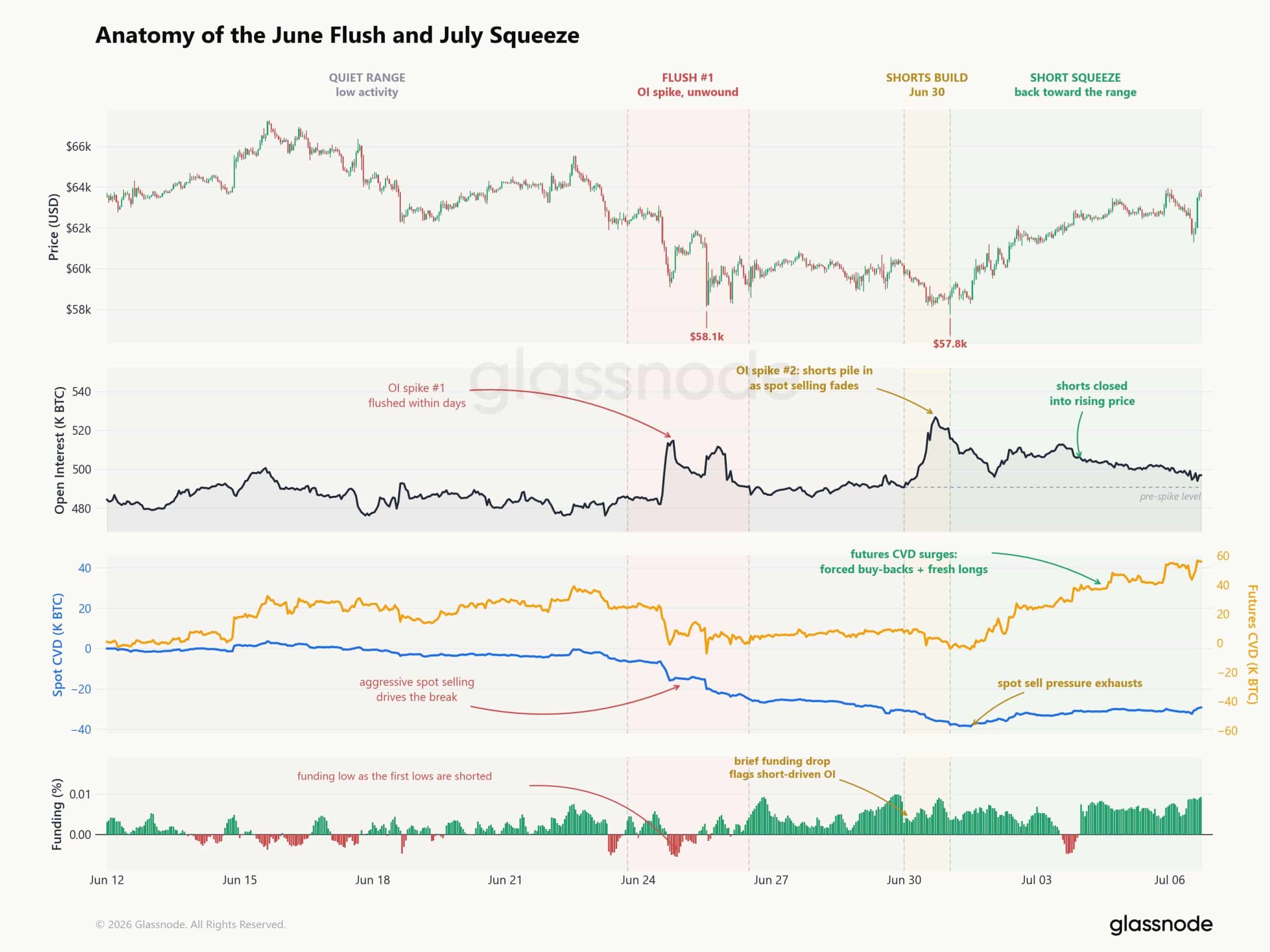
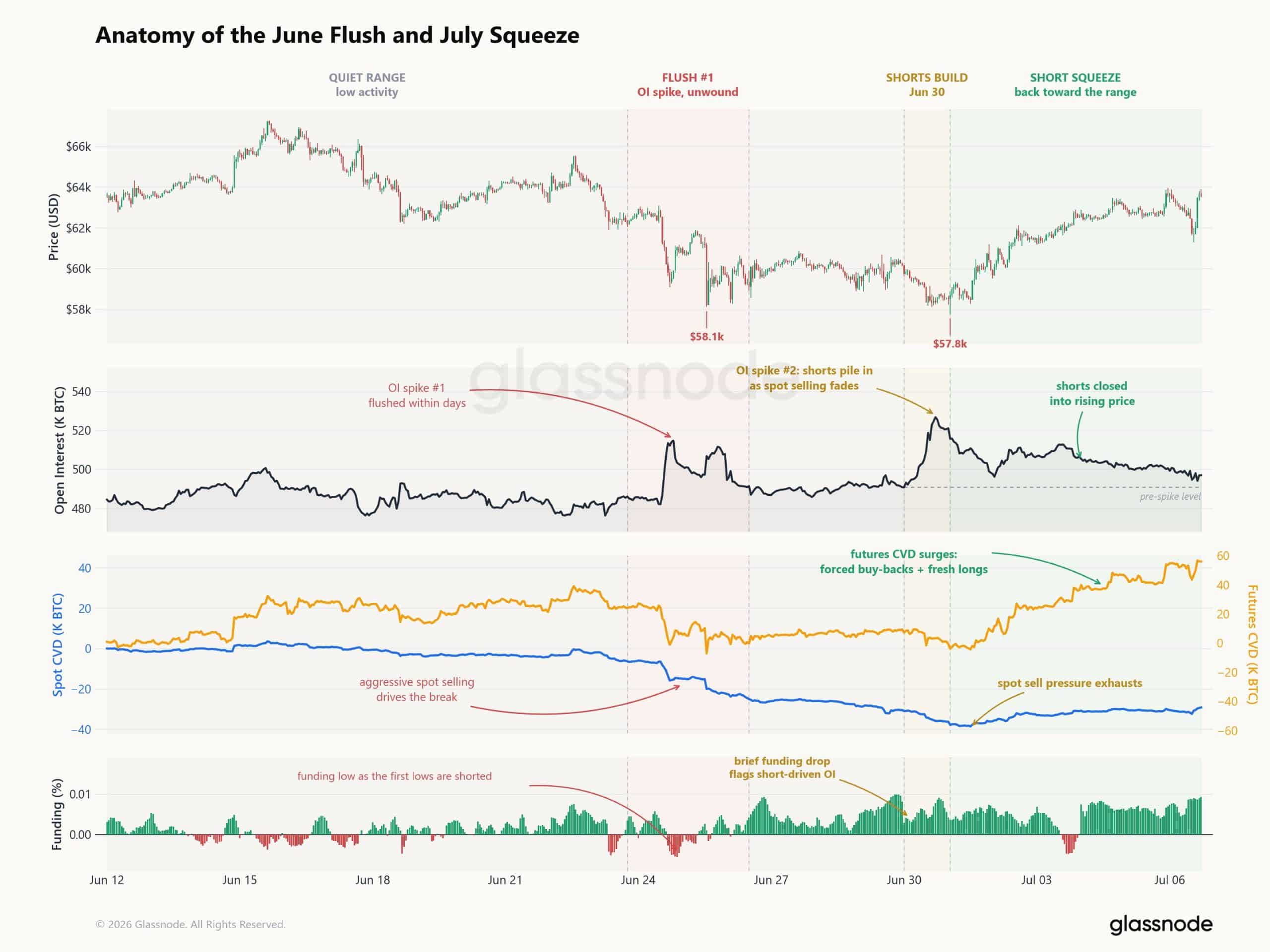
Following weeks of subdued derivatives activity, Bitcoin’s late-June decline triggered the first meaningful shift in market positioning.

More importantly, aggressive short selling targeting this level was successful just twice, with one at $57.8K.

At no point did the spot selling pressure diminish enough to prevent buyers from recovering their footing. The Open Interest had initially increased substantially over the previous week, peaking at approximately 530k BTC.

Then, sharp liquidation quickly reduced most of the resulting leverage. Notably, Bitcoin prices began to recover from the low of $57.8K to a high near $64K.

As a result, bearish positions closed while fresh long positions entered the market.
Source: Glassnode

These developments suggested growing investor confidence. Funding Rates also shifted from negative to slightly positive during the same period. That change indicated improving market sentiment without excessive leverage.

This sequence suggested sellers had begun losing downside momentum.

Persistent Spot demand also forced crowded short positions to unwind, adding fuel to the broader recovery.

A closer look at underlying demand

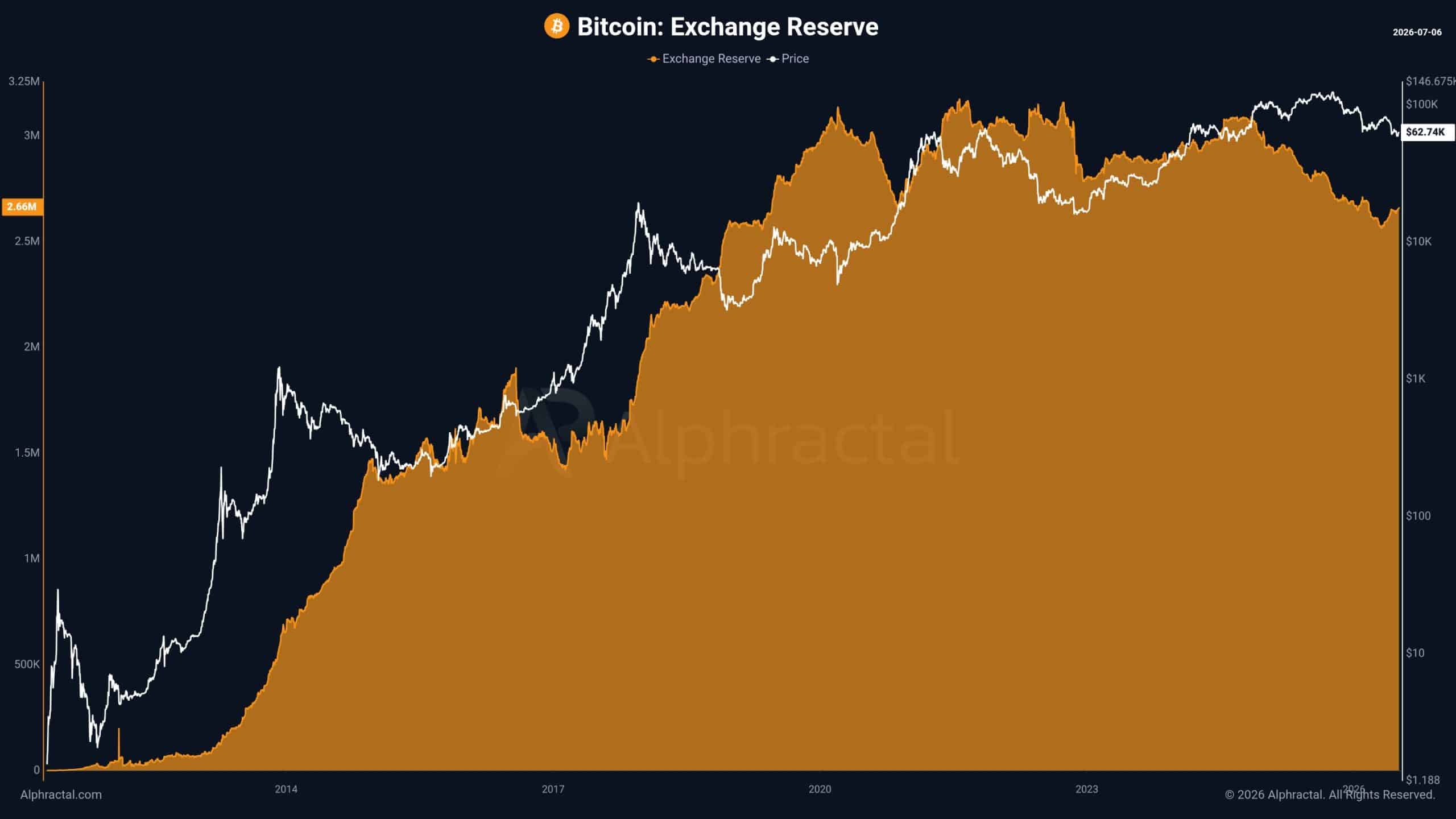
Bitcoin’s exchange flows offered another view of underlying demand. The latest data suggested exchange withdrawals continued slowing over recent months.

Exchange reserves climbed to roughly 2.66 million BTC from around 2.25 million BTC last October. The six-month reserve change also turned positive for the first time since September.
Source: Joao Wedson

The trend suggested fewer investors were moving Bitcoin [BTC] into long-term storage. Instead, more coins remained available on exchanges.

Even so, exchange reserves stayed well below levels seen during the previous market cycle’s peak.

If fresh demand failed to absorb this supply, the growing exchange balance could limit future rallies. That left Bitcoin’s longer-term recovery increasingly dependent on renewed accumulation alongside resilient price action.


Final Summary

  • Bitcoin’s [BTC] short squeeze reduced selling pressure, but sustained Spot demand remained the key driver of further upside.
  • At the same time, slowing accumulation could limit Bitcoin’s longer-term recovery despite improving market sentiment.


Trending Cryptos

Related Questions

QWhat was the main shift in Bitcoin's market positioning according to the article?

AThe late-June decline triggered the first meaningful shift in market positioning after weeks of subdued derivatives activity, leading to a significant liquidation of leverage.

QWhat do the changes in Bitcoin's Funding Rates indicate about market sentiment?

AFunding Rates shifted from negative to slightly positive, indicating improving market sentiment without excessive leverage.

QHow has the trend in Bitcoin exchange flows and reserves changed recently?

AExchange withdrawals have continued slowing, and exchange reserves have climbed. The six-month reserve change turned positive for the first time since September, suggesting fewer investors are moving BTC into long-term storage.

QWhat two key points summarize Bitcoin's current market situation based on the article's final summary?

A1) Bitcoin's short squeeze reduced selling pressure, but sustained Spot demand is the key driver for further upside. 2) Slowing accumulation could limit Bitcoin's longer-term recovery despite improving market sentiment.

QWhat risk does the growing Bitcoin exchange balance pose, according to the article?

AIf fresh demand fails to absorb the increasing supply of Bitcoin on exchanges, the growing exchange balance could limit future price rallies.

Related Reads

Illinois' 0.2% Cryptocurrency Tax Sparks Major Legal Battle

Blockchain Association and Crypto Council for Innovation filed a lawsuit on August 21 in an Illinois district court against state officials, seeking to declare the state's Digital Asset Tax Act unlawful and block its implementation. The lawsuit centers on Illinois' plan to impose a 0.2% tax on the value of a digital asset for certain transactions through a digital asset broker, effective January 1. Plaintiffs argue the tax applies even to non-sales activities like transferring assets between wallets or paying for custody services, which is unlike the treatment of traditional assets like stocks or gold. They contend this discriminates against digital assets, taxing the mechanism of storage or transfer rather than an economic gain. The complaint highlights multiple ambiguities: a single crypto purchase involving exchange, deposit, and custody could trigger multiple taxable events; the law doesn't define how to value the asset or determine a customer's residency for tax purposes, leaving brokers guessing. Businesses face potential civil and criminal penalties for non-compliance, possibly leading them to avoid Illinois customers. The groups also challenge the legislative process, noting the tax was added as a small part of a massive 1,624-page bill passed hastily, violating constitutional requirements. They claim the tax violates federal laws like the Internet Tax Freedom Act and the dormant Commerce Clause. The immediate goal is to obtain an injunction before the January 1 enforcement date, testing whether a state can single out digital asset transactions for such a tax.

cryptonews.ru19m ago

Illinois' 0.2% Cryptocurrency Tax Sparks Major Legal Battle

cryptonews.ru19m ago

Trading

Spot

Hot Articles

What is $BITCOIN

DIGITAL GOLD ($BITCOIN): A Comprehensive Analysis Introduction to DIGITAL GOLD ($BITCOIN) DIGITAL GOLD ($BITCOIN) is a blockchain-based project operating on the Solana network, which aims to combine the characteristics of traditional precious metals with the innovation of decentralized technologies. While it shares a name with Bitcoin, often referred to as “digital gold” due to its perception as a store of value, DIGITAL GOLD is a separate token designed to create a unique ecosystem within the Web3 landscape. Its goal is to position itself as a viable alternative digital asset, although specifics regarding its applications and functionalities are still developing. What is DIGITAL GOLD ($BITCOIN)? DIGITAL GOLD ($BITCOIN) is a cryptocurrency token explicitly designed for use on the Solana blockchain. In contrast to Bitcoin, which provides a widely recognized value storage role, this token appears to focus on broader applications and characteristics. Notable aspects include: Blockchain Infrastructure: The token is built on the Solana blockchain, known for its capacity to handle high-speed and low-cost transactions. Supply Dynamics: DIGITAL GOLD has a maximum supply capped at 100 quadrillion tokens (100P $BITCOIN), although details regarding its circulating supply are currently undisclosed. Utility: While precise functionalities are not explicitly outlined, there are indications that the token could be utilized for various applications, potentially involving decentralized applications (dApps) or asset tokenization strategies. Who is the Creator of DIGITAL GOLD ($BITCOIN)? At present, the identity of the creators and development team behind DIGITAL GOLD ($BITCOIN) remains unknown. This situation is typical among many innovative projects within the blockchain space, particularly those aligning with decentralized finance and meme coin phenomena. While such anonymity may foster a community-driven culture, it intensifies concerns about governance and accountability. Who are the Investors of DIGITAL GOLD ($BITCOIN)? The available information indicates that DIGITAL GOLD ($BITCOIN) does not have any known institutional backers or prominent venture capital investments. The project seems to operate on a peer-to-peer model focused on community support and adoption rather than traditional funding routes. Its activity and liquidity are primarily situated on decentralized exchanges (DEXs), such as PumpSwap, rather than established centralized trading platforms, further highlighting its grassroots approach. How DIGITAL GOLD ($BITCOIN) Works The operational mechanics of DIGITAL GOLD ($BITCOIN) can be elaborated on based on its blockchain design and network attributes: Consensus Mechanism: By leveraging Solana’s unique proof-of-history (PoH) combined with a proof-of-stake (PoS) model, the project ensures efficient transaction validation contributing to the network's high performance. Tokenomics: While specific deflationary mechanisms have not been extensively detailed, the vast maximum token supply implies that it may cater to microtransactions or niche use cases that are still to be defined. Interoperability: There exists the potential for integration with Solana’s broader ecosystem, including various decentralized finance (DeFi) platforms. However, the details regarding specific integrations remain unspecified. Timeline of Key Events Here is a timeline that highlights significant milestones concerning DIGITAL GOLD ($BITCOIN): 2023: The initial deployment of the token occurs on the Solana blockchain, marked by its contract address. 2024: DIGITAL GOLD gains visibility as it becomes available for trading on decentralized exchanges like PumpSwap, allowing users to trade it against SOL. 2025: The project witnesses sporadic trading activity and potential interest in community-led engagements, although no noteworthy partnerships or technical advancements have been documented as of yet. Critical Analysis Strengths Scalability: The underlying Solana infrastructure supports high transaction volumes, which could enhance the utility of $BITCOIN in various transaction scenarios. Accessibility: The potential low trading price per token could attract retail investors, facilitating wider participation due to fractional ownership opportunities. Risks Lack of Transparency: The absence of publicly known backers, developers, or an audit process may yield skepticism regarding the project's sustainability and trustworthiness. Market Volatility: The trading activity is heavily reliant on speculative behavior, which can result in significant price volatility and uncertainty for investors. Conclusion DIGITAL GOLD ($BITCOIN) emerges as an intriguing yet ambiguous project within the rapidly evolving Solana ecosystem. While it attempts to leverage the “digital gold” narrative, its departure from Bitcoin's established role as a store of value underscores the need for a clearer differentiation of its intended utility and governance structure. Future acceptance and adoption will likely depend on addressing the current opacity and defining its operational and economic strategies more explicitly. Note: This report encompasses synthesised information available as of October 2023, and developments may have transpired beyond the research period.

2.0k Total ViewsPublished 2025.05.13Updated 2025.05.13

What is $BITCOIN

Discussions

Welcome to the HTX Community. Here, you can stay informed about the latest platform developments and gain access to professional market insights. Users' opinions on the price of BTC (BTC) are presented below.

活动图片