Bitcoin's $78,000 Support Faces Ultimate Test: With Soaring Treasury Yields and Inflation Pressure, the Door to $75,000 is Opening

marsbitPublished on 2026-05-18Last updated on 2026-05-18

Abstract

Bitcoin has fallen below the $78,000 support level, now facing a critical test due to severe macro pressures. The price slid from above $81,000 to a low near $77,711, with the $77,700-$78,000 zone identified as the next key support. The primary headwinds are surging U.S. Treasury yields—with the 10-year approaching 4.6% and the 30-year surpassing 5.13%—and persistent inflation. April's CPI accelerated to 3.8%, while WTI oil prices climbed above $105. These factors increase the opportunity cost of holding zero-yield assets like Bitcoin and tighten the Fed's policy space. Crucially, U.S. spot Bitcoin ETFs, which previously provided a buffer, saw significant net outflows on two of the past three trading days, removing buying support when it was most needed. The technical outlook hinges on whether Bitcoin can hold above $77,700. A daily close below this level could open a path toward $76,500 and then the major $75,000 support. A recovery above $80,000 is needed to break the bearish pattern, with a close above $82,000 (the 200-day moving average) required to invalidate the breakdown. Failure to hold support could shift the narrative from a crypto correction to a broader, macro-driven risk asset deleveraging.

Author: Gino Matos

Translation: TechFlow DeepTide

DeepTide Guide: Bitcoin has fallen for two consecutive days into the $78,000 support zone after failing to break above $82,000. With the US 10-year Treasury yield approaching 4.6%, the 30-year yield breaking above 5.13%, coupled with April CPI accelerating to 3.8% and oil prices rising above $105, the macro environment is extremely unfriendly to risk assets. ETF flows have also turned to net outflows at a critical moment. Can $78,000 hold? If not, the next stop is $75,000.

$78,000: If This Level Fails, It's $75,000 Next

Bitcoin hit an intraday low of $77,711 before rebounding slightly to around $78,225. This marks the second consecutive trading day under macro pressure.

The US 10-year Treasury yield rose to 4.599%, and the 30-year yield jumped 11.8 basis points to 5.131%, hitting a new high since May 2025. BTC has fallen 3.9% from its opening price above $81,000 on May 15, with US stocks and bonds weakening simultaneously.

When BTC lost the $82,000 level, the $77,700-$78,000 range became the next key support. Now, this support is bearing the full weight of macro pressure.
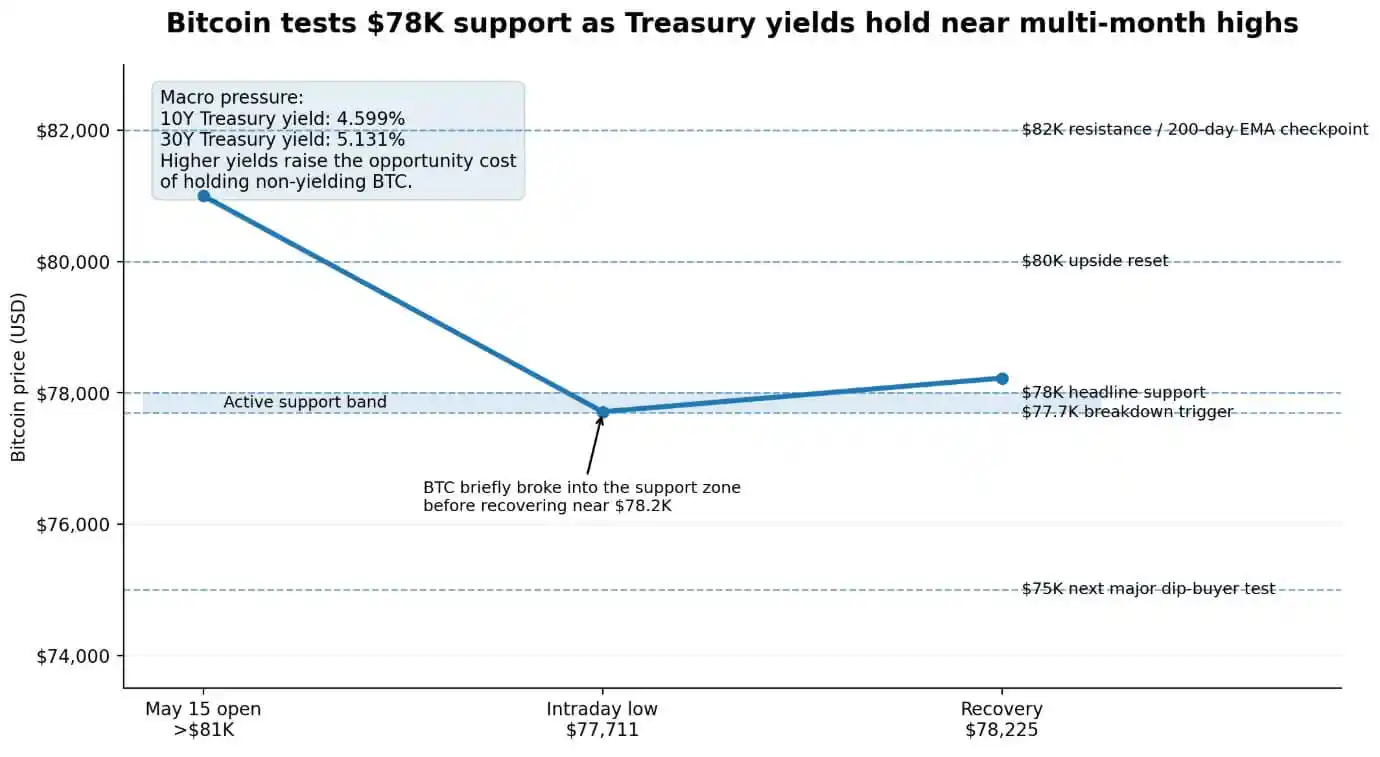
Caption: Bitcoin fell from above $81,000 at the May 15 open to an intraday low of $77,711 before rebounding to $78,225, testing the $77,700-$78,000 support band.

The Weight of Macroeconomics

BTC is a zero-yield asset, now competing against US Treasuries offering yields of 4.5%-5.1%. With the interest rate floor raised to this level, the opportunity cost of holding BTC has increased sharply.

K33 data shows Bitcoin's 30-day correlation with Nasdaq futures exceeds 0.7. During sharp Nasdaq declines, BTC's beta value amplifies. Both transmission channels are active in this sell-off, and the macro environment leaves almost no room for Fed easing.

April CPI accelerated year-on-year to 3.8%, up from 3.3% in March. Core CPI remained at 2.8%, while the energy component rose 17.9% over 12 months.

WTI crude oil closed at $105.42 on May 15, up 4.2% for the day and 11.33% for the month. Brent crude touched $109.26, up 3.35%. Trading Economics models predict Brent to reach $111.28 by the quarter's end, while HSBC raised its 2026 Brent forecast to an average of $95, potentially reaching $110 if supply agreements are delayed until late summer.

University of Michigan May data shows one-year inflation expectations rising to 4.5%. The Fed's April FOMC statement indicated a need to assess inflation before considering easing. The bar for policy relief is high.

ETF Flows Drop the Ball at a Critical Moment

CoinShares data shows that as of the week ending May 11, Bitcoin investment products attracted net inflows of $706.1 million, indicating strong institutional buying interest.

However, daily data from Farside Investors shows a sharp reversal thereafter: net outflows of $630.4 million on May 13, a small inflow of $131.3 million on May 14, and another outflow of $290.4 million on May 15.

Outflows on two out of three days. The ETF flow buffer disappeared at the very moment the $78,000 support needed defense most. This buffer had been absorbing macro headwinds in previous weeks.

Support Map

The intraday low of $77,716.09 already fell within the support range. If the daily close can reclaim territory above $78,000, this pullback would still be technically contained.

Once $77,700 is effectively broken, the downward path opens: $76,500 is the first follow-up target. After bears confirm the breakdown, $75,000 is the key psychological round number where dip-buying capital historically needs to step in with real money.

If the decline extends further, the $73,000-$74,000 range comes into view. At that point, the market narrative would shift from 'pullback' to 'macro-driven deleveraging of risk assets.'
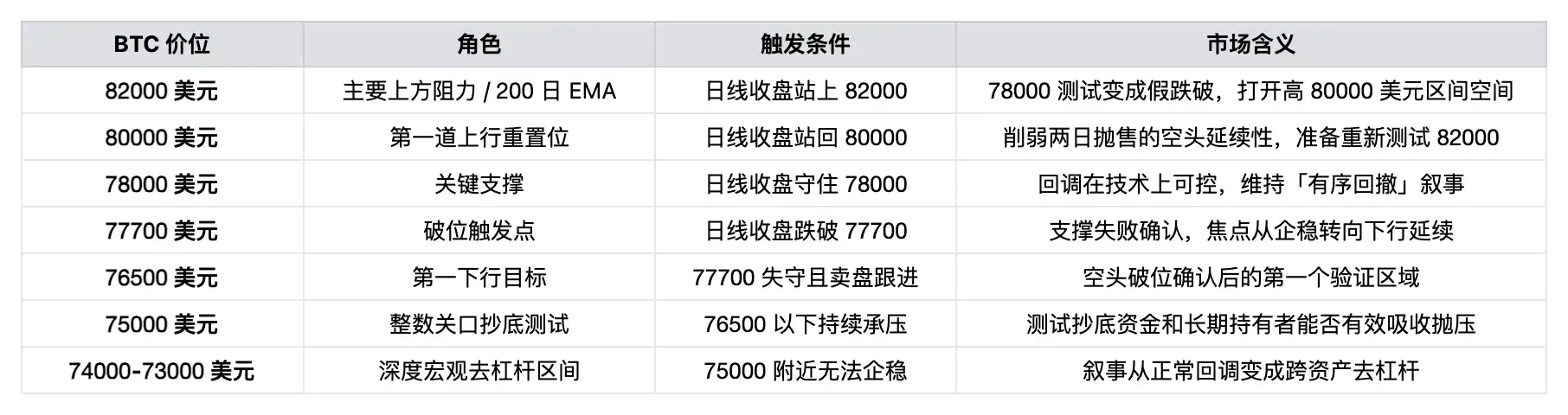
Recapturing $80,000 is the first step to reversing the bearish structure—a daily close above that level would break the sequence of lower lows over the past two trading days, giving bulls a technically clean reset.

The tougher hurdle is at $82,000. On May 13, BTC already broke below its 200-day moving average (around $82,000), meaning $82,000 serves as both a round-number resistance and a technical barrier. A daily close above $82,000 would turn the $78,000 test into a false breakdown.

Four Scenarios

What to Watch Next

If the 10-year yield retreats below 4.50%, oil prices cool from above $105, and ETF flows turn positive, Bitcoin could reclaim $80,000. That would break the pattern of lower lows over the past two days, setting the stage for a retest of $82,000—the level of the 200-day moving average that BTC broke below on May 13.

A daily close above $82,000 would turn the yield-driven retreat into a false breakdown, opening the door to the high $80,000s. The past week's decline would then be viewed as a shakeout-style correction, with the underlying accumulation logic remaining intact.

Conversely, if BTC closes below $77,700 on a daily basis while Treasury yields remain around 4.60% and ETFs see sustained outflows, the support test is confirmed to have failed. $76,500 becomes the first downside target, with a new leg lower beginning once bears confirm the breakdown. $75,000 is the key round-number level where dip-buying forces historically need to demonstrate real demand.

Continued weakness below $75,000 would target the $74,000-$73,000 range. At that point, the narrative would no longer be 'crypto market pullback,' but 'cross-asset macro deleveraging'—with stocks and bonds being repriced, and BTC simply following along.

For Bitcoin's short-term direction, the key macro variables need to stabilize first to form a rebound anchor. With the 10-year at 4.599% and the 30-year at 5.131%, they offer holders a yield floor of 4.5%-5.1%. BTC, as a zero-yield asset, is at a natural disadvantage in terms of carry. With one-year inflation expectations at 4.5% and the Fed still in an 'assessment phase,' rapid easing is far from market reality pricing.

The $78,000 zone faces a structural test: Can ETF buyers and long-term holders absorb selling pressure quickly enough amid an interest rate cost shock to stabilize the price before the support board is broken?


Related Questions

QAccording to the article, what are the two main negative macro factors currently pressuring Bitcoin's price and testing the $78,000 support level?

AThe two main negative macro factors are surging U.S. Treasury yields (10-year near 4.6% and 30-year above 5.13%) and persistent inflationary pressures, highlighted by April CPI accelerating to 3.8% and oil prices rising above $105.

QWhat key change in the behavior of Bitcoin ETF inflows is mentioned as undermining the $78,000 support?

ABitcoin ETF inflows have reversed from strong net inflows to net outflows at a critical time. Data showed net outflows of $630.4 million on May 13th and $290.4 million on May 15th, removing the 'buffer' that previously absorbed selling pressure.

QIf Bitcoin's daily close falls below $77,700, what are the next two potential price targets mentioned in the article's 'support map'?

AIf Bitcoin's daily close falls below $77,700, the next two potential price targets are $76,500 as the first follow-up target, and then the historically significant $75,000 level where real buying interest would be tested.

QWhat specific condition must Bitcoin meet to technically break the recent bearish sequence and potentially shift momentum towards testing higher resistance?

ABitcoin needs a daily close back above $80,000 to break the recent sequence of lower lows and provide a clean technical reset for bullish momentum. A close above $82,000 (the 200-day moving average) would turn the recent decline into a 'false breakdown'.

QHow does the article define the scenario where Bitcoin price falls into the $73,000-$74,000 range?

AIf Bitcoin falls into the $73,000-$74,000 range, the market narrative would change from a 'crypto market correction' to a 'macro-driven deleveraging across risk assets,' where Bitcoin is repricing alongside stocks and bonds.

Related Reads

"JUST 6th Anniversary x GasFree Super Carnival Month" Grandly Arrives: Enjoy "0" Gas Transfer Freedom & Share the 10,000 USDT Bonus Pool

The "JUST 6th Anniversary x GasFree Super Carnival Month" event has launched, celebrating the JUST ecosystem's six-year milestone within the TRON network. Running from May 18th to June 7th, the event features a 10,000 USDT prize pool and is designed to promote the GasFree smart wallet. GasFree, a key product of the JustLend DAO protocol, allows users to pay transaction fees directly with the token being transferred (e.g., USDT), eliminating the need to hold the network's native token (TRX) for gas. This innovation aims to simplify on-chain transactions and lower the entry barrier for new users. The carnival offers five main activities: 1. **GasFree Activation Challenge:** New users can earn random rewards (5.2-522 USDT) for activating GasFree and completing their first transfer. 2. **Transfer Rebate:** 200 users daily are randomly selected to receive a 100% rebate on their activation and transaction fees. 3. **Bitcoin Pizza Day Special:** A dedicated event with custom rewards to celebrate crypto culture. 4. **JUST 6th Anniversary Lucky Draw:** Special anniversary reward packages for lucky participants. 5. **Knowledge Quiz:** A trivia contest where users can win prizes by answering questions about JUST and GasFree. To participate, users need a compatible wallet like TronLink (recommended), Klever, Guarda, or NOW Wallet. They must then find the GasFree feature, fund it with USDT, and complete at least one USDT transfer to qualify for the rewards. The article highlights GasFree's significant adoption, reporting over 872 billion USD in cumulative transaction volume and more than 612 million USD in saved user fees since its launch. The event underscores JUST's commitment to enhancing the DeFi user experience by making on-chain interactions more accessible and cost-effective.

链捕手1h ago

"JUST 6th Anniversary x GasFree Super Carnival Month" Grandly Arrives: Enjoy "0" Gas Transfer Freedom & Share the 10,000 USDT Bonus Pool

链捕手1h ago

Trading

Spot
Futures

Hot Articles

What is $BITCOIN

DIGITAL GOLD ($BITCOIN): A Comprehensive Analysis Introduction to DIGITAL GOLD ($BITCOIN) DIGITAL GOLD ($BITCOIN) is a blockchain-based project operating on the Solana network, which aims to combine the characteristics of traditional precious metals with the innovation of decentralized technologies. While it shares a name with Bitcoin, often referred to as “digital gold” due to its perception as a store of value, DIGITAL GOLD is a separate token designed to create a unique ecosystem within the Web3 landscape. Its goal is to position itself as a viable alternative digital asset, although specifics regarding its applications and functionalities are still developing. What is DIGITAL GOLD ($BITCOIN)? DIGITAL GOLD ($BITCOIN) is a cryptocurrency token explicitly designed for use on the Solana blockchain. In contrast to Bitcoin, which provides a widely recognized value storage role, this token appears to focus on broader applications and characteristics. Notable aspects include: Blockchain Infrastructure: The token is built on the Solana blockchain, known for its capacity to handle high-speed and low-cost transactions. Supply Dynamics: DIGITAL GOLD has a maximum supply capped at 100 quadrillion tokens (100P $BITCOIN), although details regarding its circulating supply are currently undisclosed. Utility: While precise functionalities are not explicitly outlined, there are indications that the token could be utilized for various applications, potentially involving decentralized applications (dApps) or asset tokenization strategies. Who is the Creator of DIGITAL GOLD ($BITCOIN)? At present, the identity of the creators and development team behind DIGITAL GOLD ($BITCOIN) remains unknown. This situation is typical among many innovative projects within the blockchain space, particularly those aligning with decentralized finance and meme coin phenomena. While such anonymity may foster a community-driven culture, it intensifies concerns about governance and accountability. Who are the Investors of DIGITAL GOLD ($BITCOIN)? The available information indicates that DIGITAL GOLD ($BITCOIN) does not have any known institutional backers or prominent venture capital investments. The project seems to operate on a peer-to-peer model focused on community support and adoption rather than traditional funding routes. Its activity and liquidity are primarily situated on decentralized exchanges (DEXs), such as PumpSwap, rather than established centralized trading platforms, further highlighting its grassroots approach. How DIGITAL GOLD ($BITCOIN) Works The operational mechanics of DIGITAL GOLD ($BITCOIN) can be elaborated on based on its blockchain design and network attributes: Consensus Mechanism: By leveraging Solana’s unique proof-of-history (PoH) combined with a proof-of-stake (PoS) model, the project ensures efficient transaction validation contributing to the network's high performance. Tokenomics: While specific deflationary mechanisms have not been extensively detailed, the vast maximum token supply implies that it may cater to microtransactions or niche use cases that are still to be defined. Interoperability: There exists the potential for integration with Solana’s broader ecosystem, including various decentralized finance (DeFi) platforms. However, the details regarding specific integrations remain unspecified. Timeline of Key Events Here is a timeline that highlights significant milestones concerning DIGITAL GOLD ($BITCOIN): 2023: The initial deployment of the token occurs on the Solana blockchain, marked by its contract address. 2024: DIGITAL GOLD gains visibility as it becomes available for trading on decentralized exchanges like PumpSwap, allowing users to trade it against SOL. 2025: The project witnesses sporadic trading activity and potential interest in community-led engagements, although no noteworthy partnerships or technical advancements have been documented as of yet. Critical Analysis Strengths Scalability: The underlying Solana infrastructure supports high transaction volumes, which could enhance the utility of $BITCOIN in various transaction scenarios. Accessibility: The potential low trading price per token could attract retail investors, facilitating wider participation due to fractional ownership opportunities. Risks Lack of Transparency: The absence of publicly known backers, developers, or an audit process may yield skepticism regarding the project's sustainability and trustworthiness. Market Volatility: The trading activity is heavily reliant on speculative behavior, which can result in significant price volatility and uncertainty for investors. Conclusion DIGITAL GOLD ($BITCOIN) emerges as an intriguing yet ambiguous project within the rapidly evolving Solana ecosystem. While it attempts to leverage the “digital gold” narrative, its departure from Bitcoin's established role as a store of value underscores the need for a clearer differentiation of its intended utility and governance structure. Future acceptance and adoption will likely depend on addressing the current opacity and defining its operational and economic strategies more explicitly. Note: This report encompasses synthesised information available as of October 2023, and developments may have transpired beyond the research period.

363 Total ViewsPublished 2025.05.13Updated 2025.05.13

What is $BITCOIN

Discussions

Welcome to the HTX Community. Here, you can stay informed about the latest platform developments and gain access to professional market insights. Users' opinions on the price of BTC (BTC) are presented below.

活动图片














