Bitcoin whales’ losses cross $337 mln in Q1 2026: What it means for BTC

ambcryptoPublished on 2026-04-05Last updated on 2026-04-05

Abstract

Bitcoin (BTC) has been in a prolonged downtrend since its peak of $126k in October 2025, falling below the Short-Term Holder (STH) Realized Price and leaving over 45.8% of the total supply at a loss. In Q1 2026, investors holding 100 to 10,000 BTC realized $30.9 billion in losses, with whales accounting for $337 million in daily losses—the highest rate since the 2022 bear market. Long-term holders contributed approximately $200 million in daily losses. This aggressive loss realization suggests the market is not yet at a cycle bottom, as historical lows formed when daily losses cooled to around $25 million. Current market conditions indicate indecision, with upside volatility at 1.9 and downside volatility at 1.6. If loss realization continues and demand weakens, BTC could drop to $62,500. Otherwise, it may continue consolidating between $65k and $70k.

Bitcoin [BTC] has traded within a descending channel since its $126k peak in October 2025. Amid this prolonged downtrend, the king coin fell below the STH Realized Price, implying that all recent buyers were holding at a loss.

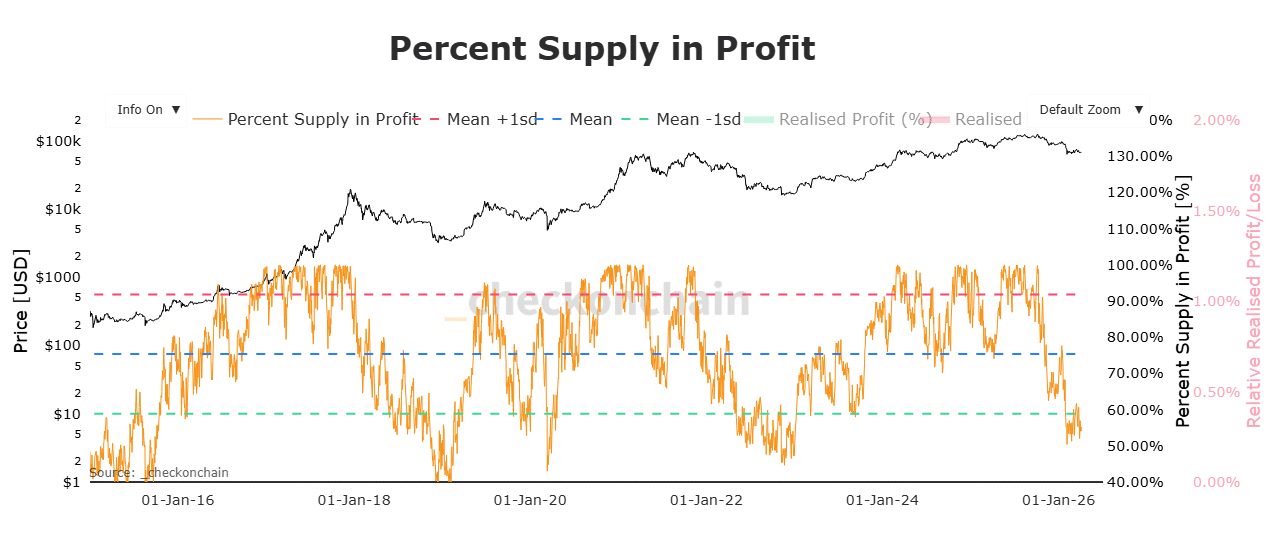
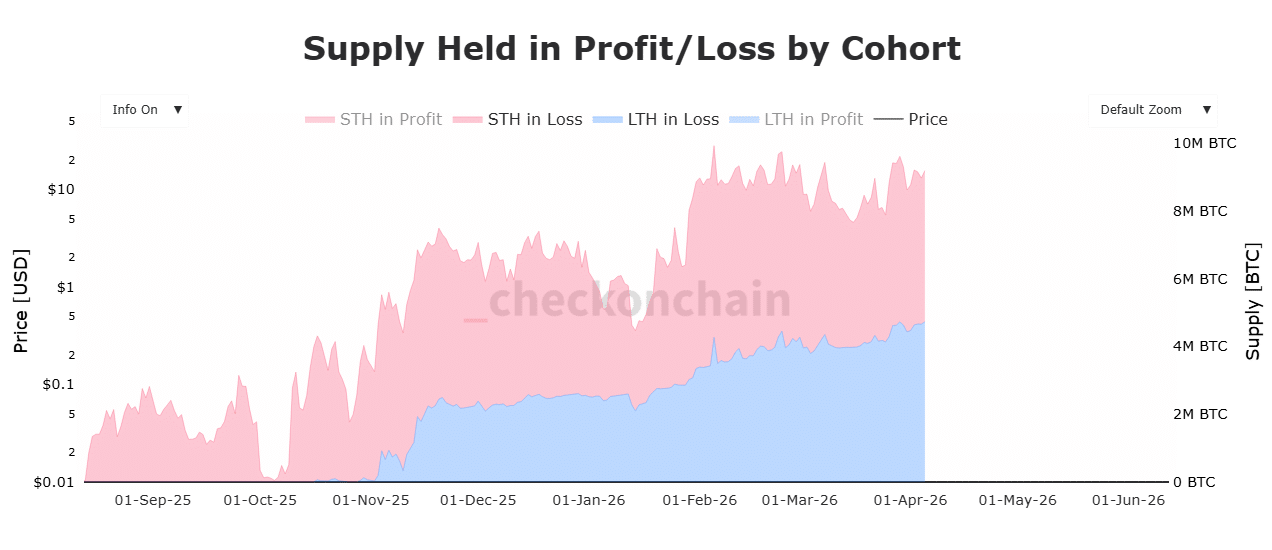
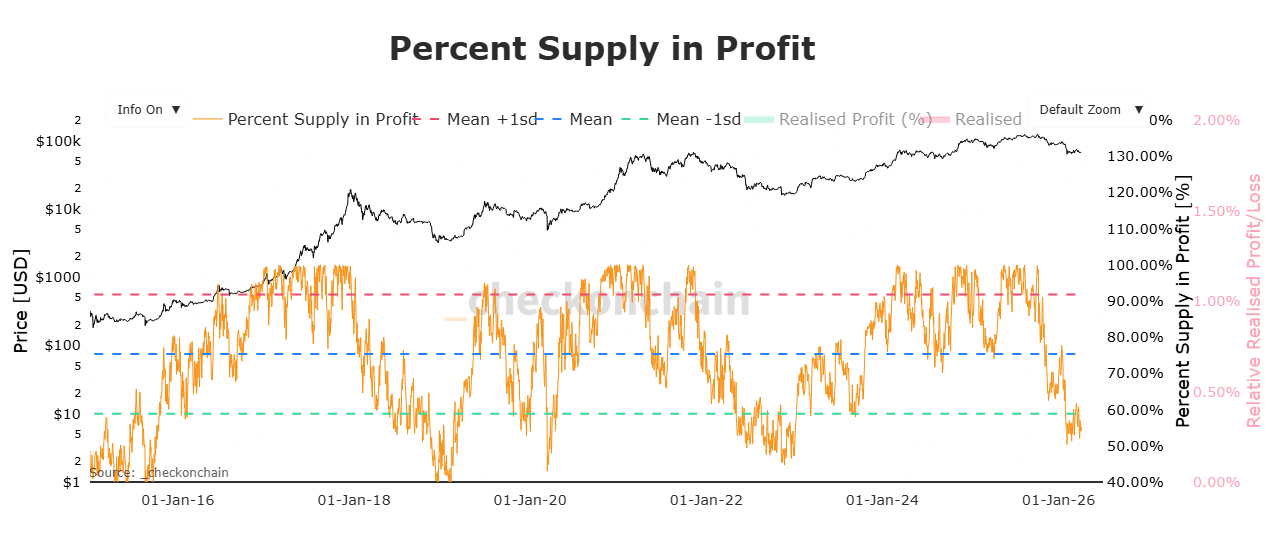
Checkonchain data showed that over 45.8% of the total supply currently sits at a loss, with only 54.12% in profit. Rising losses have pushed most market participants to capitulate, especially whales.

Source: Checkonchain

Bitcoin whales realize a $337 million loss in Q1

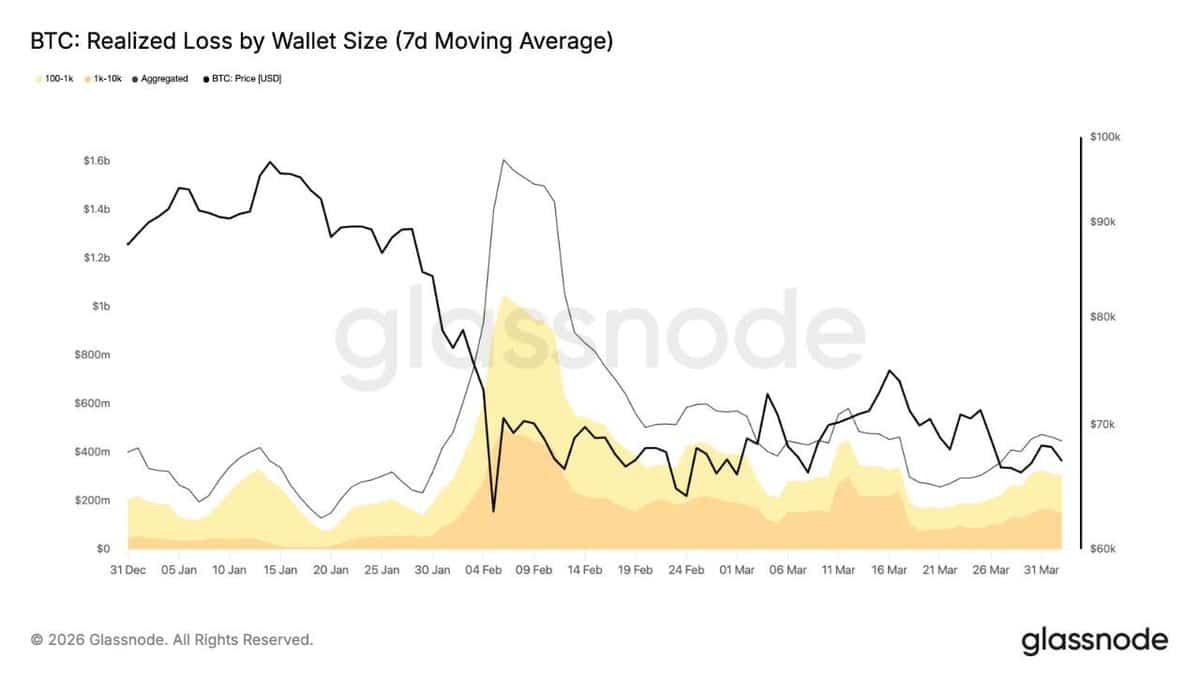
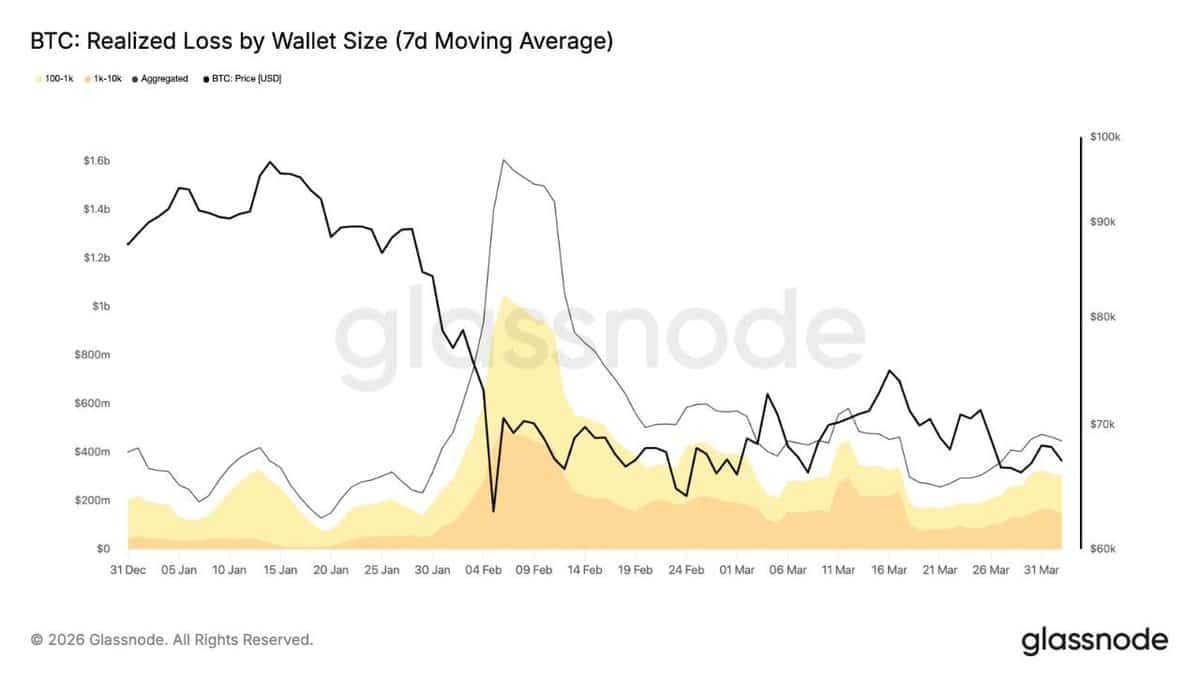
Investors holding 100 to 10,000 BTC have realized $30.9 billion in losses during the first quarter of 2026. Among these losses, whales have recorded the largest losses at $337 million per day, according to CryptoRover.

This marked the highest daily rate of losses since the 2022 bear market, signaling one of the most aggressive distribution cycles on record.

Source: Glassnode

Bitcoin’s long-term holders contributed about $200 million daily. Historically, this kind of sustained loss realization has not marked cycle bottoms but emerged before deeper drawdowns.

During the previous cycles, lows formed as realized losses cooled, with an average of $25 million per day. At the current market rate, this market is still far from reaching such low levels.

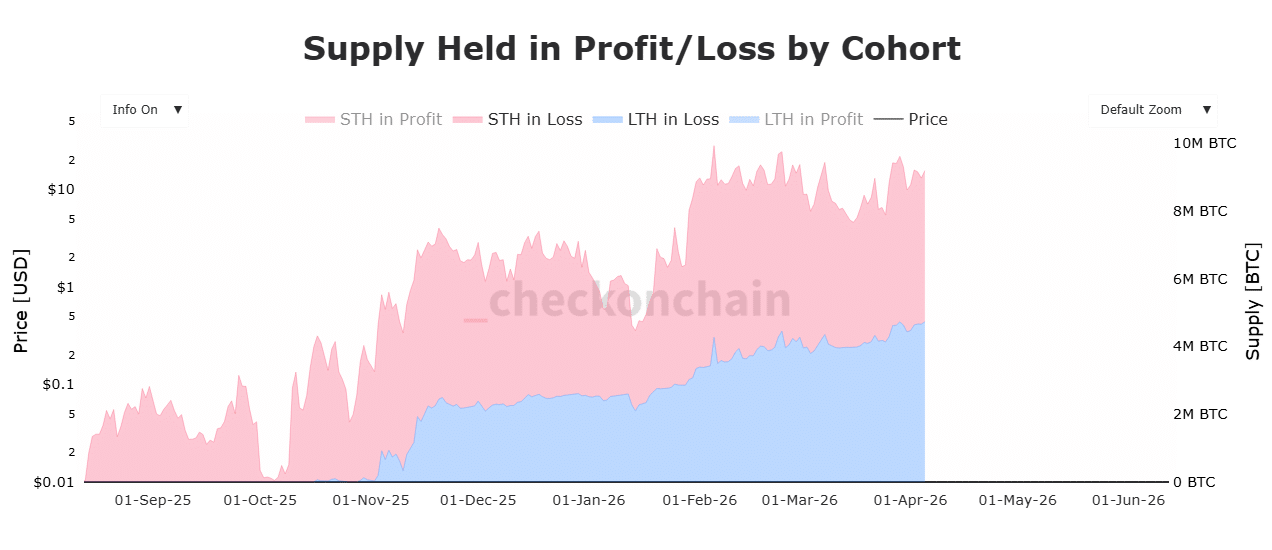
Source: Checkonchain

Coupled with that, LTH and STH supplies held at a loss have remained extremely elevated. According to Checkonchain data, LTHs and STHs supply held in losses has averaged 4k BTC daily from March to early April.

As supply at a loss continued to rise, investors have lost confidence and tried to cut losses, as evidenced by the recently realized losses.

What’s next for BTC?

Although recent market sentiment could signal strategic tax-loss harvesting, it also warns of intense external forces that are driving the market towards capital preservation.

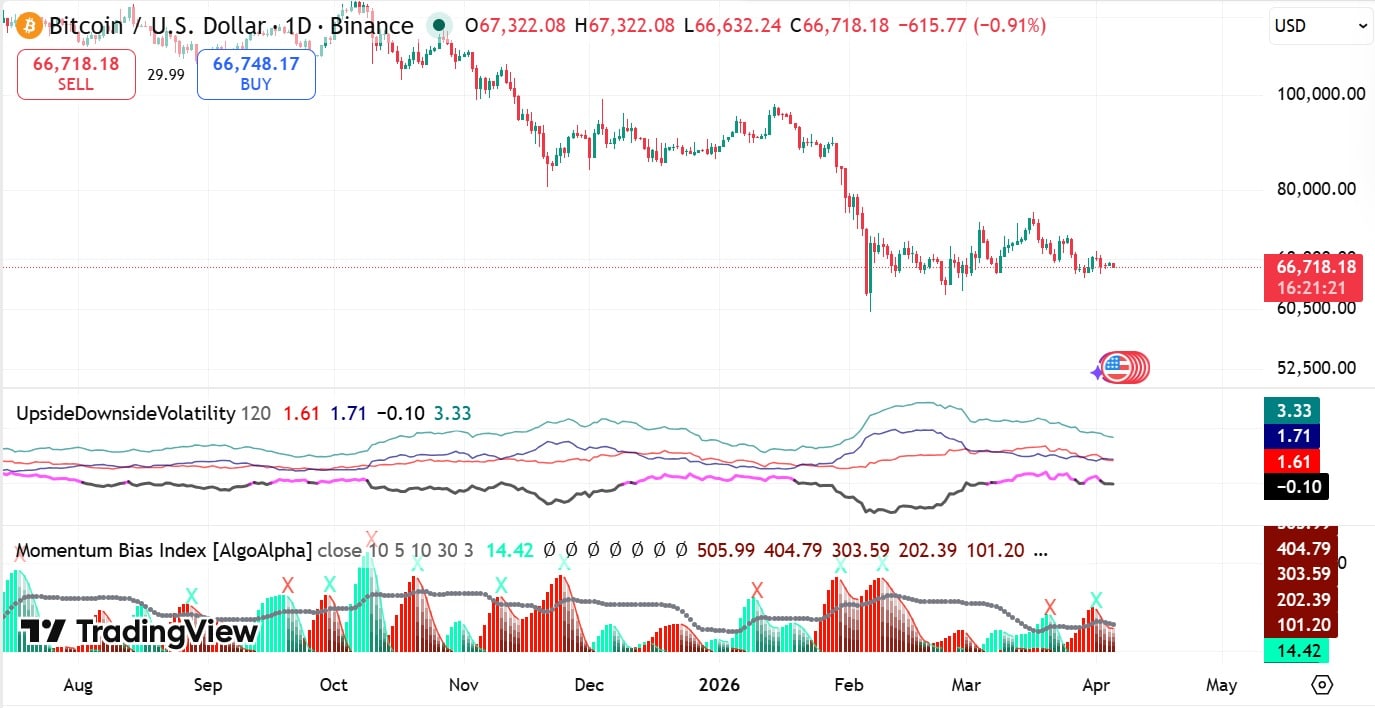
Rising losses and loss realization have significantly stretched the market, increasing downside risk. Looking at the upside and downside volatility indicator, the market remains stuck in indecision.

Source: TradingView

The upside volatility is 1.9, the downside volatility is 1.6, and the spread is -0.10, signaling slight bearishness. At the same time, the momentum bias showed weak momentum, with neither trend being strong.

Historically, such market conditions have preceded prolonged consolidation. If the prevailing sentiment persists, BTC could extend sideways movement between $70k and $65k

However, if the loss realization accelerates while demand weakens, the market could see another breakdown and likely fall to $62,500.


Final Summary

  • Bitcoin’s realized losses hit $30.9 billion in Q1, with whale realized losses exceeding $337 million.
  • BTC remains stuck in indecision with reduced volatility despite increased loss realization.

Trending Cryptos

Related Questions

QWhat was the total amount of realized losses for Bitcoin investors holding 100 to 10,000 BTC in Q1 2026?

A$30.9 billion

QWhat is the significance of Bitcoin falling below the STH Realized Price?

AIt implies that all recent buyers were holding at a loss.

QAccording to the article, what does the current high rate of loss realization historically signal for the market cycle?

AIt has not marked cycle bottoms but emerged before deeper drawdowns.

QWhat are the two potential price scenarios for BTC mentioned in the article if the current conditions persist?

AProlonged consolidation between $70k and $65k, or a breakdown to $62,500 if loss realization accelerates and demand weakens.

QWhat does the upside and downside volatility indicator values (1.9 and 1.6) with a spread of -0.10 signal for the market?

ASlight bearishness and weak momentum, with neither trend being strong.

Related Reads

Programmers Worldwide Are Wasting Money on Anthropic! The Company Can't Stand It Anymore

Anthropic recently published guidelines to help developers using Claude Code reduce unnecessary token costs. The key recommendations include: 1) Clear (/clear) conversations after completing a task to avoid carrying irrelevant file reads and command outputs into the next task. 2) Set the model and reasoning effort level at the start of a session, as switching mid-session invalidates the prompt cache, requiring a full-price recalculation of the entire dialog history. 3) Attach files using @ references instead of typing paths manually to avoid extra tool calls and searches that bloat the context. 4) Add quiet flags to verbose commands (e.g., in CLAUDE.md) to minimize lengthy output in the dialog history. 5) Use /compact while the session cache is still warm (before breaks) to compress the dialog at one-tenth the cost. 6) Offload large-output tasks to a sub-agent, which runs in an isolated context and only returns conclusions, preventing intermediate outputs from polluting the main dialog. The article explains token pricing: input tokens (prefill) are processed in parallel, while output tokens (decode) are generated serially, making output tokens five times more expensive. Caching is crucial for savings—if a request's prefix (system prompt, CLAUDE.md, dialog history) matches the previous one byte-for-byte, reading it costs only 10% of the standard input price. However, cache invalidation occurs when changing models, effort levels, fast mode, compressing dialogs, after cache expiration, or when resuming old sessions. Dialog history also grows quadratically (O(n²)) as file contents and command outputs accumulate, increasing costs per round. Proactive context management—like isolating noisy tasks, using /rewind to trim unproductive turns, and task-based session clearing—is becoming an essential skill for cost-effective AI-assisted development.

marsbit1h ago

Programmers Worldwide Are Wasting Money on Anthropic! The Company Can't Stand It Anymore

marsbit1h ago

Pax Silica vs. WAICO: The US Wants to Prohibit Europe from Using Chinese Artificial Intelligence

The United States is preparing to demand that European and other partners abandon Chinese artificial intelligence initiatives, threatening exclusion from the American-led "Pax Silica" coalition, according to a leaked U.S. State Department document. This ultimatum forces signatories of the "AI Opportunity Statement" to choose between the Western technological ecosystem and alternative frameworks, with China not explicitly named but clearly targeted. Pax Silica is a U.S. strategy for AI and semiconductor hegemony, launched in late 2025. Its European presence expanded significantly in mid-2026. Concurrently, China, Russia, and 27 other nations established the World AI Cooperation Organization (WAICO) in July 2026 as an independent intergovernmental platform promoting AI governance based on UN principles. This situation creates a difficult choice, especially for European nations balancing strategic autonomy with dependence on U.S. tech and security. It also pressures Global South countries with pragmatic ties to both Washington and Beijing. The formation of competing blocks risks fragmenting the global tech landscape, forcing companies to split supply chains, increasing costs, and potentially leading to incompatible standards and protocols. The era of open globalization in AI may be ending, replaced by geopolitical confrontation where technological sovereignty trumps economic efficiency. The decisions made will shape the global digital economy for decades.

cryptonews.ru3h ago

Pax Silica vs. WAICO: The US Wants to Prohibit Europe from Using Chinese Artificial Intelligence

cryptonews.ru3h ago

Robert Kiyosaki Shares His Mentor's Predictions About the Emergence of Bitcoin and AI

American entrepreneur and author of "Rich Dad Poor Dad," Robert Kiyosaki, discussed the influence of futurist R. Buckminster Fuller on his worldview, linking Fuller's past technological predictions to the emergence of Bitcoin and the development of artificial intelligence. In an X post, Kiyosaki also reflected on personal purpose, sharing his journey from the music business—where he worked with bands like The Police and Iron Maiden—to creating the "Cashflow" board game and writing his famous book. He described feeling an inner emptiness despite his success, a turning point that came after meeting Fuller, whom he studied with for three summers. Kiyosaki described Fuller as a "friendly genius" who foresaw world-changing developments like Bitcoin and AI. However, the core of his post focused on Fuller's philosophical impact, particularly a quote about belonging to the universe and finding purpose by dedicating one's life to the maximum benefit of others. The entrepreneur remains a vocal advocate for cryptocurrencies. He regularly advises buying Bitcoin during market panics, viewing it and assets like Ethereum, gold, and silver as hedges against traditional financial system failures. Kiyosaki has predicted a major market crash by 2026, seeing it as an opportunity for prepared investors, with long-term price targets including $750,000 for Bitcoin and $95,000 for Ethereum.

cryptonews.ru5h ago

Robert Kiyosaki Shares His Mentor's Predictions About the Emergence of Bitcoin and AI

cryptonews.ru5h ago

Etherealize CEO Calls Wall Street's Private Blockchains a 'Race to the Bottom'

Etherealize co-founder and CEO Vivek Raman criticized Wall Street's growing interest in private, permissioned blockchains, calling them a "race to the bottom." In an interview with CoinDesk, Raman argued that consortium networks fragment liquidity and return the industry to the siloed systems that blockchain technology was meant to overcome. He stated that closed networks do not interoperate, undermining two key advantages of the technology: system compatibility and liquidity concentration. Etherealize promotes Ethereum as an open, foundational layer for institutional players. Raman insists that privacy and access restrictions should be built on top of public infrastructure—at the application or L2 level—rather than creating separate, closed networks. He compared Ethereum to HTTP as a base layer, with additional permissioned and private layers akin to HTTPS. Examples of this new wave of "closed" solutions mentioned include Canton Network from Digital Asset, Circle's Arc project, and Stripe's Tempo. Raman termed this trend "consortium chains 2.0," recalling earlier initiatives like the R3 interbank consortium and the Hyperledger corporate ecosystem from 2016 that failed to gain significant traction. He reiterated his firm belief that a global, open, permissionless infrastructure is necessary as a foundational base layer. Raman previously noted in June that traditional financial institutions had begun implementing Ethereum-based solutions into real business processes.

cryptonews.ru5h ago

Etherealize CEO Calls Wall Street's Private Blockchains a 'Race to the Bottom'

cryptonews.ru5h ago

Trading

Spot

Hot Articles

How to Buy MLN

Welcome to HTX.com! We've made purchasing Melon (MLN) simple and convenient. Follow our step-by-step guide to embark on your crypto journey.Step 1: Create Your HTX AccountUse your email or phone number to sign up for a free account on HTX. Experience a hassle-free registration journey and unlock all features.Get My AccountStep 2: Go to Buy Crypto and Choose Your Payment MethodCredit/Debit Card: Use your Visa or Mastercard to buy Melon (MLN) instantly.Balance: Use funds from your HTX account balance to trade seamlessly.Third Parties: We've added popular payment methods such as Google Pay and Apple Pay to enhance convenience.P2P: Trade directly with other users on HTX.Over-the-Counter (OTC): We offer tailor-made services and competitive exchange rates for traders.Step 3: Store Your Melon (MLN)After purchasing your Melon (MLN), store it in your HTX account. Alternatively, you can send it elsewhere via blockchain transfer or use it to trade other cryptocurrencies.Step 4: Trade Melon (MLN)Easily trade Melon (MLN) on HTX's spot market. Simply access your account, select your trading pair, execute your trades, and monitor in real-time. We offer a user-friendly experience for both beginners and seasoned traders.

4.1k Total ViewsPublished 2024.03.29Updated 2026.06.02

How to Buy MLN

What is $MELON

Understanding cocomELON, $$melon: A Deep Dive into a Unique Crypto Project Introduction to cocomELON, $$melon In the rapidly evolving landscape of digital currencies and blockchain technology, innovative projects continue to emerge, each attempting to carve their niche within the decentralized ecosystem. One such project is cocomELON, $$melon, which seeks to integrate the engaging aspects of gaming with the lucrative opportunities that cryptocurrency presents. This article aims to explore the intricate details surrounding cocomELON, $$melon, its overarching vision, its creators, backers, unique operations, and timeline of important events within its development. What is cocomELON, $$melon? cocomELON, $$melon is a crypto project that seeks to create a playful and community-driven ecosystem centered around the entertainment aspect of digital assets. While the term 'cocomELON' may evoke imagery of childhood entertainment, in this context, it serves as a representation of a creative and engaging approach to cryptocurrency. The project aims to amalgamate the thrill of gaming with decentralized finance (DeFi), allowing users not just to invest but to actively participate in a platform that incentivizes creativity and user interaction. Users can expect a blend of gamified elements, including non-fungible tokens (NFTs), staking mechanisms, and collaborative community experiences—all designed to enhance user engagement while capitalizing on the expansive potential of web3 technology. Who is the creator of cocomELON, $$melon? The creator of cocomELON, $$melon remains unspecified within the available information. This anonymity can often be a notable feature in the crypto space, aligning with the ethos of decentralization and community-led projects. Despite the lack of visibility regarding the founder, the strategic vision and integration of user participation suggest a team of experienced professionals in both the tech and entertainment sectors is likely driving the initiative. Who are the investors of cocomELON, $$melon? As with many innovative crypto projects, detailed information about the investors backing cocomELON, $$melon is not publicly disclosed. However, the project's potential and outline suggest an interest from a mix of angel investors, venture capitalists, and possibly, strategic partnerships within the tech industry—particularly those involved in web3 attractions, gaming, and digital content creation. Inviting investment from relevant sectors underscores the project's commitment to developing a robust and engaging platform that addresses modern entertainment and financial needs. This ecosystem could be appealing to those looking to diversify their investment portfolios into emerging art and creative technologies. How does cocomELON, $$melon work? The operational model of cocomELON, $$melon is innovative and engaging, designed to attract and retain users within the crypto ecosystem. Here are some factors that contribute to its uniqueness: Gamification of Crypto: By integrating gaming elements into the cryptocurrency experience, cocomELON, $$melon makes the process of investing more accessible and enjoyable for users. Features such as quizzes, rewards for participation, and interactive tasks could make users feel integral to the project's success. Community-driven Development: Emphasizing a community-centric approach encourages user feedback and growth alongside the project. The ecosystem likely promotes social sharing and incentivizes collaborative initiatives, thereby ensuring a continuous flow of creative input from users. NFT Utilization: As a significant trend in digital creativity, NFTs are expected to play a pivotal role within the cocomELON, $$melon ecosystem. Users may be able to create, buy, and sell unique digital assets, providing them with a sense of ownership and expression within the community. Evolving Content: The project is positioned to adapt its offerings based on user engagement and trends, ensuring its longevity and relevance in the fast-paced digital space. Regular updates and varied content will keep users returning for fresh experiences. Timeline of cocomELON, $$melon Understanding the historical context of cocomELON, $$melon helps illustrate its development and evolution within the crypto landscape. Here are some key milestones in its journey: 2021: The conceptualization of cocomELON, $$melon takes place, introducing the blend of gaming and cryptocurrency. 2022: Community engagement strategies are developed, driving initial interest and user base formation. 2023: Pre-launch of the platform occurs with a series of marketing efforts aimed at raising awareness and gathering a community of supporters. 2024: Full launch of the cocomELON, $$melon platform, enabling users to engage with its features, participate in content creation, and commence transactions. Key Points About cocomELON, $$melon Community Engagement: The backbone of cocomELON, $$melon lies in its community-driven initiatives, fostering a strong sense of belonging and collective growth. Diversified Offerings: Incorporating gaming elements along with financial activities, the project strives to cater to a broad audience beyond just traditional investors. Adaptability: The capacity to evolve based on user interaction ensures cocomELON, $$melon remains relevant and attractive within the fast-paced landscape of cryptocurrency. User Empowerment: By promoting user-generated content and collaboration, cocomELON, $$melon aims to empower its community, transforming passive observers into active participants. In conclusion, cocomELON, $$melon presents an innovative approach within the cryptocurrency industry, merging entertainment with investment opportunities. Its focus on community engagement, adaptability, and gamified elements uniquely positions it in a crowded market, offering both existing and new crypto enthusiasts an entertaining way to engage with digital assets. As it continues its development, cocomELON, $$melon looks set to push boundaries, leveraging the creativity and collaboration of its user base, which remains at the heart of its mission.

844 Total ViewsPublished 2024.05.02Updated 2024.12.03
What is $MELON

What is MELON

Melon Dog: A New Contender in the Web3 and DeFi Landscape Introduction In the ever-evolving landscape of cryptocurrency, innovative projects continue to emerge, each with its unique vision and community-driven goals. Among them is Melon Dog ($MELON), a cryptocurrency token that operates within the web3 space and decentralized finance (DeFi) ecosystem. This project distinguishes itself by fostering a playful atmosphere while striving to build a robust community around its offerings. In this article, we explore what Melon Dog is, the factors contributing to its uniqueness, and the vision it encapsulates. What is Melon Dog ($MELON)? Melon Dog is a cryptocurrency token that prioritizes community engagement and aims to deliver a distinctive experience in the DeFi sector. The driving force behind this project is the desire to create a sense of belonging and participation among its users. Melon Dog’s approach involves not only engaging the community with various activities but also involving them in roadmap releases that guide the project's development. The core philosophy of Melon Dog hinges on the cultivation of a “cult-like” community. This strategy aims to harness the passions and interests of its members, ultimately leading to a robust and interactive ecosystem. As the DeFi space continues to develop, Melon Dog distinctly positions itself at the intersection of community-driven initiatives and innovative tokenomics. Who is the Creator of Melon Dog ($MELON)? As intriguing as the project may be, information regarding its creator remains obscured. The team behind Melon Dog has chosen to keep its identity private, which is a notable characteristic of many cryptocurrency projects in recent years. This anonymity adds a layer of mystery, although it also raises questions about accountability and transparency. While the absence of publicly available details about the project’s origins may deter certain investors, others find value in the decentralized ethos of crypto projects that embrace anonymity. In this context, Melon Dog’s creator could very well be a collective of individuals committed to the project’s mission rather than a single identifiable figure. Who are the Investors of Melon Dog ($MELON)? Currently, there is no discernible information about specific investment organizations or foundations that have financed Melon Dog. This lack of detailed investment backing underscores an important consideration: the project appears to thrive on community contribution and organic growth rather than relying on significant venture capital investments. The development of Melon Dog reflects a growing trend within the crypto industry, where community involvement often takes precedence over traditional financial backing. This model invites participation from enthusiastic users who, through their involvement, shape the project’s direction. How Does Melon Dog ($MELON) Work? Melon Dog operates by leveraging principles inherent in the DeFi and web3 spaces, dedicating itself to creating a community-oriented project. The token's functionality stems from its promise to engage users through diverse activities, such as roadmap releases and community-driven events. One of the project's unique aspects is its emphasis on interaction; users are invited not merely to invest but to actively participate in the project’s journey. This approach seeks to empower community members, giving them a sense of ownership and partnership in achieving shared goals. Moreover, the infrastructure that supports Melon Dog is inherently decentralized, which aligns with the fundamental beliefs of both the DeFi and web3 landscapes. By fostering a space where users can partake in governance and propose initiatives, the project not only promotes transparency but also encourages innovation and evolution based on collective community feedback. Timeline of Melon Dog ($MELON) Understanding the key milestones in the development of Melon Dog provides insight into its progress and community engagement efforts. Below is a timeline of important events that have marked the project’s history thus far: November 13, 2024: Melon Dog announces a new strategic roadmap aimed at expanding its community. This announcement signals a significant advancement in the project and emphasizes its commitment to fostering user engagement. While this timeline showcases a singular significant event, it reflects the project’s aspirations moving forward. Future updates and roadmap expansions will undoubtedly contribute to its evolving narrative. Key Points About Melon Dog ($MELON) Community Focus Melon Dog places a strong emphasis on building an active and engaged community. Its design and ongoing initiatives are constructed to cultivate a sense of belonging among users. Operational Framework Situated within DeFi and web3, Melon Dog stands out as a project that invites participation, enabling users to contribute to shaping its future. Roadmap Releases Regularly scheduled roadmap releases serve as touchpoints for community involvement, ensuring that the user base is informed and can actively contribute to upcoming developments. Cult-like Community The project identifies itself as a fun and cult-driven initiative, actively promoting loyalty and commitment amongst its users. Important Considerations The ongoing success of Melon Dog is intricately linked to community engagement and participation. The anonymity of its creators and absence of external funding may raise questions, but these elements also reflect a broader trend towards decentralized models within the crypto industry. Conclusion Melon Dog ($MELON) presents an intriguing case within the realms of DeFi and web3, driven by its community-centric philosophy. While details surrounding its creators and investors remain elusive, the project’s emphasis on user participation and community engagement is noteworthy. As the crypto landscape continues to evolve, Melon Dog’s unique approach may pave the way for innovative community-driven projects that thrive on collective effort and shared enthusiasm. In this playful yet purposeful venture, Melon Dog stands as a testament to the transformative power of community in the crypto ecosystem, showcasing how a united group of advocates can foster a thriving digital environment. As new developments unfold, it will be fascinating to observe how Melon Dog continues to engage its cult-like community and expand its initiatives in the ever-changing world of cryptocurrency.

2.5k Total ViewsPublished 2024.11.11Updated 2024.12.03

What is MELON

Discussions

Welcome to the HTX Community. Here, you can stay informed about the latest platform developments and gain access to professional market insights. Users' opinions on the price of MLN (MLN) are presented below.

活动图片