Bitcoin Trading Enters New Era With SEC-Approved Nasdaq Index Options

bitcoinistPublished on 2026-05-23Last updated on 2026-05-23

Abstract

The U.S. Securities and Exchange Commission (SEC) has approved Nasdaq's proposal to list and trade Bitcoin index options, though trading is not immediate. Final approval is also required from the Commodity Futures Trading Commission (CFTC), which has jurisdiction over Bitcoin as a commodity. The cash-settled, European-style options, to trade under ticker QBTC on the Philadelphia Stock Exchange, will derive their value from the Nasdaq Bitcoin Index and will not involve physical Bitcoin delivery. This decision reflects a broader regulatory shift under SEC Chairman Paul Atkins, including a move toward clearer rules supporting innovation and reports of a potential "innovation exemption" for tokenized securities. The approval represents a continued integration of Bitcoin-linked products into mainstream finance.

Trading in the new Bitcoin index options will not begin right away. The SEC approval does not automatically open the door — the Commodity Futures Trading Commission must still grant its own exemptive relief before any contracts change hands on the exchange, because Bitcoin is classified as a commodity and falls under the CFTC’s jurisdiction.

The SEC approved Nasdaq’s proposal to list the options on the Philadelphia Stock Exchange, known as Phlx, on an accelerated basis, with the decision published Friday on the agency’s website.

A Different Kind Of Bitcoin Contract

The contracts are European-style and cash-settled, meaning buyers receive the difference between the Bitcoin spot price and the strike price at expiration — no actual Bitcoin changes hands.

That structure also removes the risk of early assignment, which sets these apart from options tied to spot Bitcoin ETFs that have been available to investors.
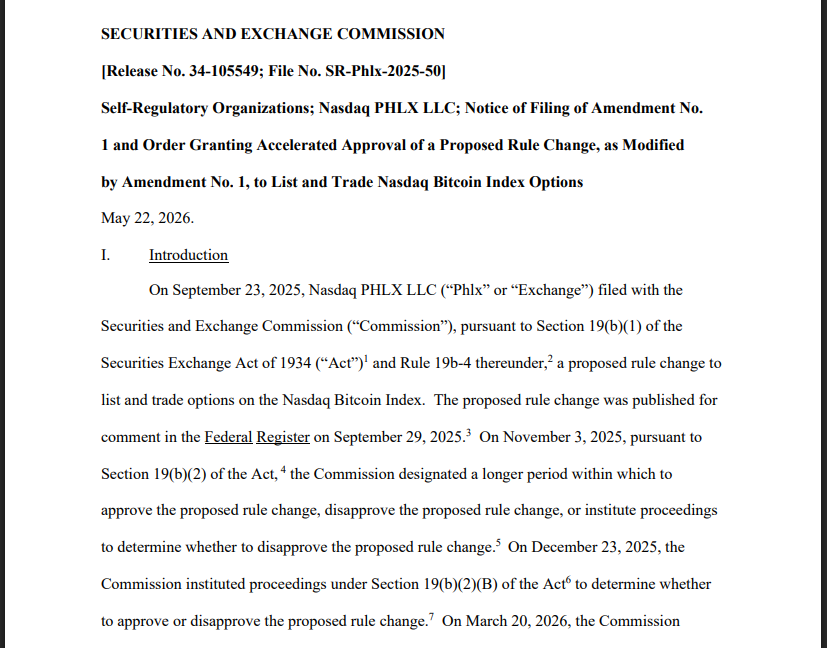
Source: SEC

The contracts will trade under the ticker QBTC, with a minimum price increment of one cent and a position limit of 24,000 contracts per side, which works out to roughly 0.12% of Bitcoin’s total outstanding supply.

They are tied to the Nasdaq Bitcoin Index, a benchmark that tracks one one-hundredth of the CME CF BTC Real Time Index, which pulls pricing data from major cryptocurrency exchanges every 200 milliseconds.

CME Group filed a comment letter last October arguing the new contracts fall under the CFTC’s exclusive authority. The SEC pushed back, writing in its order that shared jurisdiction between the two regulators is not new, citing mixed swaps and security futures as existing examples, and referencing Section 717 of the Dodd-Frank Act as the legal basis for concurrent oversight.

Bitcoin is now trading at $74,748. Chart: TradingView

A Shift In Tone At The SEC

The approval fits a broader shift underway at the SEC under Chairman Paul Atkins. The agency has moved to drop several enforcement cases against crypto firms that were launched under the previous administration, and Atkins has called publicly for clearer rules that support innovation.

Image: Economic Times

Reports indicate the SEC is also preparing what it calls an innovation exemption that would allow tokenized trading of public company shares on decentralized crypto platforms, even without consent from the companies involved.

The Philadelphia Stock Exchange will host the new QBTC contracts once both regulators have signed off, marking another step in Wall Street’s growing embrace of Bitcoin-linked financial products.

Featured image from Unsplash, chart from TradingView

Trending Cryptos

Related Questions

QWhat must happen before trading of the new Nasdaq Bitcoin index options can begin, despite SEC approval?

ABefore trading can begin, the Commodity Futures Trading Commission (CFTC) must grant its own exemptive relief. This is required because Bitcoin is classified as a commodity under the CFTC's jurisdiction.

QHow do the new Nasdaq Bitcoin index options differ from options tied to spot Bitcoin ETFs in terms of structure?

AThe new Nasdaq Bitcoin index options are European-style and cash-settled, meaning no actual Bitcoin changes hands. This structure removes the risk of early assignment, which sets them apart from options tied to spot Bitcoin ETFs.

QWhat is the ticker symbol and position limit for the new Bitcoin index options approved by the SEC?

AThe new Bitcoin index options will trade under the ticker symbol QBTC. They have a position limit of 24,000 contracts per side, which is roughly 0.12% of Bitcoin's total outstanding supply.

QWhat benchmark index will the new Nasdaq Bitcoin index options be tied to?

AThe new Nasdaq Bitcoin index options will be tied to the Nasdaq Bitcoin Index. This benchmark tracks one one-hundredth of the CME CF BTC Real Time Index, which pulls pricing data from major cryptocurrency exchanges every 200 milliseconds.

QAccording to the article, what broader shift is underway at the SEC under Chairman Paul Atkins?

AUnder Chairman Paul Atkins, the SEC is undergoing a broader shift. This includes dropping several enforcement cases against crypto firms from the previous administration and advocating for clearer rules to support innovation. The agency is also reportedly preparing an 'innovation exemption' for tokenized trading of public company shares.

Related Reads

Not Betting on Goals but on 'Tears': Polymarket Users Argue Over Ronaldo's Final World Cup Match

Title: Beyond Goals, Betting on Tears: Polymarket Users Clash Over Ronaldo's Emotional World Cup Exit On July 6, Portugal's 0-1 loss to Spain in the World Cup round of 16 marked the final tournament for Cristiano Ronaldo. The 41-year-old star's emotional reaction—red eyes, wiping his face, fighting back tears—was captured globally. Concurrently, a fierce debate erupted on the crypto prediction platform Polymarket over a specific market: "Will Ronaldo cry during the 2026 FIFA World Cup?" The market, with over $23 million in volume, saw its "YES" probability surge to 99% after the match, but the result was disputed and entered a final review phase. The core conflict centered on the market's precise rules: it required "clearly visible tears streaming down [Ronaldo's] face" in photos/videos taken on the field or bench area during Portugal's matches. While major media outlets described Ronaldo as "in tears" and footage showed him emotional, "NO" bettors argued visible tear tracks were not conclusively evident, only red eyes and dampness. Polymarket's official clarification on July 8 stated that eligible evidence existed showing Ronaldo crying with visible tears on his face post-match. The dispute now goes to a UMA oracle community vote for resolution. This incident highlights a recurring challenge for prediction markets: they excel with quantifiable events but can spark major controversies over subjective, visual, or emotional interpretations. It also serves as a reminder for participants to scrutinize rule wording meticulously, not rely on general perception. Ultimately, such high-profile disputes drive significant trading volume and attention for the platform.

Foresight News5m ago

Not Betting on Goals but on 'Tears': Polymarket Users Argue Over Ronaldo's Final World Cup Match

Foresight News5m ago

DeepSeek Secretly Builds AI Chip, Specializing in Inference, Project Started a Year Ago with No Public Recruitments

DeepSeek, the Chinese AI company known for its algorithmic models, is secretly developing its own AI chip to reduce dependence on Nvidia, according to a Reuters report. The chip is designed specifically for AI inference, not training, and the project began approximately a year ago. Currently in early stages, DeepSeek is reportedly in discussions with chip design firms, foundries, and memory suppliers. The company, historically focused on algorithmic efficiency, has been discreetly hiring chip design engineers without public job postings. This move aligns with a global trend where major AI model companies like OpenAI and Anthropic are also pursuing custom chip development. DeepSeek founder Liang Wenfeng previously highlighted chip shortages as a challenge. While the company initially trained models on Nvidia H800s and later adapted to Huawei's Ascend chips, it now seeks greater control over its hardware foundation. Designing a competitive AI chip is a significant challenge, requiring years and substantial investment with no guarantee of success. However, DeepSeek's efforts are backed by a recent major funding round of approximately 51 billion RMB (about $7.4 billion) raised in June 2026. The funds are designated for expanding data centers based on domestic chips, developing proprietary AI chips, and recruiting top global talent. Infrastructure plans are also advancing, with job postings for data center design engineers, including projects in locations like Ulanqab, Inner Mongolia. The company remains characteristically low-key, with sources speaking anonymously and no official comment from DeepSeek itself. Nevertheless, this initiative marks a strategic expansion from software algorithms into the hardware layer that powers its AI systems.

marsbit13m ago

DeepSeek Secretly Builds AI Chip, Specializing in Inference, Project Started a Year Ago with No Public Recruitments

marsbit13m ago

Trading

Spot

Hot Articles

What is $BITCOIN

DIGITAL GOLD ($BITCOIN): A Comprehensive Analysis Introduction to DIGITAL GOLD ($BITCOIN) DIGITAL GOLD ($BITCOIN) is a blockchain-based project operating on the Solana network, which aims to combine the characteristics of traditional precious metals with the innovation of decentralized technologies. While it shares a name with Bitcoin, often referred to as “digital gold” due to its perception as a store of value, DIGITAL GOLD is a separate token designed to create a unique ecosystem within the Web3 landscape. Its goal is to position itself as a viable alternative digital asset, although specifics regarding its applications and functionalities are still developing. What is DIGITAL GOLD ($BITCOIN)? DIGITAL GOLD ($BITCOIN) is a cryptocurrency token explicitly designed for use on the Solana blockchain. In contrast to Bitcoin, which provides a widely recognized value storage role, this token appears to focus on broader applications and characteristics. Notable aspects include: Blockchain Infrastructure: The token is built on the Solana blockchain, known for its capacity to handle high-speed and low-cost transactions. Supply Dynamics: DIGITAL GOLD has a maximum supply capped at 100 quadrillion tokens (100P $BITCOIN), although details regarding its circulating supply are currently undisclosed. Utility: While precise functionalities are not explicitly outlined, there are indications that the token could be utilized for various applications, potentially involving decentralized applications (dApps) or asset tokenization strategies. Who is the Creator of DIGITAL GOLD ($BITCOIN)? At present, the identity of the creators and development team behind DIGITAL GOLD ($BITCOIN) remains unknown. This situation is typical among many innovative projects within the blockchain space, particularly those aligning with decentralized finance and meme coin phenomena. While such anonymity may foster a community-driven culture, it intensifies concerns about governance and accountability. Who are the Investors of DIGITAL GOLD ($BITCOIN)? The available information indicates that DIGITAL GOLD ($BITCOIN) does not have any known institutional backers or prominent venture capital investments. The project seems to operate on a peer-to-peer model focused on community support and adoption rather than traditional funding routes. Its activity and liquidity are primarily situated on decentralized exchanges (DEXs), such as PumpSwap, rather than established centralized trading platforms, further highlighting its grassroots approach. How DIGITAL GOLD ($BITCOIN) Works The operational mechanics of DIGITAL GOLD ($BITCOIN) can be elaborated on based on its blockchain design and network attributes: Consensus Mechanism: By leveraging Solana’s unique proof-of-history (PoH) combined with a proof-of-stake (PoS) model, the project ensures efficient transaction validation contributing to the network's high performance. Tokenomics: While specific deflationary mechanisms have not been extensively detailed, the vast maximum token supply implies that it may cater to microtransactions or niche use cases that are still to be defined. Interoperability: There exists the potential for integration with Solana’s broader ecosystem, including various decentralized finance (DeFi) platforms. However, the details regarding specific integrations remain unspecified. Timeline of Key Events Here is a timeline that highlights significant milestones concerning DIGITAL GOLD ($BITCOIN): 2023: The initial deployment of the token occurs on the Solana blockchain, marked by its contract address. 2024: DIGITAL GOLD gains visibility as it becomes available for trading on decentralized exchanges like PumpSwap, allowing users to trade it against SOL. 2025: The project witnesses sporadic trading activity and potential interest in community-led engagements, although no noteworthy partnerships or technical advancements have been documented as of yet. Critical Analysis Strengths Scalability: The underlying Solana infrastructure supports high transaction volumes, which could enhance the utility of $BITCOIN in various transaction scenarios. Accessibility: The potential low trading price per token could attract retail investors, facilitating wider participation due to fractional ownership opportunities. Risks Lack of Transparency: The absence of publicly known backers, developers, or an audit process may yield skepticism regarding the project's sustainability and trustworthiness. Market Volatility: The trading activity is heavily reliant on speculative behavior, which can result in significant price volatility and uncertainty for investors. Conclusion DIGITAL GOLD ($BITCOIN) emerges as an intriguing yet ambiguous project within the rapidly evolving Solana ecosystem. While it attempts to leverage the “digital gold” narrative, its departure from Bitcoin's established role as a store of value underscores the need for a clearer differentiation of its intended utility and governance structure. Future acceptance and adoption will likely depend on addressing the current opacity and defining its operational and economic strategies more explicitly. Note: This report encompasses synthesised information available as of October 2023, and developments may have transpired beyond the research period.

664 Total ViewsPublished 2025.05.13Updated 2025.05.13

What is $BITCOIN

Discussions

Welcome to the HTX Community. Here, you can stay informed about the latest platform developments and gain access to professional market insights. Users' opinions on the price of BTC (BTC) are presented below.

活动图片