Bitcoin Stagnates, But Inflation Data Could Trigger Movement

cryptonews.ruPublished on 2026-08-12Last updated on 2026-08-12

Abstract

Bitcoin remained stuck in a narrow range around $63,500, extending a five-week period of stagnation. Persistent demand from exchange-traded funds (ETFs) has been offset by selling pressure from miners and corporate holders like MicroStrategy, creating a market stalemate. Trading volumes have fallen to a three-year low, limiting potential for decisive price movement. Analysts suggest upcoming U.S. Consumer Price Index (CPI) inflation data could be the catalyst needed to break Bitcoin out of its current range. With market participants awaiting clarity on monetary policy and digital asset regulation, implied volatility has dropped significantly. Traders remain well-hedged in derivatives markets, not positioning for an imminent breakout. However, a prolonged stall carries risk, as September has historically been Bitcoin's weakest month, with an average decline of about 4%.

On Tuesday, Bitcoin barely moved, extending a five-week period of stagnation as persistent demand from exchange-traded funds clashed with selling from miners and corporate holders.

$BTC dropped to around $63,500, falling 0.6% over the last 24 hours. More importantly, the largest cryptocurrency remained stuck in the roughly $62,000-$66,000 range that has contained prices for most of the summer.

"Bitcoin's recent price fluctuations have largely been driven by sustained ETF inflows, offset by over-the-counter sales from miners and Strategy (MSTR)," said Paul Howard, Senior Director at trading firm Wincent.
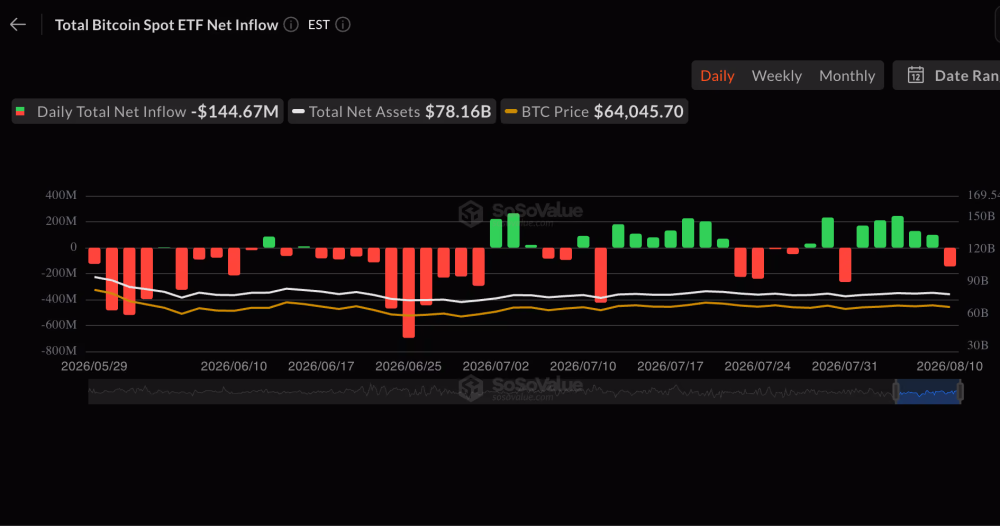
Daily Bitcoin ETF Flows Source: SooValue.

According to Paul Howard, cryptocurrency trading volumes have fallen to their lowest level in three years, leaving little opportunity for decisive movement in $BTC in either direction.

Bitfinex analysts also pointed to competing flows. They stated that ETFs and Bitcoin-treasury companies have been the two main sources of price-insensitive demand, but recent corporate treasury activity has provided offsetting selling pressure. This helps explain why $BTC rose only about 2% last week despite strong ETF inflows and better performance in broader risk markets.

Consumer Price Index (CPI) Could Wake Bitcoin from Its Slumber

Wednesday's US inflation report could finally give traders a reason to break the stalemate.

"Confidence is weak on both sides, with summer liquidity in short supply," said Jeff Anderson, Managing Partner at STS Digital.

He said implied volatility has plummeted as traders await clarity on monetary policy and the fate of the Clarity Act in the digital asset market:

"This sets the market up for a more significant move if Bitcoin breaks out of the range in either direction. Against this backdrop, Wednesday's CPI data—the first major inflation reading after Fed Chair Kevin Warsh's inflation-focused press conference following the July FOMC meeting—will be the next test."

Howard expects consolidation to continue until mid-September without a fundamental catalyst, with progress on the Clarity Act market regulation potentially being the next significant driver. Derivatives positioning also shows investors remain well-hedged, suggesting traders are not making large bets on an imminent breakout.

According to STS Digital's Anderson, the calendar could become less favorable if the stalemate drags on. Historically, September has been Bitcoin's weakest month, falling an average of about 4% since 2013, according to CoinGlass data.
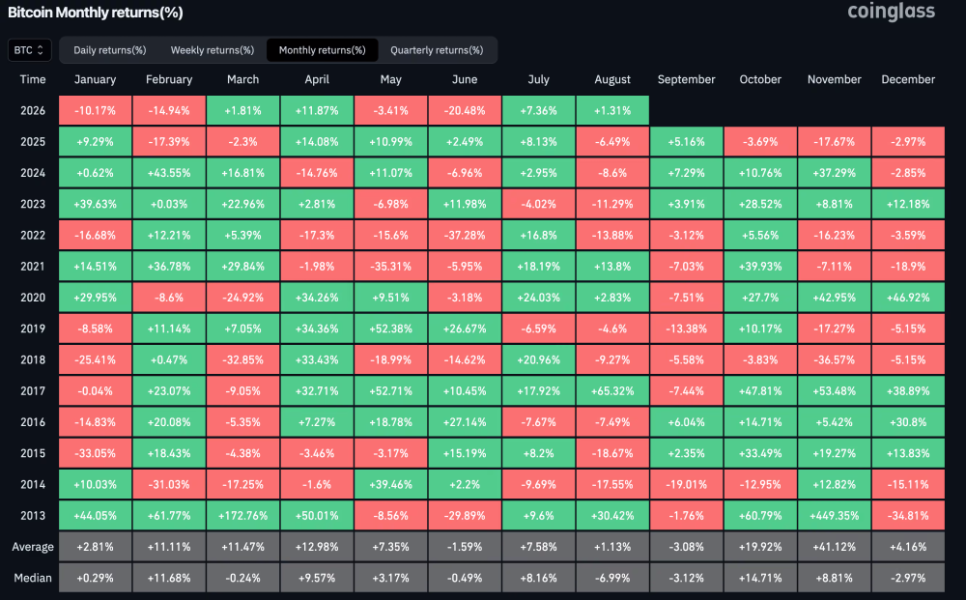
Figure 2. Bitcoin Monthly Returns. Source: CoinGlass.

end-content

Trending Cryptos

Related Questions

QWhat is the main reason given for Bitcoin's recent price stagnation?

AAccording to the article, Bitcoin's price stagnation is primarily due to a balance between sustained demand from exchange-traded funds (ETFs) and selling pressure from miners and corporate holders like MicroStrategy (MSTR). Low trading volumes have also limited decisive price movement.

QHow might the upcoming US Consumer Price Index (CPI) data impact Bitcoin?

AThe article suggests that the upcoming US CPI inflation report could provide traders with a catalyst to break the current market deadlock and move Bitcoin out of its trading range by offering clarity on monetary policy.

QWhat does the article say about Bitcoin's historical performance in September?

AThe article notes that historically, September has been Bitcoin's weakest month, with the cryptocurrency falling an average of about 4% since 2013, according to data from CoinGlass.

QAccording to analysts, what are the two main sources of 'price-insensitive demand' for Bitcoin mentioned in the article?

AThe two main sources of price-insensitive demand mentioned are spot Bitcoin ETFs and companies holding Bitcoin on their balance sheets (corporate treasuries).

QWhat potential regulatory development is mentioned as a possible future catalyst for Bitcoin's price?

AThe article mentions that progress on the Clarity Act for digital asset market regulation could be the next significant catalyst for Bitcoin's price movement.

Related Reads

XRP Price Forecast Amid Accumulation by Large Holders

XRP Price Forecast Amid Rising Accumulation by Large Holders On August 12, XRP's price increased by 1.36% to $1.01, recovering after briefly dropping below the $1 support level the previous day. Data indicates that despite weak price momentum, activity from large holders (whales) and active addresses is growing. Santiment data shows a net increase of 32 wallets holding over 1 million XRP over three months, starting May 2026. This accumulation suggests a transfer of supply from weak to strong hands. While large investors bought, retail selling contributed to a 29% decline in XRP's market cap over the same period. Concurrently, the number of active XRP addresses surged 84% from August 1 to August 11. This network activity rise occurs ahead of an XRP Ledger update expected to boost DeFi usage and despite a low 22% probability of the CLARITY Act passing in 2026, creating a bullish divergence. Technically, XRP's drop below $1 on August 12 marked a 20-month low, with the RSI at 37 favoring bears. Further sell pressure could push the price down to the $0.85 Fibonacci level. However, analysts note XRP may be oversold after a 71% decline from July 2025. A strong uptrend would require overcoming resistance at the $1.20 Fibonacci level. Separately, the Coreum bridge connecting to the XRP Ledger was hacked for $200,000 worth of XRP, exploiting a deposit verification flaw. The Ripple community confirmed the XRP Ledger itself remains secure.

cryptonews.ru21m ago

XRP Price Forecast Amid Accumulation by Large Holders

cryptonews.ru21m ago

US Consumer Price Index Drops to 3.4% as Expected, Bitcoin Rises

U.S. Consumer Price Index (CPI) inflation for July met expectations, easing concerns about a Federal Reserve interest rate hike this year. Following the data release, Bitcoin recovered, rising above the key psychological level of $64,000. The U.S. CPI fell to 3.4% year-over-year and 0.1% month-over-month, aligning with forecasts. The core CPI also matched expectations, dropping to 2.5% annually and 0.2% monthly. Bitcoin climbed to around $64,100, recovering from an intraday low near $63,400. However, trading remains in a narrow range due to uncertainty from U.S.-Iran tensions and their potential impact on energy prices. Fed Presidents Austan Goolsbee and Neel Kashkari have indicated inflation is a top concern, with Kashkari advocating for rate hikes. Despite this, the probability of a Fed rate hike at the September FOMC meeting decreased after the CPI report, which is viewed as positive for Bitcoin and the broader crypto market. Market forecasts now suggest a 67% chance rates will remain unchanged. Data from prediction platform Polymarket shows the likelihood of a rate hike this year has fallen to 54%, down from a recent peak of 60% and a July high of 79% amid escalating U.S.-Iran tensions. Market attention now shifts to tomorrow's Producer Price Index (PPI) report for a more complete picture of inflation. A low PPI reading could further reduce rate hike fears, especially following July's jobs report which indicated ongoing labor market instability.

cryptonews.ru24m ago

US Consumer Price Index Drops to 3.4% as Expected, Bitcoin Rises

cryptonews.ru24m ago

Trading

Spot

Hot Articles

What is $BITCOIN

DIGITAL GOLD ($BITCOIN): A Comprehensive Analysis Introduction to DIGITAL GOLD ($BITCOIN) DIGITAL GOLD ($BITCOIN) is a blockchain-based project operating on the Solana network, which aims to combine the characteristics of traditional precious metals with the innovation of decentralized technologies. While it shares a name with Bitcoin, often referred to as “digital gold” due to its perception as a store of value, DIGITAL GOLD is a separate token designed to create a unique ecosystem within the Web3 landscape. Its goal is to position itself as a viable alternative digital asset, although specifics regarding its applications and functionalities are still developing. What is DIGITAL GOLD ($BITCOIN)? DIGITAL GOLD ($BITCOIN) is a cryptocurrency token explicitly designed for use on the Solana blockchain. In contrast to Bitcoin, which provides a widely recognized value storage role, this token appears to focus on broader applications and characteristics. Notable aspects include: Blockchain Infrastructure: The token is built on the Solana blockchain, known for its capacity to handle high-speed and low-cost transactions. Supply Dynamics: DIGITAL GOLD has a maximum supply capped at 100 quadrillion tokens (100P $BITCOIN), although details regarding its circulating supply are currently undisclosed. Utility: While precise functionalities are not explicitly outlined, there are indications that the token could be utilized for various applications, potentially involving decentralized applications (dApps) or asset tokenization strategies. Who is the Creator of DIGITAL GOLD ($BITCOIN)? At present, the identity of the creators and development team behind DIGITAL GOLD ($BITCOIN) remains unknown. This situation is typical among many innovative projects within the blockchain space, particularly those aligning with decentralized finance and meme coin phenomena. While such anonymity may foster a community-driven culture, it intensifies concerns about governance and accountability. Who are the Investors of DIGITAL GOLD ($BITCOIN)? The available information indicates that DIGITAL GOLD ($BITCOIN) does not have any known institutional backers or prominent venture capital investments. The project seems to operate on a peer-to-peer model focused on community support and adoption rather than traditional funding routes. Its activity and liquidity are primarily situated on decentralized exchanges (DEXs), such as PumpSwap, rather than established centralized trading platforms, further highlighting its grassroots approach. How DIGITAL GOLD ($BITCOIN) Works The operational mechanics of DIGITAL GOLD ($BITCOIN) can be elaborated on based on its blockchain design and network attributes: Consensus Mechanism: By leveraging Solana’s unique proof-of-history (PoH) combined with a proof-of-stake (PoS) model, the project ensures efficient transaction validation contributing to the network's high performance. Tokenomics: While specific deflationary mechanisms have not been extensively detailed, the vast maximum token supply implies that it may cater to microtransactions or niche use cases that are still to be defined. Interoperability: There exists the potential for integration with Solana’s broader ecosystem, including various decentralized finance (DeFi) platforms. However, the details regarding specific integrations remain unspecified. Timeline of Key Events Here is a timeline that highlights significant milestones concerning DIGITAL GOLD ($BITCOIN): 2023: The initial deployment of the token occurs on the Solana blockchain, marked by its contract address. 2024: DIGITAL GOLD gains visibility as it becomes available for trading on decentralized exchanges like PumpSwap, allowing users to trade it against SOL. 2025: The project witnesses sporadic trading activity and potential interest in community-led engagements, although no noteworthy partnerships or technical advancements have been documented as of yet. Critical Analysis Strengths Scalability: The underlying Solana infrastructure supports high transaction volumes, which could enhance the utility of $BITCOIN in various transaction scenarios. Accessibility: The potential low trading price per token could attract retail investors, facilitating wider participation due to fractional ownership opportunities. Risks Lack of Transparency: The absence of publicly known backers, developers, or an audit process may yield skepticism regarding the project's sustainability and trustworthiness. Market Volatility: The trading activity is heavily reliant on speculative behavior, which can result in significant price volatility and uncertainty for investors. Conclusion DIGITAL GOLD ($BITCOIN) emerges as an intriguing yet ambiguous project within the rapidly evolving Solana ecosystem. While it attempts to leverage the “digital gold” narrative, its departure from Bitcoin's established role as a store of value underscores the need for a clearer differentiation of its intended utility and governance structure. Future acceptance and adoption will likely depend on addressing the current opacity and defining its operational and economic strategies more explicitly. Note: This report encompasses synthesised information available as of October 2023, and developments may have transpired beyond the research period.

1.8k Total ViewsPublished 2025.05.13Updated 2025.05.13

What is $BITCOIN

Discussions

Welcome to the HTX Community. Here, you can stay informed about the latest platform developments and gain access to professional market insights. Users' opinions on the price of BTC (BTC) are presented below.

活动图片