Solana Nearly Halted Finalization Due to an Outage

cryptonews.ruPublished on 2026-08-12Last updated on 2026-08-12

Abstract

On August 12th, a routing failure at infrastructure provider TeraSwitch caused approximately 90 Solana validators, representing 28.83% of staked SOL, to go offline simultaneously. This brought the network dangerously close to the 33.34% threshold at which transaction finality would halt, stopping the blockchain. The incident, highlighted by Marinade Finance, lasted about 33 minutes before routing was restored. The affected validators missed out on roughly 333 SOL in rewards during the downtime. The event underscored significant risks from infrastructure concentration, as TeraSwitch alone managed validators with 27.34% of the total staked SOL prior to the outage. Marinade Finance stated it would revise limits on validator distribution across autonomous systems and data centers to improve resilience. Some major operators, like Coinbase, already distribute infrastructure across multiple providers with backup servers to mitigate such single points of failure. The incident echoes a 2022 event where provider Hetzner, hosting ~40% of validators, disconnected nodes, though the network remained operational.

On August 12, due to a routing failure at infrastructure provider TeraSwitch, validators accounting for 28.83% of staked $SOL went offline simultaneously. This brought the network close to the 33.34% threshold at which it would have stopped finalizing transactions. This was reported by the Marinade Finance project team.

1/ Solana got 86% of the way to a halt this morning and it barely registered anywhere.
28.83% of staked $SOL went delinquent. Finality stops at 33.34%.
We added up the rewards lost across all 90 affected validators. 333 $SOL. pic.twitter.com/EEC2gYwQgz

— Marinade 🛡️ (@MarinadeFinance) August 12, 2026

The incident affected about 90 validators. The autonomous system TeraSwitch AS20326 accounted for 118.9 million $SOL, or 27.34% of the network's total stake. During the outage, 94% of that amount went offline simultaneously.

The critical level was ultimately not reached. Routing was restored after approximately 33 minutes, and the validators returned to the network. During the downtime, they missed out on about 333 $SOL in rewards.

Outage Highlights a Significant Problem

Marinade called the incident an example of infrastructure concentration risk. The project will review the limitations on distributing validators across autonomous systems, data centers, and backup infrastructure.

The problem existed even before this incident. As of July 22, TeraSwitch served validators with approximately 27.1% of staked Solana tokens. It was followed by UAB Cherry Servers (12.7%) and Latitude.sh (11%).
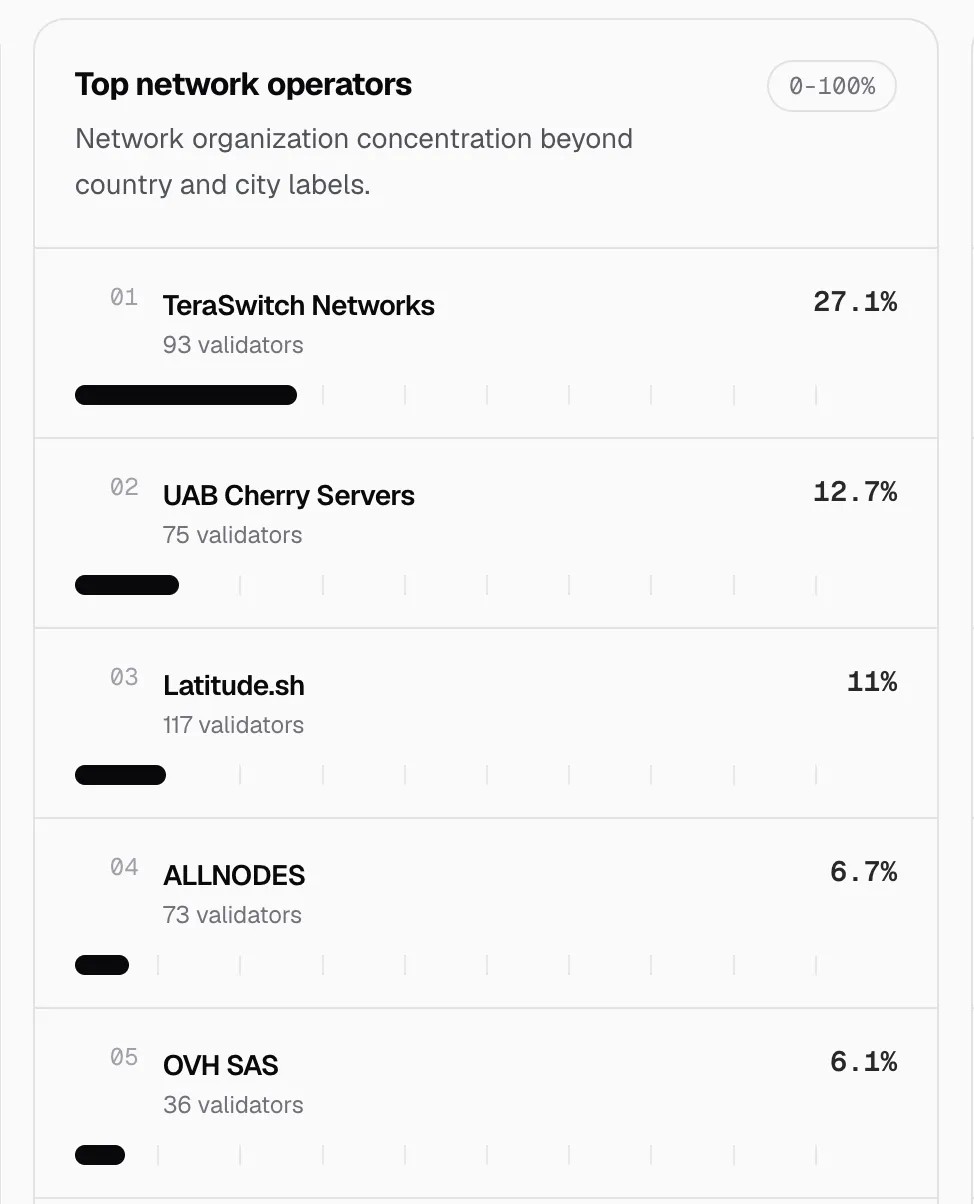
Source: Validators Solutions.

Some major operators already distribute their infrastructure across multiple providers. In its Q1 report, the Coinbase exchange stated that 13 of its validators operate via TeraSwitch, with another 10 via Latitude.

For each, the company also uses a backup server in a different location. The trading platform's team explained such a setup as necessary to limit the impact of a single provider's failure.

Recall that in November 2022, German hosting provider Hetzner turned off servers with Solana nodes. At that time, its infrastructure supported about 40% of validators with roughly 20% of the total staked coins. The network continued to operate.

In January 2026, the number of active Solana validators dropped to 800 — the lowest level since 2021. At the peak in 2023, there were over 2,500.

end-content
Trending Cryptos

Related Questions

QWhat happened to the Solana network on August 12th, and what was the critical threshold almost reached?

AOn August 12th, a routing failure at infrastructure provider TeraSwitch caused approximately 90 validators with 28.83% of staked $SOL to go offline simultaneously. This brought the network close to the 33.34% delinquency threshold, beyond which transaction finality would have stopped.

QWho reported the incident, and what financial impact did it have on the affected validators?

AThe incident was reported by the Marinade Finance team. The affected validators lost an estimated 333 $SOL in staking rewards during the approximately 33 minutes of downtime.

QWhat core issue within Solana's infrastructure did this incident highlight according to Marinade Finance?

AAccording to Marinade Finance, the incident highlighted the risk of infrastructure concentration. They plan to review limits on validator distribution across autonomous systems, data centers, and backup infrastructure.

QWhat was the market share of TeraSwitch in Solana staking before the incident, and who were the next largest providers?

AAs of July 22nd, TeraSwitch hosted validators with approximately 27.1% of staked Solana tokens. The next largest providers were UAB Cherry Servers (12.7%) and Latitude.sh (11%).

QHow does Coinbase mitigate the risk of a single infrastructure provider failure for its Solana validators?

ACoinbase mitigates this risk by distributing its validators across multiple providers (e.g., 13 via TeraSwitch and 10 via Latitude) and operating a backup server in a different location for each validator.

Related Reads

XRP Price Forecast Amid Accumulation by Large Holders

XRP Price Forecast Amid Rising Accumulation by Large Holders On August 12, XRP's price increased by 1.36% to $1.01, recovering after briefly dropping below the $1 support level the previous day. Data indicates that despite weak price momentum, activity from large holders (whales) and active addresses is growing. Santiment data shows a net increase of 32 wallets holding over 1 million XRP over three months, starting May 2026. This accumulation suggests a transfer of supply from weak to strong hands. While large investors bought, retail selling contributed to a 29% decline in XRP's market cap over the same period. Concurrently, the number of active XRP addresses surged 84% from August 1 to August 11. This network activity rise occurs ahead of an XRP Ledger update expected to boost DeFi usage and despite a low 22% probability of the CLARITY Act passing in 2026, creating a bullish divergence. Technically, XRP's drop below $1 on August 12 marked a 20-month low, with the RSI at 37 favoring bears. Further sell pressure could push the price down to the $0.85 Fibonacci level. However, analysts note XRP may be oversold after a 71% decline from July 2025. A strong uptrend would require overcoming resistance at the $1.20 Fibonacci level. Separately, the Coreum bridge connecting to the XRP Ledger was hacked for $200,000 worth of XRP, exploiting a deposit verification flaw. The Ripple community confirmed the XRP Ledger itself remains secure.

cryptonews.ru49m ago

XRP Price Forecast Amid Accumulation by Large Holders

cryptonews.ru49m ago

US Consumer Price Index Drops to 3.4% as Expected, Bitcoin Rises

U.S. Consumer Price Index (CPI) inflation for July met expectations, easing concerns about a Federal Reserve interest rate hike this year. Following the data release, Bitcoin recovered, rising above the key psychological level of $64,000. The U.S. CPI fell to 3.4% year-over-year and 0.1% month-over-month, aligning with forecasts. The core CPI also matched expectations, dropping to 2.5% annually and 0.2% monthly. Bitcoin climbed to around $64,100, recovering from an intraday low near $63,400. However, trading remains in a narrow range due to uncertainty from U.S.-Iran tensions and their potential impact on energy prices. Fed Presidents Austan Goolsbee and Neel Kashkari have indicated inflation is a top concern, with Kashkari advocating for rate hikes. Despite this, the probability of a Fed rate hike at the September FOMC meeting decreased after the CPI report, which is viewed as positive for Bitcoin and the broader crypto market. Market forecasts now suggest a 67% chance rates will remain unchanged. Data from prediction platform Polymarket shows the likelihood of a rate hike this year has fallen to 54%, down from a recent peak of 60% and a July high of 79% amid escalating U.S.-Iran tensions. Market attention now shifts to tomorrow's Producer Price Index (PPI) report for a more complete picture of inflation. A low PPI reading could further reduce rate hike fears, especially following July's jobs report which indicated ongoing labor market instability.

cryptonews.ru51m ago

US Consumer Price Index Drops to 3.4% as Expected, Bitcoin Rises

cryptonews.ru51m ago

Trading

Spot

Hot Articles

Discussions

Welcome to the HTX Community. Here, you can stay informed about the latest platform developments and gain access to professional market insights. Users' opinions on the price of SOL (SOL) are presented below.

活动图片