Bitcoin Smart Money Buys, While Retail Dumps: Why The Latest Rally Looks Well-Founded

bitcoinistPublished on 2026-01-17Last updated on 2026-01-17

Abstract

Bitcoin's recent price bounce above $95,000 is considered well-founded, driven by a clear split between investor groups. While retail traders (shrimp wallets) have been selling, reducing their holdings by 30%, large investors (whales and sharks) have been accumulating significantly, adding over 32,693 BTC to their holdings. This shift from weak to strong hands reduces selling pressure and strengthens the rally's foundation. Additionally, ongoing bearish sentiment and FUD on social media, contrary to typical retail behavior, may actually propel Bitcoin higher, potentially toward the $100,000 mark, as markets often move opposite to crowd sentiment.

A few days ago, the price of Bitcoin experienced a bounce after weeks of trading below the $91,000 mark. However, this renewed momentum appears to be gradually fading as the crypto market slowly shifts toward a bearish state, with large and retail BTC investors moving in a distinct direction.

What’s Happening Behind The Bitcoin’s Rise

Bitcoin may have slightly pulled back from its most recent bounce, but the price is still holding strong above the $95,000 level. Meanwhile, the latest jump has attracted significant attention in the broader cryptocurrency market, with the move being increasingly viewed as well-justified rather than speculative.

Currently, on-chain and market data are showing a clear divergence in who is driving the ongoing move. Santiment, a leading market intelligence and on-chain data analytics platform, disclosed that itcoin’s surge to a high of $97,800 on Wednesday seemed more than warranted due to the behavior of large and retail investors.

Institutions, long-term investors, and big wallets, together referred to as smart money, have been discreetly accumulating while retail traders have been gradually lowering their exposure and selling into strength. With the rotation of supply from weaker hands to more conviction-driven investors reducing selling pressure, the rally’s foundation is being strengthened.
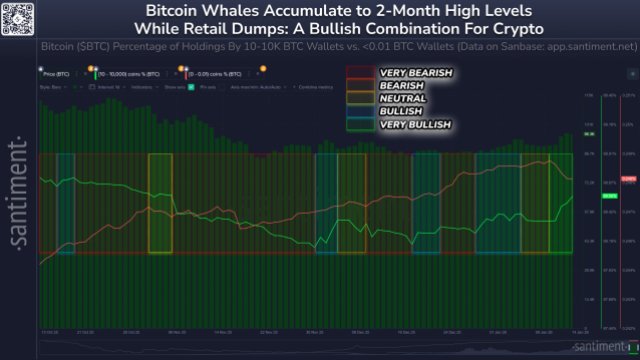
Source: Chart from Santiment on X

When whales are buying more BTC, and retail investors are dumping, it reflects a very bullish market outlook. Since January 10, whales and sharks, particularly wallets holding between 10 and 10,000 BTC, have been amassing BTC, collectively scooping up more than 32,693 BTC. This massive purchase represents a +0.24% rise to their collective holdings.

On the other hand, retail or shrimp holders, those holding less than 0.01 BTC, have collectively offloaded over 149 BTC since January 10. Data shows that the dump represents a 30% decline in their holdings altogether.

Santiment highlighted that the key signal underneath the action is that smart money is finally buying consistently, while micro money bows out. Furthermore, it is considered an ideal setup for a bull run. However, how long retail doubts the formed tiny rally will determine how long it lasts, and the “Very Bullish” green zone is still in place for the time being.

Ongoing FUD In The Market Set To Propel BTC’s Price

Even with the recent recovery, Bitcoin is seeing negative interactions from crypto enthusiasts and analysts on social media platforms. This behavior implies that the crowd is not entirely confident in the BTC rally that occurred on Wednesday. Although the development may seem present itself as negative, it is actually a good sign that the rally might extend.

Social data reveals that commentary toward BTC across social media platforms has sharply leaned to a bearish outlook as prices have bounced this week. With markets often moving in the opposite direction of retail sentiment, Santiment noted that the most FUD in 10 days is likely to propel BTC to its first return above the $100,000 mark, which was last seen on November 13, 2025.

BTC trading at $95,712 on the 1D chart | Source: BTCUSDT on Tradingview.com

Related Questions

QAccording to the article, what is the key difference in behavior between 'smart money' and retail investors during Bitcoin's recent price movement?

ASmart money (institutions, long-term investors, and big wallets) has been discreetly accumulating Bitcoin, while retail traders have been selling and reducing their exposure.

QWhat specific data does Santiment provide to show that whales and sharks are accumulating BTC?

ASince January 10, wallets holding between 10 and 10,000 BTC have collectively purchased more than 32,693 BTC, representing a +0.24% increase in their holdings.

QWhy does the article suggest that negative social media commentary (FUD) could actually be a positive sign for Bitcoin's price?

ABecause markets often move in the opposite direction of retail sentiment, and the presence of Fear, Uncertainty, and Doubt (FUD) can indicate a lack of over-optimism, potentially propelling the price higher.

QWhat price level does the article mention as a key target for Bitcoin's potential rally?

AThe article states that the current FUD is likely to propel BTC to its first return above the $100,000 mark.

QHow does the transfer of Bitcoin from 'weaker hands' to 'conviction-driven investors' affect the market, according to the analysis?

AThis rotation of supply reduces selling pressure and strengthens the foundation of the rally, making it more sustainable.

Related Reads

Vitalik's Vision for the Next Evolution of On-Chain Finance: How to Reconstruct DeFi with an 'Options Mindset'?

Vitalik Buterin recently proposed a conceptual shift for DeFi: replacing traditional Collateralized Debt Positions (CDPs) and forced liquidations with an options-based mechanism. This aims to address key vulnerabilities in current DeFi lending. The traditional CDP model, foundational to protocols like MakerDAO and Aave, allows users to borrow against collateral but relies on real-time oracles and triggers sudden, mandatory liquidations during price volatility. This can cause cascading sell-offs, oracle manipulation risks, and significant MEV extraction, exacerbating market stress. Vitalik's alternative envisions splitting an asset like 1 ETH into two complementary components: one offering stable/index-like exposure and the other absorbing the opposite risk/reward. Instead of a hard liquidation threshold, a user's exposure to the target asset would gradually and smoothly deviate (following a near-quadratic curve) as the collateral price moves. The system would primarily depend on "slow oracles" for periodic settlement rather than instant price feeds. Key potential benefits include: the elimination of abrupt, forced liquidations; drastically reduced reliance on vulnerable real-time oracles; and inherent resistance to certain MEV exploits centered on liquidation auctions. The article posits that for Ethereum DeFi to maintain its relevance amid competition from faster, cheaper chains, it must compete on sophisticated financial engineering and robustness—not just transaction speed or yields. The core value proposition should shift towards offering users clearer, more manageable risk structures, greater autonomy, and resilience in extreme scenarios, moving DeFi from high-risk experimentation towards becoming reliable financial infrastructure.

marsbit16m ago

Vitalik's Vision for the Next Evolution of On-Chain Finance: How to Reconstruct DeFi with an 'Options Mindset'?

marsbit16m ago

AI Agent Completely Transforms Web3 Gaming: From the Rugpull Bakery Bot Controversy to the New 2026 Agent Paradigm

This article explores how the AI Agent paradigm is fundamentally transforming Web3 gaming, moving from a disruptive force to a core, legitimized element. It begins with the controversy in the competitive baking game Rugpull Bakery, where automated scripts caused fairness issues. Instead of banning them, the developers integrated AI Agents into the official gameplay by providing technical documentation (skill.md, agent.json), marking a shift towards "Agentic Gaming." The piece outlines three primary implementation models for AI Agents in Web3 games by 2026: 1. **Autonomous Competitors & Economic Entities:** AI Agents act as independent players with unique strategies. Examples include TEN Protocol's poker agents, AI Arena's trainable NFT fighters, and Satoshi Strike Force's "Digital Athletes" trained on player data. The Somnia blockchain is highlighted as a dedicated "Agentic L1" infrastructure supporting this model at scale. 2. **Modular Infrastructure & Programmable Environments:** This model, exemplified by EVE Frontier, allows AI Agents to program game world logic itself. Using "Smart Assemblies" (e.g., Smart Turrets, Smart Gates), Agents can modify shared economic and physical rules on-chain, creating dynamic, player/AI-built worlds. The ERC-8183 standard further enables these automated entities to hire other AI services for complex tasks. 3. **Hybrid Companions & Dynamic Adaptation:** Here, AI serves as a collaborative partner. In Parallel Colony, highly autonomous AI Avatars work alongside human players who provide high-level guidance. Illuvium plans to use AI to make NPCs dynamic and responsive, creating personalized, emergent narratives for each player. The conclusion posits that Web3 gaming has reached a "post-human" inflection point. Blockchains' transparency and programmability, combined with new standards and infrastructure like Somnia, make integrating and governing AI Agents not just viable but essential. The future lies in a symbiotic digital order where players transition from manual laborers to commanders and partners of algorithmic intelligence.

marsbit1h ago

AI Agent Completely Transforms Web3 Gaming: From the Rugpull Bakery Bot Controversy to the New 2026 Agent Paradigm

marsbit1h ago

Trading

Spot
Futures

Hot Articles

What is $BITCOIN

DIGITAL GOLD ($BITCOIN): A Comprehensive Analysis Introduction to DIGITAL GOLD ($BITCOIN) DIGITAL GOLD ($BITCOIN) is a blockchain-based project operating on the Solana network, which aims to combine the characteristics of traditional precious metals with the innovation of decentralized technologies. While it shares a name with Bitcoin, often referred to as “digital gold” due to its perception as a store of value, DIGITAL GOLD is a separate token designed to create a unique ecosystem within the Web3 landscape. Its goal is to position itself as a viable alternative digital asset, although specifics regarding its applications and functionalities are still developing. What is DIGITAL GOLD ($BITCOIN)? DIGITAL GOLD ($BITCOIN) is a cryptocurrency token explicitly designed for use on the Solana blockchain. In contrast to Bitcoin, which provides a widely recognized value storage role, this token appears to focus on broader applications and characteristics. Notable aspects include: Blockchain Infrastructure: The token is built on the Solana blockchain, known for its capacity to handle high-speed and low-cost transactions. Supply Dynamics: DIGITAL GOLD has a maximum supply capped at 100 quadrillion tokens (100P $BITCOIN), although details regarding its circulating supply are currently undisclosed. Utility: While precise functionalities are not explicitly outlined, there are indications that the token could be utilized for various applications, potentially involving decentralized applications (dApps) or asset tokenization strategies. Who is the Creator of DIGITAL GOLD ($BITCOIN)? At present, the identity of the creators and development team behind DIGITAL GOLD ($BITCOIN) remains unknown. This situation is typical among many innovative projects within the blockchain space, particularly those aligning with decentralized finance and meme coin phenomena. While such anonymity may foster a community-driven culture, it intensifies concerns about governance and accountability. Who are the Investors of DIGITAL GOLD ($BITCOIN)? The available information indicates that DIGITAL GOLD ($BITCOIN) does not have any known institutional backers or prominent venture capital investments. The project seems to operate on a peer-to-peer model focused on community support and adoption rather than traditional funding routes. Its activity and liquidity are primarily situated on decentralized exchanges (DEXs), such as PumpSwap, rather than established centralized trading platforms, further highlighting its grassroots approach. How DIGITAL GOLD ($BITCOIN) Works The operational mechanics of DIGITAL GOLD ($BITCOIN) can be elaborated on based on its blockchain design and network attributes: Consensus Mechanism: By leveraging Solana’s unique proof-of-history (PoH) combined with a proof-of-stake (PoS) model, the project ensures efficient transaction validation contributing to the network's high performance. Tokenomics: While specific deflationary mechanisms have not been extensively detailed, the vast maximum token supply implies that it may cater to microtransactions or niche use cases that are still to be defined. Interoperability: There exists the potential for integration with Solana’s broader ecosystem, including various decentralized finance (DeFi) platforms. However, the details regarding specific integrations remain unspecified. Timeline of Key Events Here is a timeline that highlights significant milestones concerning DIGITAL GOLD ($BITCOIN): 2023: The initial deployment of the token occurs on the Solana blockchain, marked by its contract address. 2024: DIGITAL GOLD gains visibility as it becomes available for trading on decentralized exchanges like PumpSwap, allowing users to trade it against SOL. 2025: The project witnesses sporadic trading activity and potential interest in community-led engagements, although no noteworthy partnerships or technical advancements have been documented as of yet. Critical Analysis Strengths Scalability: The underlying Solana infrastructure supports high transaction volumes, which could enhance the utility of $BITCOIN in various transaction scenarios. Accessibility: The potential low trading price per token could attract retail investors, facilitating wider participation due to fractional ownership opportunities. Risks Lack of Transparency: The absence of publicly known backers, developers, or an audit process may yield skepticism regarding the project's sustainability and trustworthiness. Market Volatility: The trading activity is heavily reliant on speculative behavior, which can result in significant price volatility and uncertainty for investors. Conclusion DIGITAL GOLD ($BITCOIN) emerges as an intriguing yet ambiguous project within the rapidly evolving Solana ecosystem. While it attempts to leverage the “digital gold” narrative, its departure from Bitcoin's established role as a store of value underscores the need for a clearer differentiation of its intended utility and governance structure. Future acceptance and adoption will likely depend on addressing the current opacity and defining its operational and economic strategies more explicitly. Note: This report encompasses synthesised information available as of October 2023, and developments may have transpired beyond the research period.

363 Total ViewsPublished 2025.05.13Updated 2025.05.13

What is $BITCOIN

Discussions

Welcome to the HTX Community. Here, you can stay informed about the latest platform developments and gain access to professional market insights. Users' opinions on the price of BTC (BTC) are presented below.

活动图片