Grayscale believes the emergence of 3,000 onchain vaults with assets over $7 billion will be the next breakthrough in the cryptocurrency sector

cryptonews.ruPublished on 2026-08-01Last updated on 2026-08-01

Abstract

Grayscale Research believes that onchain vaults, which pool investor capital for professionally managed, yield-generating strategies via smart contracts, could be the next major crypto innovation to enter the mainstream. Currently, over 3,000 such vaults hold roughly $7 billion in assets. They resemble traditional Collateralized Loan Obligations (CLOs) but replace intermediaries like trustees with blockchain-based smart contracts, enabling real-time transparency, lower costs, and potentially higher liquidity. While still small compared to the $1.5 trillion global CLO market, these vaults—primarily focused on stablecoin strategies—could become foundational digital asset investment products. However, regulatory uncertainty in the U.S., particularly around whether vault managers might be deemed investment advisers or issuers of securities, remains a key obstacle for institutional adoption. Their success hinges on balancing smart contract efficiency with compliance to traditional financial standards.

Stablecoins and tokenized assets have already begun to change the face of the traditional financial system. Now Grayscale expects blockchain vaults to become the next cryptocurrency innovation to go mainstream.

Vaults pool investor funds and deploy them in yield-generating strategies. Their investment rules vary. However, many operate within established risk limits and rely on professional managers, known as curators, for capital allocation.

"Vaults are an asset management tool on the blockchain," wrote Zach Pandl, Head of Research at Grayscale, in a recent report.

This structure closely resembles collateralized loan obligations (CLOs). Both products pool investor capital into managed portfolios, aiming to generate risk-adjusted returns from underlying assets.

Smart Contracts Replace Traditional Intermediaries

The key difference lies in the infrastructure.

Traditional CLOs rely on custodians, trustees, and other intermediaries. Blockchain vaults, in contrast, use smart contracts to manage assets and settle transactions directly on blockchain networks such as Ethereum, Base, and Solana.

This architecture allows investors to monitor portfolio status and transactions in real-time. Furthermore, it can reduce administrative costs and enhance liquidity by enabling the movement of assets without traditional settlement systems.

Pandl notes that vaults can provide "full transparency, operational efficiency, and potentially higher liquidity."

The market remains small compared to traditional structured credit instruments. Grayscale estimates that over 3,000 vaults hold assets worth approximately $7 billion. These products are managed by 57 curators, with stablecoin-focused strategies accounting for 79% of the total.

For comparison: the global CLO market totals around $1.5 trillion, distributed across thousands of instruments managed by over 250 firms.
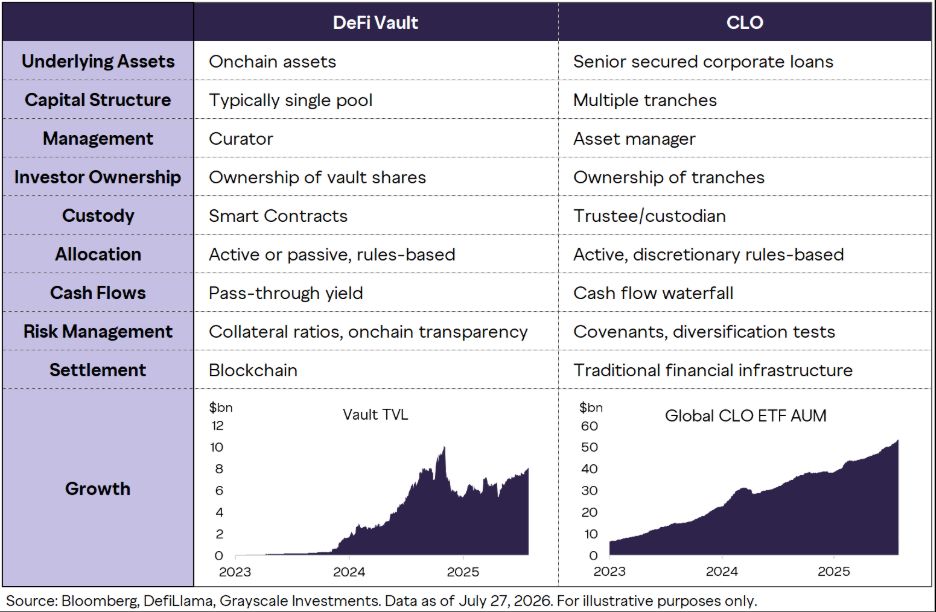
Source: Grayscale

Regulation Remains the Main Obstacle

As blockchain-based lending markets evolve, vaults could gain even more significance. Ultimately, they may become core investment products for digital assets, similar to how CLOs and managed credit funds play that role in traditional markets.

Nevertheless, U.S. securities laws create uncertainty. A vault might draw regulatory scrutiny if investors rely on a curator for selecting strategies, allocating assets, or managing risk. This level of discretionary authority may raise questions within the context of rules governing securities, investment companies, or investment advisors.

This issue is particularly important for institutional investors, who need clear standards for custody, regulatory compliance, and investor protection before committing significant capital.

Despite this, Grayscale sees significant potential. The firm's key takeaway is that vaults "could become the next crypto innovation to break into the mainstream."

Their success will depend on whether the industry can preserve the efficiency of smart contracts while meeting the legal and operational standards prevalent in the traditional financial sphere.


Related Questions

QAccording to Grayscale, what is the next cryptocurrency innovation expected to go mainstream after stablecoins and tokenized assets?

AAccording to Grayscale, blockchain-based vaults are expected to be the next cryptocurrency innovation to go mainstream.

QWhat is the core difference in infrastructure between traditional CLOs and blockchain vaults?

AThe core difference in infrastructure is that traditional CLOs rely on custodians, trustees, and other intermediaries, while blockchain vaults use smart contracts to manage assets and settle trades directly on blockchain networks.

QWhat are the potential benefits of blockchain vaults highlighted in the report?

AThe report highlights that blockchain vaults can offer 'full transparency, operational efficiency, and potentially higher liquidity' compared to traditional financial products.

QWhat is the current estimated scale of the blockchain vault market, and how does it compare to traditional CLOs?

AThe current estimated scale of the blockchain vault market is over 3,000 vaults holding about $7 billion in assets. In comparison, the global CLO market is worth approximately $1.5 trillion.

QWhat is identified as the main obstacle for the growth and mainstream adoption of blockchain vaults?

AThe main obstacle identified is regulatory uncertainty, particularly regarding U.S. securities laws and the need for clear standards around custody, compliance, and investor protection before significant institutional capital can be deployed.

Related Reads

Bitmine Nears Mastery of the '5% Alchemy', Who Will Step Up After ETH Loses Its Biggest Buyer?

Ethereum's largest corporate holder, Bitmine, is nearing its goal of holding 5% of all ETH supply, potentially within the next 6-7 weeks. This target, originally a five-year plan, is set to be achieved in just about 16 months since the strategy began in June 2025. The company currently holds approximately 4.9% of ETH supply. Upon reaching this 5% "hard cap," Bitmine plans to pause its aggressive accumulation, shifting focus toward shareholder returns and stock price recovery. This includes a large ongoing stock buyback program. Bitmine's sustained buying has been a major support for ETH, absorbing a significant portion of new supply. Its potential exit as a constant buyer raises questions about future market demand. Currently, U.S. spot Ethereum ETFs have seen net outflows, and other digital asset treasury (DAT) companies hold far smaller reserves, suggesting no immediate, comparable buyer is ready to fill the gap. Despite a large unrealized loss on its ETH holdings, Bitmine remains optimistic. Chairman Tom Lee stated the company's substantial staking rewards could cover financial obligations like dividends, reducing the need to sell core holdings. He predicts ETH could reach $5,000 by year-end and potentially $7,500 if Bitcoin surpasses $100,000. Long-term bullish drivers include asset tokenization, generational wealth transfer, and AI industry growth. While Bitmine's buying halt may test short-term market absorption, new institutional demand and Ethereum's ecosystem development are seen as potential future sources of support.

marsbit4m ago

Bitmine Nears Mastery of the '5% Alchemy', Who Will Step Up After ETH Loses Its Biggest Buyer?

marsbit4m ago

Trading

Spot
活动图片