Bitcoin Sees Post-Capitulation Conditions Align: Selling Pressure Falls 80%

bitcoinistPublished on 2025-12-30Last updated on 2025-12-30

Abstract

Bitcoin remains below $90,000, with repeated rejections fueling bearish sentiment. However, on-chain analysis by Axel Adler indicates a significant reduction in selling pressure. The realized loss z-score, which peaked between 8.7–10.9 in November with over $5 billion in daily losses, fell sharply by late December to around 1.6. Weekly realized losses dropped from $2.4 billion to approximately $0.5 billion, signaling seller exhaustion. The Net Realized Profit/Loss metric, though still negative, improved markedly in late December, shrinking its negative value by nearly half. This improvement occurred without a strong price rebound, suggesting the change stems from structural selling exhaustion rather than speculative activity. Historically, such conditions precede market stabilization and potential recovery, positioning January as a possible inflection point if new demand emerges.

Bitcoin continues to trade below the $90,000 level after multiple failed attempts to break higher since December 14, reinforcing a growing sense of caution across the market. Each rejection near this psychological threshold has added weight to the bearish narrative, with an increasing number of analysts now warning that Bitcoin may be entering a prolonged corrective phase in the year ahead.

Despite this muted price action, on-chain data suggests a more nuanced picture beneath the surface. Top analyst Axel Adler recently shared a chart tracking Bitcoin realized losses using a seven-day moving average and a z-score framework, highlighting a clear transition from November’s extreme capitulation to a period of normalization in December.
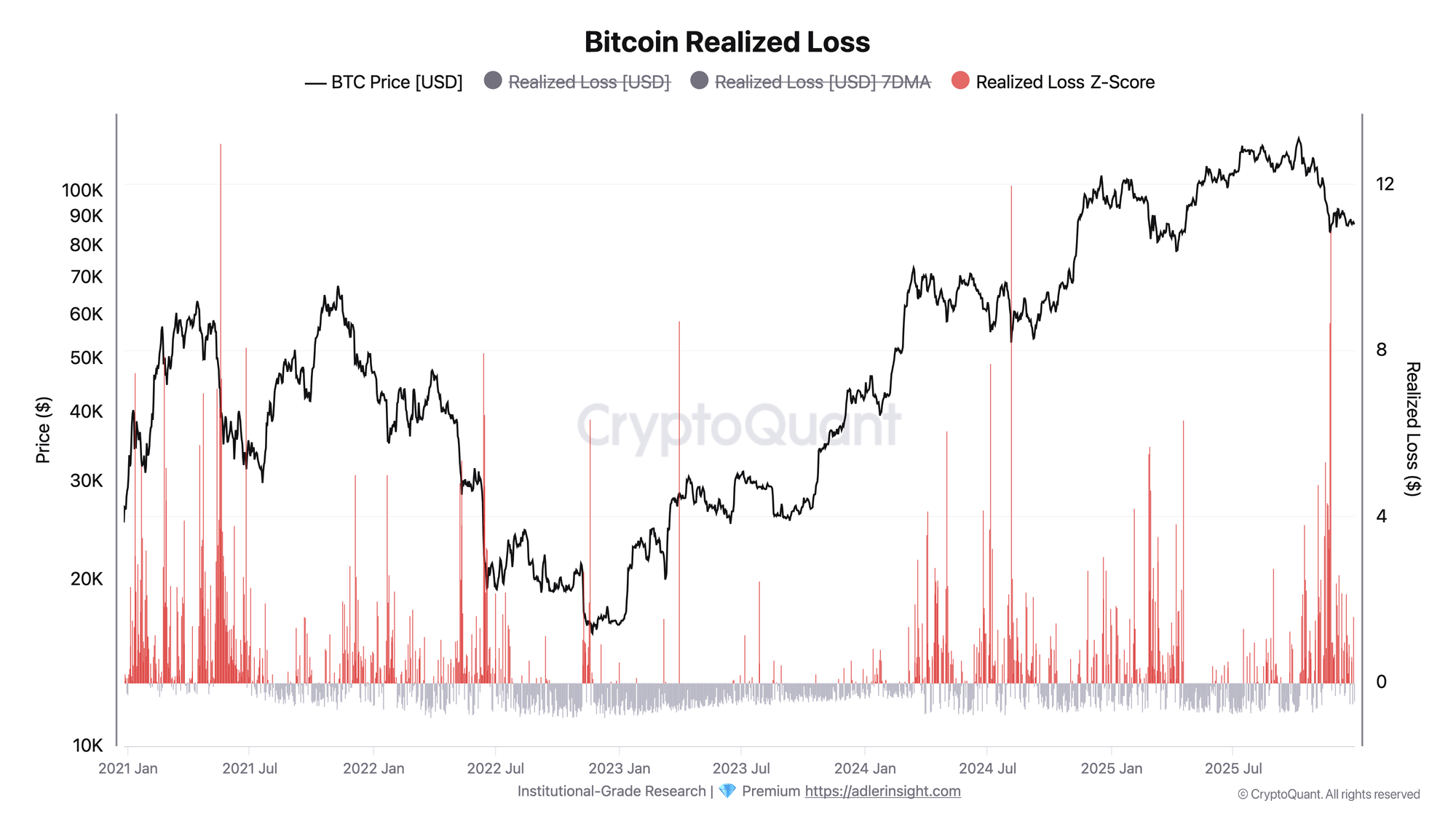
Bitcoin Realized Loss (Z-Score) | Source: Axel Adler

This metric measures the volume of losses realized when coins move, with the z-score used to identify stress extremes within the market.

November marked the peak of selling pressure. On November 21–22, the realized loss z-score surged to between 8.7 and 10.9, with daily losses exceeding $5 billion. In comparison, the late-December spike on December 26, which reached a z-score near 1.6, appears relatively minor. More importantly, weekly realized losses have collapsed from roughly $2.4 billion at the peak to around $0.5 billion, returning to levels last seen in September and October.

According to Adler, this sharp decline points to structural seller exhaustion rather than a temporary lull. Historically, markets often stabilize after such conditions, suggesting that while the price remains weak, downside pressure may be fading.

Bitcoin Indicator Signals Fading Downside Pressure

Adler’s report also highlights Bitcoin’s Net Realized Profit/Loss (P/L) metric, smoothed using a seven-day moving average, offering further insight into the market’s internal dynamics. This indicator tracks the balance between realized profits and realized losses over time. When the value is negative, losses dominate and capital is being destroyed; when positive, profit-taking outweighs loss realization.

Currently, Bitcoin’s net realized P/L remains in negative territory, confirming that the market has not fully exited a risk-off regime. However, the direction of travel is notable. Over the final week of December, the depth of negative net P/L shrank by nearly half, signaling a meaningful reduction in loss intensity.
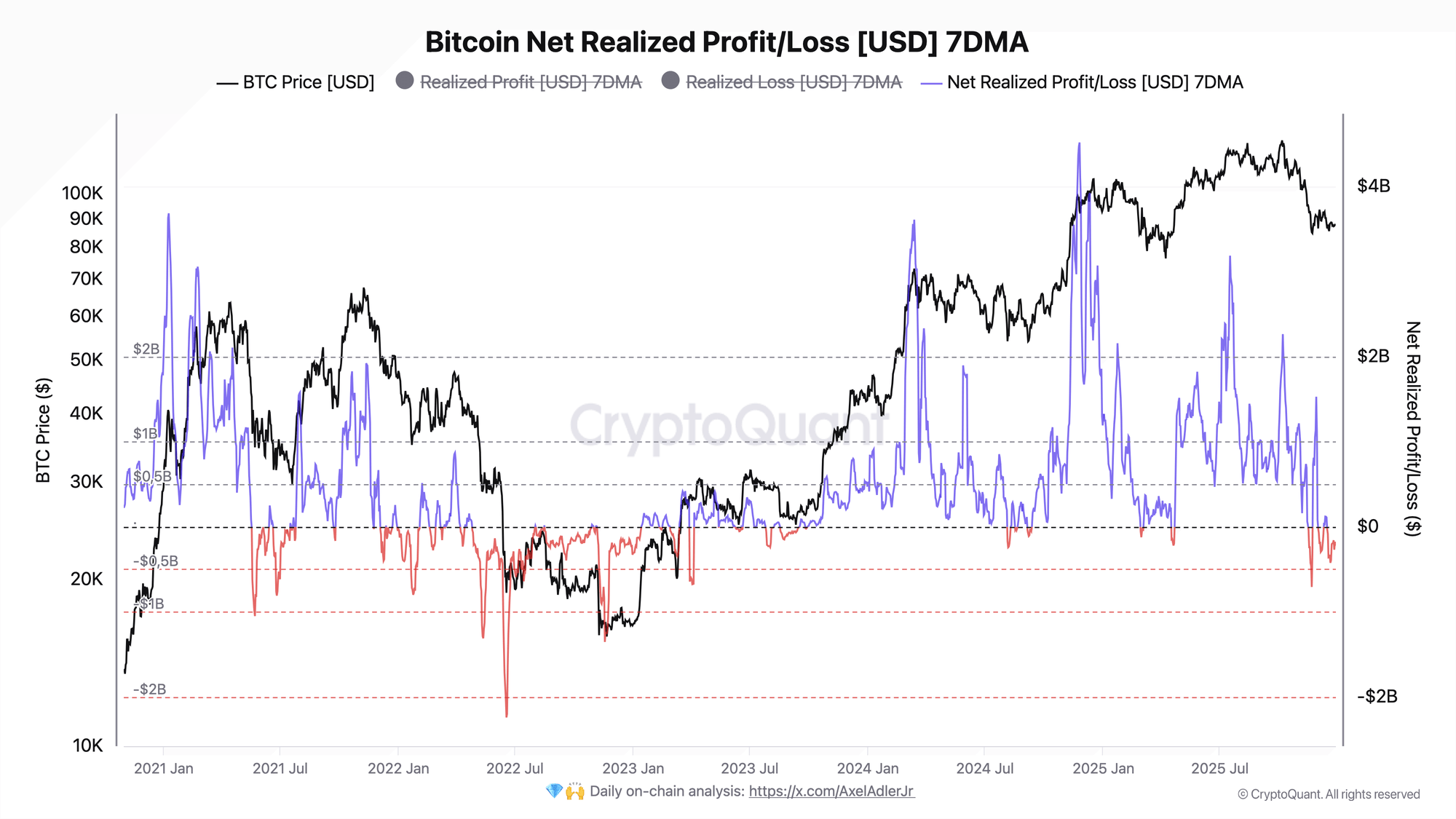
Bitcoin Net Realized Profit/Loss | Source: CryptoQuant

Importantly, this improvement has unfolded without a strong price recovery, suggesting that the change is driven by seller exhaustion rather than an artificial price squeeze or short-term speculation.

According to Adler, this behavior is structurally significant. When net realized P/L trends upward toward the zero line, it reflects a transition phase in which forced selling subsides, and marginal supply weakens. Historically, a sustained move back into positive territory has coincided with the early stages of local market recoveries.

Taken together, the realized loss and net P/L charts present a consistent narrative. November appears to have absorbed the majority of weak hands, December functioned as an absorption and stabilization phase, and January could represent a potential inflection point—provided new demand begins to enter the market.


Related Questions

QWhat does the on-chain data indicate about Bitcoin's selling pressure in December compared to November?

AThe on-chain data shows a sharp decline in selling pressure in December. The realized loss z-score dropped from peaks of 8.7-10.9 in November to around 1.6 in late December, and weekly realized losses collapsed from roughly $2.4 billion to around $0.5 billion, indicating an 80% reduction in selling pressure.

QAccording to analyst Axel Adler, what does the collapse in weekly realized losses signify for the Bitcoin market?

AAccording to Axel Adler, the collapse in weekly realized losses points to structural seller exhaustion rather than a temporary lull. Historically, markets often stabilize after such conditions, suggesting that downside pressure may be fading.

QWhat is the significance of Bitcoin's Net Realized Profit/Loss metric trending upward toward the zero line?

AWhen Bitcoin's Net Realized P/L trends upward toward the zero line, it reflects a transition phase where forced selling subsides and marginal supply weakens. Historically, a sustained move back into positive territory has coincided with the early stages of local market recoveries.

QHow did the market behavior in the final week of December demonstrate a reduction in loss intensity?

AIn the final week of December, the depth of negative net realized P/L shrank by nearly half, signaling a meaningful reduction in loss intensity. This improvement occurred without a strong price recovery, indicating it was driven by seller exhaustion rather than artificial price movements.

QWhat three-phase narrative do the realized loss and net P/L charts present for the Bitcoin market?

AThe charts present a narrative where November absorbed the majority of weak hands (capitulation), December functioned as an absorption and stabilization phase, and January could represent a potential inflection point—provided new demand begins to enter the market.

Related Reads

Kicked Out of PayPal, Musk Aims for a Comeback in the Crypto Market

Elon Musk's X (formerly Twitter) has launched its "Smart Cashtags" feature, generating approximately $1 billion in trading volume within days of its April 2026 pilot launch. The feature allows users to click on stock or crypto tickers (or even full Solana token contract addresses) in posts to view real-time price charts and discussions without leaving the app. Initially available to iPhone users in the US and Canada, with a partnership in Canada enabling direct trading via the Wealthsimple app. This move is part of Musk's broader "Everything App" vision, spearheaded by the upcoming X Money platform. Analysts, such as Mizuho's Dan Dolev, see this as a potential disruptor to the US payments market, even prompting a downgrade of PayPal's stock. X Money's beta offers services like 6% APY on deposits, cashback, and P2P transfers, with speculation it may later incorporate crypto trading and stablecoin settlements for faster transactions. However, the ambitious plan faces significant regulatory scrutiny. Senator Elizabeth Warren has questioned the sustainability of the high 6% yield and raised concerns over X's banking partner, Cross River Bank, which has a history of regulatory violations. Additional risks involve the "GENIUS Act," which may create loopholes for stablecoin issuance without full FDIC insurance coverage, potentially leaving users unprotected. The integration of social trading on a platform with over 500 million users could inject new liquidity and retail interest into the crypto market. Yet, it also amplifies risks like herd mentality and the blurring of lines between entertainment and financial speculation. Musk's return to finance, after his ouster from PayPal, hinges on balancing innovation with regulatory compliance.

marsbit44m ago

Kicked Out of PayPal, Musk Aims for a Comeback in the Crypto Market

marsbit44m ago

Trading

Spot
Futures

Hot Articles

What is $BITCOIN

DIGITAL GOLD ($BITCOIN): A Comprehensive Analysis Introduction to DIGITAL GOLD ($BITCOIN) DIGITAL GOLD ($BITCOIN) is a blockchain-based project operating on the Solana network, which aims to combine the characteristics of traditional precious metals with the innovation of decentralized technologies. While it shares a name with Bitcoin, often referred to as “digital gold” due to its perception as a store of value, DIGITAL GOLD is a separate token designed to create a unique ecosystem within the Web3 landscape. Its goal is to position itself as a viable alternative digital asset, although specifics regarding its applications and functionalities are still developing. What is DIGITAL GOLD ($BITCOIN)? DIGITAL GOLD ($BITCOIN) is a cryptocurrency token explicitly designed for use on the Solana blockchain. In contrast to Bitcoin, which provides a widely recognized value storage role, this token appears to focus on broader applications and characteristics. Notable aspects include: Blockchain Infrastructure: The token is built on the Solana blockchain, known for its capacity to handle high-speed and low-cost transactions. Supply Dynamics: DIGITAL GOLD has a maximum supply capped at 100 quadrillion tokens (100P $BITCOIN), although details regarding its circulating supply are currently undisclosed. Utility: While precise functionalities are not explicitly outlined, there are indications that the token could be utilized for various applications, potentially involving decentralized applications (dApps) or asset tokenization strategies. Who is the Creator of DIGITAL GOLD ($BITCOIN)? At present, the identity of the creators and development team behind DIGITAL GOLD ($BITCOIN) remains unknown. This situation is typical among many innovative projects within the blockchain space, particularly those aligning with decentralized finance and meme coin phenomena. While such anonymity may foster a community-driven culture, it intensifies concerns about governance and accountability. Who are the Investors of DIGITAL GOLD ($BITCOIN)? The available information indicates that DIGITAL GOLD ($BITCOIN) does not have any known institutional backers or prominent venture capital investments. The project seems to operate on a peer-to-peer model focused on community support and adoption rather than traditional funding routes. Its activity and liquidity are primarily situated on decentralized exchanges (DEXs), such as PumpSwap, rather than established centralized trading platforms, further highlighting its grassroots approach. How DIGITAL GOLD ($BITCOIN) Works The operational mechanics of DIGITAL GOLD ($BITCOIN) can be elaborated on based on its blockchain design and network attributes: Consensus Mechanism: By leveraging Solana’s unique proof-of-history (PoH) combined with a proof-of-stake (PoS) model, the project ensures efficient transaction validation contributing to the network's high performance. Tokenomics: While specific deflationary mechanisms have not been extensively detailed, the vast maximum token supply implies that it may cater to microtransactions or niche use cases that are still to be defined. Interoperability: There exists the potential for integration with Solana’s broader ecosystem, including various decentralized finance (DeFi) platforms. However, the details regarding specific integrations remain unspecified. Timeline of Key Events Here is a timeline that highlights significant milestones concerning DIGITAL GOLD ($BITCOIN): 2023: The initial deployment of the token occurs on the Solana blockchain, marked by its contract address. 2024: DIGITAL GOLD gains visibility as it becomes available for trading on decentralized exchanges like PumpSwap, allowing users to trade it against SOL. 2025: The project witnesses sporadic trading activity and potential interest in community-led engagements, although no noteworthy partnerships or technical advancements have been documented as of yet. Critical Analysis Strengths Scalability: The underlying Solana infrastructure supports high transaction volumes, which could enhance the utility of $BITCOIN in various transaction scenarios. Accessibility: The potential low trading price per token could attract retail investors, facilitating wider participation due to fractional ownership opportunities. Risks Lack of Transparency: The absence of publicly known backers, developers, or an audit process may yield skepticism regarding the project's sustainability and trustworthiness. Market Volatility: The trading activity is heavily reliant on speculative behavior, which can result in significant price volatility and uncertainty for investors. Conclusion DIGITAL GOLD ($BITCOIN) emerges as an intriguing yet ambiguous project within the rapidly evolving Solana ecosystem. While it attempts to leverage the “digital gold” narrative, its departure from Bitcoin's established role as a store of value underscores the need for a clearer differentiation of its intended utility and governance structure. Future acceptance and adoption will likely depend on addressing the current opacity and defining its operational and economic strategies more explicitly. Note: This report encompasses synthesised information available as of October 2023, and developments may have transpired beyond the research period.

363 Total ViewsPublished 2025.05.13Updated 2025.05.13

What is $BITCOIN

Discussions

Welcome to the HTX Community. Here, you can stay informed about the latest platform developments and gain access to professional market insights. Users' opinions on the price of BTC (BTC) are presented below.

活动图片













