Bitcoin reaches 20M supply milestone as final coins set to take 114 years to mine

ambcryptoPublished on 2026-03-09Last updated on 2026-03-09

Abstract

Bitcoin has reached the historic milestone of 20 million BTC mined, leaving only one million coins remaining to be issued out of its fixed supply cap of 21 million. It took 6,267 days to reach this point since the genesis block in 2009. The final BTC is expected to be mined around 2140, meaning the last million coins will take approximately 114 years to enter circulation due to Bitcoin’scheduled halving events. On-chain data shows that network adoption—such as transactions and active addresses—grew significantly faster than supply issuance. Meanwhile, miner selling pressure remains low, with the Miners’ Position Index indicating reduced transfers to exchanges. With over 95% of the total supply already mined, Bitcoin’s scarcity narrative continues to strengthen as it approaches its supply limit.

Bitcoin has crossed another historic threshold. Data shows that 20 million BTC have now been mined, leaving just one million coins left to enter circulation out of the network’s hard cap of 21 million.

According to Glassnode, reaching this milestone took 6,267 days since Bitcoin’s genesis block in January 2009. The remaining supply, however, will take significantly longer to produce due to the protocol’s programmed scarcity model.

Under Bitcoin’s current issuance schedule, the final BTC is expected to be mined around 2140. This means the last million coins will take roughly 114 years to be created.

The milestone underscores Bitcoin’s design as a finite digital asset, with supply growth slowing over time through periodic block reward halvings.

Bitcoin’s network growth accelerated faster than supply issuance

While Bitcoin’s supply has expanded gradually, on-chain data suggests network adoption and activity have grown much faster.

Glassnode’s milestone data highlights how quickly the network reached various 20-million-level activity thresholds compared to the time required to mine 20 million BTC.

For instance:

  • 20 million transactions occurred after 1,636 days
  • 20 million addresses created took 1,756 days
  • 20 million addresses with a non-zero balance took about 3,197 days
  • 20 million monthly active addresses emerged after 3,248 days

By contrast, the supply milestone required 6,267 days, reflecting Bitcoin’s intentionally slow issuance schedule.

This divergence illustrates a key feature of the network’s economic model: demand and activity can grow quickly. At the same time, supply expansion remains fixed and predictable.

Miner selling pressure remains subdued

Despite recent volatility in crypto markets, on-chain indicators suggest Bitcoin miners are not aggressively selling their holdings.

Data from CryptoQuant’s Miners’ Position Index [MPI] shows the metric currently sits around -1.6, indicating that BTC transfers from miners to exchanges are below historical averages.

The MPI tracks miner outflows relative to their yearly average. Negative readings typically signal that miners are holding rather than distributing coins, which can reduce short-term sell pressure in the market.

This behavior comes as Bitcoin trades near $68,000, following a period of broader market weakness across major cryptocurrencies.

Scarcity narrative strengthens as supply nears its limit

With over 95% of Bitcoin’s total supply now mined, the network is entering a phase where new issuance becomes increasingly limited.

Each halving event cuts block rewards in half, gradually reducing the number of new coins entering circulation. As a result, the remaining supply will be distributed more slowly over the next century.

For many investors, the combination of fixed supply and expanding network usage remains central to Bitcoin’s long-term value proposition.


Final Summary

  • Bitcoin has reached a historic milestone with 20 million BTC mined, leaving just one million coins to be issued over the next century.
  • On-chain data suggests miner selling pressure remains low, even as Bitcoin trades near $68K amid broader market volatility.


Trending Cryptos

Related Questions

QWhat is the total hard cap of Bitcoin's supply and how many coins remain to be mined after reaching the 20 million milestone?

AThe total hard cap is 21 million BTC, and 1 million coins remain to be mined after reaching the 20 million milestone.

QAccording to the article, approximately how many years will it take to mine the final Bitcoin and what is the expected year?

AIt will take roughly 114 years to mine the final Bitcoin, which is expected to occur around the year 2140.

QWhat does a negative reading on CryptoQuant's Miners' Position Index (MPI) indicate about miner behavior?

AA negative reading indicates that Bitcoin transfers from miners to exchanges are below historical averages, meaning miners are holding rather than selling their coins, which reduces short-term sell pressure.

QHow does the time taken to reach the 20 million supply milestone compare to the time it took to achieve 20 million monthly active addresses?

AThe 20 million supply milestone took 6,267 days, while it took only 3,248 days to reach 20 million monthly active addresses, showing network activity grew much faster than the supply issuance.

QWhat is the significance of Bitcoin's periodic halving events in relation to its supply?

AHalving events cut the block rewards in half, gradually reducing the number of new coins entering circulation and enforcing Bitcoin's programmed scarcity, making new issuance increasingly limited over time.

Related Reads

Capital is Moving from Cryptocurrency Speculation to Tokenized RWA Assets

In 2026, tokenized real-world assets (RWA) became one of the fastest-growing areas in crypto. Investors, weary of market volatility, are shifting capital from speculative crypto trading towards assets offering stable yield. These include tokenized government bonds (e.g., T-bills), private credit, real estate income, commodities, and money market funds. Data shows a clear preference for transparent, regulated products. Deposits into RWA protocols more than tripled year-on-year, reaching $7.4 billion in Q2, while spot trading activity surged 220%. The total on-chain value of tokenized RWAs exceeded $30 billion in 2026, more than doubling from the previous year, and approached $38 billion by August. RWA acts as a bridge between traditional finance and blockchain, not a replacement. It allows banks and asset managers to launch regulated products on public blockchains, while DeFi users gain access to previously unavailable real-world assets. Blockchain provides 24/7 settlements, transparency, programmability, and lower fees, while traditional finance contributes capital, regulation, and proven products. Tokenized private credit remains the largest RWA category (over $7 billion on-chain), benefiting from blockchain's cost reduction and transparency. Treasury bills are the fastest-growing institutional segment, driven by higher interest rates. Tokenized commodities, especially gold, are expanding, combining asset safety with blockchain trading ease. Real estate, though smaller, is also growing steadily. Tokenization is increasingly viewed as core financial infrastructure.

cryptonews.ru2h ago

Capital is Moving from Cryptocurrency Speculation to Tokenized RWA Assets

cryptonews.ru2h ago

Lone Bitcoin Miner Defies All Odds, Hits $200,000 Jackpot with Block Reward

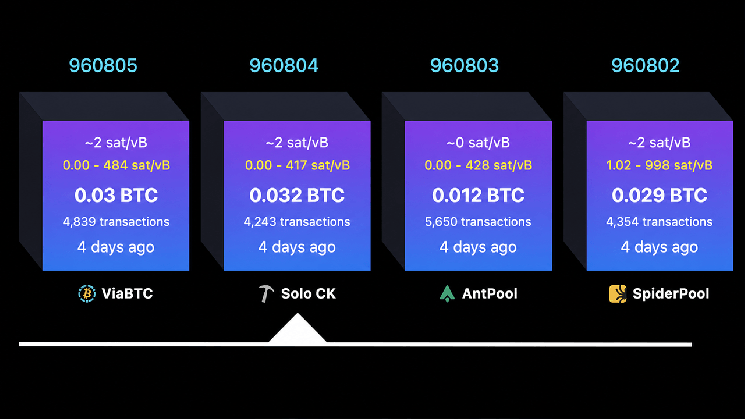
A solo Bitcoin miner, contrary to all predictions, won a $200,000 jackpot as a block reward. The payment went to an address linked to CKPool, a solo-mining service. This was the 317th solo block found by the pool. The reward consisted of the 3.125 BTC fixed subsidy and about 0.032 BTC in transaction fees from 4,243 transactions. CKPool operator Dr -ck (Con Kolivas) confirmed the win, noting the miner's hashrate was "extremely volatile, presumably rented," peaking at 100 PH/s. This represented about 0.011% of Bitcoin's total network hashrate. At that level, a miner could statistically expect to find a block roughly every 64 days, far more likely than for a typical small home setup. Solo mining differs from pool mining, where rewards are shared based on contributed work. In solo mining, a miner gets nothing unless they personally find a block, but then receives the entire reward. CKPool charges a ~2% fee on blocks found. Dr -ck noted the hashrate pattern suggested rented computing power, a practice making solo wins more accessible. He also highlighted this was the first mainnet block mined after integrating Stratum V2 code into ckpool, though the block itself was found using the older Stratum V1 protocol. Against a backdrop of mining concentration in large industrial pools, such solo finds remain rare but demonstrate that anyone with sufficient hashrate can claim a full reward without corporate or government permission. The block subsidy will remain 3.125 BTC until the next halving around April 2028. The miner's identity remains unknown, as is typical. Bitcoin's mining difficulty is due for an adjustment, and network hashrate has declined from late 2025 peaks, partly due to competition for power and hardware from AI data centers.

cryptonews.ru2h ago

Lone Bitcoin Miner Defies All Odds, Hits $200,000 Jackpot with Block Reward

cryptonews.ru2h ago

Blackrock Leads with $305 Million Inflow into Bitcoin and Ether ETFs

Money continued to flow rapidly into the largest cryptocurrency ETFs. Bitcoin and Ethereum ETFs collectively attracted over $305 million in inflows, with BlackRock again leading the charge, marking the third consecutive session of strong institutional demand. The broader market picture was mixed. Hyperliquid ($HYPE) ETFs finally saw renewed buying interest, while XRP ($XRP) ETFs faced outflows, and Solana-based products remained stagnant. In a strong session, Bitcoin ETFs recorded a net inflow of $244.42 million across five funds. BlackRock's IBIT dominated with $196.83 million, followed by ARK 21Shares' ARKB at $37.63 million and Fidelity's FBTC at $11.28 million. Vaneck's HODL was the sole fund to see an outflow (-$14.67 million), barely impacting the category's overall positive trend. Total trading volume reached $1.58 billion. Ethereum ETFs also continued their positive run, attracting $60.86 million. BlackRock's ETHA led with $50.34 million. The staking-oriented ETHB and Fidelity's FETH followed. No Ethereum ETF saw outflows. Among smaller tokens, Hyperliquid ETFs saw a minor but notable inflow of ~$966,690, potentially signaling easing selling pressure. Conversely, XRP ETFs experienced a $3.58 million outflow. Solana ETFs saw no net activity. The session solidified Bitcoin and Ethereum as the focal point for institutional capital, with BlackRock as the dominant source of demand, while activity in altcoin ETFs remained volatile.

cryptonews.ru2h ago

Blackrock Leads with $305 Million Inflow into Bitcoin and Ether ETFs

cryptonews.ru2h ago

Trading

Spot

Hot Articles

What is $BITCOIN

DIGITAL GOLD ($BITCOIN): A Comprehensive Analysis Introduction to DIGITAL GOLD ($BITCOIN) DIGITAL GOLD ($BITCOIN) is a blockchain-based project operating on the Solana network, which aims to combine the characteristics of traditional precious metals with the innovation of decentralized technologies. While it shares a name with Bitcoin, often referred to as “digital gold” due to its perception as a store of value, DIGITAL GOLD is a separate token designed to create a unique ecosystem within the Web3 landscape. Its goal is to position itself as a viable alternative digital asset, although specifics regarding its applications and functionalities are still developing. What is DIGITAL GOLD ($BITCOIN)? DIGITAL GOLD ($BITCOIN) is a cryptocurrency token explicitly designed for use on the Solana blockchain. In contrast to Bitcoin, which provides a widely recognized value storage role, this token appears to focus on broader applications and characteristics. Notable aspects include: Blockchain Infrastructure: The token is built on the Solana blockchain, known for its capacity to handle high-speed and low-cost transactions. Supply Dynamics: DIGITAL GOLD has a maximum supply capped at 100 quadrillion tokens (100P $BITCOIN), although details regarding its circulating supply are currently undisclosed. Utility: While precise functionalities are not explicitly outlined, there are indications that the token could be utilized for various applications, potentially involving decentralized applications (dApps) or asset tokenization strategies. Who is the Creator of DIGITAL GOLD ($BITCOIN)? At present, the identity of the creators and development team behind DIGITAL GOLD ($BITCOIN) remains unknown. This situation is typical among many innovative projects within the blockchain space, particularly those aligning with decentralized finance and meme coin phenomena. While such anonymity may foster a community-driven culture, it intensifies concerns about governance and accountability. Who are the Investors of DIGITAL GOLD ($BITCOIN)? The available information indicates that DIGITAL GOLD ($BITCOIN) does not have any known institutional backers or prominent venture capital investments. The project seems to operate on a peer-to-peer model focused on community support and adoption rather than traditional funding routes. Its activity and liquidity are primarily situated on decentralized exchanges (DEXs), such as PumpSwap, rather than established centralized trading platforms, further highlighting its grassroots approach. How DIGITAL GOLD ($BITCOIN) Works The operational mechanics of DIGITAL GOLD ($BITCOIN) can be elaborated on based on its blockchain design and network attributes: Consensus Mechanism: By leveraging Solana’s unique proof-of-history (PoH) combined with a proof-of-stake (PoS) model, the project ensures efficient transaction validation contributing to the network's high performance. Tokenomics: While specific deflationary mechanisms have not been extensively detailed, the vast maximum token supply implies that it may cater to microtransactions or niche use cases that are still to be defined. Interoperability: There exists the potential for integration with Solana’s broader ecosystem, including various decentralized finance (DeFi) platforms. However, the details regarding specific integrations remain unspecified. Timeline of Key Events Here is a timeline that highlights significant milestones concerning DIGITAL GOLD ($BITCOIN): 2023: The initial deployment of the token occurs on the Solana blockchain, marked by its contract address. 2024: DIGITAL GOLD gains visibility as it becomes available for trading on decentralized exchanges like PumpSwap, allowing users to trade it against SOL. 2025: The project witnesses sporadic trading activity and potential interest in community-led engagements, although no noteworthy partnerships or technical advancements have been documented as of yet. Critical Analysis Strengths Scalability: The underlying Solana infrastructure supports high transaction volumes, which could enhance the utility of $BITCOIN in various transaction scenarios. Accessibility: The potential low trading price per token could attract retail investors, facilitating wider participation due to fractional ownership opportunities. Risks Lack of Transparency: The absence of publicly known backers, developers, or an audit process may yield skepticism regarding the project's sustainability and trustworthiness. Market Volatility: The trading activity is heavily reliant on speculative behavior, which can result in significant price volatility and uncertainty for investors. Conclusion DIGITAL GOLD ($BITCOIN) emerges as an intriguing yet ambiguous project within the rapidly evolving Solana ecosystem. While it attempts to leverage the “digital gold” narrative, its departure from Bitcoin's established role as a store of value underscores the need for a clearer differentiation of its intended utility and governance structure. Future acceptance and adoption will likely depend on addressing the current opacity and defining its operational and economic strategies more explicitly. Note: This report encompasses synthesised information available as of October 2023, and developments may have transpired beyond the research period.

1.6k Total ViewsPublished 2025.05.13Updated 2025.05.13

What is $BITCOIN

Discussions

Welcome to the HTX Community. Here, you can stay informed about the latest platform developments and gain access to professional market insights. Users' opinions on the price of BTC (BTC) are presented below.

活动图片