Bitcoin Price Bottom Not In Yet, Crypto Founder Calls ‘One Final Dump’

bitcoinistPublished on 2026-04-12Last updated on 2026-04-12

Abstract

Bitcoin's recent price surge above $73,000 has sparked debate on whether the market has bottomed. However, crypto founder Joao Wedson suggests a "final dump" may still occur. His analysis, based on on-chain data, indicates that the Investor Price has fallen below the Long-Term Holder Realized Price—a signal that historically precedes a cycle bottom. This pattern suggests weaker investors are exiting while stronger hands accumulate, but the process is slow, leading to sideways or downward pressure. Market rallies are likely to fade due to selling pressure from investors seeking to break even. Wedson concludes the current structure resembles a mid-cycle reset rather than a final bottom, favoring gradual accumulation over rapid price expansion.

The Bitcoin price and the general cryptocurrency market received a major boost over the past week, as the geopolitical tensions in the Middle East seemingly reached a temporary halt. The premier cryptocurrency has maintained relatively strong momentum since breaking the psychological $70,000 resistance on Tuesday, April 7.

Now, this sudden resurgence has sparked conversations among the crypto crowd on whether the Bitcoin price has formed a structural bottom yet. According to a prominent crypto founder, the world’s largest cryptocurrency might still experience “one final dump” before the end of this bear phase.

On-Chain Signal Points To One More BTC Drop

In an April 10 post on the X platform, the Alphractal founder and CEO, Joao Wedson, highlighted an emerging signal that suggests that the Bitcoin price still likely has one more trip to the downside. This projection is based on an on-chain insight that suggests that BTC’s price tends to move toward a cycle bottom when the Investor Price falls below the Long-Term Holder (LTH) Realized Price.

Wedson explained the relevance of this on-chain insight and why it emerges before a major price and an ensuing coin accumulation. According to the on-chain data expert, the Investor Price is a metric that measures the average cost of economically active coins, and, when it falls below the LTH Realized Price, suggests fresher capital has flowed in at lower prices than long-term investors paid.

Wedson wrote on X:

This usually happens after distribution phases, when demand weakens, and marginal buyers step back. Long-term holders historically sell less when the price approaches or dips below their cost basis.
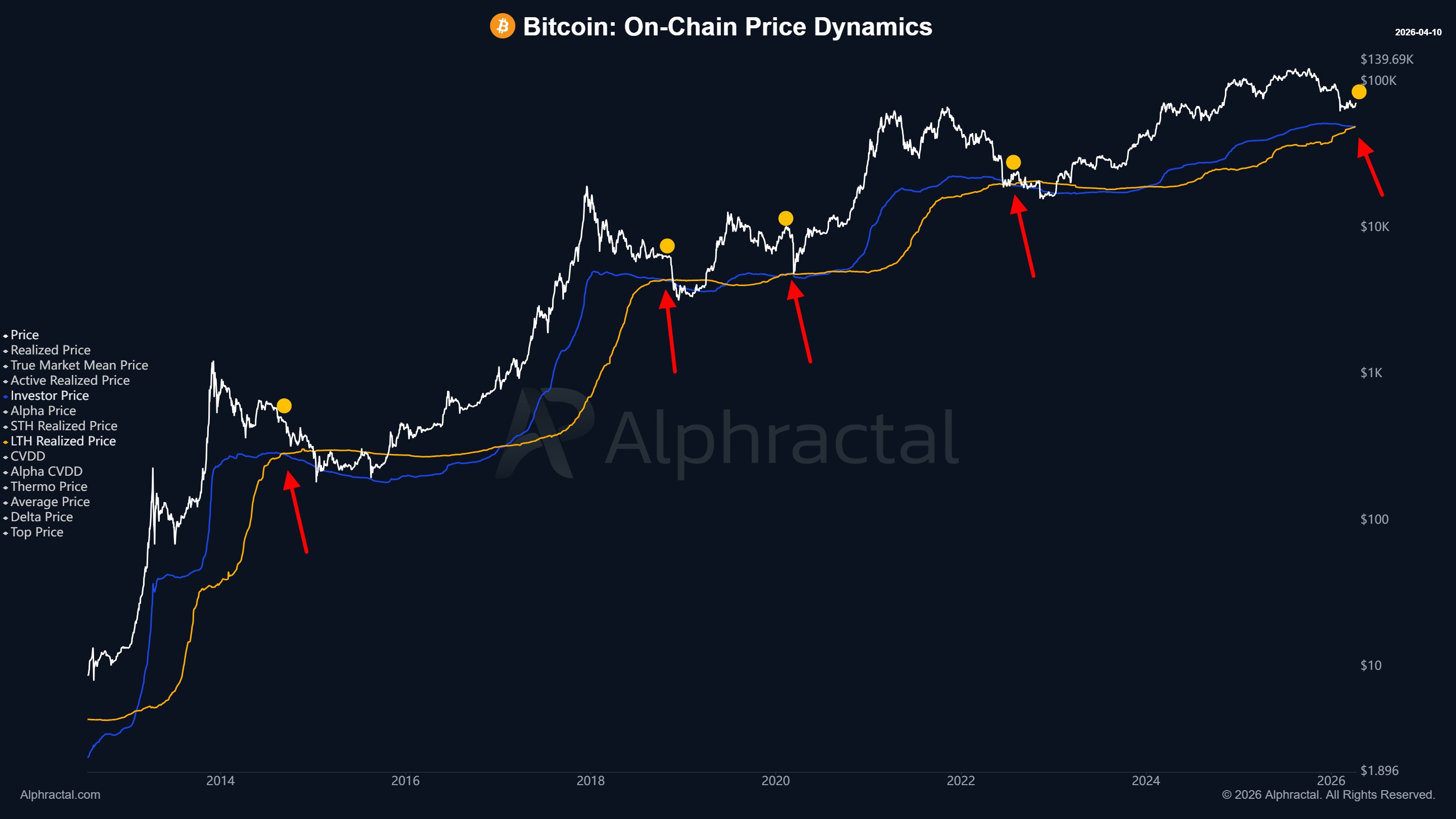
Source: @joao_wedson on X

As shown in the chart above, the LTH Realized Price appears to be breaking above the Investor Price, indicating a transition phase in which weaker hands exit while stronger hands gradually absorb supply. However, it is worth noting that this absorption is slower than expected, which explains why the Bitcoin price often falls into an intermediate accumulation range.

Moreover, with Investor Price below LTH Realized Price, market surges tend to quickly wane as they meet supply (selling pressure) from investors looking to exit at their breakeven prices. This phenomenon caps the current upside potential of the premier cryptocurrency, reinforcing possible sideways to downward price movements until a new demand impulse appears.

Finally, Wedson noted that the current Bitcoin price structure historically aligns with mid-cycle resets rather than final bottoms, mirroring a market “digesting” prior excesses, rebalancing cost bases, and moving coins to the more patient investors. “The environment favors time-based accumulation over momentum-driven expansion,” the Alphractal founder wrote.

Bitcoin Price At A Glance

As of this writing, the price of BTC sits just above the $73,100 mark, reflecting a nearly 2% jump in the past day.

The price of BTC on the daily timeframe | Source: BTCUSDT chart on TradingView


Related Questions

QAccording to Joao Wedson, what on-chain signal suggests that the Bitcoin price might experience one more trip to the downside?

AThe signal is when the Investor Price falls below the Long-Term Holder (LTH) Realized Price, indicating that fresher capital has entered at lower prices and suggesting a potential move towards a cycle bottom.

QWhat does the Investor Price metric measure, and what does it imply when it is below the LTH Realized Price?

AThe Investor Price measures the average cost of economically active coins. When it falls below the LTH Realized Price, it implies that newer investors have bought in at lower prices than long-term holders, often occurring after distribution phase when demand weakens.

QWhy do market surges tend to wane quickly when the Investor Price is below the LTH Realized Price?

AMarket surges quickly wane because they meet selling pressure from investors looking to exit at their breakeven prices, which caps the upside potential and reinforces sideways or downward price movements.

QWhat did the Alphractal founder say about the current Bitcoin price structure in historical terms?

AHe stated that the current price structure historically aligns with mid-cycle resets rather than final bottoms, indicating the market is digesting prior excesses and rebalancing cost bases, favoring time-based accumulation over momentum-driven expansion.

QWhat was the Bitcoin price at the time of writing, and how much had it increased in the past day?

AAt the time of writing, the Bitcoin price was just above $73,100, reflecting a nearly 2% jump in the past day.

Related Reads

Apple's Desired On-Device AI Sees a Dark Horse Emerge: The First Cognitive Model is Born, 4B Matches GPT-5.4

A Chinese company, Tomorrow's Journey (Nextie), has introduced what it is calling the industry's first "cognitive model" for edge devices. Named New Journey Alpha, this 4-billion-parameter model reportedly matches the performance of trillion-parameter giants like GPT-5.4 in group intelligence tasks such as debate and collective decision-making. The development follows Andrej Karpathy's vision of stripping vast factual knowledge from large language models to retain only a smaller "cognitive core" capable of reasoning, planning, and knowing its own limits. This approach directly addresses the soaring computational costs and token expenses hindering AI's widespread deployment, as highlighted by incidents like Amazon shutting down an internal AI tool due to prohibitive costs. Trained via reinforcement learning on a corpus of academic papers from 1800-2020 to enhance generalization, the model enables three key advancements: 1) Improved decision quality in multi-agent systems, 2) Drastically reduced compute costs, allowing for cost-effective cloud or on-device (e.g., MacBook) deployment, and 3) The feasibility of "proactive" AI agents that act autonomously without user prompts, unlocking new commercial possibilities beyond today's reactive models. Built by the former Microsoft Xiaoice team—known for creating a 3.6B model that outperformed a 65B Llama model—the company is now focusing on the multi-agent systems sector, a field gaining significant investor interest. The model's economic impact is profound; by achieving high-level performance with minimal parameters, it fundamentally alters the cost structure of AI services, challenging the prevailing model of ever-larger parameter counts.

marsbit2h ago

Apple's Desired On-Device AI Sees a Dark Horse Emerge: The First Cognitive Model is Born, 4B Matches GPT-5.4

marsbit2h ago

OpenAI's 'Blueprint for the Future': Making AI Beneficial for Every Person on the Planet

A new transformative technology emerges every few generations. OpenAI draws a parallel with the advent of electricity in the 1920s, which initially brought convenience but ultimately enabled unprecedented progress in medicine, engineering, and living standards by empowering people to create new possibilities. AI is poised to recreate this phenomenon. Its true significance lies not in the technology itself, but in what people can achieve with it—from understanding a medical bill or starting a business to aiding scientific discovery. OpenAI believes AI should be universally accessible, allowing everyone to use it according to their own needs. This future, however, is not guaranteed. While transformative tech can centralize power, OpenAI's philosophy is that AI must serve humanity, augmenting human capabilities and broadly distributing its benefits. The company's first commitment is to build AI for human service, aiming to empower the many rather than concentrate power in a few. Safety, alignment with human intent, and oversight are paramount. OpenAI is optimistic about AI's potential to expand human welfare but remains clear-eyed about risks. The goal is to help people achieve more, not to replace them. Full automation is not the desired future; human judgment, values, and direction will become even more critical. OpenAI outlines three core goals: 1. Build automated AI researchers to accelerate and increasingly automate the research process itself, maintaining close human collaboration. The internal projection is that by March 2028, a significant portion of their research will be conducted by AI systems working alongside human researchers. 2. Accelerate economic development by advancing science, boosting productivity, and fostering growth, while ensuring the fruits are widely shared. 3. Provide a personal AGI for everyone on Earth, allowing individuals to benefit from this transformative technology in their own way. The company is entering its third phase, moving from foundational AGI research (Phase 1) to product deployment and learning from real-world use (Phase 2). The current challenge is making advanced AI abundant, affordable, safe, practical, and usable for all individuals and organizations. OpenAI concludes that a widely distributed power structure leads to a more resilient, adaptable, and free society. A positive AI future should not be controlled by a handful of entities but built, benefited from, and owned by many. If realized correctly, AI can become a cornerstone for enhancing global productivity, creativity, scientific advancement, and economic opportunity, fulfilling the mission to ensure AGI benefits all of humanity.

marsbit3h ago

OpenAI's 'Blueprint for the Future': Making AI Beneficial for Every Person on the Planet

marsbit3h ago

Trading

Spot
Futures

Hot Articles

How to Buy ONE

Welcome to HTX.com! We've made purchasing Harmony (ONE) simple and convenient. Follow our step-by-step guide to embark on your crypto journey.Step 1: Create Your HTX AccountUse your email or phone number to sign up for a free account on HTX. Experience a hassle-free registration journey and unlock all features.Get My AccountStep 2: Go to Buy Crypto and Choose Your Payment MethodCredit/Debit Card: Use your Visa or Mastercard to buy Harmony (ONE) instantly.Balance: Use funds from your HTX account balance to trade seamlessly.Third Parties: We've added popular payment methods such as Google Pay and Apple Pay to enhance convenience.P2P: Trade directly with other users on HTX.Over-the-Counter (OTC): We offer tailor-made services and competitive exchange rates for traders.Step 3: Store Your Harmony (ONE)After purchasing your Harmony (ONE), store it in your HTX account. Alternatively, you can send it elsewhere via blockchain transfer or use it to trade other cryptocurrencies.Step 4: Trade Harmony (ONE)Easily trade Harmony (ONE) on HTX's spot market. Simply access your account, select your trading pair, execute your trades, and monitor in real-time. We offer a user-friendly experience for both beginners and seasoned traders.

3.8k Total ViewsPublished 2024.03.29Updated 2026.06.02

How to Buy ONE

Discussions

Welcome to the HTX Community. Here, you can stay informed about the latest platform developments and gain access to professional market insights. Users' opinions on the price of ONE (ONE) are presented below.

活动图片