Bitcoin Policy Institute reps sound alarm on de minimis tax exclusion

cointelegraphPublished on 2025-12-18Last updated on 2025-12-18

Abstract

The Bitcoin Policy Institute (BPI) has raised concerns that proposed U.S. legislation for a de minimis tax exemption on small cryptocurrency transactions may exclude Bitcoin, applying only to stablecoins. BPI’s head of strategy, Conner Brown, called this a "severe mistake," arguing that such an exemption would encourage Bitcoin’s use as a medium of exchange, not just a store of value. The bill, introduced by Senator Cynthia Lummis, proposes exemptions for crypto transactions under $300, with a $5,000 annual cap, and includes provisions for charitable donations and deferred taxes on mining and staking rewards. Critics question the need for stablecoin exemptions since their value is stable. High transaction fees, block times, and tax implications currently limit Bitcoin’s use as everyday cash, though the Lightning Network offers a faster, cheaper payment solution.

Representatives of the Bitcoin Policy Institute (BPI), a nonprofit Bitcoin advocacy organization, warned that US lawmakers have not included a de minimis tax exemption for Bitcoin transactions below a certain threshold.

“De Minimis tax legislation may be limited to only stablecoins, leaving everyday Bitcoin transactions without an exemption,” Conner Brown, BPI’s head of strategy, said on X, adding that the decision to exclude Bitcoin (BTC) is a “severe mistake.”

In July, Wyoming Senator Cynthia Lummis introduced a bill proposing a de minimis tax exemption for crypto transactions of $300 or less, with a $5,000 annual limit on tax-free transactions and sales.

The bill proposal also included tax exemptions for digital assets used for charitable donations and tax deferment for crypto earned through mining proof-of-work (PoW) protocols or staking to secure blockchain networks.

Allowing a tax exemption for small Bitcoin transactions would increase its use as a medium of exchange rather than just as a store of value asset, allowing a new financial system built on a Bitcoin standard, BTC advocates say.
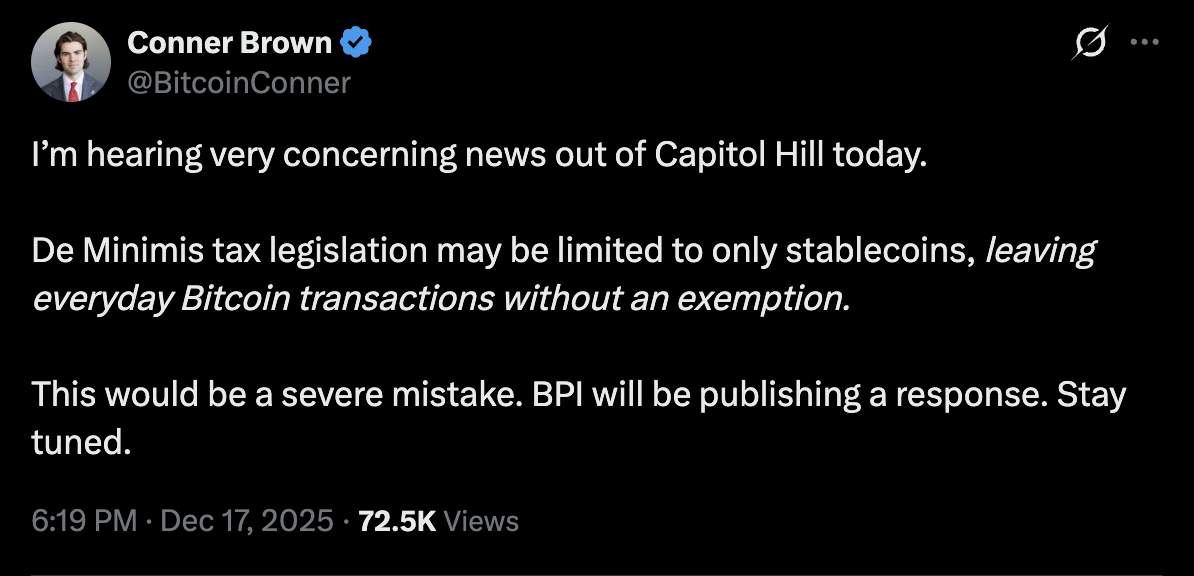
Source: Conner Brown

The discussion around de minimis tax exemptions has also raised questions about whether such relief should apply to stablecoins, which are designed to maintain a stable value.

“Why would you even need a De Minimis tax exemption for stablecoins,” Marty Bent, founder of media company Truth for The Commoner (TFTC), wrote on X. “They don’t change in value. This is nonsensical.”

Cointelegraph reached out to BPI about the proposed legislation, but had not received a response at time of publication.

Related: Japan’s new crypto tax could wake ‘sleeping giant’ of retail investors

Bitcoin is gaining value, but it isn’t being used as peer-to-peer electronic cash

The Bitcoin white paper, authored by its pseudonymous creator Satoshi Nakamoto in 2019, describes Bitcoin as a “peer-to-peer electronic cash system.”

However, relatively high transaction fees, average block times of about 10 minutes, and capital gains taxes on Bitcoin stifle BTC’s use as a payment method for goods and services.

Many Bitcoin investors choose to hold BTC for the long term, sometimes borrowing fiat currency against their BTC holdings to pay expenses and fund everyday purchases.
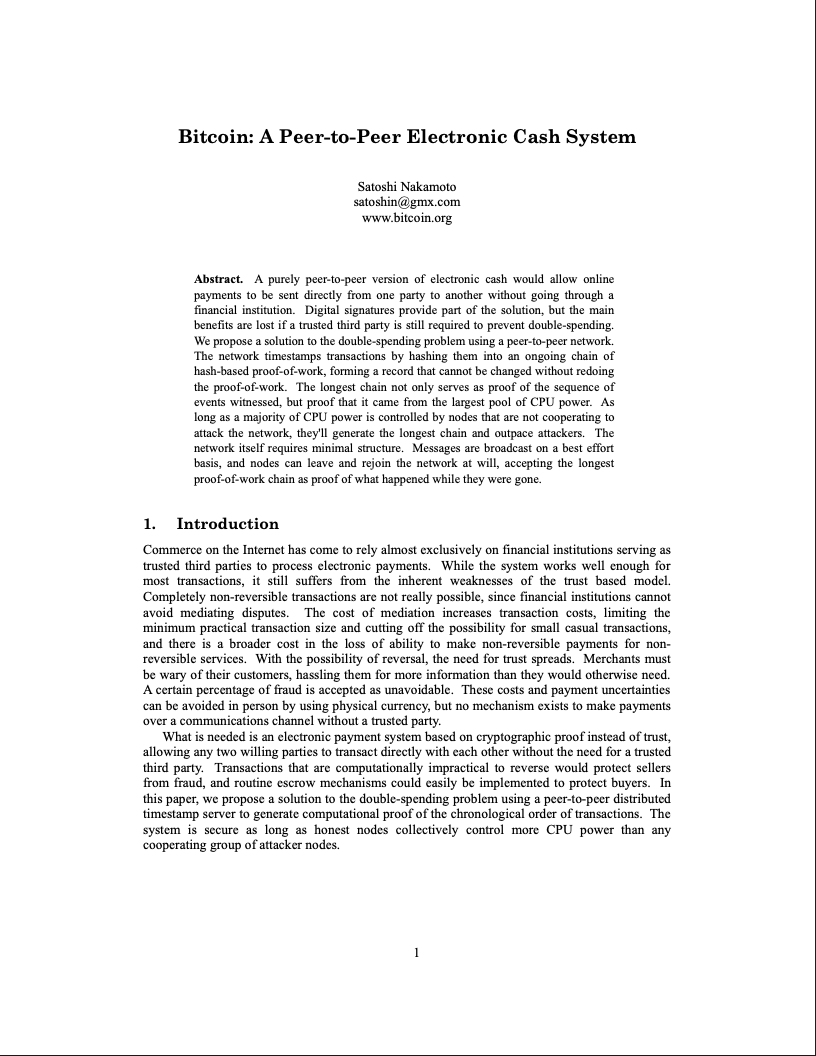
The Bitcoin white paper was published by Satoshi Nakamoto in 2009. Source: Satoshi Nakamoto Institute

The Bitcoin Lightning Network is a second-layer protocol designed for BTC payments, which works by locking a specific amount of BTC in a payment channel between two or more people.

Users connected through a payment channel can conduct multiple transactions offchain, with only the final net balance recorded on the Bitcoin ledger for settlement once the channel is closed.

This makes Bitcoin transactions faster and cheaper, as the users in the payment channel do not have to wait for new blocks to be mined or pay a network fee for each transaction between parties in the channel.

Magazine: The one thing these 6 global crypto hubs all have in common...

Related Questions

QWhat is the main concern raised by the Bitcoin Policy Institute regarding the proposed de minimis tax exemption bill?

AThe Bitcoin Policy Institute is concerned that the proposed de minimis tax exemption may be limited to only stablecoins, leaving everyday Bitcoin transactions without an exemption, which they consider a severe mistake.

QWho introduced the bill proposing a de minimis tax exemption for crypto transactions, and what are its key thresholds?

AWyoming Senator Cynthia Lummis introduced the bill, which proposes a de minimis tax exemption for crypto transactions of $300 or less, with a $5,000 annual limit on tax-free transactions and sales.

QAccording to BTC advocates, how would a tax exemption for small Bitcoin transactions impact its use?

ABTC advocates say that allowing a tax exemption for small Bitcoin transactions would increase its use as a medium of exchange, facilitating a new financial system built on a Bitcoin standard, rather than just as a store of value asset.

QWhy does Marty Bent argue that a de minimis tax exemption for stablecoins is nonsensical?

AMarty Bent argues that a de minimis tax exemption for stablecoins is nonsensical because stablecoins are designed to maintain a stable value and therefore do not change in value, making such an exemption unnecessary.

QWhat are the main factors that currently stifle Bitcoin's use as a peer-to-peer electronic cash system?

AThe main factors stifling Bitcoin's use as a peer-to-peer electronic cash system are relatively high transaction fees, average block times of about 10 minutes, and capital gains taxes on Bitcoin.

Related Reads

Trading

Spot
Futures

Hot Articles

What is $BITCOIN

DIGITAL GOLD ($BITCOIN): A Comprehensive Analysis Introduction to DIGITAL GOLD ($BITCOIN) DIGITAL GOLD ($BITCOIN) is a blockchain-based project operating on the Solana network, which aims to combine the characteristics of traditional precious metals with the innovation of decentralized technologies. While it shares a name with Bitcoin, often referred to as “digital gold” due to its perception as a store of value, DIGITAL GOLD is a separate token designed to create a unique ecosystem within the Web3 landscape. Its goal is to position itself as a viable alternative digital asset, although specifics regarding its applications and functionalities are still developing. What is DIGITAL GOLD ($BITCOIN)? DIGITAL GOLD ($BITCOIN) is a cryptocurrency token explicitly designed for use on the Solana blockchain. In contrast to Bitcoin, which provides a widely recognized value storage role, this token appears to focus on broader applications and characteristics. Notable aspects include: Blockchain Infrastructure: The token is built on the Solana blockchain, known for its capacity to handle high-speed and low-cost transactions. Supply Dynamics: DIGITAL GOLD has a maximum supply capped at 100 quadrillion tokens (100P $BITCOIN), although details regarding its circulating supply are currently undisclosed. Utility: While precise functionalities are not explicitly outlined, there are indications that the token could be utilized for various applications, potentially involving decentralized applications (dApps) or asset tokenization strategies. Who is the Creator of DIGITAL GOLD ($BITCOIN)? At present, the identity of the creators and development team behind DIGITAL GOLD ($BITCOIN) remains unknown. This situation is typical among many innovative projects within the blockchain space, particularly those aligning with decentralized finance and meme coin phenomena. While such anonymity may foster a community-driven culture, it intensifies concerns about governance and accountability. Who are the Investors of DIGITAL GOLD ($BITCOIN)? The available information indicates that DIGITAL GOLD ($BITCOIN) does not have any known institutional backers or prominent venture capital investments. The project seems to operate on a peer-to-peer model focused on community support and adoption rather than traditional funding routes. Its activity and liquidity are primarily situated on decentralized exchanges (DEXs), such as PumpSwap, rather than established centralized trading platforms, further highlighting its grassroots approach. How DIGITAL GOLD ($BITCOIN) Works The operational mechanics of DIGITAL GOLD ($BITCOIN) can be elaborated on based on its blockchain design and network attributes: Consensus Mechanism: By leveraging Solana’s unique proof-of-history (PoH) combined with a proof-of-stake (PoS) model, the project ensures efficient transaction validation contributing to the network's high performance. Tokenomics: While specific deflationary mechanisms have not been extensively detailed, the vast maximum token supply implies that it may cater to microtransactions or niche use cases that are still to be defined. Interoperability: There exists the potential for integration with Solana’s broader ecosystem, including various decentralized finance (DeFi) platforms. However, the details regarding specific integrations remain unspecified. Timeline of Key Events Here is a timeline that highlights significant milestones concerning DIGITAL GOLD ($BITCOIN): 2023: The initial deployment of the token occurs on the Solana blockchain, marked by its contract address. 2024: DIGITAL GOLD gains visibility as it becomes available for trading on decentralized exchanges like PumpSwap, allowing users to trade it against SOL. 2025: The project witnesses sporadic trading activity and potential interest in community-led engagements, although no noteworthy partnerships or technical advancements have been documented as of yet. Critical Analysis Strengths Scalability: The underlying Solana infrastructure supports high transaction volumes, which could enhance the utility of $BITCOIN in various transaction scenarios. Accessibility: The potential low trading price per token could attract retail investors, facilitating wider participation due to fractional ownership opportunities. Risks Lack of Transparency: The absence of publicly known backers, developers, or an audit process may yield skepticism regarding the project's sustainability and trustworthiness. Market Volatility: The trading activity is heavily reliant on speculative behavior, which can result in significant price volatility and uncertainty for investors. Conclusion DIGITAL GOLD ($BITCOIN) emerges as an intriguing yet ambiguous project within the rapidly evolving Solana ecosystem. While it attempts to leverage the “digital gold” narrative, its departure from Bitcoin's established role as a store of value underscores the need for a clearer differentiation of its intended utility and governance structure. Future acceptance and adoption will likely depend on addressing the current opacity and defining its operational and economic strategies more explicitly. Note: This report encompasses synthesised information available as of October 2023, and developments may have transpired beyond the research period.

363 Total ViewsPublished 2025.05.13Updated 2025.05.13

What is $BITCOIN

Discussions

Welcome to the HTX Community. Here, you can stay informed about the latest platform developments and gain access to professional market insights. Users' opinions on the price of BTC (BTC) are presented below.

活动图片