Bitcoin Pizza Day: A $41 Experiment Now Worth Billions

bitcoinistPublished on 2026-05-23Last updated on 2026-05-23

Abstract

Sixteen years after software developer Laszlo Hanyecz paid 10,000 Bitcoins for two pizzas, the crypto community marked Bitcoin Pizza Day. That $41 experiment is now worth over $767 million, briefly hitting $1.2 billion at Bitcoin's peak. The 2010 transaction proved a decentralized digital asset could facilitate real commerce, a far cry from today's ambitions. The scale has grown dramatically, with nations like Iran announcing Bitcoin could be used to pay for critical shipping tolls, though on-chain evidence remains lacking. In the US, lawmakers push for Bitcoin reserves and tax exemptions. What began as a quirky purchase has ignited a global conversation on national reserves, international trade, and the future of money itself.

Nation-state adoption of Bitcoin has become the new frontier for crypto advocates, a far cry from the days when the currency’s biggest achievement was buying two pizzas.

Sixteen years after that first recorded transaction, the Bitcoin community marked the anniversary on May 22 with fresh evidence of how far the currency has traveled.

Bitcoin Pizza Day: A Transaction That Changed Everything

Back in May 2010, software developer Laszlo Hanyecz posted an offer online: 10,000 BTC in exchange for two Papa John’s pizzas delivered to his door.

The Bitcoin he spent was worth roughly $41 at the time. At current market prices, that same amount of Bitcoin is valued at more than $767 million — and when Bitcoin hit its all-time high of around $126,000 in October 2025, those 10,000 coins briefly crossed $1.2 billion in value.

The transaction was more than a quirky footnote. Nischal Shetty, founder of crypto exchange WazirX, said the exchange proved that a decentralized digital asset could facilitate real commerce.

Only a few hundred transactions were being processed on the Bitcoin network each day at the time, with almost no payment infrastructure or institutional involvement to speak of.

From Two Pizzas To Oil Tankers

The scale of ambition surrounding Bitcoin has grown dramatically since then. In April 2026, Iran announced that ships crossing the Strait of Hormuz — one of the world’s most critical shipping waterways — could pay tolls in Bitcoin, US dollar stablecoins, or Chinese yuan.

BTCUSD now trading at $74,628. Chart: TradingView

The announcement generated significant attention in crypto circles. However, according to Sam Lyman, head of research at the Bitcoin Policy Institute, no onchain evidence exists of any oil toll being paid in Bitcoin as of publication. Tether’s USDT stablecoin has remained the dominant payment method for those transactions.
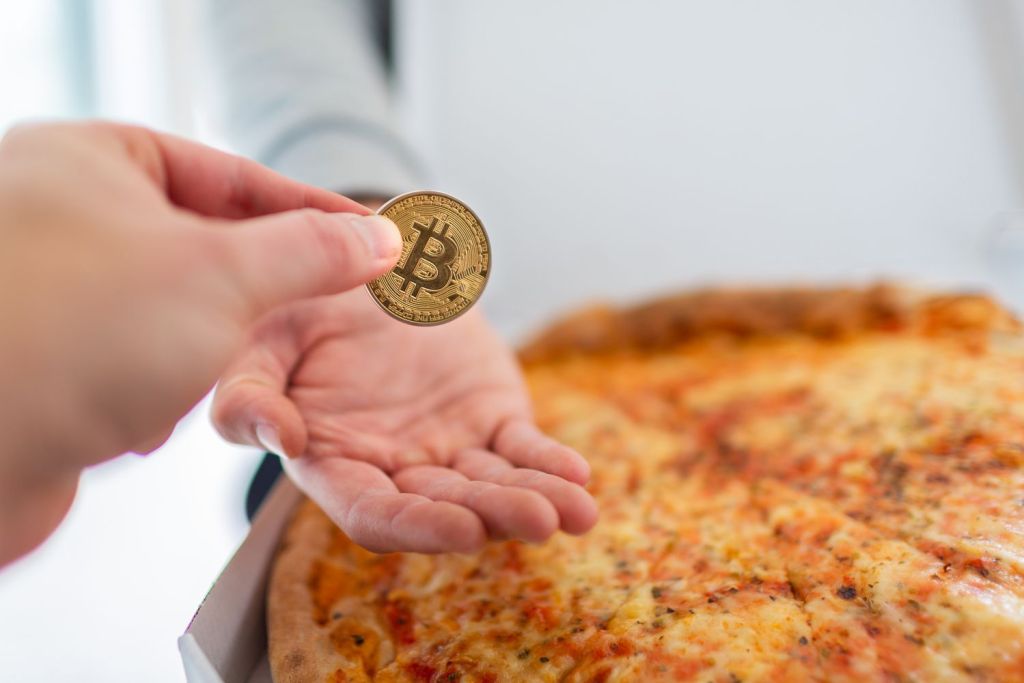
Image: Investopedia

The Long Road To Real-World Use

Back home in the US, lawmakers have been pushing Bitcoin-related legislation as well. A renewed effort to establish a strategic Bitcoin reserve was introduced through the ARMA bill, with some states also moving to exempt Bitcoin payments from certain taxes.

Hanyecz’s 2010 purchase remains the symbolic starting point for all of it. His willingness to treat Bitcoin as actual money — at a time when almost nobody else did — helped set the foundation for everything that followed.

What began as a $41 experiment is now a global conversation about national reserves, international trade, and the future of money itself.

Featured image from Unsplash, chart from TradingView

Trending Cryptos

Related Questions

QWhat was the Bitcoin Pizza Day transaction and how much was it originally worth in dollars?

AOn May 22, 2010, software developer Laszlo Hanyecz offered 10,000 BTC in exchange for two Papa John's pizzas delivered to his door. At the time, the Bitcoin he spent was worth approximately $41.

QWhat is the approximate value of the 10,000 BTC from the pizza transaction at the time the article was written?

AAt the current market prices mentioned in the article, that same amount of Bitcoin (10,000 BTC) is valued at more than $767 million.

QWhat significant milestone for Bitcoin adoption did Iran announce in April 2026 according to the article?

AIn April 2026, Iran announced that ships crossing the Strait of Hormuz could pay tolls in Bitcoin, US dollar stablecoins, or Chinese yuan.

QWhat is the current dominant payment method for the Strait of Hormuz tolls, despite Iran's announcement about Bitcoin?

AAccording to the article, Tether's USDT stablecoin has remained the dominant payment method for those transactions, with no onchain evidence of any oil toll being paid in Bitcoin.

QAccording to Nischal Shetty, founder of WazirX, what did the Bitcoin Pizza Day transaction prove?

ANischal Shetty stated that the exchange proved that a decentralized digital asset (Bitcoin) could facilitate real commerce.

Related Reads

Not Betting on Goals but on 'Tears': Polymarket Users Argue Over Ronaldo's Final World Cup Match

Title: Beyond Goals, Betting on Tears: Polymarket Users Clash Over Ronaldo's Emotional World Cup Exit On July 6, Portugal's 0-1 loss to Spain in the World Cup round of 16 marked the final tournament for Cristiano Ronaldo. The 41-year-old star's emotional reaction—red eyes, wiping his face, fighting back tears—was captured globally. Concurrently, a fierce debate erupted on the crypto prediction platform Polymarket over a specific market: "Will Ronaldo cry during the 2026 FIFA World Cup?" The market, with over $23 million in volume, saw its "YES" probability surge to 99% after the match, but the result was disputed and entered a final review phase. The core conflict centered on the market's precise rules: it required "clearly visible tears streaming down [Ronaldo's] face" in photos/videos taken on the field or bench area during Portugal's matches. While major media outlets described Ronaldo as "in tears" and footage showed him emotional, "NO" bettors argued visible tear tracks were not conclusively evident, only red eyes and dampness. Polymarket's official clarification on July 8 stated that eligible evidence existed showing Ronaldo crying with visible tears on his face post-match. The dispute now goes to a UMA oracle community vote for resolution. This incident highlights a recurring challenge for prediction markets: they excel with quantifiable events but can spark major controversies over subjective, visual, or emotional interpretations. It also serves as a reminder for participants to scrutinize rule wording meticulously, not rely on general perception. Ultimately, such high-profile disputes drive significant trading volume and attention for the platform.

Foresight News5m ago

Not Betting on Goals but on 'Tears': Polymarket Users Argue Over Ronaldo's Final World Cup Match

Foresight News5m ago

DeepSeek Secretly Builds AI Chip, Specializing in Inference, Project Started a Year Ago with No Public Recruitments

DeepSeek, the Chinese AI company known for its algorithmic models, is secretly developing its own AI chip to reduce dependence on Nvidia, according to a Reuters report. The chip is designed specifically for AI inference, not training, and the project began approximately a year ago. Currently in early stages, DeepSeek is reportedly in discussions with chip design firms, foundries, and memory suppliers. The company, historically focused on algorithmic efficiency, has been discreetly hiring chip design engineers without public job postings. This move aligns with a global trend where major AI model companies like OpenAI and Anthropic are also pursuing custom chip development. DeepSeek founder Liang Wenfeng previously highlighted chip shortages as a challenge. While the company initially trained models on Nvidia H800s and later adapted to Huawei's Ascend chips, it now seeks greater control over its hardware foundation. Designing a competitive AI chip is a significant challenge, requiring years and substantial investment with no guarantee of success. However, DeepSeek's efforts are backed by a recent major funding round of approximately 51 billion RMB (about $7.4 billion) raised in June 2026. The funds are designated for expanding data centers based on domestic chips, developing proprietary AI chips, and recruiting top global talent. Infrastructure plans are also advancing, with job postings for data center design engineers, including projects in locations like Ulanqab, Inner Mongolia. The company remains characteristically low-key, with sources speaking anonymously and no official comment from DeepSeek itself. Nevertheless, this initiative marks a strategic expansion from software algorithms into the hardware layer that powers its AI systems.

marsbit12m ago

DeepSeek Secretly Builds AI Chip, Specializing in Inference, Project Started a Year Ago with No Public Recruitments

marsbit12m ago

Trading

Spot

Hot Articles

What is $BITCOIN

DIGITAL GOLD ($BITCOIN): A Comprehensive Analysis Introduction to DIGITAL GOLD ($BITCOIN) DIGITAL GOLD ($BITCOIN) is a blockchain-based project operating on the Solana network, which aims to combine the characteristics of traditional precious metals with the innovation of decentralized technologies. While it shares a name with Bitcoin, often referred to as “digital gold” due to its perception as a store of value, DIGITAL GOLD is a separate token designed to create a unique ecosystem within the Web3 landscape. Its goal is to position itself as a viable alternative digital asset, although specifics regarding its applications and functionalities are still developing. What is DIGITAL GOLD ($BITCOIN)? DIGITAL GOLD ($BITCOIN) is a cryptocurrency token explicitly designed for use on the Solana blockchain. In contrast to Bitcoin, which provides a widely recognized value storage role, this token appears to focus on broader applications and characteristics. Notable aspects include: Blockchain Infrastructure: The token is built on the Solana blockchain, known for its capacity to handle high-speed and low-cost transactions. Supply Dynamics: DIGITAL GOLD has a maximum supply capped at 100 quadrillion tokens (100P $BITCOIN), although details regarding its circulating supply are currently undisclosed. Utility: While precise functionalities are not explicitly outlined, there are indications that the token could be utilized for various applications, potentially involving decentralized applications (dApps) or asset tokenization strategies. Who is the Creator of DIGITAL GOLD ($BITCOIN)? At present, the identity of the creators and development team behind DIGITAL GOLD ($BITCOIN) remains unknown. This situation is typical among many innovative projects within the blockchain space, particularly those aligning with decentralized finance and meme coin phenomena. While such anonymity may foster a community-driven culture, it intensifies concerns about governance and accountability. Who are the Investors of DIGITAL GOLD ($BITCOIN)? The available information indicates that DIGITAL GOLD ($BITCOIN) does not have any known institutional backers or prominent venture capital investments. The project seems to operate on a peer-to-peer model focused on community support and adoption rather than traditional funding routes. Its activity and liquidity are primarily situated on decentralized exchanges (DEXs), such as PumpSwap, rather than established centralized trading platforms, further highlighting its grassroots approach. How DIGITAL GOLD ($BITCOIN) Works The operational mechanics of DIGITAL GOLD ($BITCOIN) can be elaborated on based on its blockchain design and network attributes: Consensus Mechanism: By leveraging Solana’s unique proof-of-history (PoH) combined with a proof-of-stake (PoS) model, the project ensures efficient transaction validation contributing to the network's high performance. Tokenomics: While specific deflationary mechanisms have not been extensively detailed, the vast maximum token supply implies that it may cater to microtransactions or niche use cases that are still to be defined. Interoperability: There exists the potential for integration with Solana’s broader ecosystem, including various decentralized finance (DeFi) platforms. However, the details regarding specific integrations remain unspecified. Timeline of Key Events Here is a timeline that highlights significant milestones concerning DIGITAL GOLD ($BITCOIN): 2023: The initial deployment of the token occurs on the Solana blockchain, marked by its contract address. 2024: DIGITAL GOLD gains visibility as it becomes available for trading on decentralized exchanges like PumpSwap, allowing users to trade it against SOL. 2025: The project witnesses sporadic trading activity and potential interest in community-led engagements, although no noteworthy partnerships or technical advancements have been documented as of yet. Critical Analysis Strengths Scalability: The underlying Solana infrastructure supports high transaction volumes, which could enhance the utility of $BITCOIN in various transaction scenarios. Accessibility: The potential low trading price per token could attract retail investors, facilitating wider participation due to fractional ownership opportunities. Risks Lack of Transparency: The absence of publicly known backers, developers, or an audit process may yield skepticism regarding the project's sustainability and trustworthiness. Market Volatility: The trading activity is heavily reliant on speculative behavior, which can result in significant price volatility and uncertainty for investors. Conclusion DIGITAL GOLD ($BITCOIN) emerges as an intriguing yet ambiguous project within the rapidly evolving Solana ecosystem. While it attempts to leverage the “digital gold” narrative, its departure from Bitcoin's established role as a store of value underscores the need for a clearer differentiation of its intended utility and governance structure. Future acceptance and adoption will likely depend on addressing the current opacity and defining its operational and economic strategies more explicitly. Note: This report encompasses synthesised information available as of October 2023, and developments may have transpired beyond the research period.

664 Total ViewsPublished 2025.05.13Updated 2025.05.13

What is $BITCOIN

Discussions

Welcome to the HTX Community. Here, you can stay informed about the latest platform developments and gain access to professional market insights. Users' opinions on the price of BTC (BTC) are presented below.

活动图片