July 7th, Fable 5 didn't go offline!

In the early hours, Anthropic suddenly announced: the strongest Claude Fable 5's limited-time free access has been extended to July 12th.
Compared to the original plan, that's a full five extra days of 'free use' time.
The specific usage remains exactly the same as before: a weekly usage limit of 50%; to continue using it beyond that, you'll need to buy credits.

The wish of netizens has finally come true.

Now, the entire internet is buzzing. People are spreading the word: What are you waiting for? Go for it now!



Squeeze Every Bit from Fable 5's Brain, There's Still Five Days
Just yesterday, when everyone thought Fable 5's shutdown was a done deal, a wave of 'rescue' guides swept through the community.
Developer Alex Prompter was the first to roll out a brilliant trick to perfectly replicate Fable 5 into Opus 4.8.
Even though there's an extra 5-day 'reprieve', these hardcore self-help methods are still very useful.
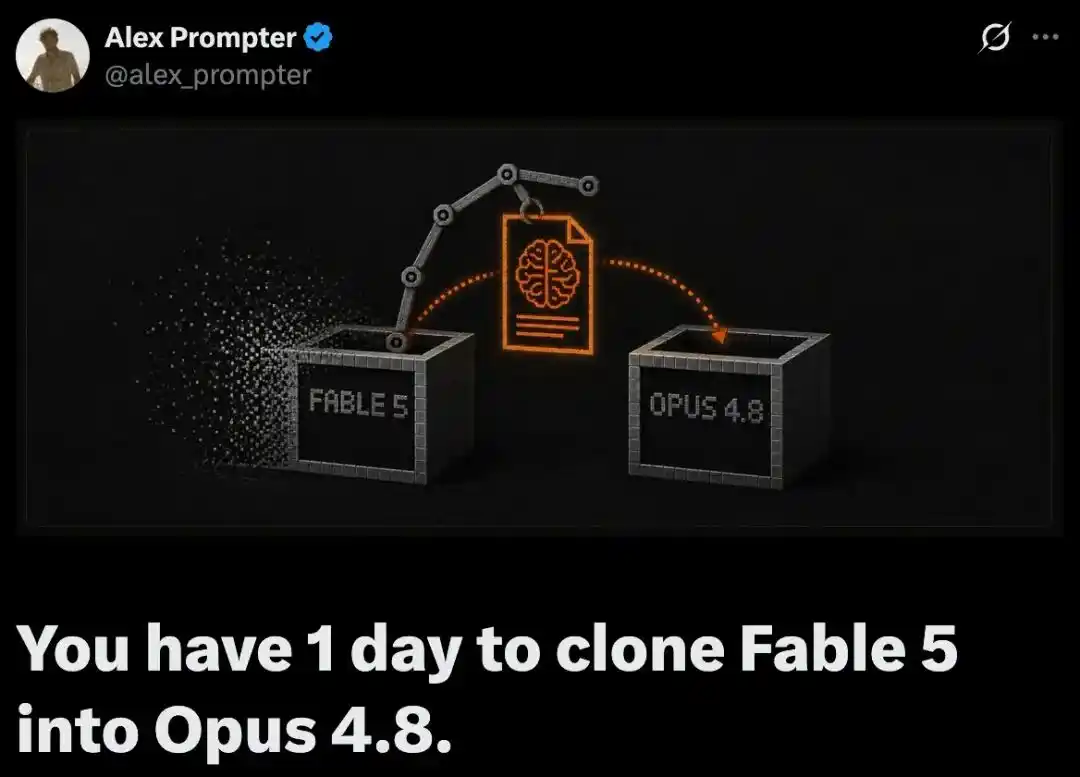
He provided a prompt sequence to extract Fable 5's 'thinking mode', making it write an executable 'operations manual'.
Then, transplant the manual into Opus 4.8 using the Project instruction or API system prompts;
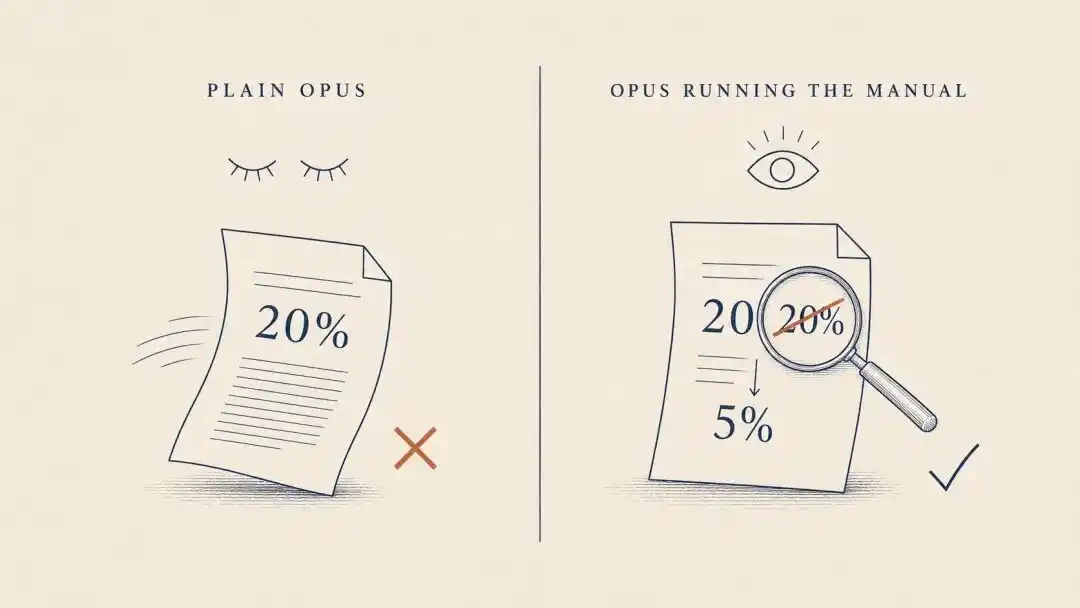
Finally, use a trap question like '5% being said as 20%' to verify if the transplantation really took effect.
Another developer, Machina, gave five steps to completely drain Fable 5's brain with one click, specifically including:
- 1. Have Fable rewrite CLAUDE.md and skills;
- 2. Conduct advisory-style business audits;
- 3. Dig deep research into an atomic Obsidian knowledge base;
- 4. Use /goal and dynamic workflows to maximize unattended time;
- 5. Install another skill to automatically record 'how it thinks'.
The core logic is simple: Extract over 50,000 answers from the frontier model to train a smaller model, costing less than $500. The teacher retires, but the student lives on forever.

Anthropic Rolls Out Cost-Saving Playbook
46% Cost, Performance Soars 92%
Right when everyone was lamenting that 'Fable 5 burns money too fast', Anthropic officially stepped in, rolling out two architectures:
- Advisor mode
- Orchestrator mode
Simply put, it's about making the large model give instructions and the small model do the legwork.
First move, Advisor mode.
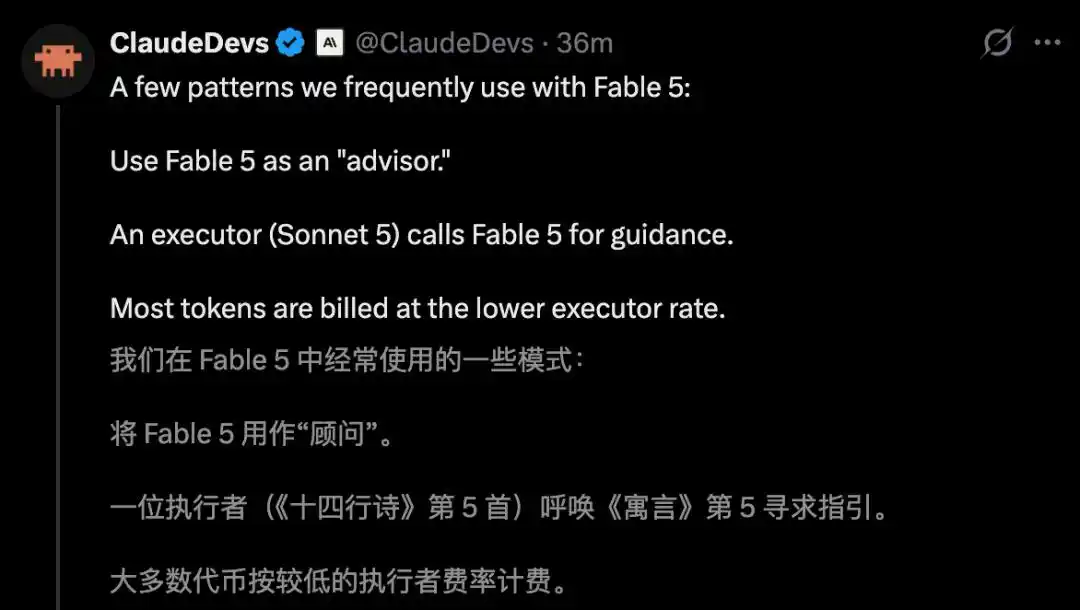
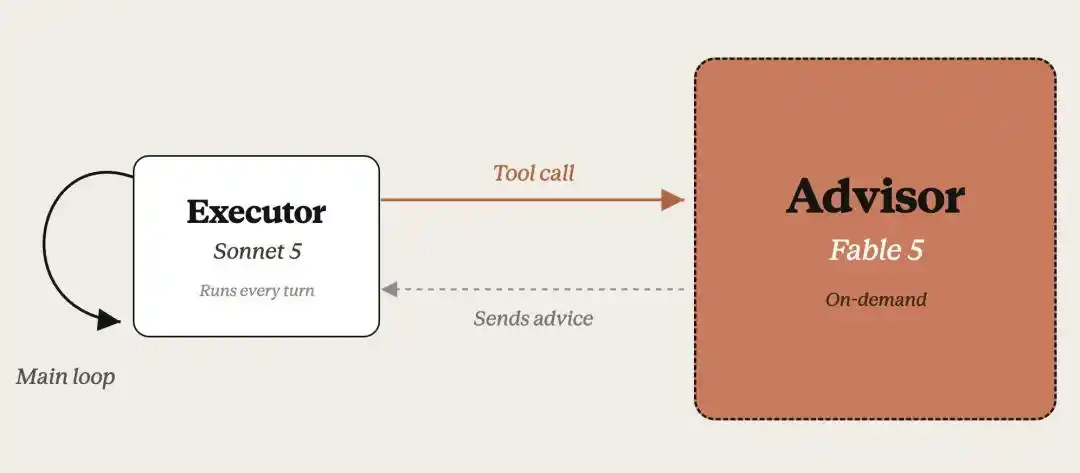
The main executor is Sonnet 5. Only when it encounters uncertain key junctures does it knock on Fable 5's door to ask for advice.
The vast majority of Tokens are billed at Sonnet 5's lower rate.
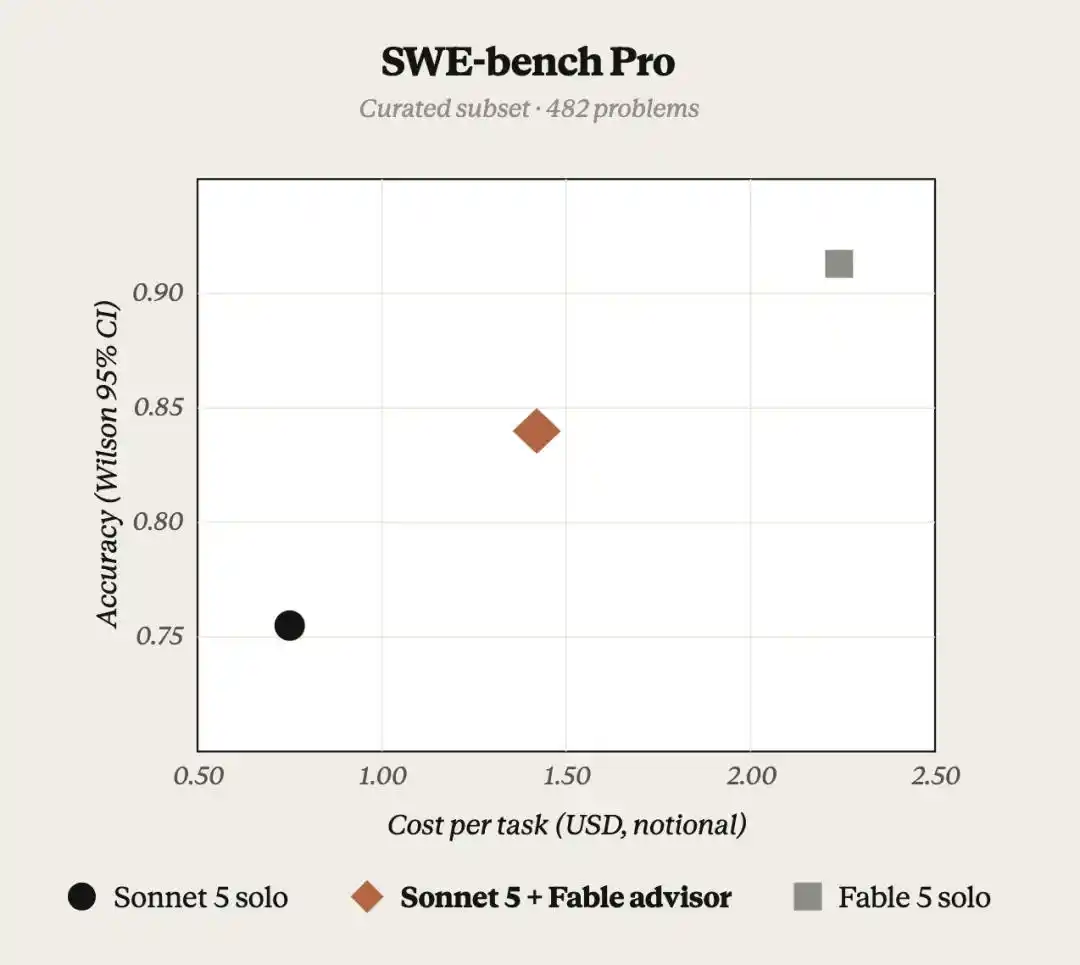
On hardcore coding tests like SWE-bench Pro, the results are quite impressive:
Sonnet 5 paired with a Fable 5 advisor spent about 63% of the cost to achieve about 92% of the score Fable 5 achieved solo.
In an entire task, Fable 5 is often called only once, responsible for steering the direction at the fork in the road, while Sonnet 5 handles all the heavy lifting.
Doing more with less money, that's exactly it.
Anthropic has already written this Advisor mode into the official documentation, with a dedicated advisor tool set up for anyone to build according to it.
The logic isn't complicated: In a task, there are actually very few places that truly require 'high-intelligence judgment'; most of the time is spent on mechanical reading and writing.
Let the expensive model only intervene at a few critical points, and the bill naturally comes down.
Second move, Orchestrator mode.
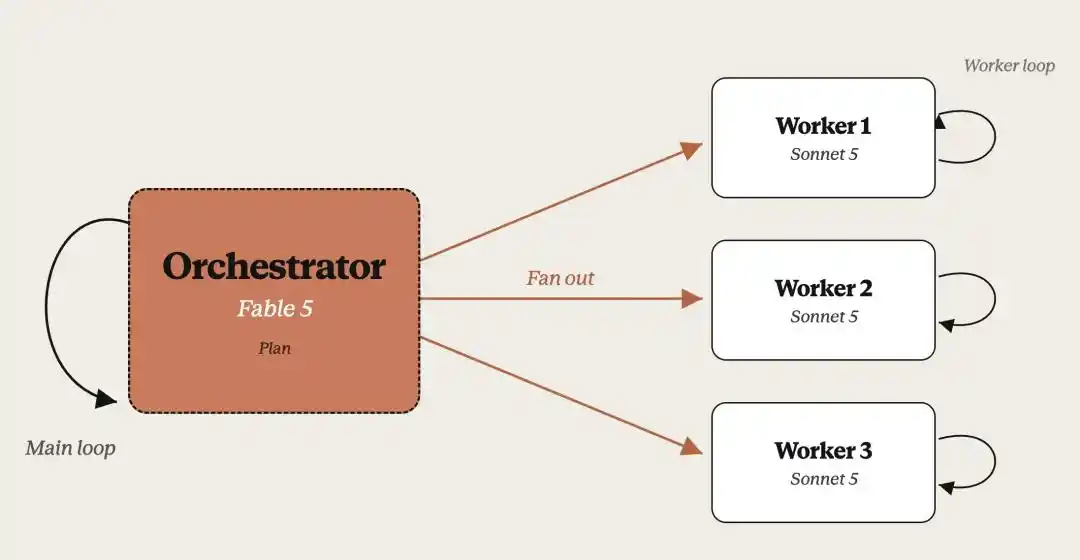
In this mode, Fable 5 is directly promoted to commander, strategizing, breaking down tasks, and assigning work to the subordinate Sonnet 5 sub-agents;
All Token-intensive research work is delegated downwards.
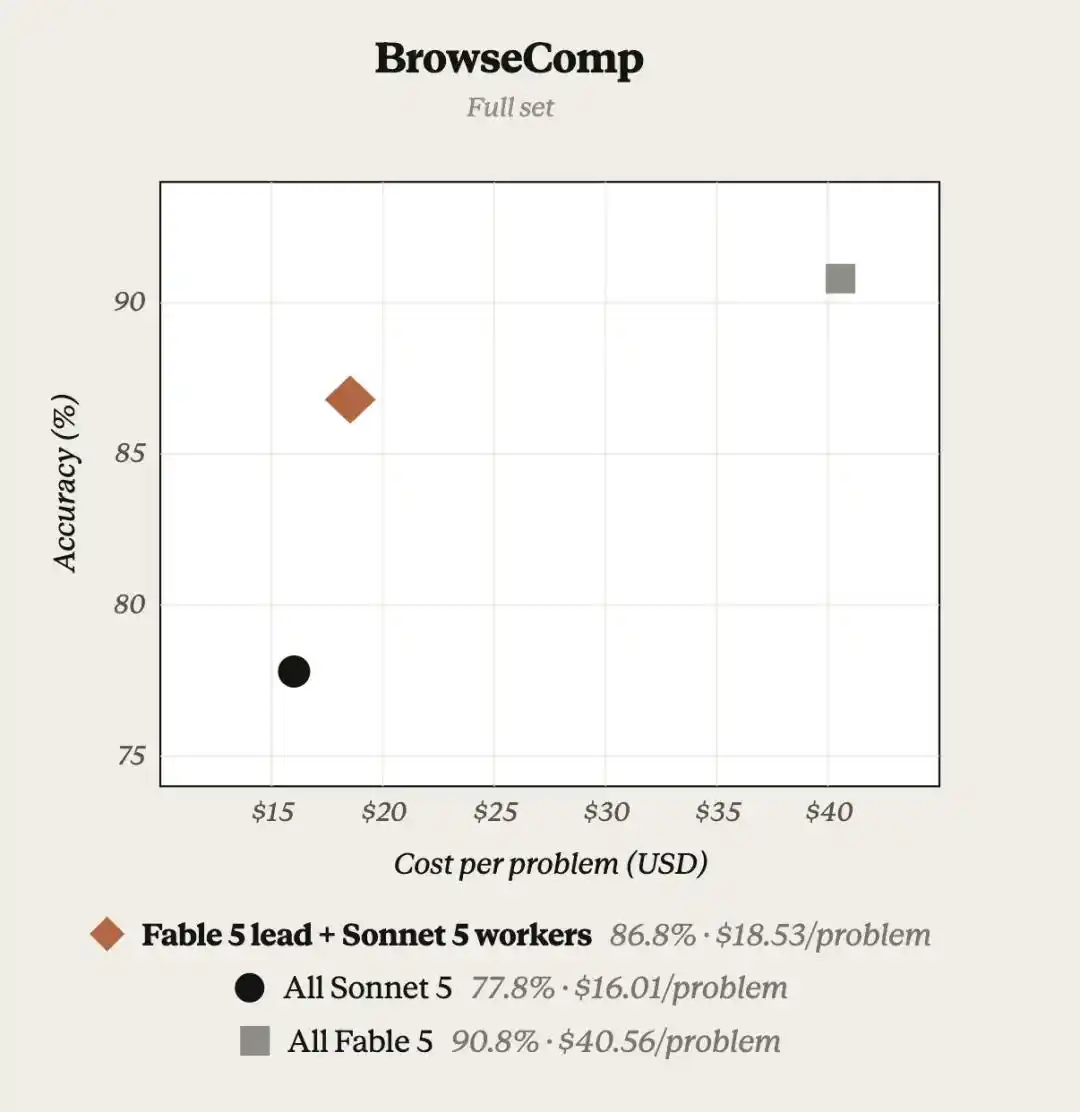
On BrowseComp, which requires massive reading, this combo delivered a knockout:
Commander Fable 5 achieved 96% of the single model's performance, but the cost was suppressed to an incredible 46%.
Just looking at proportions isn't clear enough, so Anthropic simply posted a real bill in the cookbook.
The task: Verify the ticket and reservation policies for the 10 largest national parks in the US, 20 facts in total, each needing verification against the official nps.gov pages one by one; no one is allowed to guess from memory.
The characteristic of this job is 'reading a lot': Just pulling dozens of web pages into the model accounts for most of the bill spent on reading.
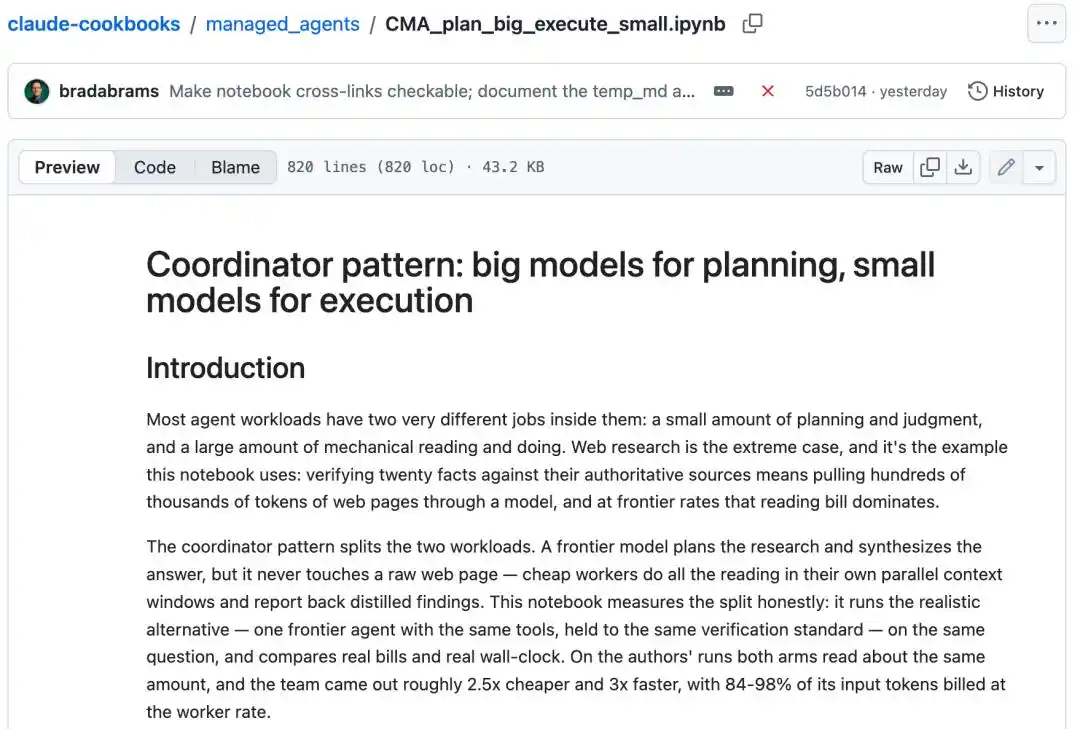
Address: https://github.com/anthropics/claude-cookbooks/blob/main/managed_agents/CMA_plan_big_execute_small.ipynb
This is where the value of division of labor comes out:
Commander Fable 5 is responsible for planning and summarizing, without touching a single webpage itself;
Sonnet 5 sub-agents read webpages in parallel within their own contexts and report refined conclusions upwards.
Under the same verification standards, the bills look like this: The team with division of labor cost about $1.61 total; switching to a single Fable 5 going solo, tackling all 20 facts directly, soars to about $4.
The team is not only about 2.5 times cheaper but also 3 times faster - 194 seconds vs. 608 seconds, with over 80% of the Tokens charged at the cheaper worker rate.

Looking at these two moves together, you'll find Anthropic is actually conveying the same signal:
The correct way to use a top-tier model has never been 'full-spec, all the way through'.
Fable 5's free window only lasts until July 12th; it will close.
But the real game-changer Anthropic packed into these few days isn't 'letting you use the strongest model for free', but rather teaching you hand-in-hand how to still afford to use it after the window closes.
Currently, the most cost-effective method: Use Fable 5 as the commander, paired with cheap Sonnet 5 as the workers!
References:
https://x.com/claudeai/status/2074548242386178258
https://support.claude.com/en/articles/15424964-claude-fable-5-promotional-access
https://x.com/ClaudeDevs/status/2074606058128224365?s=20
This article is from the WeChat public account "新智元" (New Zhi Yuan), author: ASI启示录, edited by: 桃子 (Peach).