Bitcoin Panic Selling Accelerates While Long-Term Holders Stay Inactive – Details

bitcoinistPublished on 2026-02-06Last updated on 2026-02-06

Abstract

Bitcoin is struggling to establish a clear support level near $70,000 amid persistent selling pressure and weakening sentiment. On-chain data indicates a significant surge in exchange inflows, with nearly 60,000 BTC moved in 24 hours—the largest daily amount this year. This selling is primarily driven by short-term holders realizing losses, suggesting capitulation phase where recent buyers exit under pressure. Meanwhile, long-term holders remain inactive and are not distributing coins. Such conditions often precede either a relief bounce, prolonged consolidation, or further decline. A confirmed bottom would require stabilized sentiment, reduced exchange inflows, and renewed accumulation signals, none of which are currently evident.

Bitcoin is struggling to establish a clear floor as price action hovers near the $70,000 level, a zone increasingly viewed by analysts as a decisive short-term support threshold. Persistent selling pressure, weakening sentiment, and declining momentum have kept the market on edge, with several analysts warning that further downside cannot yet be ruled out. The broader backdrop remains fragile, marked by cautious positioning and limited conviction among both retail and institutional participants.

Recent on-chain analysis from top analyst Darkfost highlights growing stress among short-term holders, a cohort historically sensitive to volatility. According to the data, Bitcoin inflows to exchanges have surged sharply, approaching 60,000 BTC within the past 24 hours. This represents the largest daily inflow recorded since the beginning of the year and suggests an increasing willingness among recent buyers to reduce exposure.
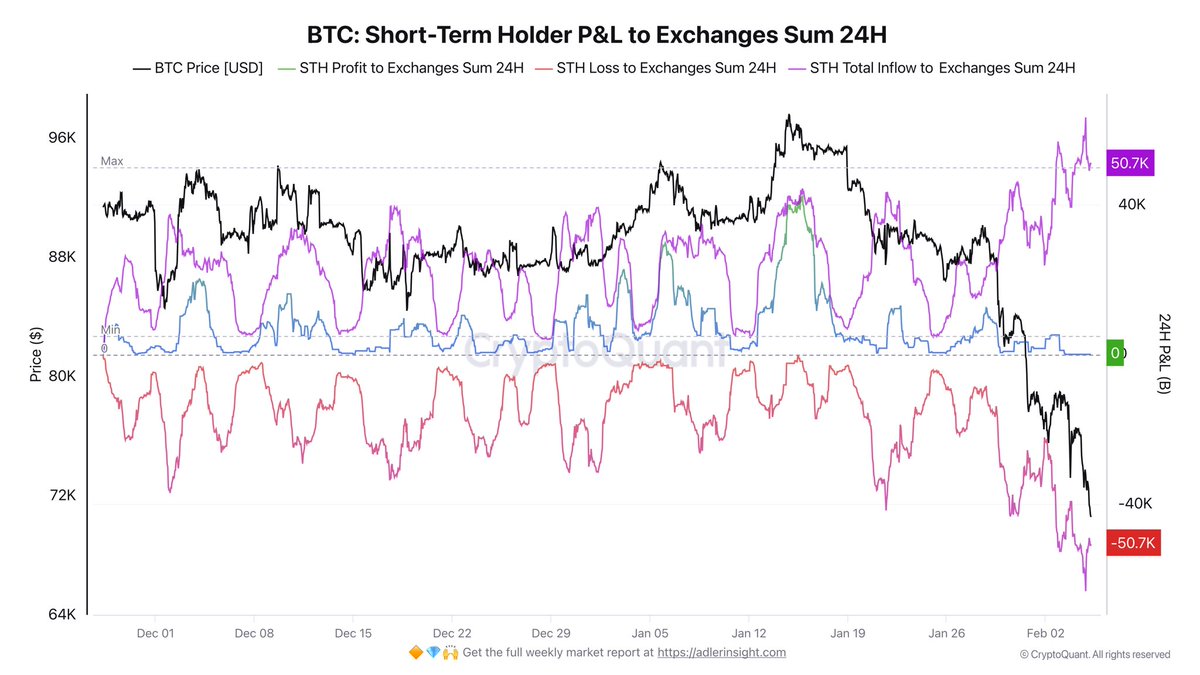
Bitcoin Short-Term Holder P&L to Exchange Sum | Source: CryptoQuant

Such flows typically translate into heightened sell-side liquidity, adding pressure to spot markets already grappling with weak demand. While exchange inflows alone do not guarantee further declines, their scale often reflects defensive positioning during uncertain phases. For now, Bitcoin remains in a structurally fragile zone where sentiment, liquidity conditions, and holder behavior will likely determine whether stabilization or deeper correction follows.

Short-Term Holder Capitulation Raises Bottoming Debate

Darkfost notes that the recent surge in Bitcoin exchange inflows has been driven almost entirely by short-term holders (STH) realizing losses. According to the data, the BTC moved to exchanges over the past day was transferred below acquisition cost, confirming that recent entrants are exiting under pressure rather than taking profits.

At the same time, there is little evidence of long-term holders (LTH) distributing coins in profit, suggesting that the more structurally committed cohort remains largely inactive. This combination is often described as a capitulation phase, where weaker hands exit while stronger holders wait.

Historically, such episodes can precede several different outcomes rather than an immediate reversal. One possibility is a relief bounce if selling pressure becomes exhausted and liquidity stabilizes. Another scenario involves a prolonged consolidation period as the market digests losses and rebuilds demand. A deeper decline cannot be excluded either, particularly if macro liquidity tightens or spot demand fails to absorb continued exchange inflows.

Capitulation alone does not define a bottom. Confirmation typically requires stabilization in SOPR, declining exchange inflows, and renewed accumulation signals. Until those appear, Bitcoin remains in a vulnerable phase where sentiment, liquidity conditions, and holder behavior will likely shape the next directional move.


Related Questions

QWhat is the current key support level for Bitcoin's price according to analysts?

AThe $70,000 level is viewed by analysts as a decisive short-term support threshold.

QWhich group of Bitcoin holders is primarily responsible for the recent surge in exchange inflows?

AShort-term holders (STH) are primarily responsible for the recent surge in Bitcoin inflows to exchanges.

QWhat does the data indicate about the state of long-term holders (LTH) during this market phase?

AThe data indicates that long-term holders (LTH) are largely inactive, with little evidence of them distributing coins for a profit.

QWhat is the significance of the large daily Bitcoin inflow to exchanges mentioned in the article?

AThe inflow of nearly 60,000 BTC in 24 hours is the largest since the beginning of the year and suggests an increasing willingness among recent buyers to sell, adding significant sell-side pressure to the market.

QAccording to the analyst, what is required to confirm that a market bottom has been formed, beyond just capitulation?

AConfirmation of a bottom typically requires stabilization in the Spent Output Profit Ratio (SOPR), a decline in exchange inflows, and signals of renewed accumulation.

Related Reads

Why Do You Always Lose Money on Polymarket? Because You're Betting on News, While the Pros Read the Rules

Why do you always lose money on Polymarket? Because you bet on news, while the pros study the rules. This article explains how top traders ("che tou") profit by meticulously analyzing market rules, not just predicting events. Polymarket, a prediction market platform, often sees disputes over event outcomes due to ambiguous rule wording. For instance, a market asking "Who will be the leader of Venezuela by the end of 2026?" was misinterpreted by many who bet on Delcy Rodríguez, assuming she held power. However, the rules specified "officially holds" as the formally appointed, sworn-in individual. Since Nicolás Maduro was still recognized as president officially, he won the market—even being in prison. To resolve such disputes, Polymarket uses a decentralized arbitration system via UMA protocol. The process involves: 1. Proposal: Anyone can propose a market outcome by staking 750 USDC, earning 5 USDC if unchallenged. 2. Dispute: A 2-hour window allows challenges with a 750 USDC stake; successful challengers earn 250 USDC. 3. Discussion: A 48-hour period on UMA Discord for evidence and debate. 4. Voting: UMA token holders vote in two 24-hour phases (blind then public). Outcomes require >65% consensus and 5M tokens voted; otherwise, four re-votes occur before Polymarket intervention. 5. Settlement: Results are final and automatic. Unlike traditional courts, Polymarket’s system lacks separation between arbitrators and stakeholders—voters often hold market positions, creating conflicts of interest. This leads to herd mentality in discussions and non-transparent outcomes without explanatory rulings, preventing precedent formation. Thus, success on Polymarket hinges on deep rule interpretation, not just event prediction, exploiting gaps between reality and contractual wording.

marsbit1h ago

Why Do You Always Lose Money on Polymarket? Because You're Betting on News, While the Pros Read the Rules

marsbit1h ago

DeepSeek Funding: Liang Wenfeng's 'Realist' Pivot

DeepSeek, a leading Chinese AI company, has initiated its first external funding round, aiming to raise at least $300 million at a valuation of no less than $10 billion. This move marks a significant shift from its founder Liang Wenfeng’s previous idealistic stance of rejecting external capital to maintain independence. Despite strong financial backing from its parent company, quantitative trading firm幻方量化 (Huanfang Quant), which provided an estimated $700 million in revenue in 2025 alone, DeepSeek faces mounting challenges. Key issues include a 15-month gap in major model updates, delays in its flagship V4 release, and the loss of several core researchers to competitors offering significantly higher compensation. The company is also undergoing a strategic pivot by migrating its infrastructure from NVIDIA’s CUDA to Huawei’s Ascend platform, a move aligned with China’s push for technological self-reliance amid U.S. export controls. However, DeepSeek lags behind rivals like智谱AI and MiniMax—both now publicly listed—in areas such as product ecosystem, multimodal capabilities, and commercialization. The funding round, though relatively small in scale, is seen as a way to establish a market-validated valuation anchor, making employee stock options more competitive and facilitating talent retention. It also signals DeepSeek’s transition from a pure research-oriented organization to a commercially-driven player in the global AI ecosystem.

marsbit2h ago

DeepSeek Funding: Liang Wenfeng's 'Realist' Pivot

marsbit2h ago

Trading

Spot
Futures

Hot Articles

What is $BITCOIN

DIGITAL GOLD ($BITCOIN): A Comprehensive Analysis Introduction to DIGITAL GOLD ($BITCOIN) DIGITAL GOLD ($BITCOIN) is a blockchain-based project operating on the Solana network, which aims to combine the characteristics of traditional precious metals with the innovation of decentralized technologies. While it shares a name with Bitcoin, often referred to as “digital gold” due to its perception as a store of value, DIGITAL GOLD is a separate token designed to create a unique ecosystem within the Web3 landscape. Its goal is to position itself as a viable alternative digital asset, although specifics regarding its applications and functionalities are still developing. What is DIGITAL GOLD ($BITCOIN)? DIGITAL GOLD ($BITCOIN) is a cryptocurrency token explicitly designed for use on the Solana blockchain. In contrast to Bitcoin, which provides a widely recognized value storage role, this token appears to focus on broader applications and characteristics. Notable aspects include: Blockchain Infrastructure: The token is built on the Solana blockchain, known for its capacity to handle high-speed and low-cost transactions. Supply Dynamics: DIGITAL GOLD has a maximum supply capped at 100 quadrillion tokens (100P $BITCOIN), although details regarding its circulating supply are currently undisclosed. Utility: While precise functionalities are not explicitly outlined, there are indications that the token could be utilized for various applications, potentially involving decentralized applications (dApps) or asset tokenization strategies. Who is the Creator of DIGITAL GOLD ($BITCOIN)? At present, the identity of the creators and development team behind DIGITAL GOLD ($BITCOIN) remains unknown. This situation is typical among many innovative projects within the blockchain space, particularly those aligning with decentralized finance and meme coin phenomena. While such anonymity may foster a community-driven culture, it intensifies concerns about governance and accountability. Who are the Investors of DIGITAL GOLD ($BITCOIN)? The available information indicates that DIGITAL GOLD ($BITCOIN) does not have any known institutional backers or prominent venture capital investments. The project seems to operate on a peer-to-peer model focused on community support and adoption rather than traditional funding routes. Its activity and liquidity are primarily situated on decentralized exchanges (DEXs), such as PumpSwap, rather than established centralized trading platforms, further highlighting its grassroots approach. How DIGITAL GOLD ($BITCOIN) Works The operational mechanics of DIGITAL GOLD ($BITCOIN) can be elaborated on based on its blockchain design and network attributes: Consensus Mechanism: By leveraging Solana’s unique proof-of-history (PoH) combined with a proof-of-stake (PoS) model, the project ensures efficient transaction validation contributing to the network's high performance. Tokenomics: While specific deflationary mechanisms have not been extensively detailed, the vast maximum token supply implies that it may cater to microtransactions or niche use cases that are still to be defined. Interoperability: There exists the potential for integration with Solana’s broader ecosystem, including various decentralized finance (DeFi) platforms. However, the details regarding specific integrations remain unspecified. Timeline of Key Events Here is a timeline that highlights significant milestones concerning DIGITAL GOLD ($BITCOIN): 2023: The initial deployment of the token occurs on the Solana blockchain, marked by its contract address. 2024: DIGITAL GOLD gains visibility as it becomes available for trading on decentralized exchanges like PumpSwap, allowing users to trade it against SOL. 2025: The project witnesses sporadic trading activity and potential interest in community-led engagements, although no noteworthy partnerships or technical advancements have been documented as of yet. Critical Analysis Strengths Scalability: The underlying Solana infrastructure supports high transaction volumes, which could enhance the utility of $BITCOIN in various transaction scenarios. Accessibility: The potential low trading price per token could attract retail investors, facilitating wider participation due to fractional ownership opportunities. Risks Lack of Transparency: The absence of publicly known backers, developers, or an audit process may yield skepticism regarding the project's sustainability and trustworthiness. Market Volatility: The trading activity is heavily reliant on speculative behavior, which can result in significant price volatility and uncertainty for investors. Conclusion DIGITAL GOLD ($BITCOIN) emerges as an intriguing yet ambiguous project within the rapidly evolving Solana ecosystem. While it attempts to leverage the “digital gold” narrative, its departure from Bitcoin's established role as a store of value underscores the need for a clearer differentiation of its intended utility and governance structure. Future acceptance and adoption will likely depend on addressing the current opacity and defining its operational and economic strategies more explicitly. Note: This report encompasses synthesised information available as of October 2023, and developments may have transpired beyond the research period.

363 Total ViewsPublished 2025.05.13Updated 2025.05.13

What is $BITCOIN

Discussions

Welcome to the HTX Community. Here, you can stay informed about the latest platform developments and gain access to professional market insights. Users' opinions on the price of BTC (BTC) are presented below.

活动图片