Bitcoin miners hold firm as stocks sink – What it means for BTC

ambcryptoPublished on 2026-07-19Last updated on 2026-07-19

Abstract

Bitcoin miners are maintaining their holdings despite financial strain, as indicated by a decline in BTC sent to exchanges. Despite the Miners' Financial Health Index signaling bear-market conditions and mining stocks falling significantly, the seven-day moving average of miner-to-exchange flows dropped nearly 36% in early July. This reduction in immediately available supply could ease selling pressure on Bitcoin, potentially supporting its price as it attempts to reclaim $65,000. However, the decrease in exchange transfers does not definitively confirm accumulation, as miners may be using other venues. The increase in the dollar value of miner wallets is largely attributed to Bitcoin's price appreciation during the period.

Bitcoin [BTC] climbed above $65,000 during the week beginning the 12th of July. A cooler Consumer Price Index reading supported the move by easing inflation concerns.

However, BTC later retreated toward $64,000. Beneath this volatility, miners continued sending fewer coins to exchanges despite worsening financial conditions.

Why are Bitcoin miners struggling?

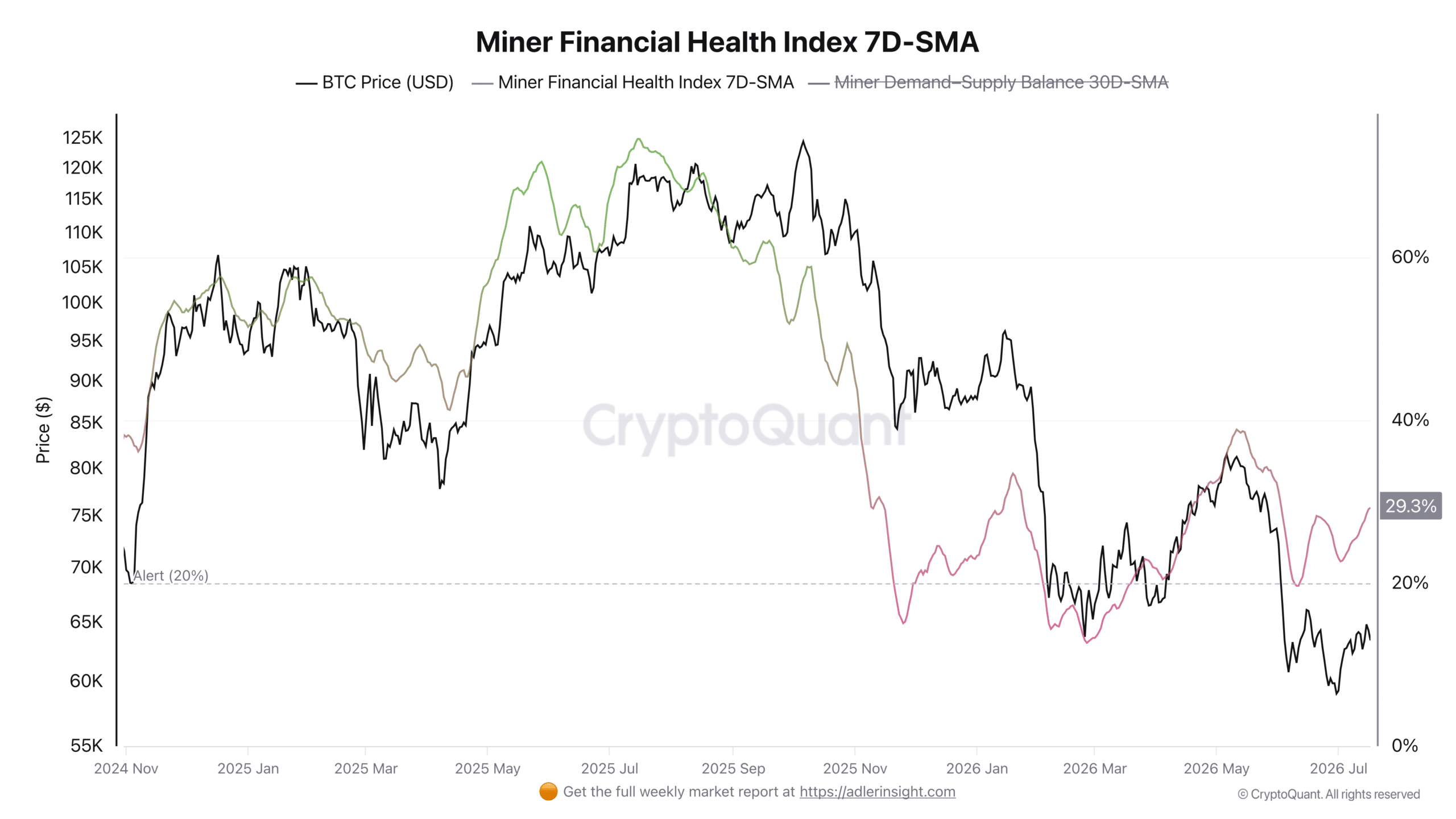
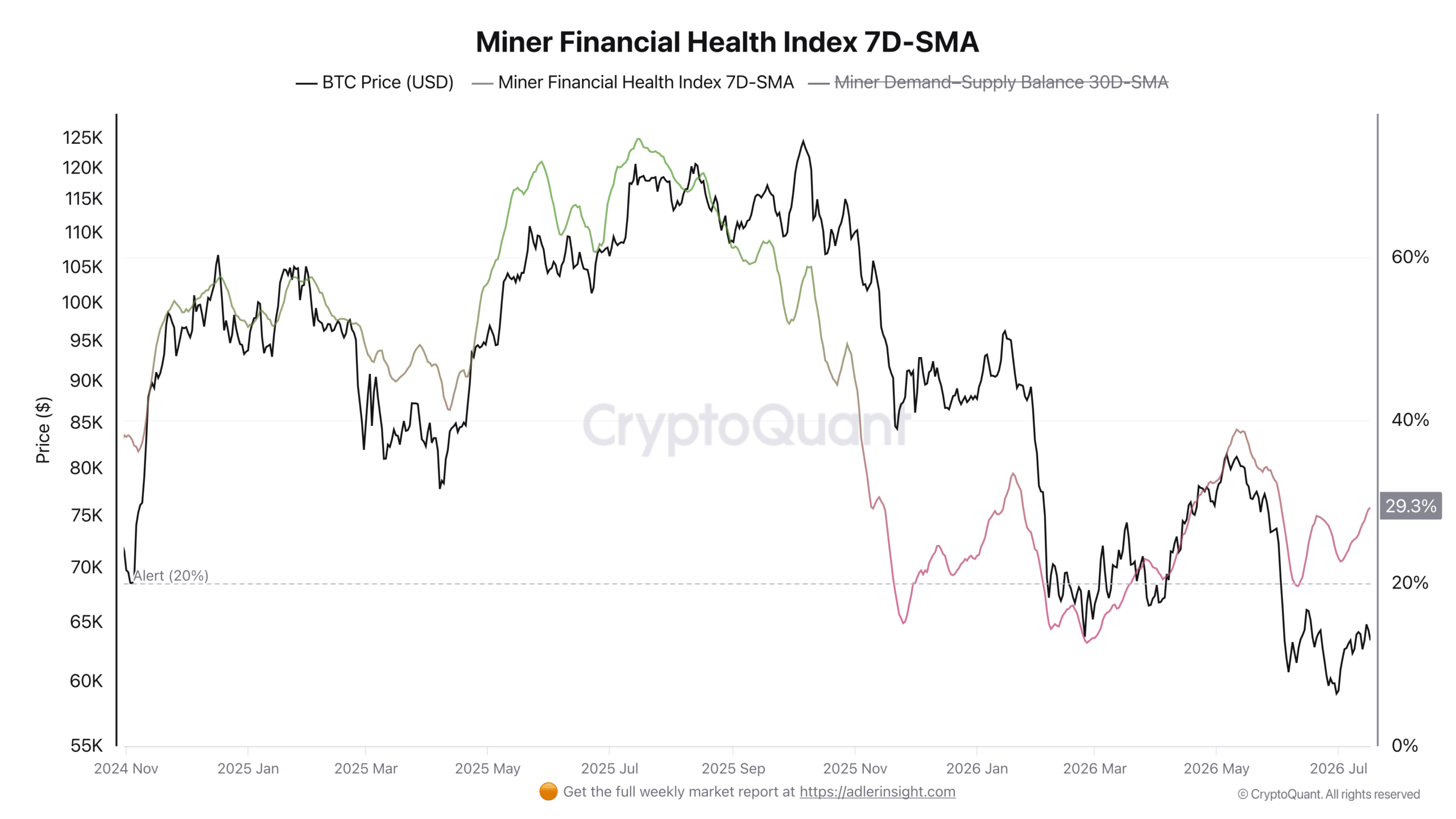
CryptoQuant data showed that miners faced significant pressure, based on its Miners’ Financial Health Index. The index combines mining revenue, fees, issuance, and other inputs to measure the industry’s overall financial health.
Source: CryptoQuant

Based on its seven-day Moving Average, the index stood near 29% at press time. Readings between 10% and 30% have historically aligned with bear-market conditions.

Such conditions can pressure miners’ income and increase their need to sell reserves. However, exchange-flow data showed that selling pressure had eased.

Are miners sending less BTC?

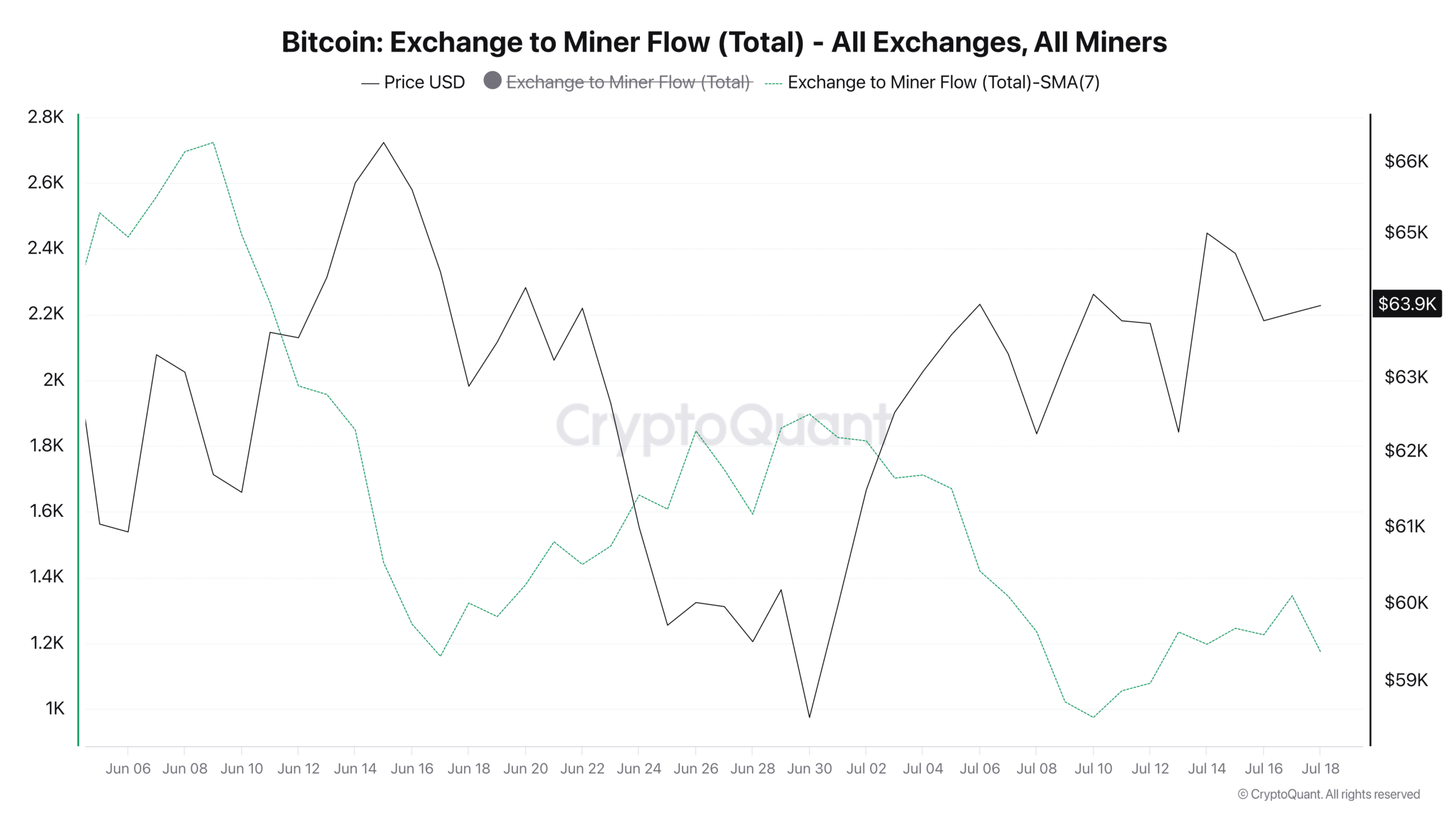
CryptoQuant’s Miner to Exchange Flow showed that miners transferred less Bitcoin to exchanges despite their financial strain. Based on the seven-day SMA, exchange flows fell from 1,825.86 BTC on the 1st of July to 1,173.66 BTC.
Source: CryptoQuant

This represented a decline of nearly 36%, suggesting that miners reduced their immediately available exchange supply.

However, lower exchange flows did not necessarily confirm accumulation. Miners could also have moved coins through untracked venues or held them elsewhere.

The dollar value of Bitcoin in miner wallets increased by $4.7 billion, from $71.5 billion to roughly $76.2 billion.

Much of this increase could reflect Bitcoin’s price appreciation rather than growth in miners’ BTC holdings. Bitcoin rose from $58,624 on the 1st of July to $63,999 at press time.

Why are mining stocks falling?

Publicly listed Bitcoin mining stocks lost 12% collectively over the past month, according to Artemis.

The decline highlighted the financial pressure facing mining companies, even as Bitcoin’s price recovered.

Over five days, Cipher Mining [CIFR] dropped 20.3%, while Iris Energy [IREN] fell 18.3%. TeraWulf [WULF] declined 17.3%. By contrast, Bitcoin added more than $42 billion in market capitalization during the same period.

This divergence suggested that investors remained concerned about miners’ operating costs and profitability despite BTC’s recovery.

Lower miner exchange flows could reduce one source of immediate selling pressure. However, the data did not prove that miners were accumulating Bitcoin.

For now, miners’ reluctance to transfer BTC to exchanges may support supply conditions as Bitcoin attempts to reclaim $65,000.


Final Summary

  • Miner exchange flows fell nearly 36% despite worsening financial conditions across the industry.
  • Mining stocks declined sharply, while lower exchange transfers may ease immediate Bitcoin selling pressure.


Trending Cryptos

Related Questions

QWhat is the current state of the Bitcoin Miners' Financial Health Index, and what does it historically indicate?

ABased on its seven-day Moving Average, the index stood near 29% at the time of the article. Readings between 10% and 30% have historically aligned with bear-market conditions for the mining industry.

QHow did Bitcoin miner-to-exchange flows change in early July, and what is one interpretation of this trend?

AMiners' Bitcoin transfers to exchanges fell from 1,825.86 BTC on July 1st to 1,173.66 BTC, a decline of nearly 36%. This suggests miners reduced the immediately available supply of BTC on exchanges, which could ease immediate selling pressure.

QWhat was the performance of publicly listed Bitcoin mining stocks compared to Bitcoin's price in the period discussed?

APublicly listed Bitcoin mining stocks collectively lost 12% over the past month, with significant individual declines (e.g., Cipher Mining -20.3%). This contrasted with Bitcoin's price recovery and a $42+ billion increase in market capitalization over five days.

QAccording to the article, what are two possible explanations for miners sending less BTC to exchanges despite financial strain?

AFirst, miners could be accumulating (holding) Bitcoin. Second, they could be moving coins through untracked venues or holding them elsewhere (like private wallets), not necessarily on exchanges.

QWhat key factor contributed to the increase in the dollar value of Bitcoin held in miner wallets from $71.5B to $76.2B?

AMuch of the $4.7 billion increase likely reflects Bitcoin's price appreciation (rising from ~$58,624 to ~$63,999) rather than a significant growth in the actual number of BTC holdings.

Related Reads

Intern, Earning 120,000 Monthly

An article titled "Intern, Monthly Income of 120,000 RMB" discusses the intense competition for top AI talent in China, highlighted by a viral social media post. A Tsinghua University student from the prestigious Yao Class reportedly received a staggering internship offer from the AI company DeepSeek with a daily salary of 5,500 RMB (pre-tax), translating to over 120,000 RMB per month. This case exemplifies the fierce "talent war" raging among major tech firms. Companies like DeepSeek, Huawei, Tencent, and ByteDance are aggressively recruiting interns and fresh graduates with unprecedented compensation packages, high conversion rates to full-time positions, and even company stock options for top performers like those in Moonshot AI's "Time Travel Plan." The trend shows recruitment starting earlier, even targeting high school students. The driving force is the belief that a few exceptional individuals can be pivotal in the AI race. Salaries for elite AI researchers have skyrocketed from around one million RMB annually to tens of millions. Young, highly-educated talents from top schools, seen as adaptable "AI Natives," are being placed at the forefront of core projects. Examples include Tencent appointing a 27-year-old former OpenAI researcher as its Chief AI Scientist. In essence, the competition is shifting from just models and computing power to a battle for talent density. A new generation of young experts is rapidly rising to central roles, poised to reshape the future AI landscape.

marsbit2h ago

Intern, Earning 120,000 Monthly

marsbit2h ago

Trading

Spot

Hot Articles

What is $BITCOIN

DIGITAL GOLD ($BITCOIN): A Comprehensive Analysis Introduction to DIGITAL GOLD ($BITCOIN) DIGITAL GOLD ($BITCOIN) is a blockchain-based project operating on the Solana network, which aims to combine the characteristics of traditional precious metals with the innovation of decentralized technologies. While it shares a name with Bitcoin, often referred to as “digital gold” due to its perception as a store of value, DIGITAL GOLD is a separate token designed to create a unique ecosystem within the Web3 landscape. Its goal is to position itself as a viable alternative digital asset, although specifics regarding its applications and functionalities are still developing. What is DIGITAL GOLD ($BITCOIN)? DIGITAL GOLD ($BITCOIN) is a cryptocurrency token explicitly designed for use on the Solana blockchain. In contrast to Bitcoin, which provides a widely recognized value storage role, this token appears to focus on broader applications and characteristics. Notable aspects include: Blockchain Infrastructure: The token is built on the Solana blockchain, known for its capacity to handle high-speed and low-cost transactions. Supply Dynamics: DIGITAL GOLD has a maximum supply capped at 100 quadrillion tokens (100P $BITCOIN), although details regarding its circulating supply are currently undisclosed. Utility: While precise functionalities are not explicitly outlined, there are indications that the token could be utilized for various applications, potentially involving decentralized applications (dApps) or asset tokenization strategies. Who is the Creator of DIGITAL GOLD ($BITCOIN)? At present, the identity of the creators and development team behind DIGITAL GOLD ($BITCOIN) remains unknown. This situation is typical among many innovative projects within the blockchain space, particularly those aligning with decentralized finance and meme coin phenomena. While such anonymity may foster a community-driven culture, it intensifies concerns about governance and accountability. Who are the Investors of DIGITAL GOLD ($BITCOIN)? The available information indicates that DIGITAL GOLD ($BITCOIN) does not have any known institutional backers or prominent venture capital investments. The project seems to operate on a peer-to-peer model focused on community support and adoption rather than traditional funding routes. Its activity and liquidity are primarily situated on decentralized exchanges (DEXs), such as PumpSwap, rather than established centralized trading platforms, further highlighting its grassroots approach. How DIGITAL GOLD ($BITCOIN) Works The operational mechanics of DIGITAL GOLD ($BITCOIN) can be elaborated on based on its blockchain design and network attributes: Consensus Mechanism: By leveraging Solana’s unique proof-of-history (PoH) combined with a proof-of-stake (PoS) model, the project ensures efficient transaction validation contributing to the network's high performance. Tokenomics: While specific deflationary mechanisms have not been extensively detailed, the vast maximum token supply implies that it may cater to microtransactions or niche use cases that are still to be defined. Interoperability: There exists the potential for integration with Solana’s broader ecosystem, including various decentralized finance (DeFi) platforms. However, the details regarding specific integrations remain unspecified. Timeline of Key Events Here is a timeline that highlights significant milestones concerning DIGITAL GOLD ($BITCOIN): 2023: The initial deployment of the token occurs on the Solana blockchain, marked by its contract address. 2024: DIGITAL GOLD gains visibility as it becomes available for trading on decentralized exchanges like PumpSwap, allowing users to trade it against SOL. 2025: The project witnesses sporadic trading activity and potential interest in community-led engagements, although no noteworthy partnerships or technical advancements have been documented as of yet. Critical Analysis Strengths Scalability: The underlying Solana infrastructure supports high transaction volumes, which could enhance the utility of $BITCOIN in various transaction scenarios. Accessibility: The potential low trading price per token could attract retail investors, facilitating wider participation due to fractional ownership opportunities. Risks Lack of Transparency: The absence of publicly known backers, developers, or an audit process may yield skepticism regarding the project's sustainability and trustworthiness. Market Volatility: The trading activity is heavily reliant on speculative behavior, which can result in significant price volatility and uncertainty for investors. Conclusion DIGITAL GOLD ($BITCOIN) emerges as an intriguing yet ambiguous project within the rapidly evolving Solana ecosystem. While it attempts to leverage the “digital gold” narrative, its departure from Bitcoin's established role as a store of value underscores the need for a clearer differentiation of its intended utility and governance structure. Future acceptance and adoption will likely depend on addressing the current opacity and defining its operational and economic strategies more explicitly. Note: This report encompasses synthesised information available as of October 2023, and developments may have transpired beyond the research period.

906 Total ViewsPublished 2025.05.13Updated 2025.05.13

What is $BITCOIN

Discussions

Welcome to the HTX Community. Here, you can stay informed about the latest platform developments and gain access to professional market insights. Users' opinions on the price of BTC (BTC) are presented below.

活动图片