Bitcoin Miners Face a Crucial Moment in August After Revenue Recovery

cryptonews.ruPublished on 2026-08-03Last updated on 2026-08-03

Abstract

Bitcoin miners are facing a pivotal moment in August following a partial recovery in revenues in July. After mining income plummeted 23% in June to $836.41 million, it saw a modest rebound to $875.35 million in July, supported by a slight 1.6% increase in Bitcoin's price over the previous 30 days. However, revenues remain well below May's peak of $1.086 billion. The key metric of "hashprice"—the spot value of hashpower—has also improved slightly from $29.01 to $31.59 per PH/s over 30 days, but profit margins remain thin. The coming weeks introduce new variables: the BIP-110 proposal is entering a key signaling phase around August 8-9 but with low support, likely causing only short-term chain instability rather than significant fee revenue changes. Concurrently, an expected Bitcoin network difficulty adjustment of around 1.87% will add pressure. Potentially more impactful is the upcoming eCash fork by Paul Sztorc later in August. New SHA-256 chains often attract speculative hashpower due to initially low difficulty, offering miners a chance for higher short-term profits before economic realities redirect them back to Bitcoin. This shift could temporarily improve profitability for miners who remain on the main Bitcoin chain. Ultimately, the weeks ahead will reveal where miners believe the greatest profit lies as they navigate these competing events.

The mining revenue trend over the past six months reflects a familiar situation for miners. Fluctuations in Bitcoin price and spikes in on-chain activity can temporarily boost revenue, but the main burden is still carried by block rewards. Transaction fees may make headlines during short-lived surges, yet they remain only a small part of what actually sustains mining operations month after month.

Monthly mining revenue data provided by Newhedge.io shows that July brought only a partial recovery after a sharp 23% plunge in June—a drop that wiped out May's gains and then some. April ended with mining revenue of $947.26 million, which jumped to $1.086 billion in May, making it one of the most successful months for miners recently.
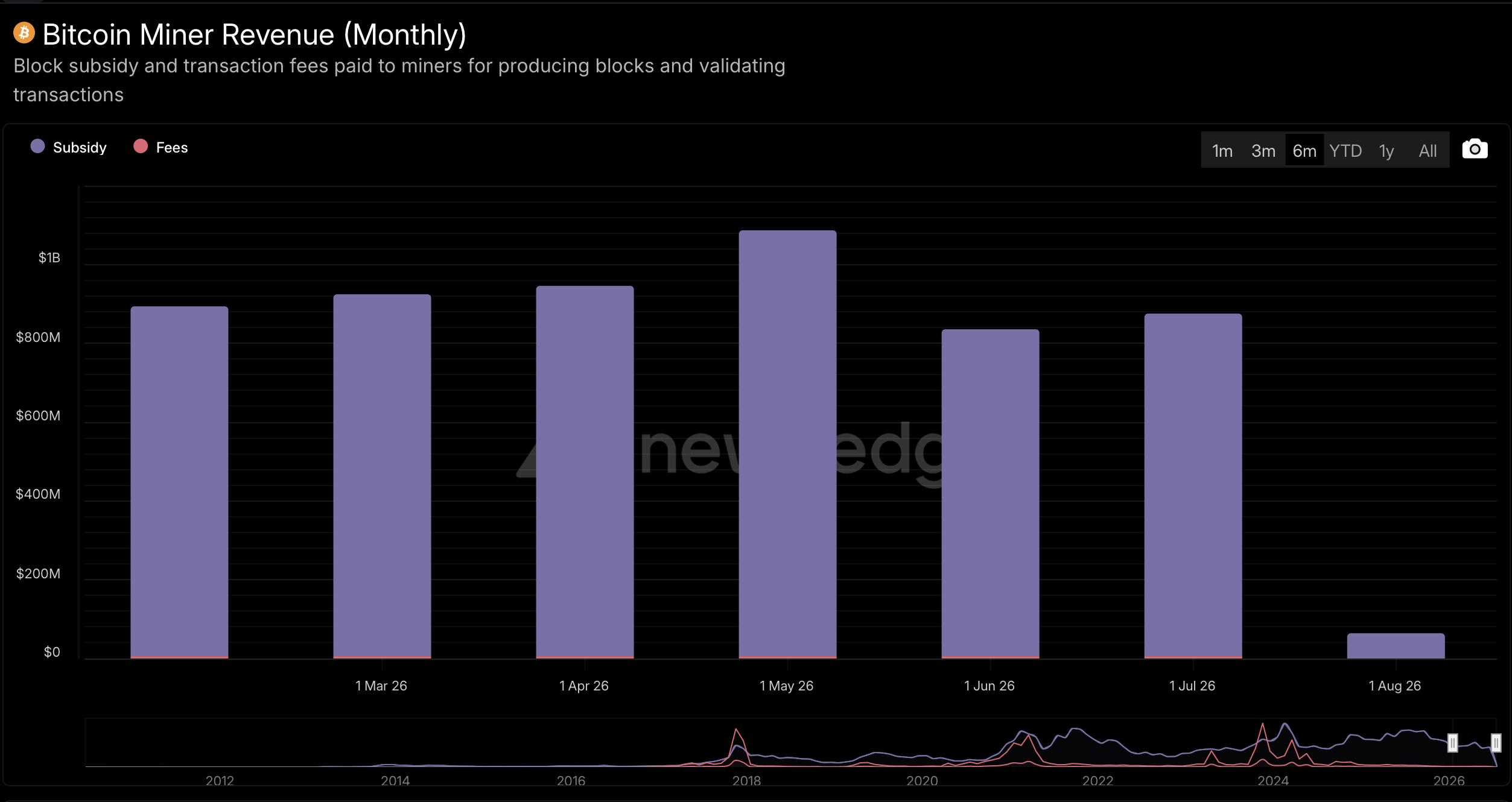
Monthly mining revenue data from Newhedge.io. Six-month period recorded on August 2, 2026.

This momentum did not last long. In June, revenue plummeted sharply to $836.41 million—a sharp reversal that quickly reminded operators of how quickly favorable conditions can disappear.

Bitcoin Price Provides a Small Boost

Although the $BTC price has fallen by 2.2% over the past two weeks, the overall picture is less bleak. Over the past 30 days, Bitcoin has maintained a modest gain of 1.6%, giving miners at least some support, even though revenue figures remain significantly below May's peak.

This modest Bitcoin price increase gave miners a little extra breathing room in July. Monthly mining revenue rose from $836.41 million in June to $875.35 million in July.

'Hashprice' Metric Improves, But Margins Remain Low

This may also be reflected in the 'hashprice'—a term describing the spot price of hashrate per terahash (TH/s), petahash (PH/s), exahash (EH/s), and so on. 30 days ago, the spot cost for one PH/s, according to statistics recorded on hashrateindex.com, was $29.01.
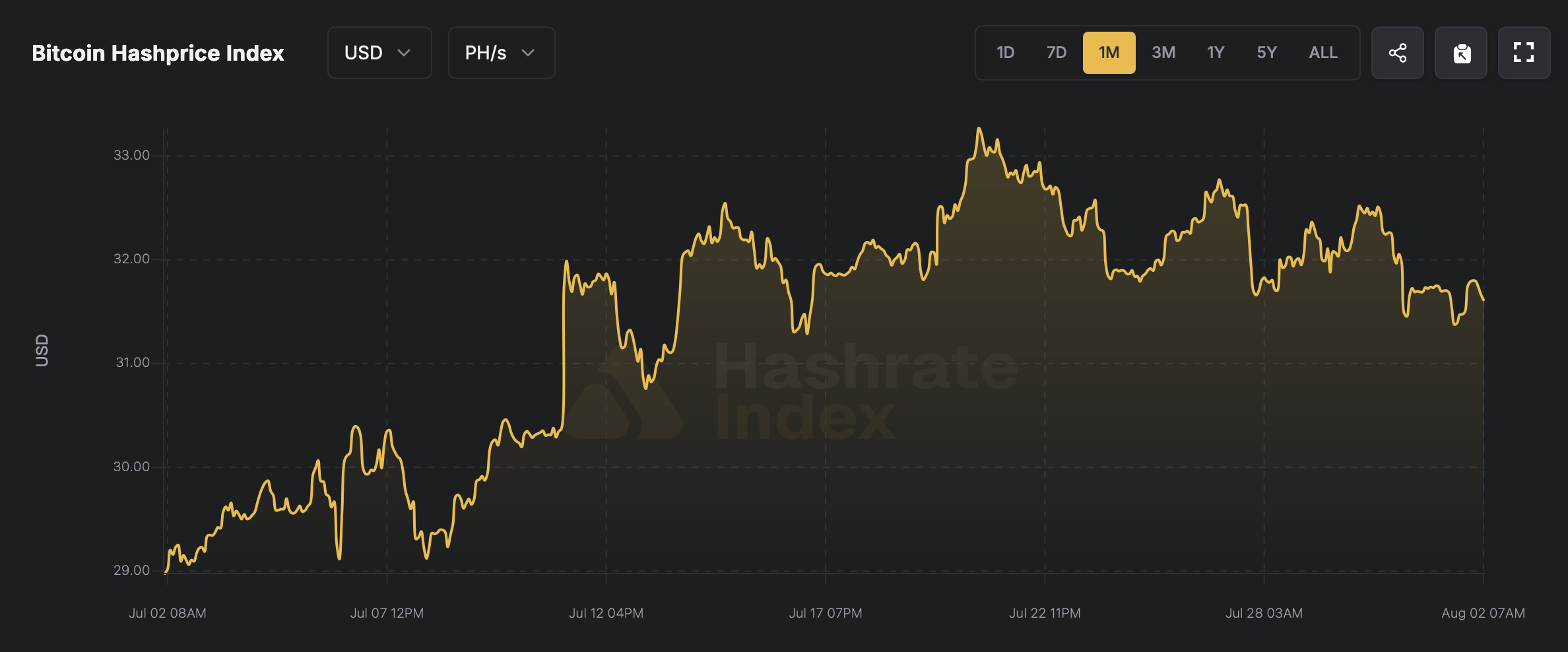
30-day hashprice statistics from hashrateindex.com on August 2, 2026.

Today the hashprice is $31.59 per PH/s, leaving a small margin despite the modest July recovery. August could shake things up: two competing forks are giving miners new incentives to reconsider where to direct their computing power.

BIP-110 Faces Difficulty Increase

BIP-110 enters a crucial signaling phase around August 8–9, but with support levels still fluctuating around 2%, the proposal is unlikely to be adopted. As a result, miners will be observing short-term chain instability rather than a meaningful change in fee revenue. Interestingly, the next difficulty adjustment in the Bitcoin network is expected to occur just as BIP-110 enters its signaling window, putting two closely watched events on a collision course. Current estimates point to a difficulty increase of 1.87%, creating an added layer of pressure as miners weigh their options.

eCash Fork Could Alter Hashpower Distribution

Later this month, Paul Sztorc's eCash fork might present a more interesting compromise. New SHA-256 chains often attract speculative hashpower when difficulty starts low, giving some miners a chance for higher short-term profits before economic viability pulls them back to Bitcoin. Ultimately, equipment will be oriented towards profitability, and any significant departure from mining $BTC could leave the remaining miners with slightly better economics after the next adjustment.

The next few weeks should show where miners believe the greatest profit lies.

end-content

Trending Cryptos

Related Questions

QWhat was the main factor that partially recovered Bitcoin mining revenue in July 2024 after the sharp drop in June?

AThe modest 1.6% price increase in Bitcoin over the preceding 30 days provided miners with some additional room for maneuver, leading to a revenue increase from $836.41 million in June to $875.35 million in July.

QWhat is 'hashprice' and what was its improvement over the 30-day period ending August 2, 2026?

A'Hashprice' refers to the spot price of hash rate per terahash, petahash, or exahash. Over the 30-day period ending August 2, 2026, it increased from $29.01 per PH/s to $31.59 per PH/s.

QAccording to the article, why is the upcoming BIP-110 signaling phase unlikely to lead to significant fee revenue changes for miners?

ABIP-110 is unlikely to be adopted because its support level remains around 2%, well below the required threshold. Therefore, miners are expected to watch for short-term chain instability rather than a meaningful change in fee revenue.

QWhat potential impact could the upcoming eCash fork by Paul Sztorc have on Bitcoin's hash rate distribution?

AThe new SHA-256 chain from the eCash fork could attract speculative hash power due to initially low difficulty, offering some miners a chance for higher short-term profits. This could temporarily redirect hash power away from Bitcoin.

QWhat two key events are expected to coincide around August 8-9, 2026, according to the article?

AThe key signaling phase for BIP-110 is expected to coincide with the next Bitcoin network difficulty adjustment, which is forecasted to be an increase of approximately 1.87%.

Related Reads

In-depth: The Foreign Guest Genspark

The article "The Foreign Guest: Genspark" investigates the identity and business practices of AI startup Genspark, which presents itself as a Palo Alto-based "AI Costco" offering a subscription bundle of over 70 models and numerous AI agent tools. Despite its official Silicon Valley narrative, Genspark's founding team has deep roots in Chinese tech giant Baidu, a history systematically downplayed in its branding. The company actively cultivates an image as an elite US firm, heavily publicizing partnerships and endorsements from OpenAI, Anthropic, and Microsoft, while distancing itself from the Chinese AI community and obscuring its connections to Chinese investors and open-weight models (like those from DeepSeek, Moonshot AI, and MiniMax) that power its services. Genspark's core strategy involves rapidly cloning and integrating successful AI product concepts (e.g., from Perplexity, Manus, Plaud) into its unified platform, supported by aggressive marketing, including Super Bowl ads and paid native content in publications like The Wall Street Journal. Critically, the article suggests a significant portion of its engineering and product development is conducted by a team in Beijing, operating outside its official US corporate structure. This duality allows Genspark to leverage Chinese talent and models for efficiency and cost reduction while constructing a public facade as a purely American success story. The piece concludes that Genspark's most effective agent is its own corporate identity, meticulously engineered to obscure its Chinese underpinnings and be perceived solely as a Silicon Valley company.

marsbit11m ago

In-depth: The Foreign Guest Genspark

marsbit11m ago

Debate: Korean Workers Fear Unemployment, While Musk Envisions a Society 'Without Work'?

While South Korean auto workers fear job losses from robotics, Elon Musk envisions a future where AI and robots render most work optional. This article explores the growing tension between immediate anxieties over automation and long-term visions of a post-work society. The piece begins with recent strikes at Hyundai's Korean plants, where unions, amid standard wage negotiations, also sought job guarantees against advancing robotics—specifically mentioning Boston Dynamics' Atlas. This reflects how anxiety about technological displacement is emerging even before robots are fully capable of replacing skilled labor on assembly lines. The author argues that while current robotics still struggle with the nuanced, experiential knowledge of veteran workers, the *perception* of imminent replacement is fueling social conflict prematurely. This modern "Luddite" sentiment is compared to the 19th-century English textile workers who smashed machines. Historically, Luddites weren't simply anti-technology; they were protesting the rapid devaluation of their skills and the unequal distribution of productivity gains. Similarly, today's workers ask who will bear the cost of transition and share in the new wealth created by machines. In contrast, figures like Elon Musk propose an optimistic endpoint: with AI and robotics driving extreme abundance, the link between work and survival could break. He suggests concepts like "Universal High Income" could allow society to share the technological bounty, transforming work from a necessity into a choice. The core challenge, however, lies in the transition. The author notes that technology's benefits diffuse slowly, while its disruptive costs—job losses, skill obsolescence—can be concentrated and immediate. The risk is a painful interim period where productivity gains are captured by a few before new social contracts, safety nets, and retraining systems are established. The conclusion calls for proactive governance. Just as past industrial revolutions gave rise to labor standards and social safety nets, the robotics era needs its own frameworks. These should address job transition support, distribution of productivity gains, safety liability, and ethical deployment. Embracing such "constraints" is not opposition to progress but a necessary step to ensure technology benefits society broadly. The discussion sparked by Hyundai's workers, therefore, is not premature but essential.

marsbit24m ago

Debate: Korean Workers Fear Unemployment, While Musk Envisions a Society 'Without Work'?

marsbit24m ago

CATL Invests in a 00s Graduate from Harbin Institute of Technology

Contemporary Amperex Technology Co., Limited (CATL) has exclusively invested in the Pre-A round of RoboParty, a company founded by 22-year-old Huang Yi. A former student at Harbin Institute of Technology, Huang built a bipedal humanoid robot in his dorm room and later dropped out to launch RoboParty in Shanghai. The company focuses on developing a fully open-source platform for humanoid robots, combining self-developed hardware, operating systems (Party OS), and foundational models. RoboParty's strategy emphasizes open-source collaboration to accelerate development and build a developer ecosystem, positioning itself as foundational infrastructure for embodied AI. Since its 2025 founding, the team—composed largely of top-tier university graduates—has secured six funding rounds in eight months, with investors including Matrix Partners, Xiaomi, and now CATL. This investment by CATL's corporate venture arm signals strong industry confidence in RoboParty's potential for real-world manufacturing and complex scenarios. Huang Yi prioritizes technological excellence and developer community growth over rapid commercialization. The company has already garnered significant interest from developers and research institutions globally. With a focus on continuous, rapid iteration and open innovation, RoboParty aims to prove the versatility of humanoid robots and drive the field toward an open-source future.

marsbit27m ago

CATL Invests in a 00s Graduate from Harbin Institute of Technology

marsbit27m ago

Will SpaceX's First Quarterly Report Rescue Its Stock Price Under the Pressure of 1.2 Billion Shares Unlocking?

SpaceX is set to release its first quarterly earnings report since going public, a key test for its stock which has declined 20% from its IPO price. Approximately 9.12 billion shares are set to unlock on August 6, with an additional 3.19 billion following a week later, creating potential selling pressure from early investors. A strong report may be the only catalyst to reverse the downtrend. The report will cover three segments: Space, Connectivity (Starlink), and AI. The AI business, centered on the merged xAI, is the biggest uncertainty. While it generated $818 million in revenue last quarter, it also reported a $2.5 billion operating loss and $7.7 billion in capital expenditures. New data center rental agreements with Anthropic and Google, particularly the substantial $1.25 billion monthly deal with Anthropic, add significant revenue variability this quarter. Investors await guidance on AI's future outlook and the timeline for launching AI computing satellites via Starship. Starlink remains the stable profit driver, ending last quarter with 10.3 million subscribers. Key metrics will be user growth, average revenue per user (ARPU), and enterprise/government contract backlogs. The Space segment, which posted a $657 million operating loss last quarter, will be scrutinized for updates on Starship development following its 13th test flight and the pace of Falcon 9 launches, many of which support internal Starlink deployment. Wall Street expects Q2 revenue of around $6.9 billion and EBITDA of $2.1 billion. However, as this is the first earnings report, analyst forecasts lack a historical baseline and could see significant variance. With a current market cap of ~$1.4 trillion and a high valuation, the market's reaction post-earnings will hinge on the report's strength, the magnitude of post-lockup selling, and ongoing investor concerns.

marsbit27m ago

Will SpaceX's First Quarterly Report Rescue Its Stock Price Under the Pressure of 1.2 Billion Shares Unlocking?

marsbit27m ago

Trading

Spot

Hot Articles

What is $BITCOIN

DIGITAL GOLD ($BITCOIN): A Comprehensive Analysis Introduction to DIGITAL GOLD ($BITCOIN) DIGITAL GOLD ($BITCOIN) is a blockchain-based project operating on the Solana network, which aims to combine the characteristics of traditional precious metals with the innovation of decentralized technologies. While it shares a name with Bitcoin, often referred to as “digital gold” due to its perception as a store of value, DIGITAL GOLD is a separate token designed to create a unique ecosystem within the Web3 landscape. Its goal is to position itself as a viable alternative digital asset, although specifics regarding its applications and functionalities are still developing. What is DIGITAL GOLD ($BITCOIN)? DIGITAL GOLD ($BITCOIN) is a cryptocurrency token explicitly designed for use on the Solana blockchain. In contrast to Bitcoin, which provides a widely recognized value storage role, this token appears to focus on broader applications and characteristics. Notable aspects include: Blockchain Infrastructure: The token is built on the Solana blockchain, known for its capacity to handle high-speed and low-cost transactions. Supply Dynamics: DIGITAL GOLD has a maximum supply capped at 100 quadrillion tokens (100P $BITCOIN), although details regarding its circulating supply are currently undisclosed. Utility: While precise functionalities are not explicitly outlined, there are indications that the token could be utilized for various applications, potentially involving decentralized applications (dApps) or asset tokenization strategies. Who is the Creator of DIGITAL GOLD ($BITCOIN)? At present, the identity of the creators and development team behind DIGITAL GOLD ($BITCOIN) remains unknown. This situation is typical among many innovative projects within the blockchain space, particularly those aligning with decentralized finance and meme coin phenomena. While such anonymity may foster a community-driven culture, it intensifies concerns about governance and accountability. Who are the Investors of DIGITAL GOLD ($BITCOIN)? The available information indicates that DIGITAL GOLD ($BITCOIN) does not have any known institutional backers or prominent venture capital investments. The project seems to operate on a peer-to-peer model focused on community support and adoption rather than traditional funding routes. Its activity and liquidity are primarily situated on decentralized exchanges (DEXs), such as PumpSwap, rather than established centralized trading platforms, further highlighting its grassroots approach. How DIGITAL GOLD ($BITCOIN) Works The operational mechanics of DIGITAL GOLD ($BITCOIN) can be elaborated on based on its blockchain design and network attributes: Consensus Mechanism: By leveraging Solana’s unique proof-of-history (PoH) combined with a proof-of-stake (PoS) model, the project ensures efficient transaction validation contributing to the network's high performance. Tokenomics: While specific deflationary mechanisms have not been extensively detailed, the vast maximum token supply implies that it may cater to microtransactions or niche use cases that are still to be defined. Interoperability: There exists the potential for integration with Solana’s broader ecosystem, including various decentralized finance (DeFi) platforms. However, the details regarding specific integrations remain unspecified. Timeline of Key Events Here is a timeline that highlights significant milestones concerning DIGITAL GOLD ($BITCOIN): 2023: The initial deployment of the token occurs on the Solana blockchain, marked by its contract address. 2024: DIGITAL GOLD gains visibility as it becomes available for trading on decentralized exchanges like PumpSwap, allowing users to trade it against SOL. 2025: The project witnesses sporadic trading activity and potential interest in community-led engagements, although no noteworthy partnerships or technical advancements have been documented as of yet. Critical Analysis Strengths Scalability: The underlying Solana infrastructure supports high transaction volumes, which could enhance the utility of $BITCOIN in various transaction scenarios. Accessibility: The potential low trading price per token could attract retail investors, facilitating wider participation due to fractional ownership opportunities. Risks Lack of Transparency: The absence of publicly known backers, developers, or an audit process may yield skepticism regarding the project's sustainability and trustworthiness. Market Volatility: The trading activity is heavily reliant on speculative behavior, which can result in significant price volatility and uncertainty for investors. Conclusion DIGITAL GOLD ($BITCOIN) emerges as an intriguing yet ambiguous project within the rapidly evolving Solana ecosystem. While it attempts to leverage the “digital gold” narrative, its departure from Bitcoin's established role as a store of value underscores the need for a clearer differentiation of its intended utility and governance structure. Future acceptance and adoption will likely depend on addressing the current opacity and defining its operational and economic strategies more explicitly. Note: This report encompasses synthesised information available as of October 2023, and developments may have transpired beyond the research period.

1.4k Total ViewsPublished 2025.05.13Updated 2025.05.13

What is $BITCOIN

Discussions

Welcome to the HTX Community. Here, you can stay informed about the latest platform developments and gain access to professional market insights. Users' opinions on the price of BTC (BTC) are presented below.

活动图片