Perhaps the most successful Agent for Genspark is Genspark itself. It only needs to execute one long-term mission: to make the world believe it has always been just an American AI company from Palo Alto.
On July 24, 2026, NVIDIA co-founder and CEO Jensen Huang unprecedentedly opened an account on social media, and his first post shocked the entire AI community.
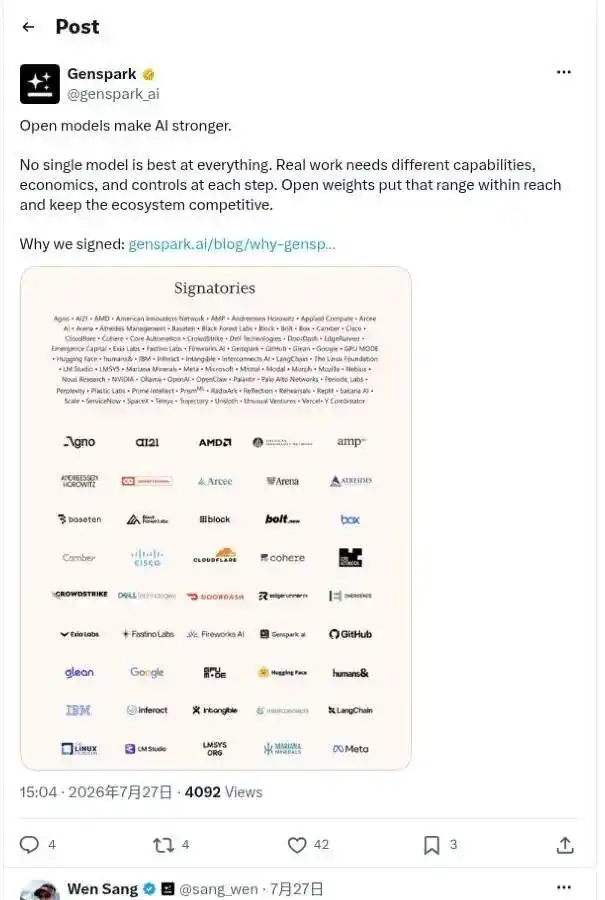
Huang called on the entire AI community to jointly sign an open letter. This letter attempts to persuade US policymakers: open-weight models are not a national security burden, but essential infrastructure for the US to maintain global AI leadership.
The release of this open letter has an indispensable background: the Chinese AI startup Moonshot AI released its open-weight model K3. In multiple tests such as long-term programming, tool calling, deep research, office tasks, and visual understanding, K3 competes in the same tier as the most advanced closed-source models like GPT-5.6 Sol, Claude Opus 4.8, and Claude Fable 5, and even surpasses them on some Agent and programming benchmarks.
This has sparked concern among US AI policymakers: voices calling for a ban on open-weight models from China are incessant—after all, whether it's DeepSeek , Zhipu AI, Moonshot AI, MiniMax , or Alibaba's Tongyi Qianwen , the world's most advanced open-weight model providers are largely from China.
Huang Renxun attempted to curb this spreading policy intent. In the open letter, he emphasized: closed-source models are not inherently safer, and open weights might be the most important path to AI safety. Openness means innovation, competition, and that US technical standards can continue to influence the world.
As of July 30, over 230 companies and organizations had signed the joint letter, including OpenAI and Google, whose main products are closed-source models, who joined at the last minute. Only Anthropic, which advocates banning Chinese open-weight models, refused to sign.
The vast majority of signatories were US companies and a few European companies.Among them was a rather inconspicuous name: Genspark.
In its official website description, Genspark calls itself "an all-in-one AI workspace trusted by millions of users worldwide, serving as a trusted partner of OpenAI and recommended by Anthropic, we integrate cutting-edge technologies from the world's leading AI platforms, offering powerful autonomous AI agents that transform how people work."
It is intriguing in itself: an AI Agent cluster proactively declares itself a trusted partner of OpenAI and a recommended platform by Anthropic, using the brands of Silicon Valley's two leading closed-source model labs for endorsement, yet signs the joint letter initiated by Huang Renxun in support of open weights.
Genspark published a blog post specifically explaining why it signed the open letter.
At the beginning of this short blog, Genspark stated its support for the US's AI leadership position, believing it requires a robust and open ecosystem, and that openness is also the foundation of Agentic AI. Genspark claims its current flagship product, Genspark AI Workspace 6.0, is built upon calling and orchestrating over 70 models, and this model requires the protection of an open-weight ecosystem.
Then, it shifted gears, beginning to criticize the unique risks brought by open weights, and further pointed out that open weights require strict evaluation, safeguards, governance and accountability mechanisms, and robust human supervision, but closure is not the answer.
It's not hard to notice: Genspark's true stance on open weights is vastly different from the position of Huang's open letter and the open model camp; it is actually closer to OpenAI, Anthropic, and Google DeepMind.In other words, Genspark's safety philosophy aligns more closely with closed-source labs, yet publicly signed a joint letter defending open weights.
For Genspark, open weight is not a technological belief to be loyally defended, but a commercial condition that can reduce costs, increase choices, and weaken the bargaining power of upstream suppliers (foundation models). It can agree with the safety concerns of closed-source labs in terms of values, but in terms of business model, it must hope that open models continue to exist.
On the other hand, participating in the signing of the open-weight open letter is a necessary gesture to demonstrate Genspark's stance of influencing US AI policy making and its commitment to promoting US AI leadership. Together with the brand endorsements from OpenAI and Anthropic—two top-tier closed-source AI labs for Genspark—it forms the narrative basis that Genspark is a "US AI company".
Genspark's parent company MainFunc's official website states: This is a Silicon Valley company headquartered in Palo Alto, California, founded by former employees of Microsoft, Google, Meta, YouTube, and Pinterest, with offices in Singapore, Tokyo, and other places.
These are true. Among the six co-founders found in public information, except for the late-joining COO Wen Sang (who holds a Ph.D. from MIT and had 9 years of SaaS entrepreneurship experience), CEO Eric Jing previously worked at Microsoft Research Asia, CTO Kay Zhu, Chief Architect Jiakai Justin Liu, and engineering lead Ray Zhong all worked at Google. Co-founder Lenjoy Lin worked at Google, YouTube, and Pinterest successively.
What is better known in the industry is: Genspark's two most important co-founders, Eric Jing and Kay Zhu, both worked at Baidu before founding this company. However, in Genspark's external introductions, this experience has been systematically downplayed.
Eric Jing previously served as Vice President of Baidu and CEO of Xiaodu Technology; Kay Zhu previously served as Chief Architect of Baidu Intelligent Assistant and CTO of Xiaodu Technology. Before founding Genspark, Eric Jing had no long-term work experience in the US, while Kay Zhu worked at Baidu's US Research Institute in Silicon Valley. In November 2023, the two co-founded MainFunc, initially in Singapore, and soon moved to Silicon Valley, US.
The professional social profiles of the several co-founders do not deliberately hide their experience at Baidu, but in media interviews, this experience is often vaguely stated or directly omitted. However, mainstream Western media like Reuters and Bloomberg never forget to "complete" this part of the information for them.
In an interview about financing, Genspark's current main spokesperson, COO Wen Sang, introduced Eric Jing as: "My co-founder who built a company before this from zero to $5.5 billion", rewriting Eric's experience of incubating and later independently financing Xiaodu within Baidu into an entrepreneurial story almost completely detached from the Baidu background.
In contrast, Dario Amodei, co-founder of Anthropic, who consistently advocates strict restrictions on China's access to advanced chips and cutting-edge AI capabilities, has been quite candid about his brief tenure at Baidu's US Research Institute. He has mentioned that period multiple times to the media, saying it was during his work on speech recognition at Baidu's lab that he observed the sustained gains from the simultaneous scaling of models, data, and compute.
For Genspark's main founders, their mention of this Baidu experience is far more sparing than Dario Amodei's.
The "Foreign Guest" from Silicon Valley
Multiple practitioners from Chinese frontier model labs, AI Agent startups, and investment institutions told us: during visits to Silicon Valley, Genspark was one of the hardest AI startups for them to approach.
These individuals can usually meet with researchers and product leaders from NVIDIA, OpenAI, Google DeepMind, Meta, Thinking Machines Lab, and even Anthropic through colleagues, investors, or academic networks, to exchange ideas on models, Agent engineering, and AI industry trends. Infrastructure companies like Fireworks AI and Together AI, co-founded by Chinese in Silicon Valley, also frequently discuss adaptation, deployment, and business cooperation with visiting Chinese model and application teams.
As open-weight models from China like DeepSeek , Qwen, Kimi , GLM, and MiniMax continue to expand their influence in Silicon Valley's entrepreneurial ecosystem, such exchanges have become more frequent over the past year. For model platforms, inference service providers, and Agent companies, Chinese open models are no longer just an external variable to observe, but a part of the actual supply chain.
Genspark is an exception.
Multiple individuals who have tried to contact Genspark told us that scheduling meetings with core founders like Eric Jing and Kay Zhu was very difficult. Some requests were politely declined on the grounds that the team was focused on product development; others received no clear response for a long time.
A similar sense of distance also exists between Genspark and the Silicon Valley Chinese entrepreneurial community.
The basic consensus among Chinese companies and community organizations involved in organizing Bay Area AI events is: inviting Genspark co-founders to give speeches or participate in panels usually requires more communication effort than inviting founders from other startups of similar scale. Especially when the event's name or positioning clearly carries "China" or "Chinese" attributes, the success rate of invitations is even lower.
Even if they eventually accept the invitation, Genspark is often not satisfied with being arranged as ordinary panelists. Multiple event organizers said the team had requested adding an independent 20-30 minute product demo or keynote speech outside the original agenda, and suggested adjustments to fellow panelists, session design, and speaking order.
These requests themselves are not incomprehensible. Startups attending events naturally hope for product exposure. But in Silicon Valley community events that rely on equal exchange and mutual support, this practice of turning every appearance into a controlled brand showcase can feel awkward to organizers.
After the event, this distance persists. Unlike other speakers who actively post photos, thank organizers, and introduce fellow entrepreneurs, Genspark's official social media accounts rarely proactively promote these Chinese community events, usually limited to likes, reposts, or polite interactions.
The above individual cases are insufficient to prove that Genspark has a unified "avoid Chinese community" policy internally. But together they present a highly consistent experience: For Chinese events that require equal participation and where the agenda cannot be fully controlled, Genspark appears cautious or even aloof; for commercial conferences that can provide clear brand benefits, independent stages, and international endorsement, its investment is much more active.
Since 2025, this difference has taken on a more public and easier-to-verify side.
Genspark became the Super Platinum Sponsor of the MIT AI Conference 2025. This was not an academic conference held on the MIT campus, but an industry conference promoted by MIT alumni entrepreneurial organizations and held at the Computer History Museum in Mountain View, California. The organizer, when announcing the sponsorship, highlighted Wen Sang's MIT Ph.D. background, Genspark's claimed revenue growth rate, and the customer case endorsements given to it by OpenAI and Anthropic.
Genspark's social media actively reposted this event, with likes and replies just over a dozen.
As Genspark's COO and co-founder, Wen Sang also entered the conference agenda, discussing on stage with entrepreneurs like Tim Shi, co-founder of Cresta, and Ramin Hasani, CEO of Liquid AI. Attendees came from Microsoft, Adobe, Replit, Spotify, and several US startups.
Subsequently, Genspark became the Co-Working Sponsor for Step Dubai 2026 and was listed as a sponsor and showcase partner for AI Summit Seoul 2026. Meanwhile, its co-founders have appeared at events like RAISE Paris, VentureBeat Transform, AI Dev, and Microsoft Ignite.
This constitutes a stark resource allocation: facing invitations from Chinese entrepreneurial community events, Genspark emphasizes busy R&D, attempts to control the agenda, and demands conditions like demo showcases; while facing commercial conferences that can provide global brand endorsement—even if the guest caliber and quality are not top-tier—it is willing to either purchase sponsorship or actively amplify the speech effect on official social media, while posting photos of co-founders with various globally renowned figures attending.
At mainstream international conferences, it is willing to take the stage as a Silicon Valley AI company from Palo Alto, endorsed by OpenAI and Anthropic; when facing peers from China, it usually refuses; and when facing the Chinese community also in Silicon Valley, it behaves more like a "foreign guest" who needs to be formally invited, arranged an independent stage, and whose fellow panel lineup is carefully confirmed.
Genspark's "foreign guest" posture is also reflected in how it cooperates with large language models from different camps.
On the list of US companies and institutions that signed the joint letter by Huang Renxun supporting open-weight models, most are active collaborators with open-weight models. They are certainly aware that the vast majority of open-weight models come from China, but this does not stop them from proactively announcing partnerships with these models on Day 1 or even Day 0 as soon as their weights are released.
Taking Moonshot AI's K3 model as an example, signatory companies like Vercel, Fireworks AI, Together AI, and Nebius all announced integration with K3 at the first opportunity. For inference platforms, cloud service providers, and development tools, the ability to complete deployment at the first moment a model is released is proof of technical capability and market competitiveness. It doesn't matter if the model comes from San Francisco, Paris, or Beijing; if developers need it, it should be provided as soon as possible.
Genspark's reaction, however, is completely different.
As of now, Genspark has not publicly announced direct integration with K3 like Vercel, Fireworks AI, Together AI, and Nebius did; its official social media has not congratulated Moonshot AI on the model release, nor described the two as partners.
This contrasts sharply with its behavior when facing US closed-source models: after the releases of GPT-5.6 Sol and Claude Opus 4.8, Genspark promptly announced integration and bundled the new model's capabilities with its own product updates for promotion.
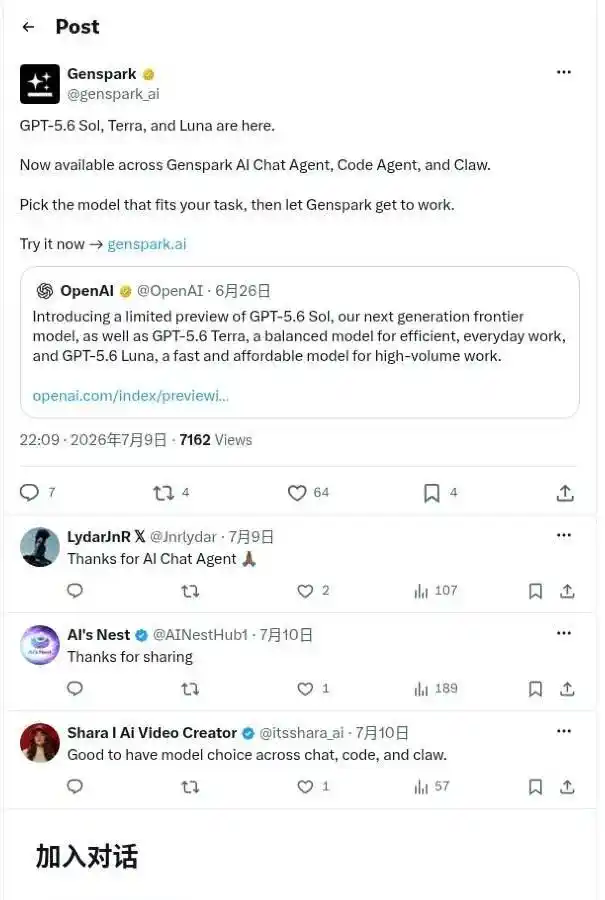
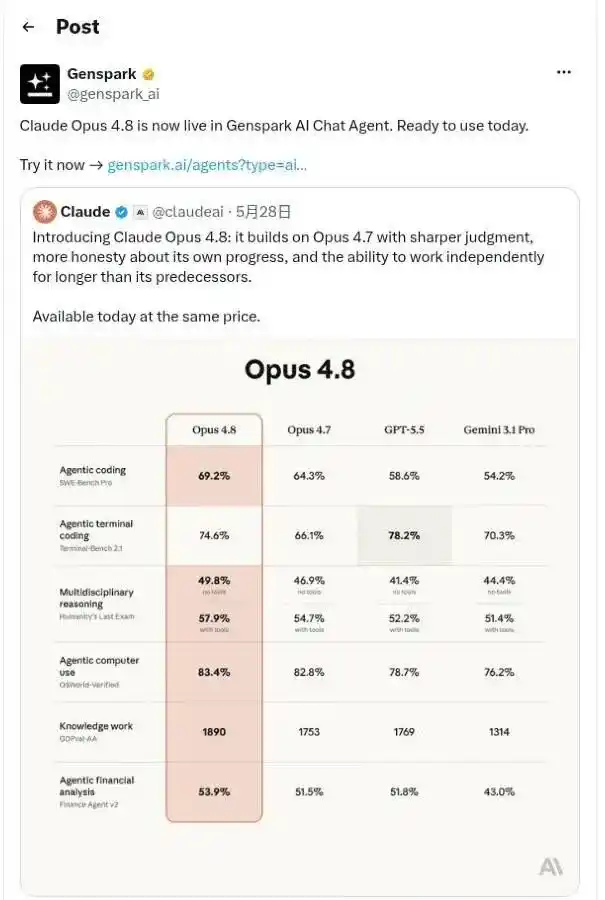
Genspark's eagerness to integrate and co-market with OpenAI and Anthropic's flagship models is as cheerful and impatient as Chinese video Agent teams like LibTV and OiiOii announcing integration with ByteDance's Seedance 2.0 at the first opportunity. It has never shown such enthusiasm towards Chinese open-weight models.
However, back in January 2025 when Genspark's main product was still AI search rather than an Agent cluster, it did mention on social media having integrated the then-popular-in-Silicon-Valley DeepSeek -R1, though at that time AWS, Windows Azure, and Genspark's main competitor at the time, Perplexity, had already announced integration with R1; it was merely following suit.
Kimi has not been entirely absent from Genspark's products. When previously releasing AI Developer, Genspark once listed " Kimi + Groq" in its model list, but this is closer to calling the Kimi model via third-party inference platforms like Groq, rather than establishing a direct API partnership with Moonshot AI.
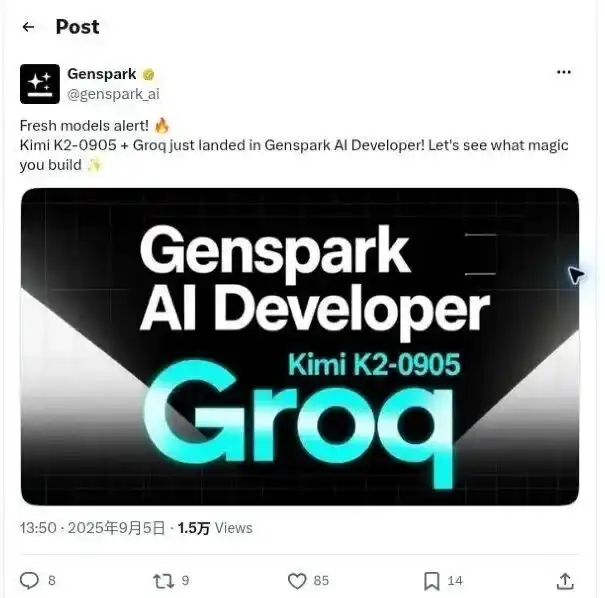
Direct API partnerships usually mean the model company and the application side establish a one-to-one integration relationship. Both parties coordinate on product releases, model updates, performance optimization, and even brand exposure. The model provider also lists the application as a "partner" or "integration case" on its official website or social media, gaining clear visibility and an ecosystem position.
Integration via third-party inference platforms like Groq is more like "relay usage"—the model is first deployed at the infrastructure layer, and then the platform provides unified inference capabilities. The application calls the platform's interface rather than the model company's native API, thus the model source is weakened or even hidden; it's difficult for the outside world to perceive the model company's direct involvement from the product level.
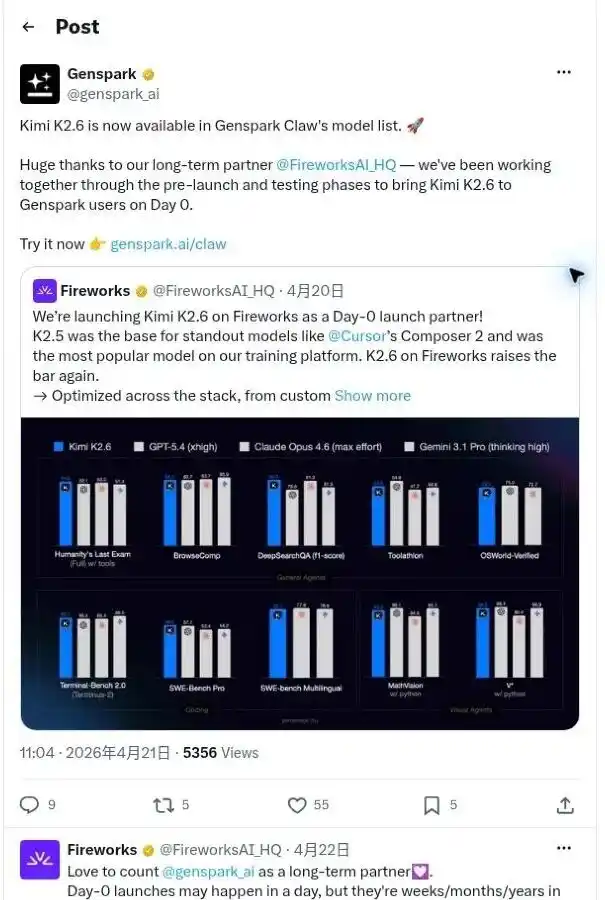
Genspark's official announcements have mentioned capabilities like integrating Moonshot AI's K2.6 model via Fireworks, also clearly stating it's accessed through Fireworks AI's inference platform, not direct integration. Genspark and Kimi 's official social media respectively thanked the cooperation with Fireworks, but there was no interaction between each other.
It's worth mentioning: Genspark and Moonshot AI are both companies invested in by Singaporean VC Lanchi Capital. Lanchi Capital has invested in numerous Chinese AI startups, yet in Genspark's official external disclosures of its investors, it has consistently been "invisibly" handled.
Based on Genspark's public claim that its Agents orchestrate over 70 models, it's not difficult to infer that most open-weight models from China are on Genspark's integration list. It's just that Genspark prefers to orchestrate them via inference service providers like Groq, Fireworks, and Together AI, which are based in the US, rather than wanting to be associated with them in terms of brand.
Chinese open-weight models can help Genspark reduce inference costs, increase model choices, improve the flexibility of multi-model orchestration, and even become an important part of product capabilities, but being an indirect supply chain component is their "proper role"; it's best not to appear in Genspark's circle of friends.
Genspark's "circle of friends" belongs exclusively to OpenAI and Anthropic, and sometimes also to Microsoft.
On May 19, 2026, Genspark CEO Eric Jing specifically showcased a bottle of wine from OpenAI and a thank-you note on X, publicly thanking "Sam, Greg, and Denise."
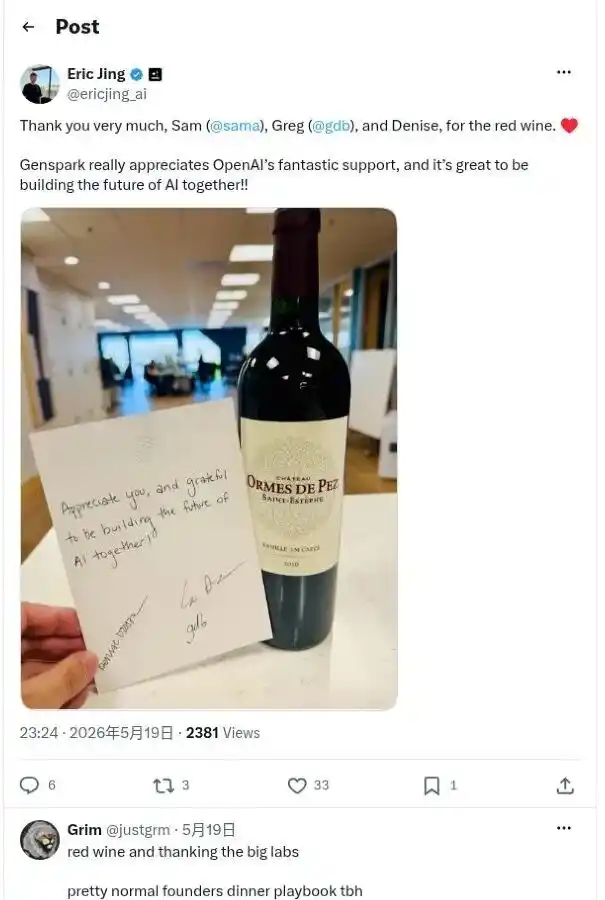
Sam Altman and Greg Brockman are OpenAI's two co-founders, serving as CEO and President of OpenAI respectively, which is widely known. Denise's full name is Denise Dresser, OpenAI's Chief Revenue Officer.
Combined with the thank-you note without a letterhead, it's not hard to infer: this is a standard gift from OpenAI's leadership to customers purchasing a certain scale of tokens, with no special indication.
However, individuals familiar with how this bottle of wine was given to Eric Jing revealed to us: that day, Eric Jing and his colleagues visited OpenAI's headquarters. The reception was handled by several Chinese engineers from OpenAI, and the two sides engaged in a courtesy conversation for about one to two hours. Upon parting, Eric Jing and his team received this gift.
Yet in Eric Jing's tweet, he referred to the three prominent figures from OpenAI as if they were acquaintances.
Eric Jing later wrote: Genspark is very grateful for the "amazing support" provided by OpenAI and said both sides are "building the future of AI together." This post is still visible on X.
He tagged two of the three executives in the post; no one replied. This significantly diminished the sense of unspoken familiarity he tried to create. Among the sparse comments below, a Genspark user posted a picture, accusing Eric Jing of "cheating loyal consumers with problematic credit systems."
But undoubtedly, Genspark is a significant customer of OpenAI and Anthropic, and indeed, because of this monetary relationship, has received a certain degree of brand endorsement from these two top-tier labs.
In October 2025, the OpenAI Developer Conference was held in San Francisco. Sam Altman announced in his keynote the list of customers whose API calls had exceeded one trillion tokens and thanked them. Among them were Genspark and CTO Kay Zhu's names, ranked 28th.
Kay Zhu immediately posted on LinkedIn, saying: "Never imagined one day seeing my own name in Sam's keynote." He then excitedly announced: MainFunc (Genspark) has "officially become a TRILLION-token company," while showcasing the physical commemorative plaque given by OpenAI.
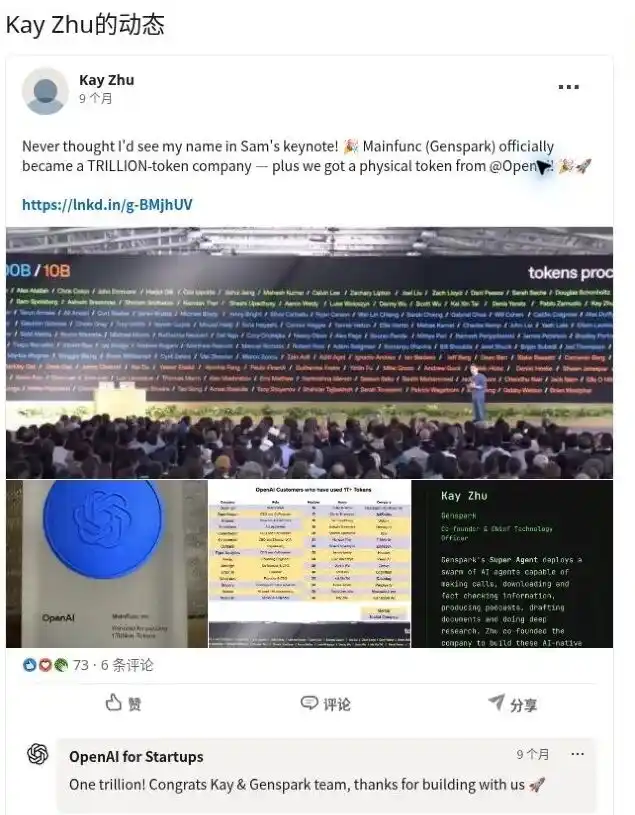
The so-called "trillion token club" proves that, as of the statistical point, Genspark's OpenAI API organization had processed at least one trillion tokens, reflecting a substantial actual call volume. It first proves procurement scale and usage intensity, not technical prowess, and cannot even prove it all came from real end-user consumption.
But in Kay Zhu's narrative, what's truly worth boasting about isn't just that Genspark consumed one trillion tokens, but that the company name appeared in Sam Altman's speech and received a tangible OpenAI token that could be photographed and displayed. A milestone recognition from an upstream supplier for a major customer was thus transformed into proof of Genspark's entry into Silicon Valley's AI inner circle.
Genspark's brand association with Anthropic is even more systematic.
Anthropic not only published a Genspark customer case on its official website but also listed it in the "Powered by Claude" partner list. Its official case directly describes Claude as the core of Genspark Super Agent: Claude is not only responsible for deciding the next action among over 150 tools but also handles multi-model solution summarization and final code generation.
Anthropic's case page even incorporated Genspark's claimed revenue scale, product architecture, and engineering efficiency, providing a comprehensive set of technical and commercial endorsements from a frontier model lab. The essence of this narrative structure is: without the support of Claude series models and engineering capabilities, Genspark is nothing.
Genspark promoted this far beyond an ordinary customer case. The official account called the relationship an "Incredible partnership." Co-founder Lenjoy Lin publicly thanked this "amazing partnership" under Anthropic's post, and Kay Zhu became the protagonist in Claude's official content series "The Problem Solvers."
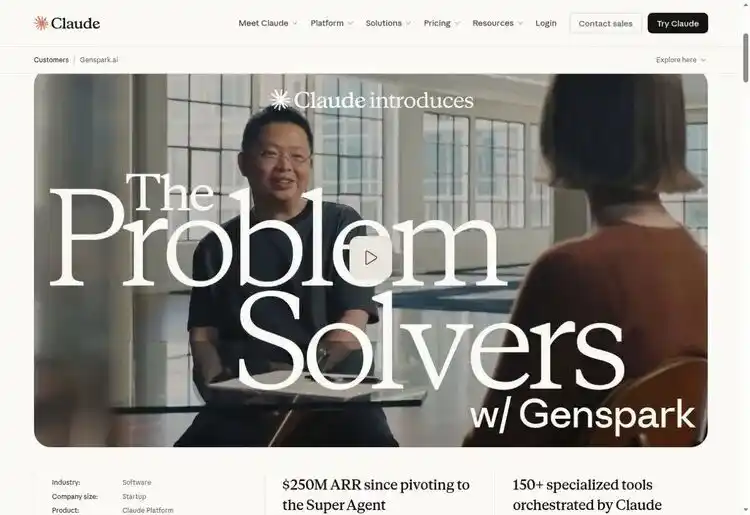
In this video interview released by Claude's official channel, Genspark was directly introduced as "an all-in-one AI workspace built on Claude." Kay Zhu also repeatedly emphasized the "deep mutual trust" and "very tight feedback loop" between the two sides.
This customer interview video was live-streamed by Genspark's social media right from the start of filming, specifically highlighting "currently at Anthropic's office."
Anthropic indeed promotes Genspark as a representative customer publicly, presumably because of the money. What we understand is: the scale of Genspark's procurement and calls to the Anthropic API is no less than its consumption with OpenAI.
On the customer lists of OpenAI and Anthropic, "super customers" like Cursor, GitHub Copilot, etc., contribute at least hundreds of millions of dollars in annual revenue to these two frontier model companies respectively.
Based on Genspark's publicly disclosed token call volume, Claude's claim of its core position in Genspark's product architecture, and estimates of Genspark's claimed revenue scale: Genspark currently likely pays between $25 million and $60 million annually for OpenAI and Anthropic models, with Anthropic possibly receiving slightly higher revenue than OpenAI.
Microsoft plays an even more flexible role in Genspark's "circle of friends."
In November 2025, Genspark announced its entry into the Microsoft ecosystem as a launch partner for Microsoft Agent 365. Later, it unilaterally announced upgrading the cooperation to a "global strategic partnership," planning to embed its Agents into Word, Excel, PowerPoint, Microsoft 365, and Agent 365, and enter the enterprise market via Microsoft Marketplace.
Microsoft also introduced Eric Jing and Genspark in an official feature article, emphasizing that Azure provides infrastructure for its multi-model orchestration while helping this startup, which lacks large enterprise sales capabilities, reach Microsoft's enterprise customers.
Genspark announced this cooperation during Microsoft's Ignite 2025 conference. Interestingly, another Chinese-background general Agent startup—Manus's co-founder Tao Zhang—was invited to share on the main stage as an Agent partner at this conference.
This did not affect Genspark's promotion schedule. During the conference, Genspark COO Wen Sang took a photo with Microsoft CEO Satya Nadella, immediately praised this "world-class leader" on social media, and announced the expectation to further deepen cooperation between Microsoft and Genspark. The company also repeatedly emphasized in press releases, website introductions, and media materials that the founding team came from Microsoft and highlighted Eric Jing's career experience participating in Bing's creation.
These materials, repeatedly combined by Genspark, create a clear identity effect: Eric Jing is not just a founder who purchased Azure and integrated with Microsoft Agent 365, but is portrayed as a "Microsoft veteran" returning to the Microsoft ecosystem and recognized by the former Silicon Valley giant.
It must be acknowledged: Genspark never fabricated its cooperation with OpenAI, Anthropic, and Microsoft. They are real and have clear commercial value—OpenAI and Anthropic gained a rapidly growing API customer; Microsoft gained an Agent 365 application partner; Genspark gained model capabilities, cloud infrastructure, and enterprise distribution channels.
But this never means the relationship between the giants and Genspark is as equal and inseparable as the company itself describes.
Facing US tech giants, Genspark hopes every procurement, integration, customer case, executive photo, even a bottle of wine, is seen to the greatest extent and interpreted at the level of a strategic partnership.
But facing Chinese open-weight model companies, even when their models are already in its product, the ideal state Genspark anticipates is: "only the model capabilities remain; the developer's name, the company's brand, and the relationship between the two are all hidden."
Genspark refuses to define itself in any way using the source of Chinese technology, but in fact, this cannot truly be achieved.
Although almost no traces related to China can be found in Genspark's official website description and public communications, and it does not directly serve users in mainland China, it's hard to say that its continuously rising annualized revenue, now reaching $250 million, contains no contribution from Chinese clients at all.
The problem first lies in scale.
Compared to companies like Duolingo, OpenRouter, Shopify, Salesforce, Notion, and T-Mobile, which rank ahead of Genspark in OpenAI's "trillion token club," Genspark lacks matching public user scale and a sufficiently large enterprise customer list.
AICPB data shows that starting from March 2026, Genspark's website monthly visits dropped from 21.84 million to 12.15 million in June, a cumulative decrease of about 44%. Yet during the same period, Genspark's claimed annualized revenue rapidly increased from $200 million on March 12 to $250 million on April 8.
Website traffic certainly does not equal revenue. Enterprise clients, high-priced plans, annual contracts, and desktop products can all decouple revenue growth from web traffic. But when a product-driven growth AI startup increases annualized revenue by $50 million within a month while user visits continuously decline, what truly deserves questioning is not just how many people are using Genspark, but who is paying Genspark.
Multiple individuals familiar with the Chinese AI industry and cross-border AI supply chains mentioned a possibility to us: some Chinese companies unable to directly procure API services from OpenAI, especially Anthropic, but wishing to use US frontier model capabilities in their own products, are using Genspark as an indirect "transit" channel.
This transaction may not manifest as a simple resale of API keys. A more realistic approach is for Genspark, as a US company entity, to procure model services, then package the model capabilities into custom interfaces or hosted solutions for sale to downstream clients.
If such transactions indeed exist, several anomalous numbers for Genspark receive another explanation: it can continue to increase annualized revenue while website traffic declines, and consume more tokens despite limited public user scale; service fees paid by Chinese clients to Genspark can be counted into its recurring revenue, and the model calls generated continue to accumulate under Genspark's name.
As of now, we have not obtained contracts and bills that can fully reconstruct such transactions. But sources from different channels gave similar descriptions of this cooperation method.
Legally, Genspark is a US company, not in regions publicly restricted by OpenAI and Anthropic. For the two upstream model companies, it is a US customer headquartered in Palo Alto with massive call volume and astonishing growth. As for whose products the model capabilities ultimately enter and who actually uses them after passing through Genspark's Agents and enterprise services, it's difficult for outsiders to discern from API call volume and customer cases.
OpenAI and Anthropic certainly have the ability to further audit end users and application scenarios. But facing a key customer who has entered the trillion token club and may contribute tens of millions of dollars in annual revenue, audit standards, commercial interests, and customer relationships are never completely independent, especially when these two top AI companies need revenue growth to sprint towards IPO.
Cheetah Mobile's history provides a thought-provoking reference. It was once one of Facebook and Google's most important advertising agents and traffic partners in China. CEO Fu Sheng attended Facebook client breakfast meetings and publicly took photos with then Facebook COO Sheryl Sandberg. Yet this "close" relationship did not change the real positions in the industry chain: starting late 2018, Facebook and Google successively severed Cheetah Mobile's accounts, citing reasons like click injection hijacking ads and intrusive ads.
On the surface, Genspark tries hard to distance itself from China. Chinese model companies are not allowed into its circle of friends; Chinese investment institutions rarely appear in its financing narrative; Chinese peers find it difficult to gain the same public interaction with it as with US tech companies. But behind this carefully maintained "US company" image, Chinese models, capital, and potential "clients" may never have truly left.
In a sense, the harder Genspark tries to prove it has nothing to do with China, the more it deserves questioning: is this deliberately hidden relationship merely a past it is unwilling to mention, or is it still generating revenue for it in the present?
AI Costco, Clone Maniac, and Ad Machine
It must be admitted that Genspark is not just a "shell" company where co-founders and executives post photos with AI celebrities on social media, deliberately exaggerate "close relationships" with Silicon Valley giants, and on the surface deliberately distance themselves from anything Chinese while secretly maintaining connections.
It possesses product replication, engineering integration, and commercial advertising capabilities rare among Silicon Valley AI startups. These scarce and crucial capabilities indeed allow Genspark to stand out among general Agent products, often making its peer Manus feel acutely uncomfortable, and leaving its former competitor Perplexity far behind.
But all of this is completely unrelated to the Silicon Valley attributes and US business world it strives to associate with. In spirit, Genspark is utterly disconnected from the country it claims to be rooted in. Its spiritual world leads directly to the wild early days of the Chinese internet, an era completely built on jungle rules. Once a certain AI product form gains market validation, or even before users embrace it, Genspark can rapidly deconstruct its functions, integrate existing models and tools, and launch a sufficiently similar, more aggressively priced Genspark version incorporated into a unified subscription system in an extremely short time.
It has never invented any new product concept but is always the fastest to move hot concepts into the same "AI supermarket." From AI search, general Agent, Slides, Sheets, Docs, Browser, Developer, Designer, voice input, email assistant, to Claw, SecondBrain, and the AI recording card almost replicating Plaud... Genspark's core capability has never been technical barriers but the continuous observation of the market, rapid follow-up, batch shelving, and then bundling these products for sale using low prices, multi-model routing switching, and large-scale advertising.
In the most prominent position on the membership benefits page, Genspark directly writes: "Genspark is the AI Costco. We select the best for you."
Genspark is the Costco of AI, it then claims: packing all cutting-edge models and all AI Agents into the same membership system, so users no longer need to pay separately for ChatGPT, Claude, Lovable, Perplexity, and Typeless.
Eric Jing also repeatedly used this phrase on social media. As early as November 2025 when Claude Opus 4.5 was released, he described Genspark as the "AI Costco" that selects the best models for users, emphasizing that buying just one subscription is enough. Later, the company's website upgraded this phrase to the core slogan of its membership product and reminded users again at the end of the page: "You found the AI Costco."
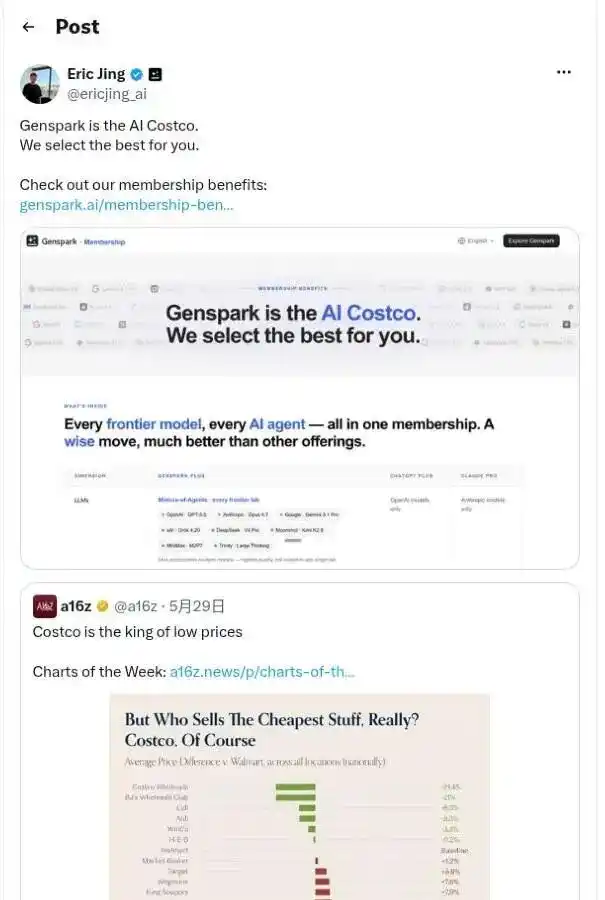
This is indeed a somewhat genius, precise metaphor: if OpenAI and Anthropic are producing the "raw materials" of the AI era, then Genspark is the Costco downstream of them: rarely inventing the goods on the shelves, but skilled at procurement, repackaging, bulk display, and making consumers feel that buying one membership card means owning the entire AI world.
It bulk purchases tokens from OpenAI, Anthropic, Google, and multiple open model companies, packaging over 70 models, 80+ tools, and 20+ data sources into one subscription account. Users don't need to separately buy ChatGPT, Claude, Gemini, Midjourney, Gamma, Cursor, Lovart , Wispr Flow, and NotebookLM; they just need to buy credits from Genspark to generate slides, documents, spreadsheets, images, videos, podcasts, and code, call browsers, handle emails, attend meetings, make calls, or have an "AI employee" named Claw work for them 24/7.
This is Genspark's value most easily understood by consumers and most likely to generate revenue: it may not be the best in any single category, but the shelves are long enough, the products numerous enough, and the membership price seems cost-effective enough.
Someone in the VC world joked to us: Genspark is an upgraded LibLib Pro across the ocean.
More interestingly, as an AI Costco, new products in this warehouse often hit the shelves shortly after others' products become hot sellers.
At the end of May 2024, Perplexity launched Perplexity Pages, which organizes search results into complete pages. A few weeks later, Genspark released Sparkpage, centered on automatically generating web pages, as its first product, officially entering the AI search market.
In March 2025, Manus gained popularity with its general Agent capable of autonomously decomposing tasks, calling tools, and delivering complete results. Less than a month later, on April 2, Genspark shut down its original AI search product and launched Super Agent with highly similar functional structure and product positioning, rapidly redefining itself as a general Agent company.
Subsequently, this product machine began expanding its shelves at a pace of almost once a week.
On April 22, AI Slides launched, entering the AI presentation market already validated by Gamma, Canva, and Manus; AI Sheets launched on May 8, AI Drive and Download Agent on May 15, Google Workspace integration began in early June, and AI Browser was released on June 10—almost in the same time window when Dia opened beta and Perplexity was preparing to launch Comet.
On July 2, Genspark released AI Docs; on July 9, it launched AI Pods, which can generate professional podcasts based on prompts, a product form easily reminiscent of the already popular NotebookLM with its Audio Overviews; on August 14, it launched AI Developer after Cursor, Claude Code, Lovable, Bolt, and Replit had already educated the market; a week later on August 21, it launched AI Designer less than three months after Lovart released its AI Design Agent.
Genspark's executives are not entirely "invisible."
Multiple domestic and Silicon Valley Chinese entrepreneurs sighed to us that they sought meetings with Eric Jing, hoping to learn product operations and go-to-market experience in the English-speaking world from him. Soon after being granted a meeting, Genspark released a new component completely matching their demo's functions and even interface. And often these young entrepreneurs' demos had not yet officially launched or been released.
Of course, there are also cases of perfect replication without needing to meet the founder.
At the end of July 2025, YanYu Technology, the parent company of LibLib, was about to officially launch its overseas visual design tool Lovart in San Francisco, after two months of public beta with invitation codes on X. YanYu's founder Chen Mian really wanted to meet Eric Jing for advice; an introduction via others was declined by Eric with "focusing on product, let's schedule later." Four weeks later, Chen Mian saw Genspark's AI Designer.
By 2026, this "following" had progressed from the functional level to the naming level.
In January, Genspark released Speakly, focusing on voice input; its naming can hardly not remind people of the already rapidly growing Wispr Flow and Typeless; simultaneously launched AI Inbox Workflow also entered the email Agent market already contested by Shortwave, Lindy, and others.
OpenClaw appeared as Clawdbot in late 2025 and became one of Silicon Valley's hottest open-source Agent projects in early 2026. On March 12, Genspark launched Genspark Claw running on a dedicated cloud computer, not only retaining the most recognizable name "Claw" but also adopting the core interaction method of assigning tasks to a 24/7 online Agent via instant messaging tools. The difference is OpenClaw requires users to deploy themselves, while Genspack packaged it into a paid, hosted, click-to-use commercial product.
Any "closeness" between Genspark and other AI products could be explained as industry consensus. AI companies simultaneously entering browser, code, document, design, and voice markets is not enough in itself to prove who "copied" whom. And Genspark does add its own multi-model orchestration, tool calling, and Agent execution capabilities to existing categories, which not everyone can do.
However, when such deliberate "closeness" appears consecutively in release timing, product naming, interface form, feature combination, and even market rhetoric, "industry consensus" increasingly resembles a well-trained product strategy: wait for a category to be validated by other companies, then create a Genspark version in an extremely short time, stuff it into the existing subscription, and announce it as a "world first"—WORLD FIRST.
"WORLD FIRST" has almost become a fixed phrase in Genspark's product blogs.
From the world's first asynchronous Agent, the world's first data search Agent, to the world's first fully Agentic download Agent, the world's first one-sentence-generate-any-document AI Docs, adding a new shelf, Genspark reinvents "world first" each time.
This is not something a simple "clone company" can achieve. Cloning is just the surface; the real capability behind it is a highly industrialized product assembly line: calling existing models, integrating existing tools, reusing unified accounts, credits, storage, and Agent frameworks, then using AI to generate most of the code, completing new feature assembly and launch in extremely short cycles.
Competitors need to build a company around one product; Genspark tries to cover the entire Product Hunt with one company.
What truly makes the "industry convergence" explanation seem strained is Genspark's hardware product launched in July 2026: SecondBrain Note—what it calls Genspark Note.
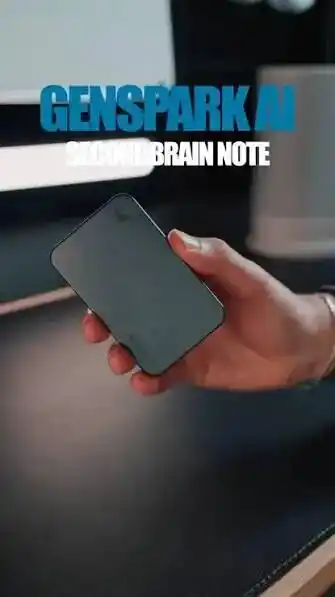
This is an ultra-thin AI recording card that attaches to the back of a phone via magnets: supports face-to-face meetings and phone call recording, automatically completes transcription, summarization, and information extraction, then syncs content to Genspark's SecondBrain. It's about 2.9mm thick, weighs 26 grams, offers 64GB storage, can record continuously for up to 35 hours, with a launch price of $179.
It is almost a photocopy of Plaud Note.
Plaud launched the credit-card-shaped, MagSafe-attached Plaud Note back in 2023; the Plaud Note Pro released in 2025 also focuses on dual-mode meeting & phone recording, AI transcription and summarization, with a body about 2.9mm thick, built-in 64GB storage, and also priced at $179.
The two not only solve the same problem but even hardware form, usage method, core functions, size parameters, storage capacity, and price anchor seem to come from the same product requirements document.
If Genspark's AI Slides, AI Developer, and AI Designer can still be explained as startups collectively chasing hot software sectors, SecondBrain Note can hardly be lightly dismissed with this reason.
From the product level visible to consumers, Genspark almost moved the entire product definition already validated by Plaud onto its own shelf, then connected it to SecondBrain, email, calendar, and Agent systems in the backend, packaging "being able to continue executing tasks after recording" as its differentiation.
Plaud spent years making AI recording cards a category; Genspark, with one product launch, brought the category into its membership warehouse.
How is this achieved? This assembly line is so complex and large; does it really not require that many engineers? Genspark's LinkedIn page shows the company has only dozens of employees, mostly in the San Francisco Bay Area except for a few in Japan, with an extremely limited number of engineers, many hired after 2026.
An industry insider revealed to us that in the second half of 2025, an investor in Manus expressed confusion about Manus maintaining a team of 100 people, over half engineers, after moving to Singapore, saying Genspark only has 20-30 people, very few full-time engineers, so why is its product expansion capability so strong?
Manus co-founder and CEO Xiao Hong had to "plead" in explanation: Genspark definitely has more than 20-30 people.
According to our understanding: as a "US company" claiming to be founded by former employees of Microsoft, Google, Meta, YouTube, and Pinterest, headquartered in Palo Alto, California, with offices in Tokyo and Singapore, Genspark's actual "engineering team" consists of dozens of people working in the Zhongguancun area of Haidian District, Beijing.
In other words, Genspark across the ocean has been conducting Costco-like product assembly line, engineering replication through a shadowy "affiliated company." Genspark co-founders including Eric Jing and Kay Zhu frequently appear at this company's office.
Genspark externally boasts an extremely small, highly efficient "US team," but what truly supports this product machine's continuous operation may never be the people in the public organizational chart, but a Chinese R&D system deliberately isolated outside the company's structure and narrative.
Silicon Valley is Genspark's display window; Zhongguancun is its undisclosed factory.
If Genspark's front end is an AI Costco and its back end is a never-stopping cloning machine, then outside the warehouse and machine, Genspark also places a powerful "megaphone."
Genspark repeatedly tells a legendary growth story: before reaching $100 million ARR, the company didn't spend money on advertising; growth came almost entirely from product and word-of-mouth.
This claim cannot withstand scrutiny.
Genspark might not have purchased expensive traditional brand ads like Super Bowl or New York subway before reaching $100 million ARR, but it was certainly not without paid marketing.
As early as the beginning of 2025, promoted tweets with "Ad" labels purchased and distributed by Genspark appeared on X; Instagram and LinkedIn also saw creator content marked "ad," "sponsored," and "WorkWithGenspark."
Genspark also publicly launched an affiliate marketing program in September 2025, promising to pay referrers 20% commission per transaction. Related investigations show the company had already organized a content network of over 60 creators by early 2025. These creators were internally called "interns" but were actually paid per video, generating about 20 million TikTok and Instagram plays for Genspark within two weeks.
The cleverness of this approach lies precisely in that it doesn't look like advertising. Creators publish product reviews, feature demos, and experience videos like "accidentally discovered an amazing AI tool" from personal accounts, with commercial relationships sometimes only disclosed via inconspicuous tags. Paid promotion is thus packaged as user-generated recommendations, and concentrated distribution appears as products suddenly "going viral organically" on social media.
So, Genspark's so-called "no advertising before $100 million ARR" more accurately means: no expensive and conspicuous traditional brand advertising before that point.
It's just that after $100 million ARR, it no longer hides being an advertising machine.
In February 2026, Genspark purchased two 30-second Super Bowl ads at once, featuring Matthew Broderick, star of "Ferris Bueller's Day Off." Based on the market price of over $8 million per 30-second Super Bowl ad that year, TV media costs alone could exceed $16 million, not including celebrity, production, agency, and subsequent promotion costs.
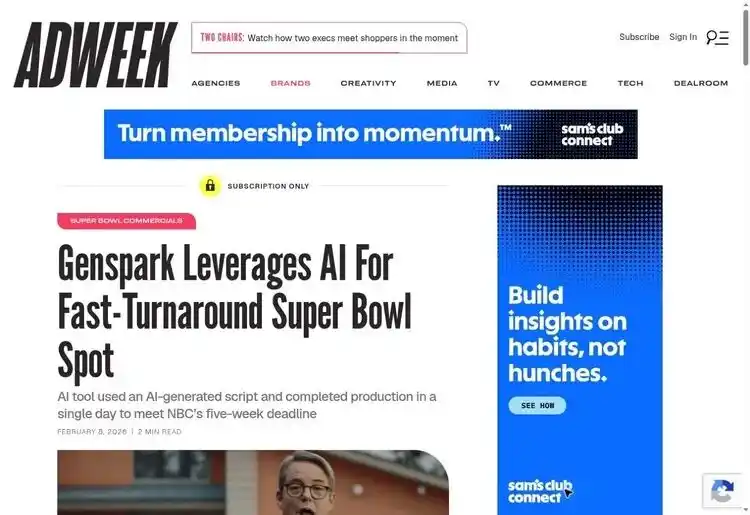
The company later claimed website traffic grew 10 times overnight after the ad aired. Genspark COO Wen Sang described this ad buy as a bold experiment completed in an extremely short time and repeatedly told this story in podcasts, interviews, and on social media.
After the Super Bowl, Genspark rolled ads into the New York subway.
Genspark excitedly announced on official social media: "We took over the NYC Subway," saying Genspark is bringing AI to "the city that never stops working." One ad had only one extremely concise line: "JOB DONE."
But New Yorkers added another interpretation for it.
Someone added the letter "G" before "DONE," changing the entire ad to "JOB GONE"—jobs lost. A single-letter graffiti transformed Genspark's original promise of efficiency and automation into public outcry against AI replacing jobs.
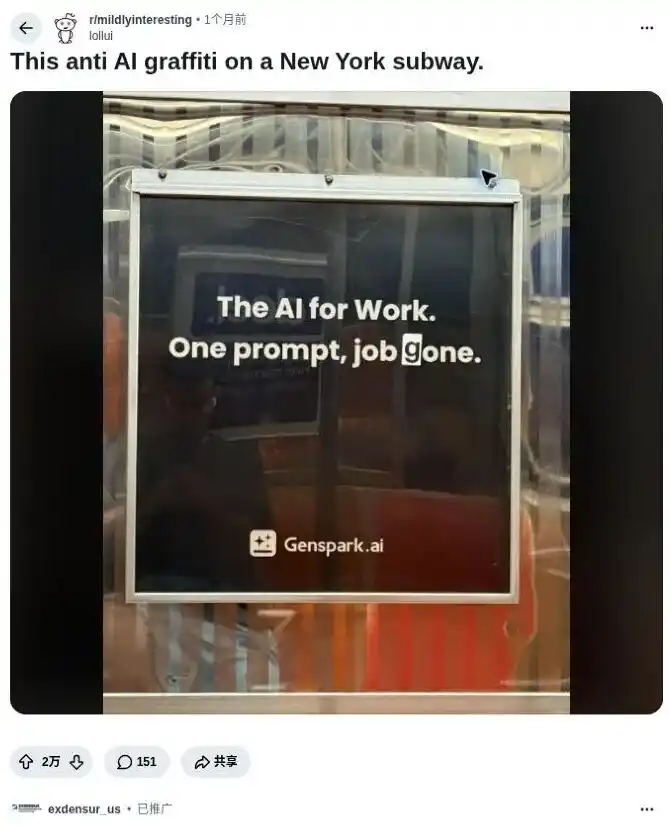
The New York subway graffiti clearly didn't make Genspark scale back offline ads. Later, it bought columns, banners, and electronic screens at San Francisco's 4th & King Caltrain terminal, achieving nearly full-station coverage. Strictly speaking, Caltrain is a commuter rail connecting San Francisco and Silicon Valley, not an urban subway; but for an AI company eager to reach tech workers, passenger density and target audience here are clearly more precise than ordinary subways.
This time, Genspark's ads also saw significant improvement. New York's vague and easily provocative "One prompt, job done" was replaced with "Make AI work you."
In this ad, AI is no longer a replacer making work and workers disappear together but becomes a tool commanded by people. Genspark didn't change its product's promise of automation but learned to repackage "replacing you" as "serving you."
This at least shows Genspark's ad iteration ability matches its product replication speed: after one ad buy faced mockery, it didn't reduce budget but quickly revised wording, increased information density, and spread ads to places Silicon Valley engineers pass daily commuting.
Genspark then densely entered AI tool promotion networks on YouTube, Instagram, TikTok, LinkedIn, and X. Numerous productivity bloggers, office software review accounts, entrepreneurship mentors, and affiliate marketers published structurally highly consistent content around the same time: stop buying 10 AI tools, spend only $20/month, have an AI employee work for you 24/7.
These ads sell not a specific capability but a Costco-like price illusion: as long as one subscription includes enough items, consumers find it hard to judge each item's actual value individually, or how many features will be actually used before credits run out.
Simultaneously, Genspark continues buying another more expensive kind of traffic—credibility.
As mentioned earlier, Super Platinum sponsorship of MIT AI Conference, Co-Working Sponsor for Step Dubai, showcase partnership at AI Summit Seoul, executive photos during Microsoft Ignite, trillion token plaque from OpenAI, Anthropic customer case video, etc., together form a brand promotion system covering entrepreneurial communities, enterprise clients, developers, and capital markets.
Noteworthy is Genspark's story of "appearing" in The Wall Street Journal.
In June 2026, a lengthy Q&A with Eric Jing appeared on The Wall Street Journal's website titled "The Rise of AI-Native Organizations and AI Specialists." The page fully replicated the WSJ Business section's fonts, column navigation, and visual style, with a hand-drawn portrait of Eric Jing. Readers could easily mistake it for a formal WSJ reporter interview with Genspark's CEO.
But this was not a report from The Wall Street Journal's news editorial department.
The page wasn't on wsj.com where news is typically published but on partners.wsj.com used for commercial content. The top clearly labels "Paid Program"; clicking "What's This?" reveals an unambiguous explanation: "This is paid content created by The Wall Street Journal Advertising Department."
At the bottom, it repeats: This content was produced by the Custom Content team within The Wall Street Journal Advertising Department.
This isn't a regular display ad Genspark bought either, but a custom native advertising project themed "The AI Specialist Era." Besides Eric Jing's personal Q&A, it included an interview with COO Wen Sang titled "On the Front Lines of AI," a profile promoting "10x knowledge workers," and a customer case of Japanese ad agency ADK using Genspark.
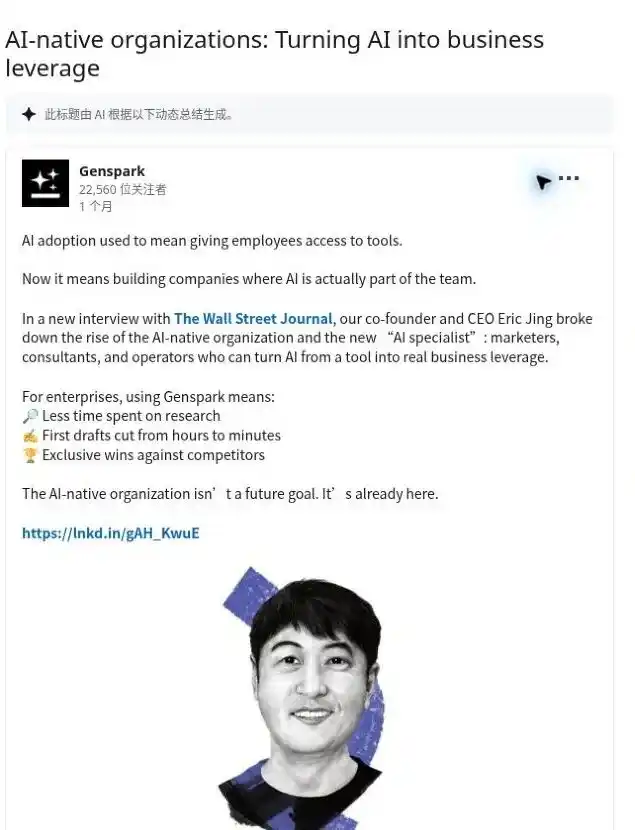
Genspark's LinkedIn account posted this news. It openly wrote: "In a new Wall Street Journal interview, our co-founder and CEO Eric Jing explains the rise of AI-native organizations."
Eric Jing himself reposted the content on X, even posting a photo on social media holding the printed layout of this "report." A CEO holding his own purchased ad placement is somewhat amusing.
This also explains why Genspark needs to keep releasing products.
A "suite" spanning search, browser, docs, design, code, voice, meetings, email, and cloud computers naturally has more advertising entry points than a single product. Each added feature allows reissuing news, reinviting bloggers for reviews, recreating a competitor, retelling the story "we've changed how work is done again."
Products are responsible for creating ad material; ads are responsible for creating users and revenue; revenue numbers in turn become the most important material for the next round of ads.
This is a complete perpetual growth machine.
However, traffic from the Super Bowl doesn't stay forever. AICPB data shows Genspark website visits peaked at 21.84 million in March 2026, then declined for three consecutive months to only 12.15 million in June; the attention peak created by the Super Bowl quickly faded. Ads in NYC subway and San Francisco Caltrain Station couldn't reverse this trend.
But for Genspark, whether traffic stays long-term may not be the only goal. As long as some users buy annual plans, some enterprises sign contracts, some investors believe the growth story, and some media continue citing its ARR, advertising has completed its task.
This is Genspark's hardest-to-replicate "moat": it won't invent products earlier than any competitor but can always faster put others' categories on its shelves; it may not have the most unique models but can buy enough models; it may not hold user attention long-term but dares to buy two ads at once where attention is most expensive.
In this sense, Genspark is indeed a highly competitive company.
Its competitiveness never comes from the ambition and wisdom to pursue frontier intelligence, but from a more complex systemic ability: observing what's trending, replicating what's been validated, hiding what might compromise its American identity, and pushing everything else to market at the fastest speed.
This system is also used to produce Genspark itself.
Microsoft resume, OpenAI plaque, Anthropic's "intimate partner," photo with Nadella, and WSJ paid content are placed on the most prominent shelves; Baidu experience, backing from Chinese investment institutions, mysterious Beijing engineering team, and indirectly called Chinese open-weight models are moved to the warehouse depths.
Everything American is glamorous; everything Chinese is unspeakable. This is Genspark's survival logic, and the true meaning of "Foreign Guest Genspark."
It plays a Silicon Valley company needing formal reception before Chinese peers, while trying to erase the Chinese organizational experience it relies on for success before Silicon Valley. It's not simply moving from China to the US but commercially using two worlds simultaneously while allowing only one to appear in the sunlight.
In this sense, perhaps Genspark's most successful Agent is Genspark itself: it orchestrates American models, Chinese engineers, global capital, Silicon Valley brands, and media credibility to jointly execute a long-term mission, making the world believe: it has always been just an American AI company from Palo Alto.
This article is from the WeChat public account "Silicon Star Man Pro," author: Xiaotuotuo