Bitcoin Fork BIP-110 Lags Behind BTC by 300 Blocks and Will Need 6 Years to Catch Up

cryptonews.ruPublished on 2026-08-11Last updated on 2026-08-11

Abstract

A Bitcoin blockchain fork triggered by the BIP-110 proposal has stalled significantly, falling 326 blocks behind the main Bitcoin network and facing an estimated 6.3-year wait for its next difficulty adjustment. The fork activated on Saturday at block 961,632 after failing to gain the required 55% miner support for its rule change, which aimed to ban non-payment data (like images and text) in transactions within a year. Instead of adopting the change, nodes running BIP-110 software began rejecting all blocks not flagged for the proposal, creating a separate chain. This new chain has only produced two blocks since the split. Mining has effectively halted because it inherited Bitcoin's high mining difficulty but offers a coin with no market value, exchange listings, or buyers. Consequently, the fork cannot progress until 2016 blocks are created to trigger a difficulty reduction, a process that monitoring tools now estimate will take over six years. While some analysts, like Nick Ruck of LVRG Research, view the experiment as a failure that demonstrates the security of Bitcoin's main chain relies on overwhelming miner consensus, others urge caution. Co-founder Himanshu Sahay of Arch noted it's too early for definitive conclusions, emphasizing that Bitcoin rule changes depend on coordinated support across miners, developers, and the ecosystem.

The Bitcoin-derived blockchain is currently so lacking in miners that its correction mechanism will only activate in six years.

The blockchain that forked from Bitcoin on Saturday has not progressed since. It remains stuck at block 961,633, its second block. Bitcoin has since advanced to block 961,959, leaving the fork 326 blocks behind.

The split occurred due to a proposal called BIP-110, which would have banned the storage of images, text, and other non-payment data in Bitcoin transactions within a year. Changing Bitcoin's rules requires miner consensus, which miners signal by tagging the blocks they create. BIP-110 required 55% of blocks over two weeks. At its peak, it reached about 2.6%.

But instead of being adopted, the proposal had a secondary path built in. At block 961,632, computers running BIP-110 software began rejecting all blocks lacking this tag, regardless of the miners' decision.

Almost no blocks have this tag, so these computers rejected the blockchain being built by nearly all of Bitcoin's mining power and began following a blockchain consisting only of blocks that do have the tag.

The Bitcoin ledger consists of blockchains, each a bundle of transactions added by miners—companies operating warehouses of specialized computers that compete to create the next block. They are paid in newly issued bitcoins plus transaction fees, and a block arrives roughly every 10 minutes.

This 10-minute pace is not automatic. The network sets a difficulty level, which determines the amount of computational work a miner must perform to create a valid block, and recalculates it every 2016 blocks. If blocks arrive too quickly, the work becomes harder. If too slowly, it becomes easier.

At the normal rate, creating 2016 blocks takes about two weeks.
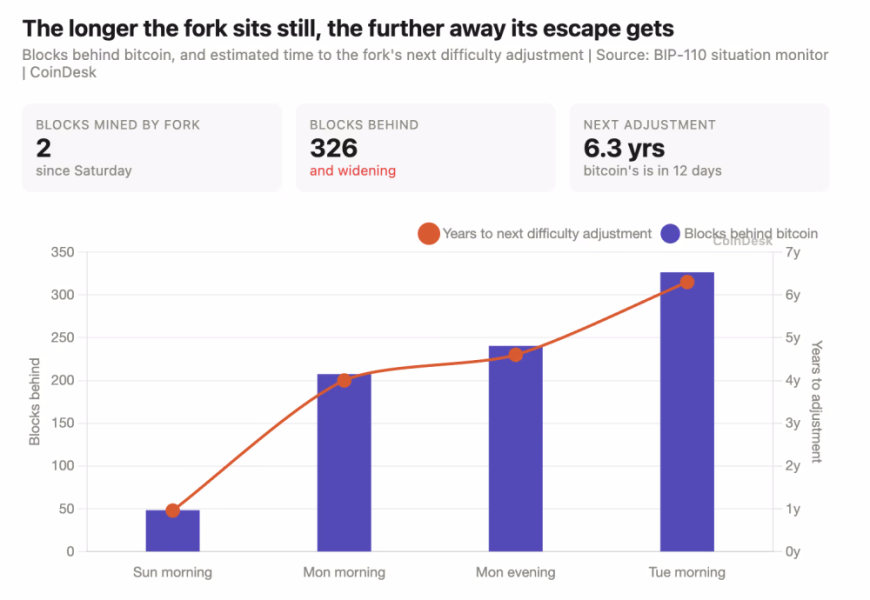
The longer the fork remains static, the further it falls behind. Source: Shaurya Malwa.

Two blocks were created on this blockchain. Then mining stopped because its cost is identical to Bitcoin mining—both blockchains inherited the same difficulty at the split, while the coin used as payment has no market, no exchange listings, and no buyers.

Furthermore, at current rates, mining cannot become easier unless 2016 blocks are initially created. Real-time monitoring currently estimates this timeframe at 6.3 years, compared to 350 days on Sunday.

This number is calculated based on the time of the last blocks created, so every hour of inactivity pushes it further out. Bitcoin's next difficulty adjustment is expected in 12 days.

"The BIP-110 experiment has essentially failed after creating just two blocks and falling behind the main blockchain," said Nick Ruck, Director of LVRG Research. "Bitcoin's security and progress remain tightly linked to the overwhelming majority of computational power, i.e., the total computing power miners use to run the network. Controversial rule changes without broad support from miners and the broader economy are doomed to stall as minority forks emerge, leaving the main network intact."

However, not everyone considers the matter settled.

"I think it's too early to draw any firm conclusions from the initial block creation," said Himanshu Sahay, co-founder of Arch. "Changes to Bitcoin's rules depend on coordination among miners, developers, and the entire ecosystem, and while this divergence is worth watching, I would be cautious about calling it a failure at this stage."


end-content

Trending Cryptos

Related Questions

QWhat is the main reason why the Bitcoin fork based on BIP-110 is lagging behind by over 300 blocks?

AThe fork is lagging because it has virtually no mining power. Almost all miners are continuing to work on the original Bitcoin blockchain, leaving the BIP-110 chain with only two blocks since the fork. The required work for the next difficulty adjustment is insurmountable without significant hash rate.

QAccording to the article, how long is it currently estimated for the BIP-110 fork to create the 2016 blocks needed for its next difficulty adjustment?

AIt is currently estimated to take approximately 6.3 years for the BIP-110 fork to create the 2016 blocks required for its next difficulty adjustment. This timeframe continues to increase with every hour the chain remains idle.

QWhat specific rule change did BIP-110 propose that led to the blockchain split?

ABIP-110 proposed a rule change that would have prohibited the storage of images, text, and other non-payment data in Bitcoin transactions within a one-year timeframe.

QWhat was the second, more contentious path built into the BIP-110 proposal that caused the split?

AThe second path mandated that computers running BIP-110 software would begin rejecting all blocks that did not signal support for the proposal, regardless of the overall miner consensus. This caused them to follow a separate chain.

QAccording to Nick Ruck from LVRG Research, why did the BIP-110 experiment fail?

ANick Ruck stated the experiment failed because it lacked the support of the overwhelming majority of the network's hash rate. He argues that controversial rule changes without broad support from miners and the wider economy are destined to stall as minority forks, leaving the main chain intact.

Related Reads

New Claude models will embed invisible watermarks in generated text

Anthropic has announced that starting from August 2, 2026, new Claude models deployed in the European Union will incorporate machine-readable invisible watermarks into generated text. This measure will apply globally wherever Claude is offered, including via its API, applications, and through partners like AWS, Google Cloud, and Microsoft Foundry. The watermarking mechanism for text is distinct from file provenance. For text, invisible watermarks will be woven directly into the model's responses without altering meaning, quality, or readability, and are designed to persist through copying and pasting and partially through editing. This system is separate from the C2PA standard. For files (e.g., .png, .jpg), Claude already attaches C2PA-compliant metadata signatures to indicate AI origin. Models released before August 2, 2026 (including the current Claude Opus 5) are in a transitional period and do not embed text watermarks, though Anthropic is working to add support. Currently, there are no public tools to detect these text watermarks; Anthropic states it is developing such tools and will release technical details later. The timing aligns with the EU AI Act's Article 50, which from August 2, 2026, mandates labeling of AI-generated content, with potential fines for non-compliance. A key technical question remains regarding the watermark's resilience to paraphrasing or translation by other AI models, which in other industry experiments has significantly reduced detection accuracy.

cryptonews.ru8m ago

New Claude models will embed invisible watermarks in generated text

cryptonews.ru8m ago

Trading

Spot

Hot Articles

What is $BITCOIN

DIGITAL GOLD ($BITCOIN): A Comprehensive Analysis Introduction to DIGITAL GOLD ($BITCOIN) DIGITAL GOLD ($BITCOIN) is a blockchain-based project operating on the Solana network, which aims to combine the characteristics of traditional precious metals with the innovation of decentralized technologies. While it shares a name with Bitcoin, often referred to as “digital gold” due to its perception as a store of value, DIGITAL GOLD is a separate token designed to create a unique ecosystem within the Web3 landscape. Its goal is to position itself as a viable alternative digital asset, although specifics regarding its applications and functionalities are still developing. What is DIGITAL GOLD ($BITCOIN)? DIGITAL GOLD ($BITCOIN) is a cryptocurrency token explicitly designed for use on the Solana blockchain. In contrast to Bitcoin, which provides a widely recognized value storage role, this token appears to focus on broader applications and characteristics. Notable aspects include: Blockchain Infrastructure: The token is built on the Solana blockchain, known for its capacity to handle high-speed and low-cost transactions. Supply Dynamics: DIGITAL GOLD has a maximum supply capped at 100 quadrillion tokens (100P $BITCOIN), although details regarding its circulating supply are currently undisclosed. Utility: While precise functionalities are not explicitly outlined, there are indications that the token could be utilized for various applications, potentially involving decentralized applications (dApps) or asset tokenization strategies. Who is the Creator of DIGITAL GOLD ($BITCOIN)? At present, the identity of the creators and development team behind DIGITAL GOLD ($BITCOIN) remains unknown. This situation is typical among many innovative projects within the blockchain space, particularly those aligning with decentralized finance and meme coin phenomena. While such anonymity may foster a community-driven culture, it intensifies concerns about governance and accountability. Who are the Investors of DIGITAL GOLD ($BITCOIN)? The available information indicates that DIGITAL GOLD ($BITCOIN) does not have any known institutional backers or prominent venture capital investments. The project seems to operate on a peer-to-peer model focused on community support and adoption rather than traditional funding routes. Its activity and liquidity are primarily situated on decentralized exchanges (DEXs), such as PumpSwap, rather than established centralized trading platforms, further highlighting its grassroots approach. How DIGITAL GOLD ($BITCOIN) Works The operational mechanics of DIGITAL GOLD ($BITCOIN) can be elaborated on based on its blockchain design and network attributes: Consensus Mechanism: By leveraging Solana’s unique proof-of-history (PoH) combined with a proof-of-stake (PoS) model, the project ensures efficient transaction validation contributing to the network's high performance. Tokenomics: While specific deflationary mechanisms have not been extensively detailed, the vast maximum token supply implies that it may cater to microtransactions or niche use cases that are still to be defined. Interoperability: There exists the potential for integration with Solana’s broader ecosystem, including various decentralized finance (DeFi) platforms. However, the details regarding specific integrations remain unspecified. Timeline of Key Events Here is a timeline that highlights significant milestones concerning DIGITAL GOLD ($BITCOIN): 2023: The initial deployment of the token occurs on the Solana blockchain, marked by its contract address. 2024: DIGITAL GOLD gains visibility as it becomes available for trading on decentralized exchanges like PumpSwap, allowing users to trade it against SOL. 2025: The project witnesses sporadic trading activity and potential interest in community-led engagements, although no noteworthy partnerships or technical advancements have been documented as of yet. Critical Analysis Strengths Scalability: The underlying Solana infrastructure supports high transaction volumes, which could enhance the utility of $BITCOIN in various transaction scenarios. Accessibility: The potential low trading price per token could attract retail investors, facilitating wider participation due to fractional ownership opportunities. Risks Lack of Transparency: The absence of publicly known backers, developers, or an audit process may yield skepticism regarding the project's sustainability and trustworthiness. Market Volatility: The trading activity is heavily reliant on speculative behavior, which can result in significant price volatility and uncertainty for investors. Conclusion DIGITAL GOLD ($BITCOIN) emerges as an intriguing yet ambiguous project within the rapidly evolving Solana ecosystem. While it attempts to leverage the “digital gold” narrative, its departure from Bitcoin's established role as a store of value underscores the need for a clearer differentiation of its intended utility and governance structure. Future acceptance and adoption will likely depend on addressing the current opacity and defining its operational and economic strategies more explicitly. Note: This report encompasses synthesised information available as of October 2023, and developments may have transpired beyond the research period.

1.7k Total ViewsPublished 2025.05.13Updated 2025.05.13

What is $BITCOIN

Discussions

Welcome to the HTX Community. Here, you can stay informed about the latest platform developments and gain access to professional market insights. Users' opinions on the price of BTC (BTC) are presented below.

活动图片