Bitcoin eyes macro jump to $70K after drop below $60k – What’s next for BTC?

ambcryptoPublished on 2026-07-03Last updated on 2026-07-03

Abstract

Bitcoin's price recently dipped below $60,000 but has since recovered to around $61,540. While technical indicators like the RSI and MACD show some bullish signs, they are not strongly convincing. On-chain data reveals a market reset, with asset managers' net long exposure at its lowest since U.S. spot Bitcoin ETF launches, though they remain net long. Leveraged funds have significantly reduced net short positions, and open interest has fallen sharply, indicating leverage is being unwound. Long-term holders are buying at lower prices, providing support. However, Bitcoin remains below its 30-day moving average, suggesting the overall trend is not yet fully bullish. Large transfers to exchanges like Coinbase Prime have occurred, potentially indicating future selling pressure. Analysts warn that downside risk remains as Bitcoin has not reached severely oversold levels typical of cycle bottoms. The market's next major move may depend on institutional activity.

The price of Bitcoin [BTC] recently dropped from $60,000 to $58,000. However, at press time it was trading at $61,540.15, following a 2.01% increase in the past 24 hours. But a month-long decline of 8% is now raising concerns for the king coin.

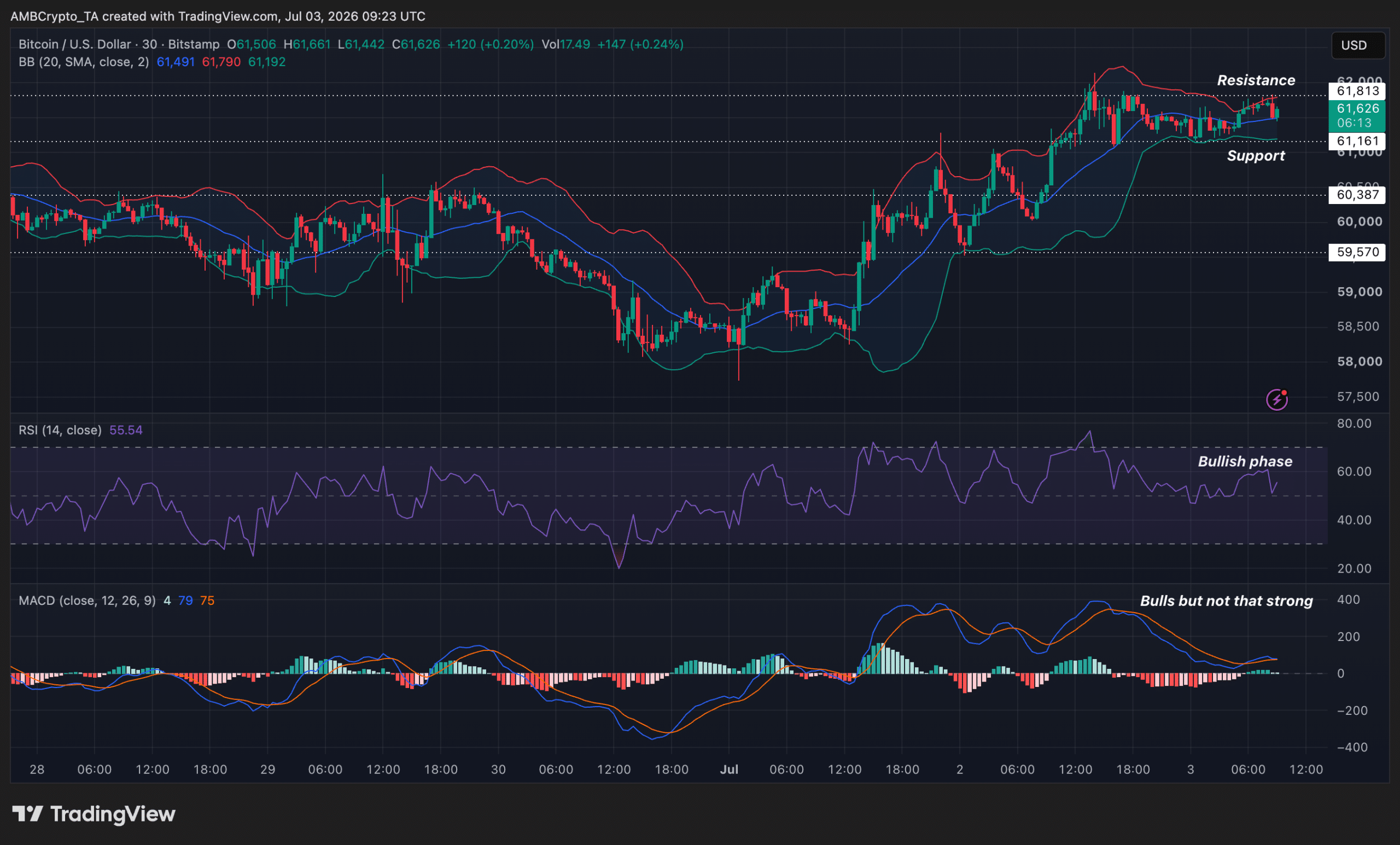
Consequently, given that the RSI was above 55 at press time and the MACD was flashing green bars, the price analysis suggested that bulls were strong. However, if looked at closely, the bull signs were not forceful, as the Signal line and MACD lines were almost joining.

Additionally, Bollinger Bands expanding following a squeeze indicated the presence of upcoming volatility.
Source: Trading View

Bitcoin’s on-chain metrics spark concerns

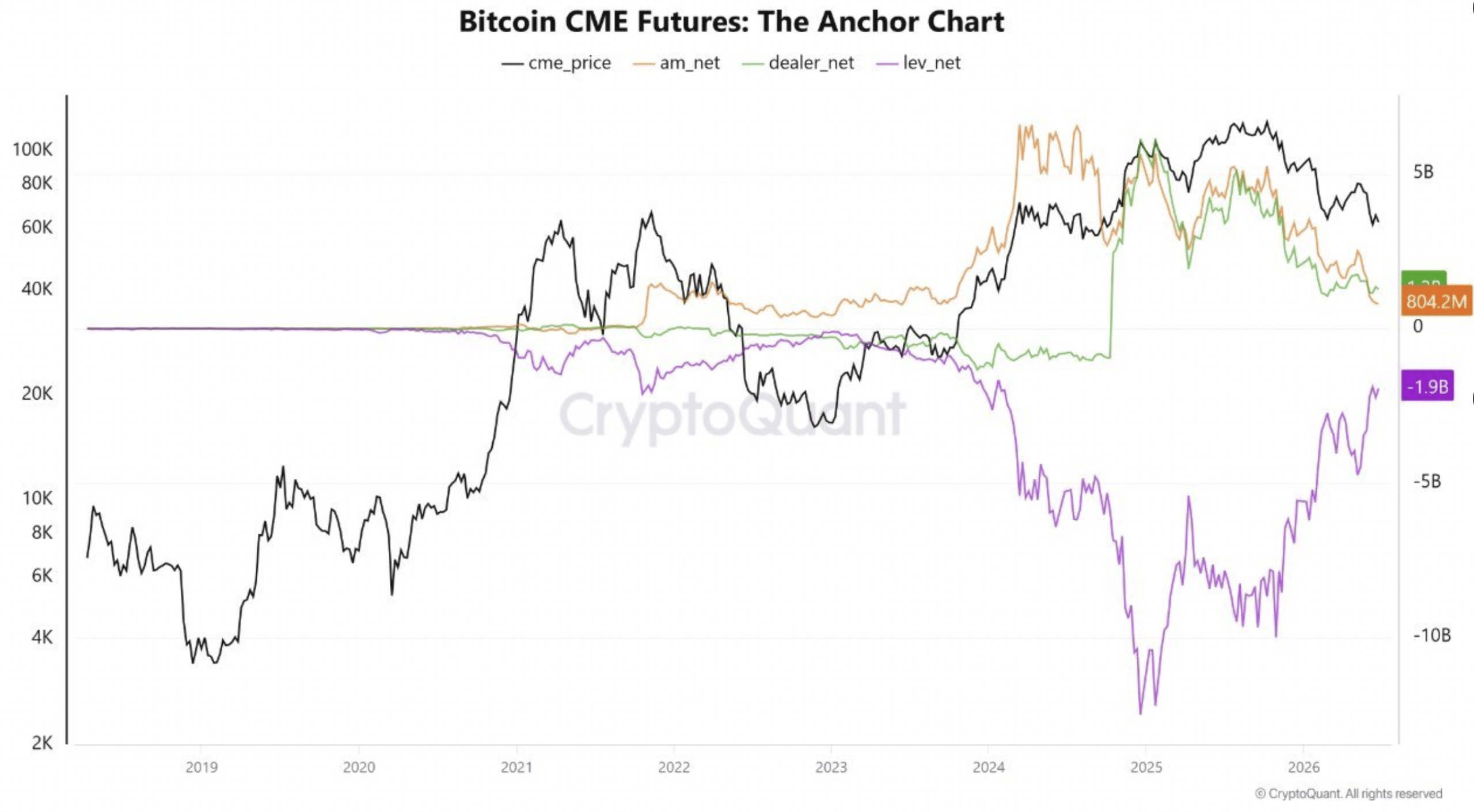
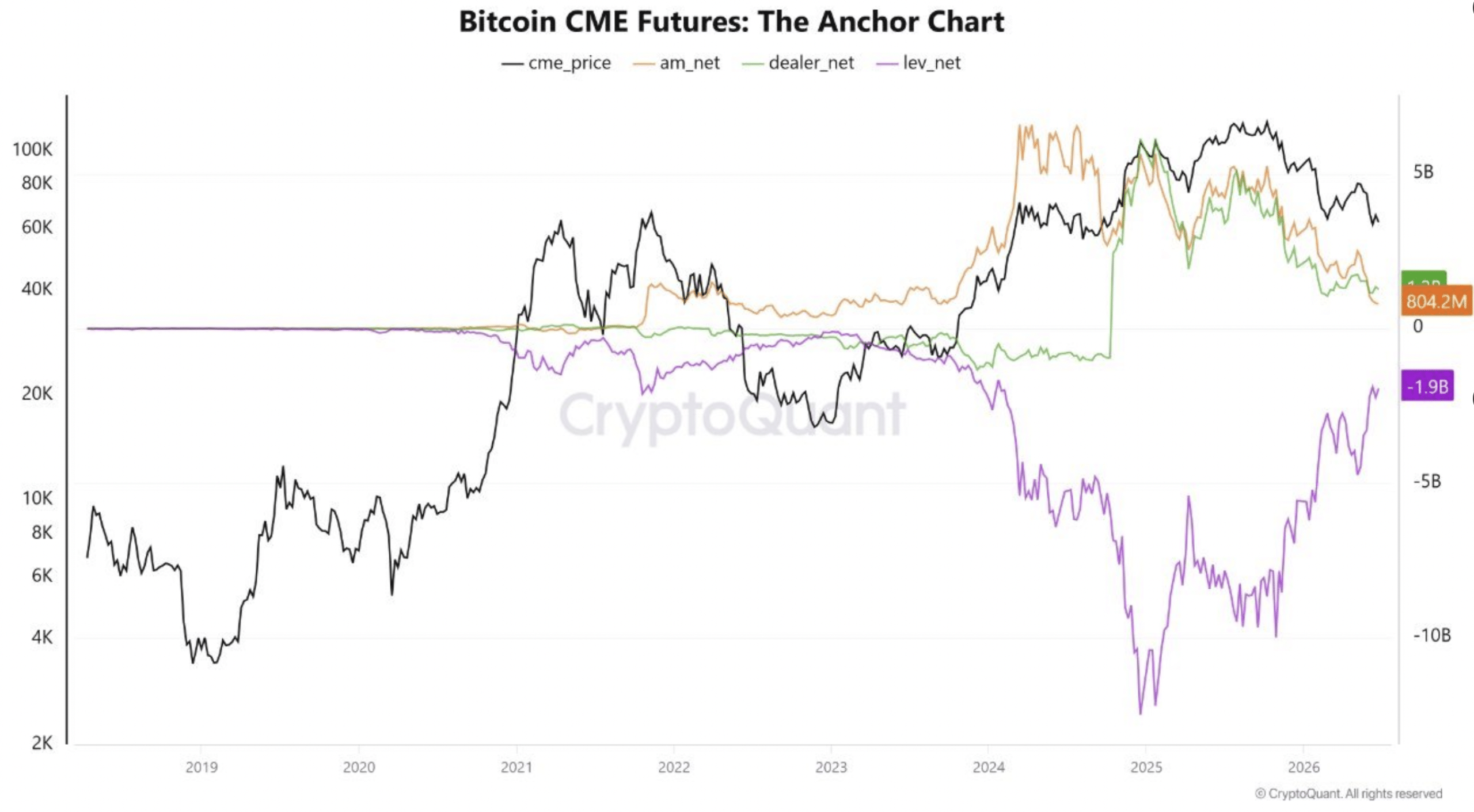
Still, instead of being completely pessimistic, CryptoQuant’s most recent CME Bitcoin futures data suggested a market reset.
Source: CryptoQuant

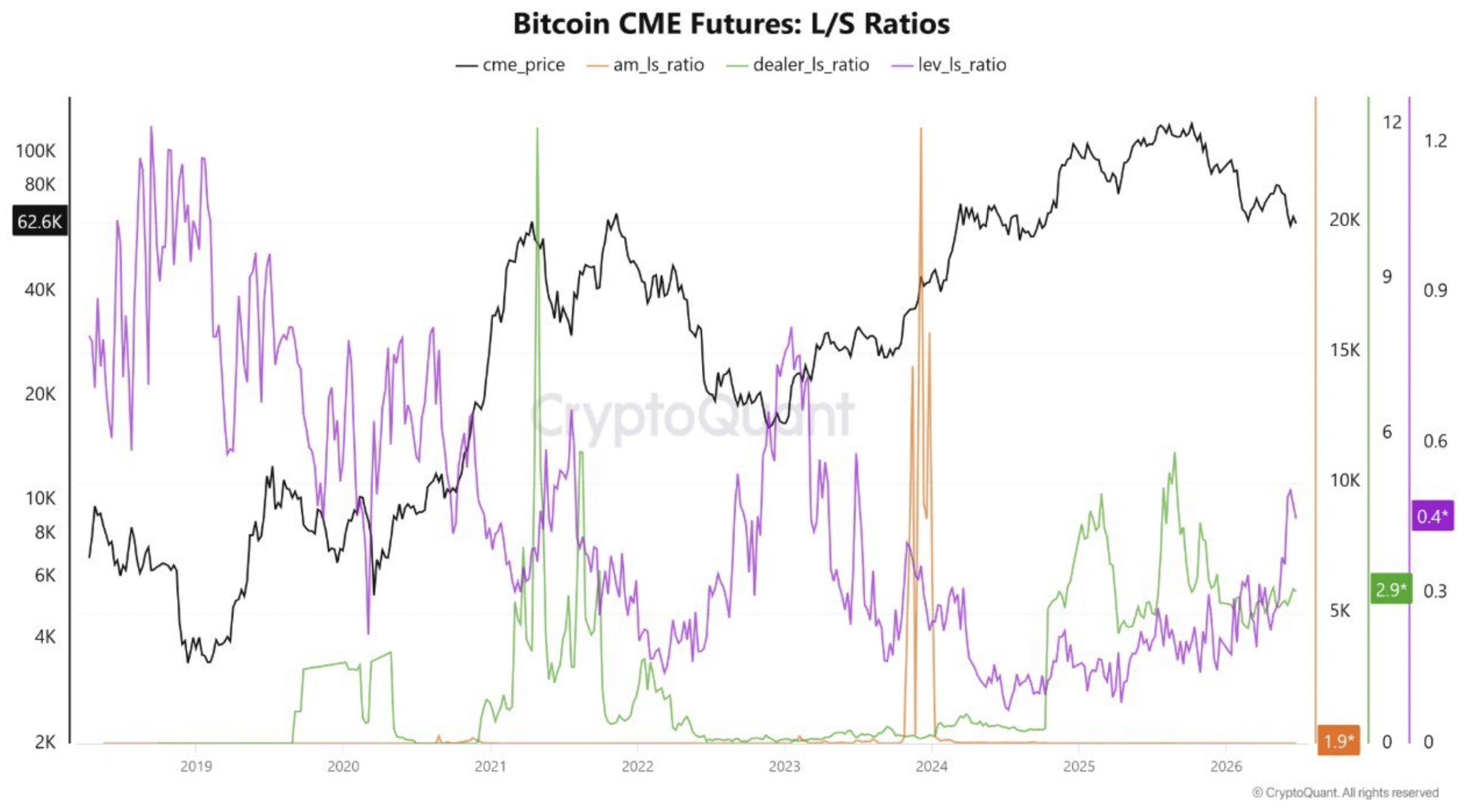
According to the chart, the net long exposure of asset managers has decreased to $800 million, the lowest since the introduction of U.S. spot Bitcoin ETFs. However, they still maintain a nearly 2:1 long-to-short ratio, indicating a decrease in conviction rather than a bearish shift.
Source: CryptoQuant

Meanwhile, the leveraged funds have cut their net short positions by 67.5% as shrinking futures premiums made basis trades less profitable.

Moreover, open interest has decreased by 63.5%, which is significantly greater than the decline in Bitcoin’s price. This suggests that leverage is being removed from the derivatives market rather than being sold off on the open market.

Therefore, there is now a positioning vacuum as a result of both bullish and hedging positions being abnormally light. Similar conditions existed in November 2022 before Bitcoin’s 30% rally, but the market environment was different this time due to the presence of spot ETFs.

Hence, if institutional longs or hedge fund basis trades return first, that will probably determine the next big move.

Has the bullish narrative started to build yet?

At the same time, long-term holders (LTHs) intervened to buy Bitcoin at reduced prices, easing selling pressure and creating a solid price floor. This in turn resulted in the bearish momentum swiftly subsiding.

This aided in Bitcoin’s recovery above a crucial technical level.

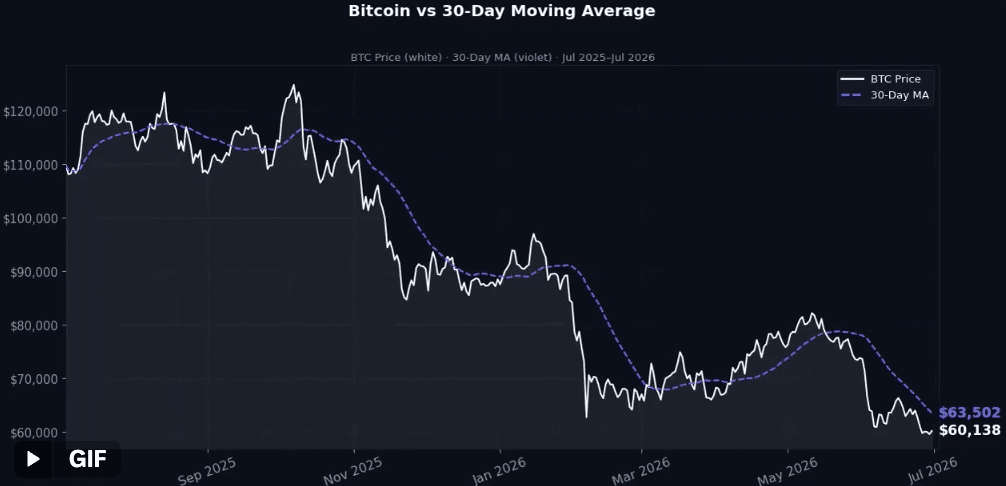
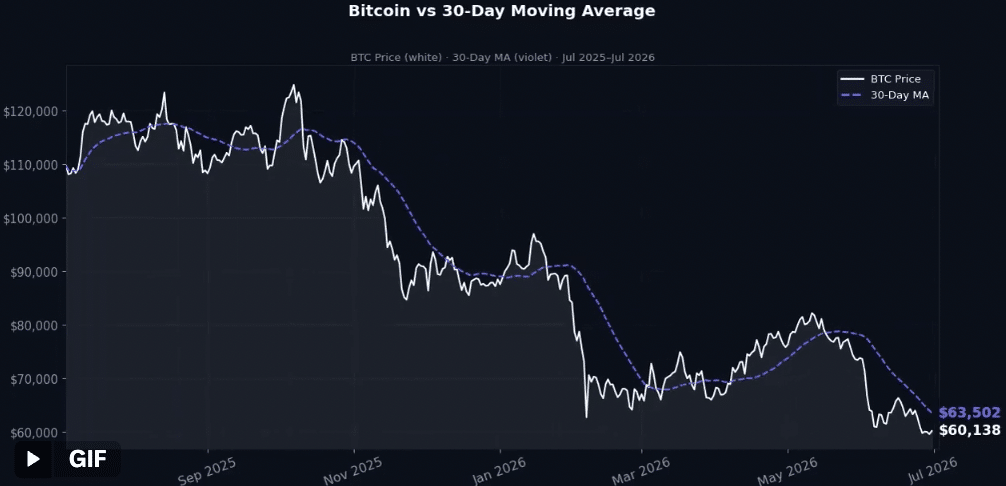
Although Bitcoin has gained 2.9% weekly and is now above its 7-day moving average, it is still below its 30-day moving average, indicating that while short-term momentum is improving, the overall trend has not yet fully turned bullish.
Source: CryptoQuant/X

Asset reshuffling

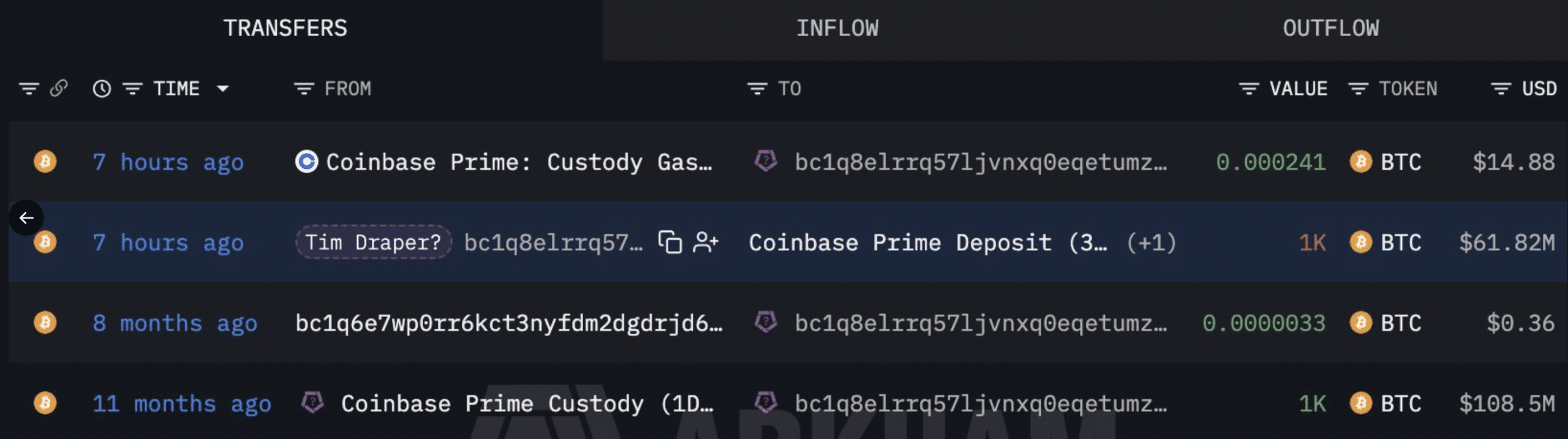
While all this was happening, 1,000 BTC worth $61.8 million was transferred to Coinbase Prime from a wallet that may have been connected to Tim Draper.
Source: Arkham

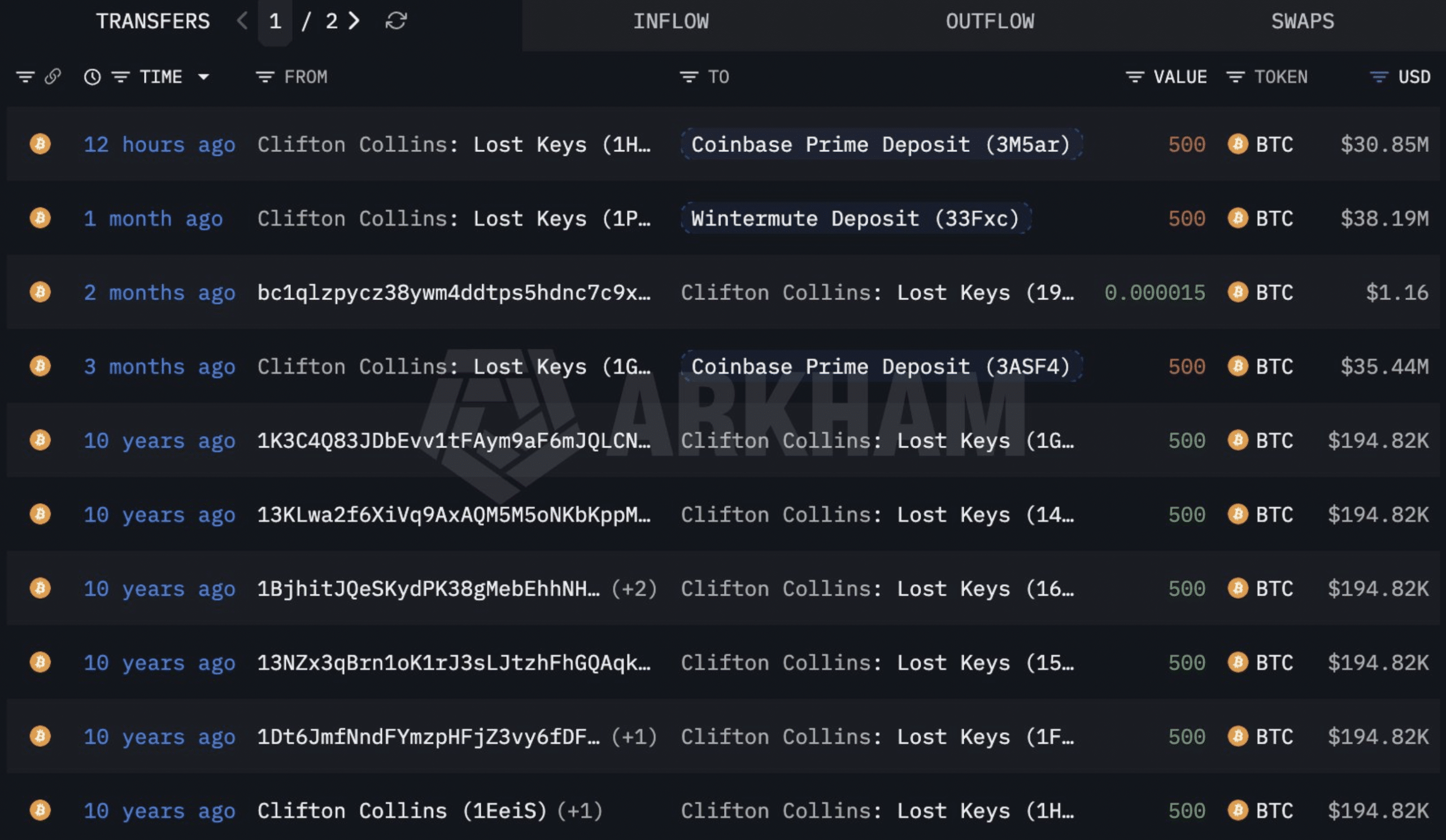
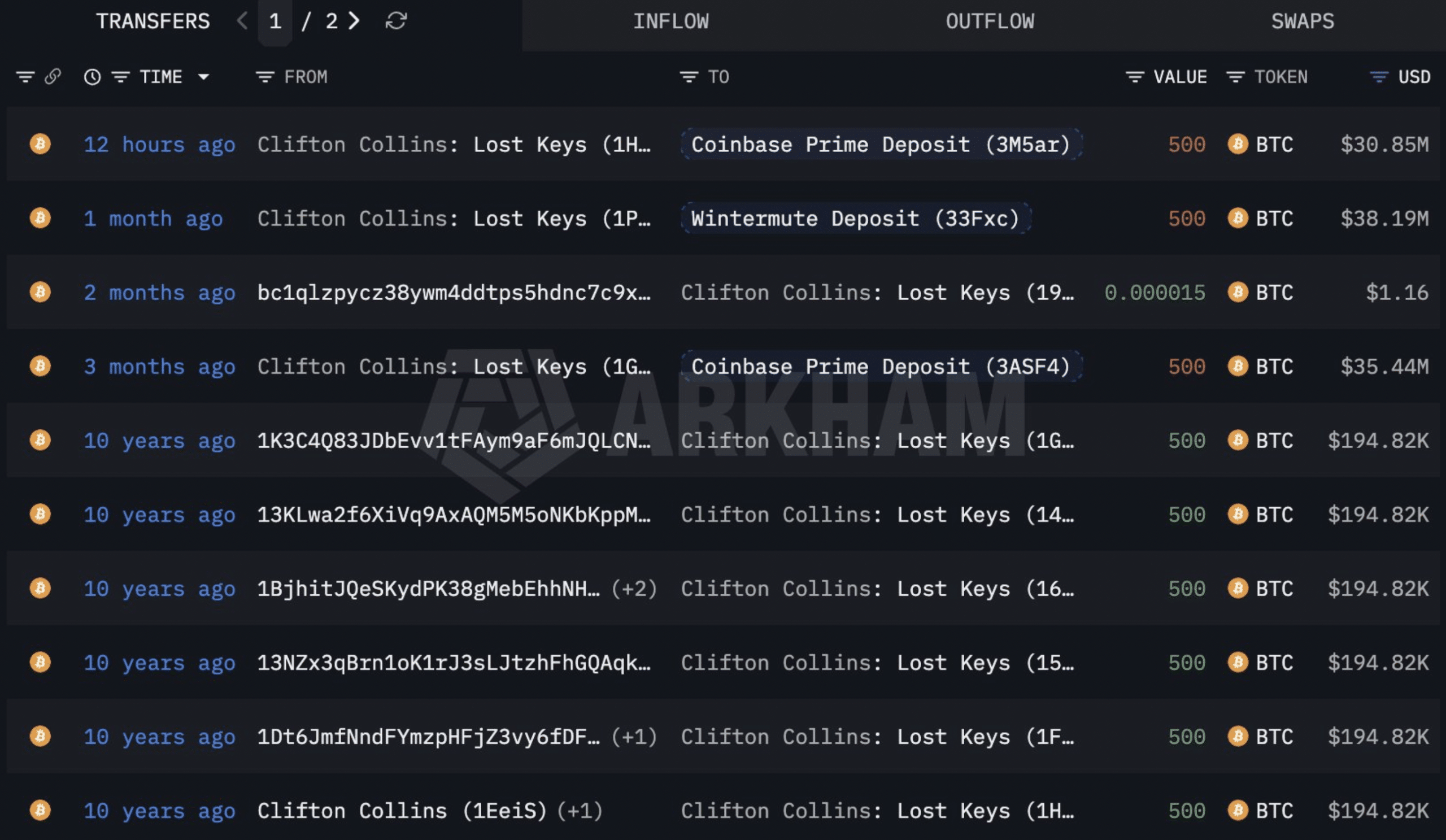
Additionally, a wallet associated with Clifton Collins, meanwhile, moved 1,500 BTC to Coinbase Prime and Wintermute over the previous three months and then deposited an additional 500 BTC ($30.9 million) to Coinbase Prime.

Though these transfers raise the possibility of more supply entering the market, they do not always signify an immediate selling.
Source: Arkham

Clubbing all these together, even, crypto analyst Axel Adler Jr. recently claimed that on-chain metrics indicate that there is still more downside risk. This is because Bitcoin has not yet reached the severely oversold conditions observed at previous cycle bottoms.


Final Summary

  • Even though Bitcoin has risen above $61,500, it is still below its 30-day moving average.
  • ETF withdrawals and sell-offs continue to be the main factors influencing Bitcoin’s current and future price movement.


Trending Cryptos

Related Questions

QWhat is Bitcoin's current price and how has it changed recently according to the article?

AAccording to the article, Bitcoin (BTC) was trading at $61,540.15 at press time. It experienced a 2.01% increase in the past 24 hours, but also had a month-long decline of 8%.

QWhat do the technical indicators like RSI and MACD suggest about the market strength?

AThe price analysis suggests that bulls were strong, with the RSI above 55 and the MACD flashing green bars. However, the bull signs were not forceful, as the Signal line and MACD lines were almost joining.

QWhat does the CME Bitcoin futures data indicate about institutional positions?

ACryptoQuant's CME Bitcoin futures data shows that the net long exposure of asset managers has decreased to $800 million, the lowest since the introduction of U.S. spot Bitcoin ETFs. They still maintain a nearly 2:1 long-to-short ratio, indicating a decrease in conviction rather than a full bearish shift.

QAccording to the on-chain analysis, what role did long-term holders (LTHs) play in the recent price action?

ALong-term holders (LTHs) intervened to buy Bitcoin at reduced prices. This action eased selling pressure, created a solid price floor, and helped the bearish momentum subside, aiding in Bitcoin's recovery above a crucial technical level.

QWhat are the two main factors the article states are influencing Bitcoin's current and future price movement?

AThe article states that ETF withdrawals and sell-offs continue to be the main factors influencing Bitcoin's current and future price movement.

Related Reads

BIS Report Compliance Observations: The True Risks of Stablecoins Go Beyond 'De-pegging'

The BIS report, "Anchoring trust in money: innovation beyond stablecoins," highlights that the primary risks of stablecoins extend beyond potential de-pegging. It argues that the core challenge is whether stablecoins can be integrated into a financial system that is identifiable, monitorable, accountable, and regulatable. While acknowledging efficiency gains like faster payments and programmability, BIS emphasizes that money requires an institutional framework—including legal certainty, liquidity support, and financial integrity controls—which many stablecoins currently lack. The report details compliance risks, noting that while blockchain transactions are transparent, address visibility does not equate to identity or purpose clarity. This creates a systemic risk as pseudonymity, non-custodial wallets, and cross-chain bridges can undermine AML/CFT controls. Furthermore, these risks can spill over into the traditional financial system through on- and off-ramps. The future direction, per BIS, is not to prohibit innovation but to embed regulatory rules—such as identity verification and transaction screening—directly into the technological infrastructure of tokenized finance. The key takeaway for compliance is that any new financial instrument must clearly address questions of customer identification, transaction monitoring, accountability, and cross-border rule consistency to be viable as a mainstream payment tool.

marsbit51m ago

BIS Report Compliance Observations: The True Risks of Stablecoins Go Beyond 'De-pegging'

marsbit51m ago

When US Giants Collectively "Defect" to Chinese AI Models

When Silicon Valley Giants Turn to Chinese AI Models to Cut Costs A surprising trend is emerging: major U.S. tech companies are significantly reducing AI costs by switching to Chinese models. Coinbase, the largest U.S. cryptocurrency exchange, reportedly halved its AI spending after migrating to China's GLM-5.2 and Kimi 2.7 models, despite increasing usage. They achieved this through a sophisticated three-part strategy: implementing an automatic routing system to select the most cost-effective model per task, boosting cache hit rates from 5% to 60% to reuse computations, and employing "context engineering" to provide AI with more precise, less cluttered information. They are not alone. AI startup Lindy switched from Claude to DeepSeek, saving millions, while Snowflake's tests found GLM-5.2 solved 66% of coding tasks compared to Claude Opus's 67%—but at a fraction of the cost (output pricing is 5-7 times lower). While the top Western models may offer slightly better stability, the massive price differential is leading many businesses to reconsider their value proposition. This shift signals a deeper change in the AI industry, moving beyond pure performance benchmarks to a fierce cost competition. As pressure mounts, even OpenAI and Anthropic have begun slashing prices. For users, this means more choices, lower costs, and a crucial lesson: using multiple models based on task complexity, optimizing with caching, and keeping contexts lean are now key to leveraging AI efficiently and affordably.

marsbit58m ago

When US Giants Collectively "Defect" to Chinese AI Models

marsbit58m ago

BIS Report Compliance Watch: The Real Risks of Stablecoins Are Not Just 'De-pegging'

BIS Report Compliance Observations: The real risks of stablecoins go beyond "depegging" The BIS report "Anchoring trust in money: innovation beyond stablecoins" argues that while stablecoins and tokenization offer efficiency gains, their primary risk lies in fitting into an identifiable, monitorable, accountable, and regulatable financial system. Money's trust stems not just from technology but from institutional arrangements: a common unit of account, guaranteed redemption at par, liquidity support, regulatory frameworks, and financial integrity requirements. Stablecoins, operating on permissionless blockchains with pseudo-anonymity and non-custodial wallets, create systemic compliance gaps: unclear customer identity, incomplete fund origins, unexplained transaction purposes, fragmented cross-chain paths, and ambiguous liability. On-chain transparency does not equal compliance transparency. Public addresses don't reveal identity or intent. While blockchain analytics aid law enforcement, they cannot replace routine, large-scale AML/CFT controls. Effective compliance requires a closed-loop process encompassing customer onboarding, transaction monitoring, investigation, reporting, and audit. Stablecoin risks are not confined to the blockchain; they re-enter the traditional financial system via on/off-ramps, exchanges, and payment institutions. This forces banks to monitor client accounts for activity linked to virtual assets. The future direction is not to prohibit innovation but to embed rules into the technology. Tokenized finance should integrate with the existing two-tier monetary system, embedding compliance—like customer identification, pre-transaction screening, and auditable data trails—directly into the transaction flow. For compliance professionals, the key takeaway is that any new financial instrument must answer core questions: Who identifies the customer? Who monitors transactions? Who handles exceptions? Who is liable? Compliance is not the antithesis of innovation but the essential infrastructure for its sustainable growth.

链捕手59m ago

BIS Report Compliance Watch: The Real Risks of Stablecoins Are Not Just 'De-pegging'

链捕手59m ago

When American Giants 'Defect' to Chinese AI Models

Summary: The trend of major U.S. technology firms adopting more cost-effective Chinese AI models is gaining momentum. A prime example is Coinbase, the largest U.S. cryptocurrency exchange, which reportedly halved its AI expenditure by switching to Chinese models GLM-5.2 and Kimi 2.7, while its usage volume increased. This was achieved through a sophisticated cost-saving system featuring intelligent model routing (selecting the most suitable model per task), dramatically improving cache hit rates from 5% to 60%, and implementing "Context Engineering" to streamline prompts. This shift is not isolated. Other companies like the AI startup Lindy and data cloud firm Snowflake are making similar moves, drawn by the significant price disparity. For instance, GLM-5.2 costs $1.40/$4.40 per million tokens (input/output), compared to $5/$25 for Claude Opus 4.7. While top Western models may offer slightly higher stability or speed in complex tasks, the performance gap is narrowing, making the price difference harder to justify for many enterprise use cases. The implications are significant for both businesses and individual users. It highlights the importance of a multi-model strategy based on task requirements, the value of caching and reusing outputs, and the effectiveness of providing concise context. Ultimately, this migration signals a potential reshaping of the AI industry's pricing model, moving competition from pure performance benchmarks to practical cost-effectiveness, with increased choice and downward price pressure benefiting end-users.

链捕手1h ago

When American Giants 'Defect' to Chinese AI Models

链捕手1h ago

Trading

Spot

Hot Articles

What is $BITCOIN

DIGITAL GOLD ($BITCOIN): A Comprehensive Analysis Introduction to DIGITAL GOLD ($BITCOIN) DIGITAL GOLD ($BITCOIN) is a blockchain-based project operating on the Solana network, which aims to combine the characteristics of traditional precious metals with the innovation of decentralized technologies. While it shares a name with Bitcoin, often referred to as “digital gold” due to its perception as a store of value, DIGITAL GOLD is a separate token designed to create a unique ecosystem within the Web3 landscape. Its goal is to position itself as a viable alternative digital asset, although specifics regarding its applications and functionalities are still developing. What is DIGITAL GOLD ($BITCOIN)? DIGITAL GOLD ($BITCOIN) is a cryptocurrency token explicitly designed for use on the Solana blockchain. In contrast to Bitcoin, which provides a widely recognized value storage role, this token appears to focus on broader applications and characteristics. Notable aspects include: Blockchain Infrastructure: The token is built on the Solana blockchain, known for its capacity to handle high-speed and low-cost transactions. Supply Dynamics: DIGITAL GOLD has a maximum supply capped at 100 quadrillion tokens (100P $BITCOIN), although details regarding its circulating supply are currently undisclosed. Utility: While precise functionalities are not explicitly outlined, there are indications that the token could be utilized for various applications, potentially involving decentralized applications (dApps) or asset tokenization strategies. Who is the Creator of DIGITAL GOLD ($BITCOIN)? At present, the identity of the creators and development team behind DIGITAL GOLD ($BITCOIN) remains unknown. This situation is typical among many innovative projects within the blockchain space, particularly those aligning with decentralized finance and meme coin phenomena. While such anonymity may foster a community-driven culture, it intensifies concerns about governance and accountability. Who are the Investors of DIGITAL GOLD ($BITCOIN)? The available information indicates that DIGITAL GOLD ($BITCOIN) does not have any known institutional backers or prominent venture capital investments. The project seems to operate on a peer-to-peer model focused on community support and adoption rather than traditional funding routes. Its activity and liquidity are primarily situated on decentralized exchanges (DEXs), such as PumpSwap, rather than established centralized trading platforms, further highlighting its grassroots approach. How DIGITAL GOLD ($BITCOIN) Works The operational mechanics of DIGITAL GOLD ($BITCOIN) can be elaborated on based on its blockchain design and network attributes: Consensus Mechanism: By leveraging Solana’s unique proof-of-history (PoH) combined with a proof-of-stake (PoS) model, the project ensures efficient transaction validation contributing to the network's high performance. Tokenomics: While specific deflationary mechanisms have not been extensively detailed, the vast maximum token supply implies that it may cater to microtransactions or niche use cases that are still to be defined. Interoperability: There exists the potential for integration with Solana’s broader ecosystem, including various decentralized finance (DeFi) platforms. However, the details regarding specific integrations remain unspecified. Timeline of Key Events Here is a timeline that highlights significant milestones concerning DIGITAL GOLD ($BITCOIN): 2023: The initial deployment of the token occurs on the Solana blockchain, marked by its contract address. 2024: DIGITAL GOLD gains visibility as it becomes available for trading on decentralized exchanges like PumpSwap, allowing users to trade it against SOL. 2025: The project witnesses sporadic trading activity and potential interest in community-led engagements, although no noteworthy partnerships or technical advancements have been documented as of yet. Critical Analysis Strengths Scalability: The underlying Solana infrastructure supports high transaction volumes, which could enhance the utility of $BITCOIN in various transaction scenarios. Accessibility: The potential low trading price per token could attract retail investors, facilitating wider participation due to fractional ownership opportunities. Risks Lack of Transparency: The absence of publicly known backers, developers, or an audit process may yield skepticism regarding the project's sustainability and trustworthiness. Market Volatility: The trading activity is heavily reliant on speculative behavior, which can result in significant price volatility and uncertainty for investors. Conclusion DIGITAL GOLD ($BITCOIN) emerges as an intriguing yet ambiguous project within the rapidly evolving Solana ecosystem. While it attempts to leverage the “digital gold” narrative, its departure from Bitcoin's established role as a store of value underscores the need for a clearer differentiation of its intended utility and governance structure. Future acceptance and adoption will likely depend on addressing the current opacity and defining its operational and economic strategies more explicitly. Note: This report encompasses synthesised information available as of October 2023, and developments may have transpired beyond the research period.

575 Total ViewsPublished 2025.05.13Updated 2025.05.13

What is $BITCOIN

Discussions

Welcome to the HTX Community. Here, you can stay informed about the latest platform developments and gain access to professional market insights. Users' opinions on the price of BTC (BTC) are presented below.

活动图片