Bitcoin Distribution Ends: Mid-Cycle Pause Or Start Of A Longer Bear Market?

bitcoinistPublished on 2026-02-18Last updated on 2026-02-18

Abstract

Bitcoin has faced persistent selling pressure since its October 2025 all-time high near $125,000, with prices dropping sharply toward $60,000. According to analyst Axel Adler, on-chain data—specifically the Entity-Adjusted Liveliness metric—peaked in December 2025 and has since trended downward, historically signaling the end of distribution and the start of accumulation phases. Previous cycles suggest such transitions can last 1.1 to 2.5 years, implying the current market may be entering a prolonged restructuring period rather than a brief pause. Investors are monitoring both price action and on-chain signals to gauge whether further downside risk or stabilization lies ahead.

Bitcoin has faced persistent selling pressure since October, when the price reversed sharply after reaching an all-time high near $125,000. Within weeks, the market dropped toward the $60,000 region, triggering a broad shift in sentiment from late-cycle optimism to defensive positioning. While volatility is not unusual after strong rallies, the speed of this correction has reinforced concerns that the market may be transitioning into a deeper cyclical slowdown rather than a brief consolidation phase.

According to top analyst Axel Adler, on-chain data support this interpretation. The Entity-Adjusted Liveliness metric — which tracks long-term coin activity relative to holding behavior — peaked at approximately 0.02676 in December 2025, about two months after the price ATH. This lag is typical for cumulative on-chain indicators. Since then, the metric has begun trending downward, historically a signal that distribution phases are ending and accumulation periods are beginning.

Previous cycles show that similar reversals in liveliness often preceded extended accumulation phases lasting roughly 1.1 to 2.5 years. If the pattern holds, the current market environment may reflect an early-stage restructuring phase rather than an imminent recovery. Investors are therefore watching both price action and on-chain signals closely to assess whether stabilization or further downside risk lies ahead.

Adler further notes that liveliness peaked shortly after Bitcoin’s all-time high and has since begun trending downward, a pattern historically associated with a transition from distribution toward accumulation. In this context, the central question is no longer whether a bear phase has begun, but rather its depth and duration. Entity-Adjusted Liveliness — which measures the ratio of coin days destroyed to coin days created while filtering internal entity transfers — provides insight into long-term holder behavior and capital rotation across the network.
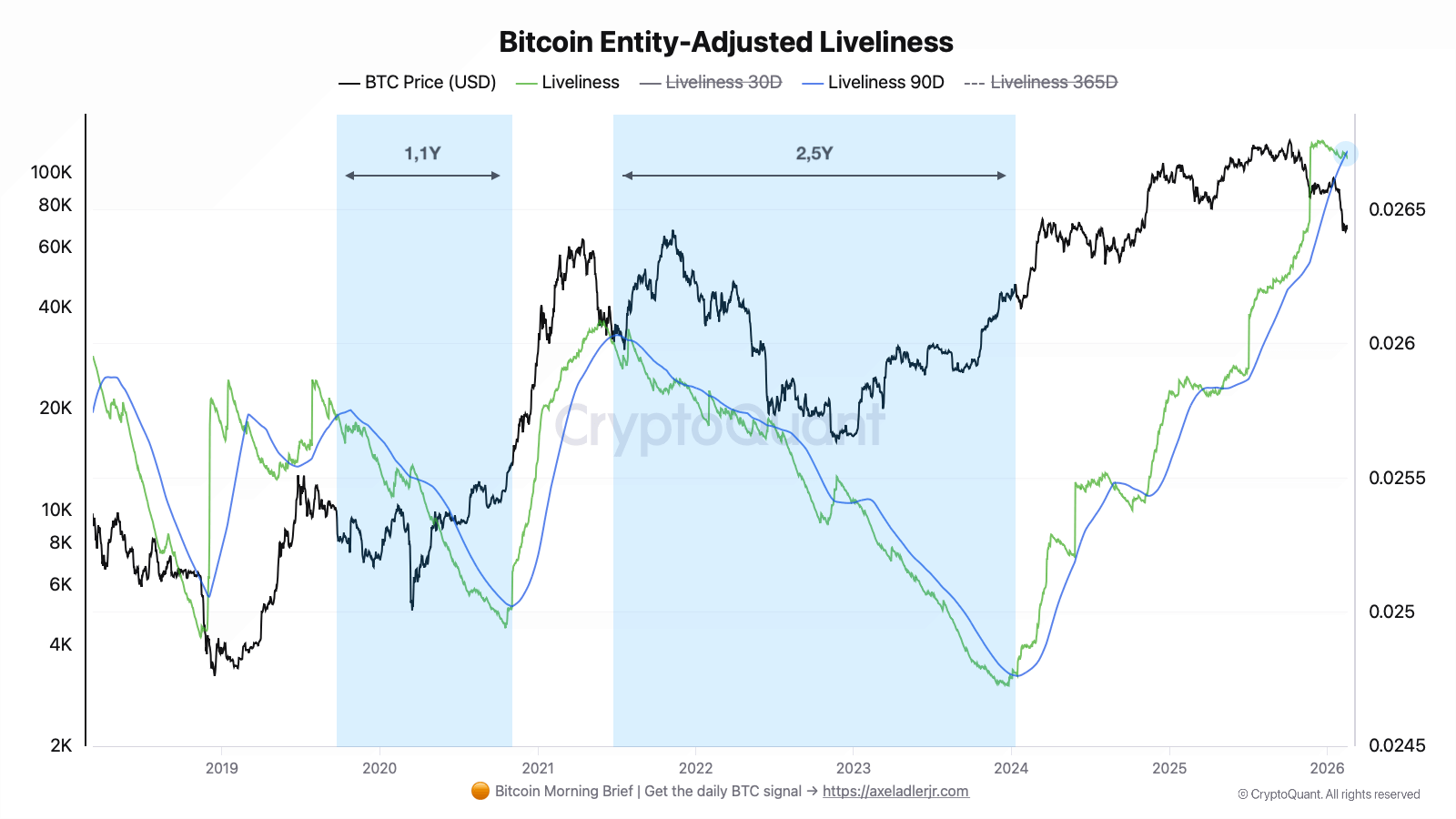
Bitcoin Entity-Adjusted Liveliness | Source: CryptoQuant

Although Bitcoin reached roughly $125,000 in October 2025, liveliness continued rising for two additional months, peaking near 0.02676 in December, a typical lag for cumulative on-chain metrics. As of mid-February 2026, the indicator has eased to about 0.02669, already below both its 30-day and 90-day moving averages, which now act as overhead resistance. This configuration historically reflects declining spending activity among long-term holders.

Previous cycles show comparable structures. Accumulation phases beginning in 2020 lasted about 1.1 years, while the 2022–2024 period extended roughly 2.5 years. If this pattern repeats, accumulation could persist into late 2026 or even mid-2027. Confirmation would likely require the 90-day average to roll over decisively below the 365-day trend, signaling a fully established structural transition.


Trending Cryptos

Related Questions

QWhat is the Entity-Adjusted Liveliness metric and what does it indicate about Bitcoin's market cycle?

AThe Entity-Adjusted Liveliness metric tracks long-term coin activity relative to holding behavior by measuring the ratio of coin days destroyed to coin days created while filtering internal entity transfers. A downward trend in this metric historically signals that distribution phases are ending and accumulation periods are beginning, indicating a transition in long-term holder behavior.

QAccording to the analyst, what does the recent peak and subsequent decline in the Liveliness metric suggest about Bitcoin's market phase?

AThe Liveliness metric peaked at approximately 0.02676 in December 2025, about two months after Bitcoin's all-time high, and has since begun trending downward. This pattern is historically associated with a transition from distribution toward accumulation, suggesting the market may be entering an early-stage restructuring phase rather than experiencing an imminent recovery.

QHow long did previous Bitcoin accumulation phases last according to the article, and what might this imply for the current cycle?

APrevious accumulation phases lasted roughly 1.1 years (2020) and 2.5 years (2022-2024). If this pattern repeats, the current accumulation phase could persist into late 2026 or even mid-2027.

QWhat price levels does the article mention regarding Bitcoin's recent all-time high and subsequent correction?

ABitcoin reached an all-time high near $125,000 in October 2025, then corrected sharply downward toward the $60,000 region within weeks.

QWhat confirmation would indicate a fully established structural transition to an accumulation phase according to the on-chain data?

AConfirmation would require the 90-day moving average of the Entity-Adjusted Liveliness metric to roll over decisively below the 365-day trend, signaling declining spending activity among long-term holders and a complete structural transition.

Related Reads

Has Bitcoin Bottomed, or Is a 'Shakeout' Approaching? What's the Situation with XRP?

Cryptocurrency analytics platform Santiment shared key insights on Bitcoin and altcoin markets, highlighting significant signals from on-chain data. Analysis shows Bitcoin's 365-day MVRV ratio has fallen to -26%, indicating substantial losses for long-term holders, a level historically associated with market bottom formations and long-term buying opportunities. While short-term MVRV is near breakeven, suggesting no clear directional signal, the annual perspective points to a bottom before bullish cycles. On-chain data reveals divergent behavior: large wallets (10-10,000 BTC) have been accumulating, adding ~18,500 BTC in 10 days, while smaller retail investors continue buying dips. Analysts caution that high retail demand can sometimes create a risk of a final market shakeout or correction. The altcoin market shows a mixed picture. Ethereum's 365-day MVRV is around -33%, but recent monthly gains combined with overly optimistic social sentiment pose a short-term correction risk. XRP is in oversold territory with 30-day and 365-day MVRVs at -57.5% and -45.5% respectively, signaling potential for a strong mid-to-long term rebound. Social activity and optimism are rising for Solana, while investor sentiment remains calmer towards Cardano. Future direction for Bitcoin and altcoins depends not only on on-chain metrics but also on macroeconomic and regulatory developments. The Federal Reserve's interest rate decision and upcoming policy rulings are increasing market volatility expectations, while uncertainty around the U.S. Congressional clarity process continues to pressure pricing. *This is not investment advice.

cryptonews.ru1h ago

Has Bitcoin Bottomed, or Is a 'Shakeout' Approaching? What's the Situation with XRP?

cryptonews.ru1h ago

Bank of Korea Reveals Results of Tokenized Deposit Testing

The Bank of Korea has announced the results of its pilot test for tokenized deposits. Involving 28 central banks and international financial organizations, the project saw participation from major South Korean banks including KB Kookmin Bank, NH NongHyup Bank, Shinhan Bank, Woori Bank, and Hana Bank. Transactions, from payment orders to final settlement, were completed in real time, averaging just 80 seconds. The test involved 30 transactions across 17 different scenarios—such as corporate and interbank transfers—and was conducted in six currencies, including the Korean won, US dollar, and euro, with a total transaction value reaching approximately $995,000. The central bank reported that the platform operated stably throughout, despite being only partially connected to the existing banking infrastructure. Settlements using tokenized deposits were executed seamlessly, quickly, and transparently. An internal transfer of 20 million won (about $13,890) between NH NongHyup Bank and Shinhan Bank was also successfully processed via the Project Agora platform, which involved connecting to the Bank of Korea's CBDC test platform, Project Hangang. Additionally, KB Kookmin Bank and Japan's MUFG Bank tested cross-border payments using these deposit tokens—digital certificates issued by commercial banks within the pilot, not directly by the central bank. The Bank of Korea plans to continue testing payments with tokenized deposits. This follows last year's pledge by South Korean authorities to tighten regulations for won-based stablecoins, which will require approval from both the central bank and the Financial Services Commission.

cryptonews.ru3h ago

Bank of Korea Reveals Results of Tokenized Deposit Testing

cryptonews.ru3h ago

Trading

Spot

Hot Articles

What is $BITCOIN

DIGITAL GOLD ($BITCOIN): A Comprehensive Analysis Introduction to DIGITAL GOLD ($BITCOIN) DIGITAL GOLD ($BITCOIN) is a blockchain-based project operating on the Solana network, which aims to combine the characteristics of traditional precious metals with the innovation of decentralized technologies. While it shares a name with Bitcoin, often referred to as “digital gold” due to its perception as a store of value, DIGITAL GOLD is a separate token designed to create a unique ecosystem within the Web3 landscape. Its goal is to position itself as a viable alternative digital asset, although specifics regarding its applications and functionalities are still developing. What is DIGITAL GOLD ($BITCOIN)? DIGITAL GOLD ($BITCOIN) is a cryptocurrency token explicitly designed for use on the Solana blockchain. In contrast to Bitcoin, which provides a widely recognized value storage role, this token appears to focus on broader applications and characteristics. Notable aspects include: Blockchain Infrastructure: The token is built on the Solana blockchain, known for its capacity to handle high-speed and low-cost transactions. Supply Dynamics: DIGITAL GOLD has a maximum supply capped at 100 quadrillion tokens (100P $BITCOIN), although details regarding its circulating supply are currently undisclosed. Utility: While precise functionalities are not explicitly outlined, there are indications that the token could be utilized for various applications, potentially involving decentralized applications (dApps) or asset tokenization strategies. Who is the Creator of DIGITAL GOLD ($BITCOIN)? At present, the identity of the creators and development team behind DIGITAL GOLD ($BITCOIN) remains unknown. This situation is typical among many innovative projects within the blockchain space, particularly those aligning with decentralized finance and meme coin phenomena. While such anonymity may foster a community-driven culture, it intensifies concerns about governance and accountability. Who are the Investors of DIGITAL GOLD ($BITCOIN)? The available information indicates that DIGITAL GOLD ($BITCOIN) does not have any known institutional backers or prominent venture capital investments. The project seems to operate on a peer-to-peer model focused on community support and adoption rather than traditional funding routes. Its activity and liquidity are primarily situated on decentralized exchanges (DEXs), such as PumpSwap, rather than established centralized trading platforms, further highlighting its grassroots approach. How DIGITAL GOLD ($BITCOIN) Works The operational mechanics of DIGITAL GOLD ($BITCOIN) can be elaborated on based on its blockchain design and network attributes: Consensus Mechanism: By leveraging Solana’s unique proof-of-history (PoH) combined with a proof-of-stake (PoS) model, the project ensures efficient transaction validation contributing to the network's high performance. Tokenomics: While specific deflationary mechanisms have not been extensively detailed, the vast maximum token supply implies that it may cater to microtransactions or niche use cases that are still to be defined. Interoperability: There exists the potential for integration with Solana’s broader ecosystem, including various decentralized finance (DeFi) platforms. However, the details regarding specific integrations remain unspecified. Timeline of Key Events Here is a timeline that highlights significant milestones concerning DIGITAL GOLD ($BITCOIN): 2023: The initial deployment of the token occurs on the Solana blockchain, marked by its contract address. 2024: DIGITAL GOLD gains visibility as it becomes available for trading on decentralized exchanges like PumpSwap, allowing users to trade it against SOL. 2025: The project witnesses sporadic trading activity and potential interest in community-led engagements, although no noteworthy partnerships or technical advancements have been documented as of yet. Critical Analysis Strengths Scalability: The underlying Solana infrastructure supports high transaction volumes, which could enhance the utility of $BITCOIN in various transaction scenarios. Accessibility: The potential low trading price per token could attract retail investors, facilitating wider participation due to fractional ownership opportunities. Risks Lack of Transparency: The absence of publicly known backers, developers, or an audit process may yield skepticism regarding the project's sustainability and trustworthiness. Market Volatility: The trading activity is heavily reliant on speculative behavior, which can result in significant price volatility and uncertainty for investors. Conclusion DIGITAL GOLD ($BITCOIN) emerges as an intriguing yet ambiguous project within the rapidly evolving Solana ecosystem. While it attempts to leverage the “digital gold” narrative, its departure from Bitcoin's established role as a store of value underscores the need for a clearer differentiation of its intended utility and governance structure. Future acceptance and adoption will likely depend on addressing the current opacity and defining its operational and economic strategies more explicitly. Note: This report encompasses synthesised information available as of October 2023, and developments may have transpired beyond the research period.

1.3k Total ViewsPublished 2025.05.13Updated 2025.05.13

What is $BITCOIN

Discussions

Welcome to the HTX Community. Here, you can stay informed about the latest platform developments and gain access to professional market insights. Users' opinions on the price of BTC (BTC) are presented below.

活动图片













