Bitcoin Depot names new CEO as revenue faces 40% drop risk

ambcryptoPublished on 2026-03-27Last updated on 2026-03-27

Abstract

Bitcoin Depot Inc. (BTM), North America's largest Bitcoin ATM operator, has appointed Alex Holmes, former CEO of MoneyGram, as its new CEO following the resignation of Scott Buchanan. Co-founder Brandon Mintz also stepped down as executive chairman but remains on the board. These changes were part of a pre-planned executive transition from November 2025. The company faces significant challenges, with Yahoo Finance projecting a 30-40% revenue decline in 2026 due to regulatory pressures, including operational suspensions in states like Connecticut over high fees and consumer protection issues. Revenue fell sharply in Q4 2025, and Q1 2026 EPS is estimated at -0.69. BTM stock, trading at $2.62, has been declining for over nine months and has lost its correlation with Bitcoin’s price, currently at a negative 0.30 coefficient. The stock must break out of its descending channel to signal a potential recovery.

Bitcoin Depot Inc. [Nasdaq: BTM] is North America’s largest operator of Bitcoin ATMs, with over 9,000 machines across the United States and Canada. However, the company recently announced changes to its executive team.

Amidst continuous regulatory concerns for Bitcoin Depot, Scott Buchanan resigned, and Alex Holmes, a former CEO of MoneyGram, was named the new CEO. Holmes emphasized that he wanted to improve operations and make sure that rules were followed.

In addition, Brandon Mintz, a co-founder, resigned from his position as executive chairman to serve on the board of directors. They implemented the changes in accordance with an earlier plan from November 2025.

What’s fueling the 30% revenue decline projection?

However, Yahoo Finance’s analysis estimates a 30% to 40% decline in revenue in 2026 due to regulatory issues. For instance, Connecticut suspended BTM operations in the state. The suspension was a result of excessive fees and failure to refund those defrauded.

In the first three quarters of 2025, BTM managed to record more than $150 million, but the fourth quarter earnings declined by about $50 million. Notably, earnings per share for Q1 2026 were estimated at negative 0.69.
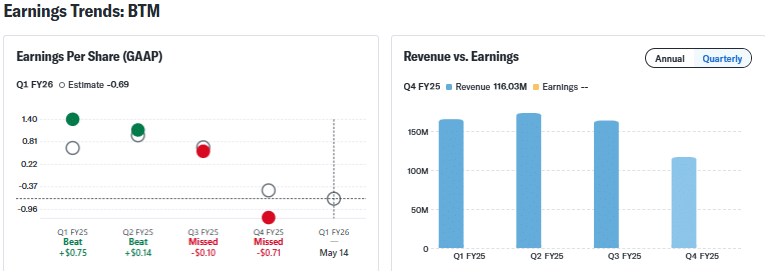
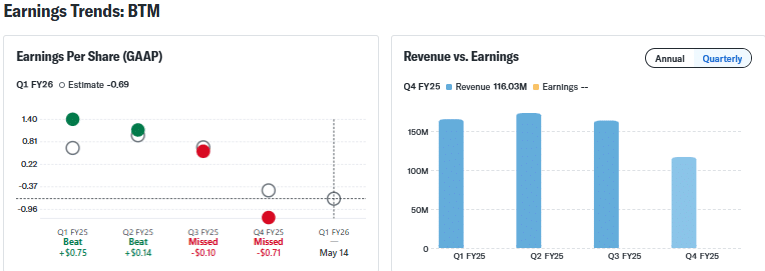
Source: Yahoo Finance

To be specific, BTM’s average estimate for Q1 2026 ranged between $98 million and $133 million. The continuous loss of revenue since the end of the third quarter in 2025 has contributed to the decline in price of BTM since mid-June.

BTM stock losing correlation with BTC price

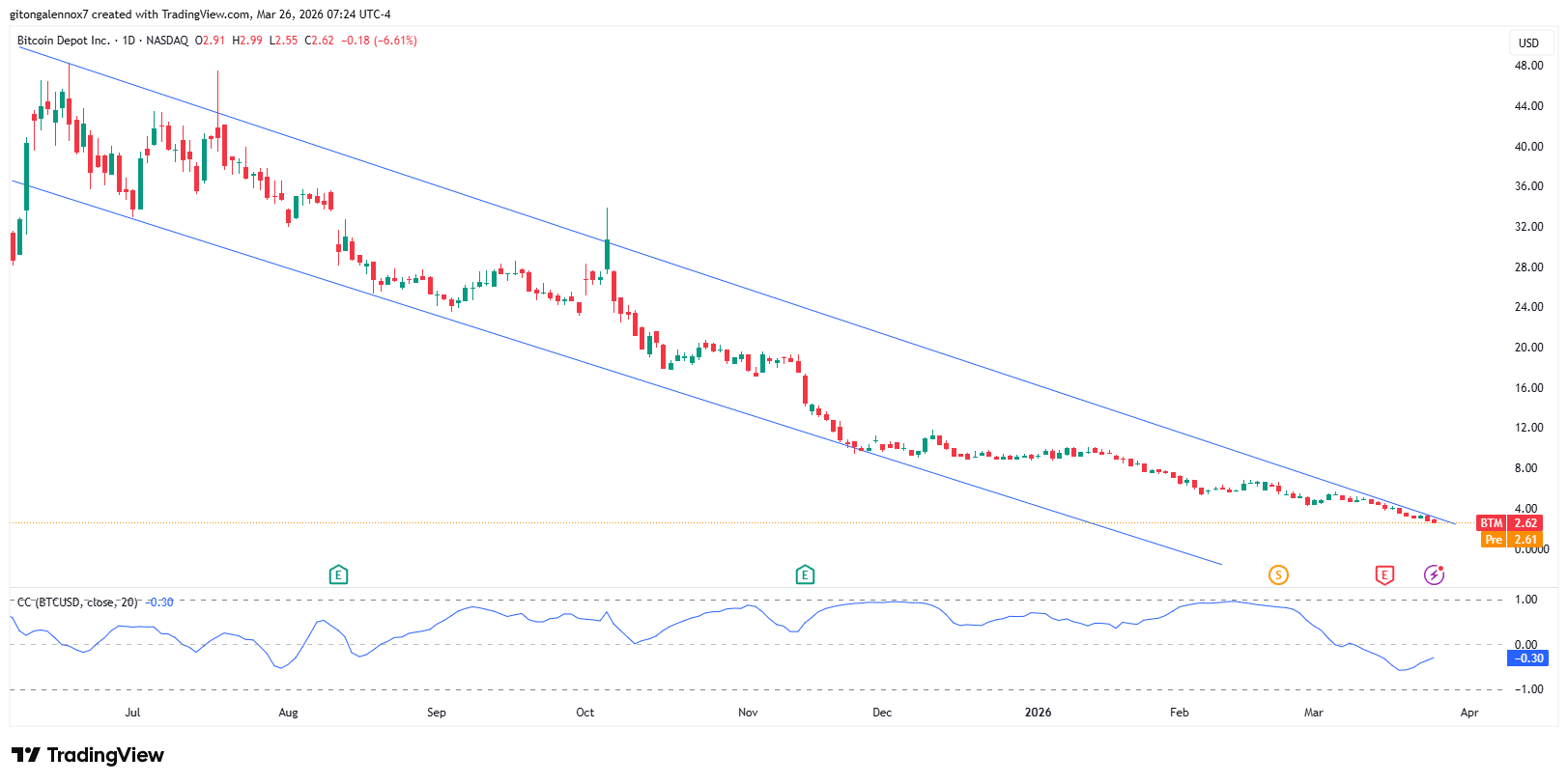
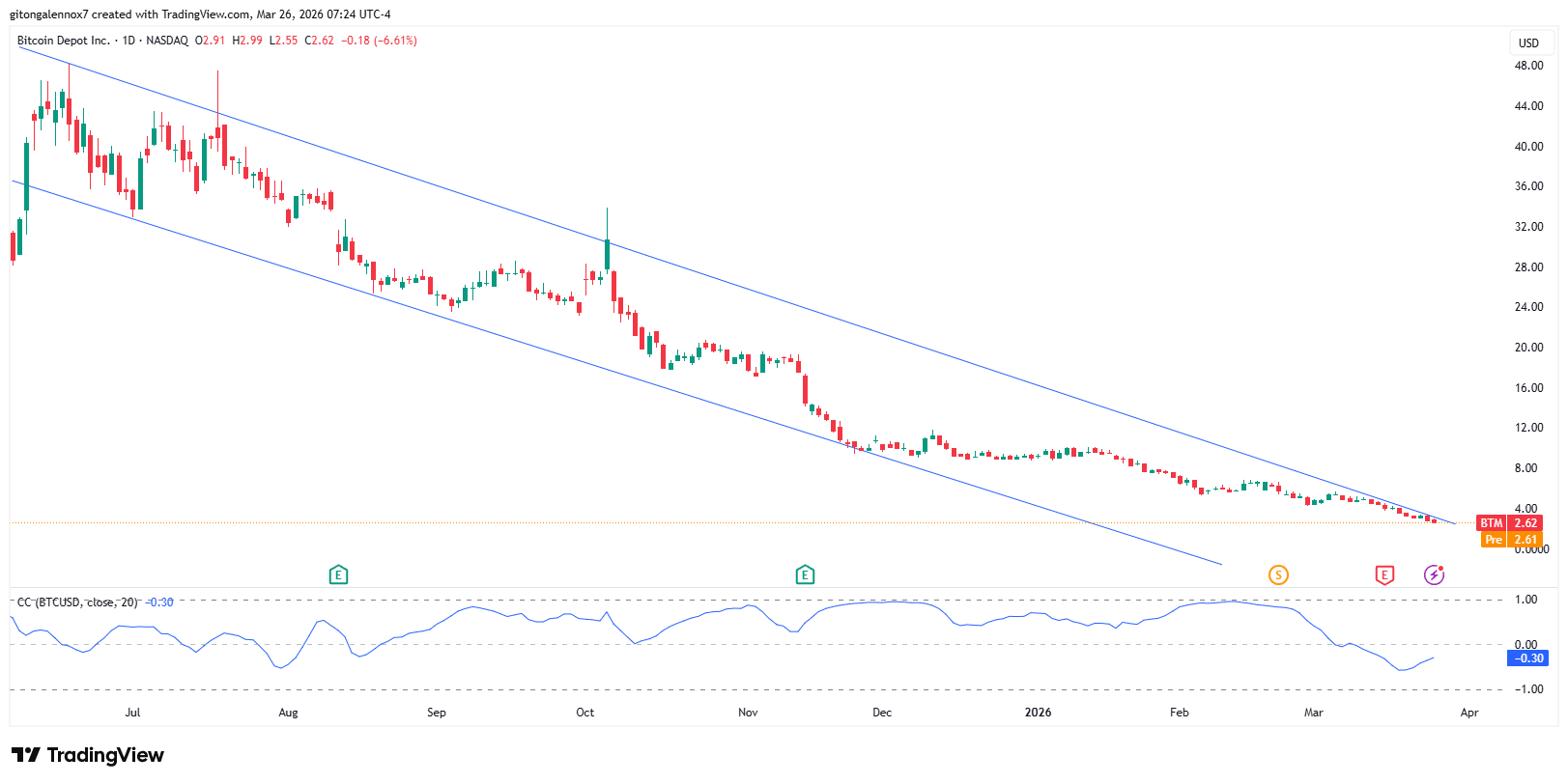
The price action of Bitcoin Depot stock has been trending down a channel for more than nine months. BTM stock was at $2.62 as of writing.

The stock has lost its correlation with the Bitcoin [BTC] price, with the coefficient at negative 0.30. This explains why the Bitcoin price has been rising recently while the firm’s stock has been declining.
Source: BTM/USD on TradingView

Every time BTM has hit the resistance of the channel, it has resulted in a lower low, though it has been bouncing off its slanting support level. For the price to be bullish, the stock has to break and stay above the descending channel.


Final Summary

  • Bitcoin Depot has changed its top executives following a memo dated November 2025.
  • BTM projects a decline of 30% in revenue, which has been evident in its stock price.

Trending Cryptos

Related Questions

QWho is the new CEO of Bitcoin Depot and what is his background?

AAlex Holmes, the former CEO of MoneyGram, has been named the new CEO of Bitcoin Depot.

QWhat is the projected revenue decline for Bitcoin Depot in 2026 and why?

AYahoo Finance's analysis estimates a 30% to 40% decline in revenue in 2026, primarily due to regulatory issues, such as the suspension of operations in Connecticut over excessive fees and failure to refund fraud victims.

QWhat was the correlation coefficient between BTM stock and Bitcoin's price, and what does it indicate?

AThe correlation coefficient was negative 0.30, indicating that BTM stock has lost its positive correlation with Bitcoin's price, which is why the stock has been declining even as Bitcoin's price has been rising.

QWhat significant change occurred with co-founder Brandon Mintz?

ABrandon Mintz resigned from his position as executive chairman to serve on the company's board of directors.

QWhat is the current stock price trend for Bitcoin Depot (BTM) and what must happen for it to become bullish?

ABTM stock has been trending downward in a descending channel for over nine months. For the price to become bullish, the stock must break and stay above this descending channel.

Related Reads

From South Korea to the United States: Blue-Collar Jobs Are Becoming Increasingly Popular, Thanks to AI

AI is reshaping the labor market's value proposition. The traditional four-year college degree is losing its appeal as a guaranteed career path, while skilled blue-collar trades like electricians, welders, and plumbers are experiencing historic demand and wage premiums. This shift is driven by dual pressures: AI's displacement of certain white-collar roles and a booming need for physical infrastructure and data center construction. Data confirms the trend. In the U.S., vocational school revenue surged, and a significant portion of recent layoffs are AI-related. Surveys show a majority of Gen Z adults plan to pursue blue-collar work, citing better job security against AI automation. Vocational education interest has exploded recently. Experts cite a psychological shift as younger generations seek tangible, AI-resistant careers and avoid high student debt. In many cases, salaries for skilled trades now match or exceed those requiring a bachelor's degree. In South Korea, semiconductor vocational high schools boast near-total employment, with graduates securing high-paying roles at companies like Samsung. The shortage is structural, exacerbated by a retiring baby boomer workforce and massive infrastructure projects. Companies like JPMorgan Chase, Meta, and Lowe's are investing heavily in training programs. However, overcoming historical stigma and a "perception gap" around trade careers remains a key challenge to closing the talent gap.

marsbit51m ago

From South Korea to the United States: Blue-Collar Jobs Are Becoming Increasingly Popular, Thanks to AI

marsbit51m ago

Qualcomm: AI Hype Subsides, When Will Smartphones Emerge from the Gloom?

Qualcomm reported its Q3 FY2026 results (ending June 2026), with revenue of $9.95B, down 4% YoY but above expectations. Gross margin declined to 53.1%, pressured by rising costs across manufacturing and memory. Key business segments showed mixed performance: Handset revenue fell 19.6% YoY to $5.09B, dragged by an 11% decline in non-Apple Android shipments and weaker high-end mix. Conversely, Automotive revenue surged 61% to $1.59B, and IoT grew 9% to $1.83B. Core operating profit dropped 41% YoY due to margin compression and higher expenses. Management's Q4 FY2026 guidance projects revenue of $9.7B-$10.5B, in line with consensus, but Non-GAAP EPS guidance of $2.05-$2.25 fell short of expectations. Amidst persistent weakness in its core handset market, Qualcomm is pursuing growth in AI, focusing on Edge AI (smartphones, PCs, automotive) and Data Center AI. Its data center strategy includes four pillars: AI accelerators (e.g., AI200), commercial CPUs (Dragonfly C1000), custom silicon, and connectivity solutions. While these initiatives initially boosted its stock, concerns over AI capital expenditure sustainability have since erased those gains. The company targets $5B in data center revenue for FY2027 and $15B for FY2029. The report concludes that with the traditional handset business still under pressure, the data center opportunity is currently viewed as a longer-term option, and a more conservative valuation based on core operations may be warranted until AI contributions materialize.

marsbit56m ago

Qualcomm: AI Hype Subsides, When Will Smartphones Emerge from the Gloom?

marsbit56m ago

From TPU to Self-Evolving Agents: How Jeff Dean Predicts the Next Step in AI

At the 2026 YC Startup School, Jeff Dean outlined his vision for AI's next phase, shifting focus from simply scaling models to building intelligent, autonomous systems. He believes AI's progress is no longer just about creating smarter models, but about integrating them into systems capable of long-term, iterative work, automated experimentation, and continuous learning. This evolution moves the competition from "who has the bigger model" to "who can best organize intelligence." Dean suggests AI capabilities are now comparable to a junior engineer, enabling the automation of complex workflows. However, the true challenge and opportunity lie in managing these AI "workers" at scale. He emphasizes the importance of **context engineering**—structuring tools, memory, and feedback loops—over raw model power. For startups, this means building deep expertise in niche domains where general models currently fail (near 0-1% success rates), leveraging proprietary data, specialized tools, and domain-specific evaluators. A recurring theme is re-examining fundamental constraints. Dean's past work, like moving Google's search index to memory or creating the TPU, stemmed from questioning outdated assumptions about hardware and cost. He sees similar inflection points today, particularly in **specialized inference hardware** to drastically reduce latency and energy consumption for real-time Agent operation. Notably, he points out that in modern AI systems, the dominant cost is often not computation but **data movement**. Reliable, long-running Agents require robust system design, borrowing concepts from distributed computing like checkpointing, state management, and parallel exploration to handle failures and maintain progress over days or weeks. As AI automates execution, the scarcest human skills will shift to **defining clear specifications**, **judging what problems are worth solving** (taste), and designing effective feedback loops. Ultimately, Dean's framework prioritizes understanding the problem deeply, identifying the true bottlenecks, and systematically building closed-loop systems where AI can not only perform tasks but also improve AI itself.

marsbit56m ago

From TPU to Self-Evolving Agents: How Jeff Dean Predicts the Next Step in AI

marsbit56m ago

Trading

Spot

Hot Articles

What is $BITCOIN

DIGITAL GOLD ($BITCOIN): A Comprehensive Analysis Introduction to DIGITAL GOLD ($BITCOIN) DIGITAL GOLD ($BITCOIN) is a blockchain-based project operating on the Solana network, which aims to combine the characteristics of traditional precious metals with the innovation of decentralized technologies. While it shares a name with Bitcoin, often referred to as “digital gold” due to its perception as a store of value, DIGITAL GOLD is a separate token designed to create a unique ecosystem within the Web3 landscape. Its goal is to position itself as a viable alternative digital asset, although specifics regarding its applications and functionalities are still developing. What is DIGITAL GOLD ($BITCOIN)? DIGITAL GOLD ($BITCOIN) is a cryptocurrency token explicitly designed for use on the Solana blockchain. In contrast to Bitcoin, which provides a widely recognized value storage role, this token appears to focus on broader applications and characteristics. Notable aspects include: Blockchain Infrastructure: The token is built on the Solana blockchain, known for its capacity to handle high-speed and low-cost transactions. Supply Dynamics: DIGITAL GOLD has a maximum supply capped at 100 quadrillion tokens (100P $BITCOIN), although details regarding its circulating supply are currently undisclosed. Utility: While precise functionalities are not explicitly outlined, there are indications that the token could be utilized for various applications, potentially involving decentralized applications (dApps) or asset tokenization strategies. Who is the Creator of DIGITAL GOLD ($BITCOIN)? At present, the identity of the creators and development team behind DIGITAL GOLD ($BITCOIN) remains unknown. This situation is typical among many innovative projects within the blockchain space, particularly those aligning with decentralized finance and meme coin phenomena. While such anonymity may foster a community-driven culture, it intensifies concerns about governance and accountability. Who are the Investors of DIGITAL GOLD ($BITCOIN)? The available information indicates that DIGITAL GOLD ($BITCOIN) does not have any known institutional backers or prominent venture capital investments. The project seems to operate on a peer-to-peer model focused on community support and adoption rather than traditional funding routes. Its activity and liquidity are primarily situated on decentralized exchanges (DEXs), such as PumpSwap, rather than established centralized trading platforms, further highlighting its grassroots approach. How DIGITAL GOLD ($BITCOIN) Works The operational mechanics of DIGITAL GOLD ($BITCOIN) can be elaborated on based on its blockchain design and network attributes: Consensus Mechanism: By leveraging Solana’s unique proof-of-history (PoH) combined with a proof-of-stake (PoS) model, the project ensures efficient transaction validation contributing to the network's high performance. Tokenomics: While specific deflationary mechanisms have not been extensively detailed, the vast maximum token supply implies that it may cater to microtransactions or niche use cases that are still to be defined. Interoperability: There exists the potential for integration with Solana’s broader ecosystem, including various decentralized finance (DeFi) platforms. However, the details regarding specific integrations remain unspecified. Timeline of Key Events Here is a timeline that highlights significant milestones concerning DIGITAL GOLD ($BITCOIN): 2023: The initial deployment of the token occurs on the Solana blockchain, marked by its contract address. 2024: DIGITAL GOLD gains visibility as it becomes available for trading on decentralized exchanges like PumpSwap, allowing users to trade it against SOL. 2025: The project witnesses sporadic trading activity and potential interest in community-led engagements, although no noteworthy partnerships or technical advancements have been documented as of yet. Critical Analysis Strengths Scalability: The underlying Solana infrastructure supports high transaction volumes, which could enhance the utility of $BITCOIN in various transaction scenarios. Accessibility: The potential low trading price per token could attract retail investors, facilitating wider participation due to fractional ownership opportunities. Risks Lack of Transparency: The absence of publicly known backers, developers, or an audit process may yield skepticism regarding the project's sustainability and trustworthiness. Market Volatility: The trading activity is heavily reliant on speculative behavior, which can result in significant price volatility and uncertainty for investors. Conclusion DIGITAL GOLD ($BITCOIN) emerges as an intriguing yet ambiguous project within the rapidly evolving Solana ecosystem. While it attempts to leverage the “digital gold” narrative, its departure from Bitcoin's established role as a store of value underscores the need for a clearer differentiation of its intended utility and governance structure. Future acceptance and adoption will likely depend on addressing the current opacity and defining its operational and economic strategies more explicitly. Note: This report encompasses synthesised information available as of October 2023, and developments may have transpired beyond the research period.

1.4k Total ViewsPublished 2025.05.13Updated 2025.05.13

What is $BITCOIN

Discussions

Welcome to the HTX Community. Here, you can stay informed about the latest platform developments and gain access to professional market insights. Users' opinions on the price of BTC (BTC) are presented below.

活动图片















