Bitcoin deleverages after $13.45B expiry, but will weak demand stall recovery at $66K?

ambcryptoPublished on 2026-03-28Last updated on 2026-03-28

Abstract

Following a significant $13.45 billion options expiry, Bitcoin underwent a broad deleveraging event, with Open Interest dropping 42% and reducing gamma constraints. This reset eased liquidation risks and suppressed short-term volatility, allowing the price to stabilize near $66,300. However, the market remains in a state of extreme fear, with weak demand and cautious sentiment hindering a strong recovery. Futures Open Interest declined further, funding rates turned negative, and long/short ratios hovered near parity, reflecting low conviction. The current structure is cleaner but fragile, leaving Bitcoin highly sensitive to macroeconomic triggers and headline-driven moves. For sustained stability, stronger spot demand is essential; otherwise, the market remains vulnerable to renewed volatility.

As the markets headed for the weekend, Bitcoin [BTC] cleared $13.45 billion in contracts, removing dense short-term positioning and easing gamma constraints. As this overhang faded, the price slipped towards $65,500, reflecting risk aversion driven by geopolitical tension and extreme fear.
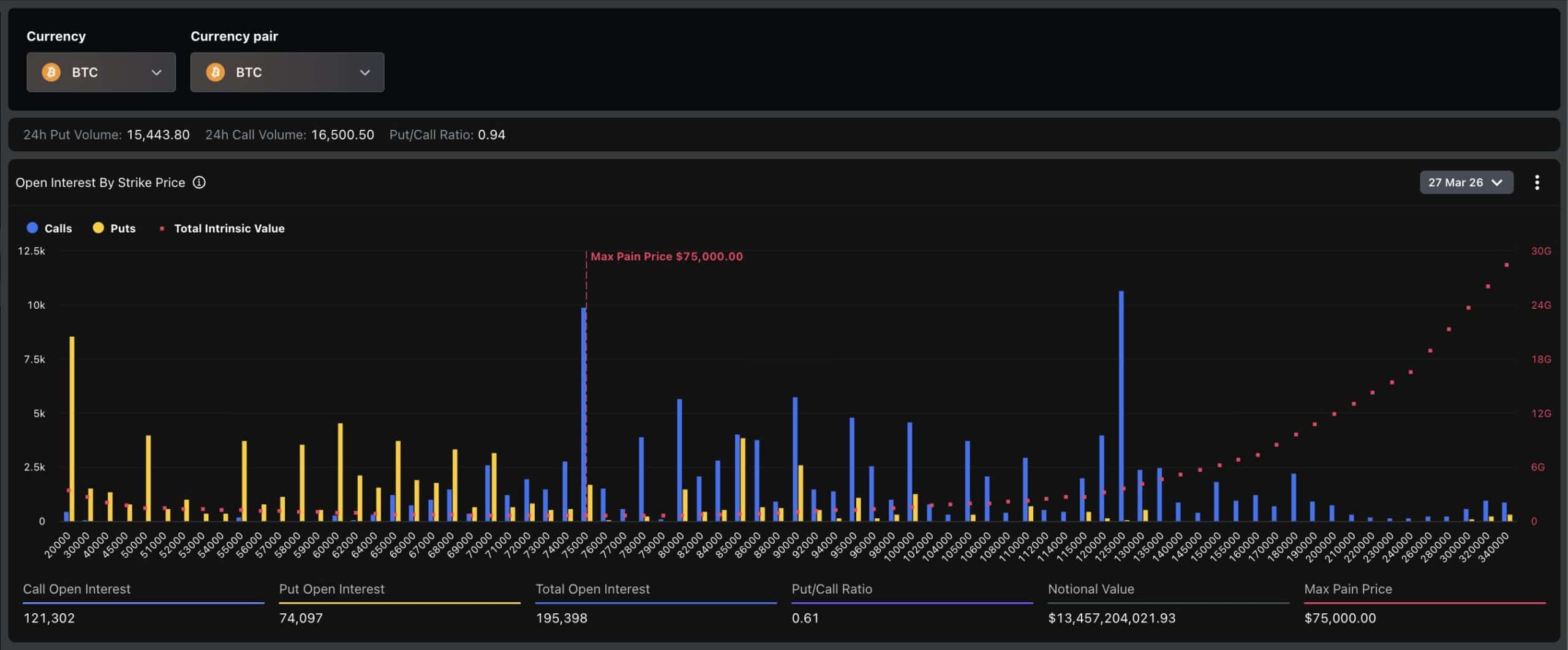
Source: Deribit

As pressure built, Open Interest fell by 42%, dropping from roughly 550,000 to 320,000 contracts after expiry.

This sharp contraction confirmed broad deleveraging across the board. Especially as traders closed positions, rather than triggering cascading liquidations.
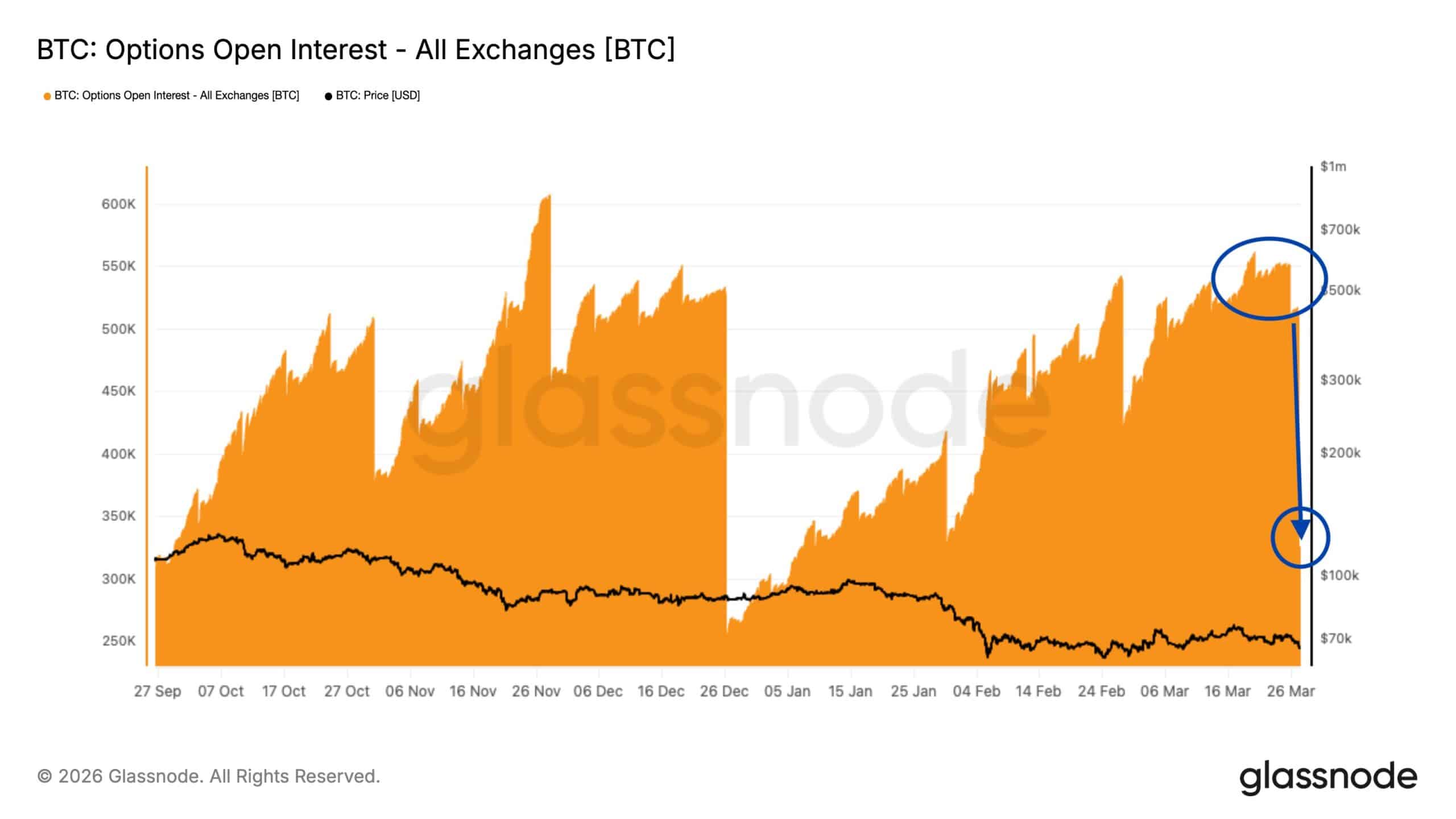
Source: Glassnode

As leverage reset, derivatives pressure declined into lower percentiles, reinforcing that speculative excess has been flushed from the system. The price then stabilized near $66,300, where buyers began absorbing supply within a cleaner, less crowded structure.

This stabilization is evidence of balance, not strength, as demand has so far been cautious under macro stress. With positioning reset, Bitcoin now enters a transitional phase where fresh flows will likely define the next volatility expansion or directional move.

Will low leverage suppress or unleash volatility?

Bitcoin’s derivatives structure reset after the 27 March expiry, leaving Futures Open Interest (OI) near $108.4 billion after a 0.58% decline. As leverage thinned, crowded positioning eased, which removed gamma constraints that had tightly pinned short-term price action.

As the OI declined, liquidation risk dropped. This typically suppresses realized volatility in the immediate post-expiry phase. This happens because fewer leveraged positions remain to trigger forced moves, allowing the price to stabilize within a calmer range.

With strikes clustered around $66,000–$67,000 and leverage rebuild still weak, Bitcoin now sits at a pivot where muted volatility can persist. And yet, any new positioning or macro trigger can quickly drive expansion.

Bitcoin in extreme fear as market awaits demand shift

Bitcoin’s post-expiry reset now shifts into a sentiment phase marked by sustained stress rather than recovery. At the time of writing, the Fear and Greed Index was holding between 11 and 12 for a third session – A sign of downside expectations.

Thanks to this caution, BTC Futures Open Interest dropped by another 3.33% to $50.06 billion – Extending the deleveraging trend. Such a sustained reduction lowers liquidation risk, but it also removes structural buffers that once softened volatility.
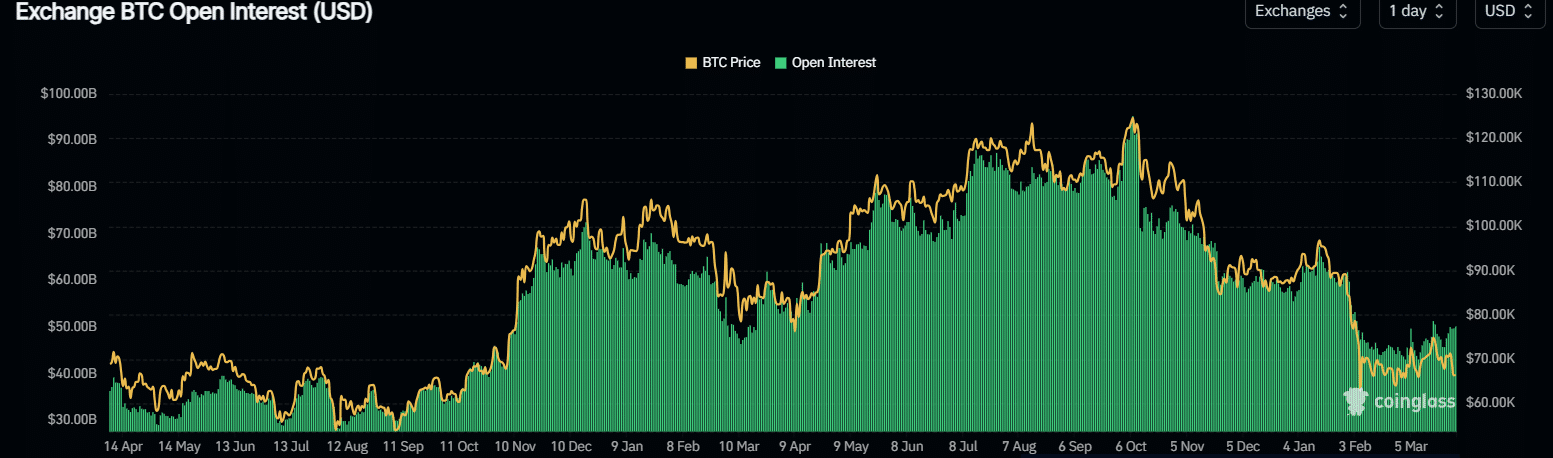
CoinGlass

Funding has been slightly negative, while long/short ratios hovered near parity, reinforcing weak conviction across participants. As geopolitical tension builds, this fragile positioning will leave the price increasingly sensitive to headline-driven moves.

Extreme fear alone cannot confirm a bottom without demand. If spot absorption fails to emerge, Bitcoin remains exposed to renewed volatility expansion.

Taken together, it can be argued that Bitcoin has reset its structure. However, conviction remains weak near $66,000. If spot absorption strengthens, recovery can stabilize. On the contrary, if leverage rebuilds first, volatility will likely expand, especially under macro pressure.


Final Summary

  • Bitcoin [BTC] cleared $13.45 billion expiry as Open Interest fell by 42%, reducing liquidation risk but leaving the price near $66,000 with weak demand.
  • Bitcoin now depends on spot absorption for stability, while leverage rebuild risks renewed volatility under macro pressure.


Trending Cryptos

Related Questions

QWhat was the total value of Bitcoin options contracts that expired, and what was the subsequent percentage drop in Open Interest?

A$13.45 billion in contracts expired, and Open Interest fell by 42%.

QTo what level did the price of Bitcoin slip after the expiry, and what was the primary reason for this risk aversion?

AThe price slipped towards $65,500, primarily due to risk aversion driven by geopolitical tension and extreme fear.

QWhat is the current reading on the Fear and Greed Index, and what does this signify for market expectations?

AThe Fear and Greed Index was holding between 11 and 12, which is a sign of extreme fear and downside expectations.

QAccording to the article, what two factors will define Bitcoin's next directional move after its structural reset?

AFresh flows and any new positioning or macro trigger will define the next volatility expansion or directional move.

QWhat is the key condition needed for Bitcoin's price recovery to stabilize at the $66,000 level?

AThe key condition is for spot absorption to strengthen; if leverage rebuilds first, it risks renewed volatility instead.

Related Reads

Within Strategy's Framework, STRC's Dividend Yield Remains at 12% as Share Price Stays Below Par Value

Michael Saylor, Executive Chairman of Strategy (MSTR), confirmed that the dividend rate for its STRC perpetual preferred shares will remain at 12.00% through August 2026. The rate has increased from 9% at its July 2025 launch to the current high via a "ratchet" mechanism, which permanently raises the rate by 0.5% whenever the share price falls below $95. This mechanism is intended to push the price back toward its $100 par value and support Strategy's "at-the-market" (ATM) program for issuing new shares to fund Bitcoin purchases. However, the mechanism has not worked as intended. STRC shares closed at $89.46 on July 31, remaining about 10-11% below par value despite the record-high dividend. Competition from rival Strive's higher-yielding SATA securities has pressured demand. The persistent discount has forced Strategy to suspend new STRC issuances via its ATM program, limiting this funding channel for Bitcoin acquisitions. STRC's struggles reflect Bitcoin's own volatility, as the preferred shares historically move in tandem. Analysts have warned the ratchet structure carries long-term, one-way risk. A law firm is investigating Strategy's ability to maintain dividend payments if Bitcoin's price stays low. Retail investors own roughly 83% of outstanding STRC shares, a group seen as prone to panic selling during downturns. In response, Strategy has established financial reserves, including a liquidity cushion covering about 26 months of dividend/interest obligations, and a $2 billion share buyback program alongside a Bitcoin monetization framework, though the company emphasized it is not obligated to sell any Bitcoin.

cryptonews.ru6m ago

Within Strategy's Framework, STRC's Dividend Yield Remains at 12% as Share Price Stays Below Par Value

cryptonews.ru6m ago

Analyst: Bitcoin's Price Will Drop to $60k in August, Then Rebound to $70k

Financial analyst Andrey Poroshin has provided a new forecast for Bitcoin's price dynamics in August. Poroshin, an analyst at the Bitbanker exchange, expects the cryptocurrency market to experience a downturn this month, with prices retesting the $60,000 level due to a lack of supportive macroeconomic catalysts. He noted that the recent US Federal Reserve decision to hold interest rates did not significantly impact the market, while inflation remains above the 2% target. Poroshin stated that Bitcoin is ending July under pressure from moderate volatility and a lack of new macroeconomic stimuli, leading to continued market caution. According to his base scenario, Bitcoin will drop to a range of $60,000 to $62,000 before recovering to $70,000. He pointed out that even $70,000 remains below the cost of mining in the US, which has prompted some miners to shift towards AI data center operations. Poroshin cited the winding down of BitMEX's operations as a potential catalyst for a price rebound, suggesting the exit of weaker players often coincides with market reversals and reduced short-term selling pressure. He believes Bitcoin is currently less susceptible to geopolitical shocks, such as the Iran-US conflict, and does not expect significant market changes in August related to the pending CLARITY Act. Looking ahead, Poroshin forecasts that September will bring more active price fluctuations driven by potential Fed rate decisions and possible discussions or approval of the CLARITY Act.

cryptonews.ru6m ago

Analyst: Bitcoin's Price Will Drop to $60k in August, Then Rebound to $70k

cryptonews.ru6m ago

Trading

Spot

Hot Articles

What is $BITCOIN

DIGITAL GOLD ($BITCOIN): A Comprehensive Analysis Introduction to DIGITAL GOLD ($BITCOIN) DIGITAL GOLD ($BITCOIN) is a blockchain-based project operating on the Solana network, which aims to combine the characteristics of traditional precious metals with the innovation of decentralized technologies. While it shares a name with Bitcoin, often referred to as “digital gold” due to its perception as a store of value, DIGITAL GOLD is a separate token designed to create a unique ecosystem within the Web3 landscape. Its goal is to position itself as a viable alternative digital asset, although specifics regarding its applications and functionalities are still developing. What is DIGITAL GOLD ($BITCOIN)? DIGITAL GOLD ($BITCOIN) is a cryptocurrency token explicitly designed for use on the Solana blockchain. In contrast to Bitcoin, which provides a widely recognized value storage role, this token appears to focus on broader applications and characteristics. Notable aspects include: Blockchain Infrastructure: The token is built on the Solana blockchain, known for its capacity to handle high-speed and low-cost transactions. Supply Dynamics: DIGITAL GOLD has a maximum supply capped at 100 quadrillion tokens (100P $BITCOIN), although details regarding its circulating supply are currently undisclosed. Utility: While precise functionalities are not explicitly outlined, there are indications that the token could be utilized for various applications, potentially involving decentralized applications (dApps) or asset tokenization strategies. Who is the Creator of DIGITAL GOLD ($BITCOIN)? At present, the identity of the creators and development team behind DIGITAL GOLD ($BITCOIN) remains unknown. This situation is typical among many innovative projects within the blockchain space, particularly those aligning with decentralized finance and meme coin phenomena. While such anonymity may foster a community-driven culture, it intensifies concerns about governance and accountability. Who are the Investors of DIGITAL GOLD ($BITCOIN)? The available information indicates that DIGITAL GOLD ($BITCOIN) does not have any known institutional backers or prominent venture capital investments. The project seems to operate on a peer-to-peer model focused on community support and adoption rather than traditional funding routes. Its activity and liquidity are primarily situated on decentralized exchanges (DEXs), such as PumpSwap, rather than established centralized trading platforms, further highlighting its grassroots approach. How DIGITAL GOLD ($BITCOIN) Works The operational mechanics of DIGITAL GOLD ($BITCOIN) can be elaborated on based on its blockchain design and network attributes: Consensus Mechanism: By leveraging Solana’s unique proof-of-history (PoH) combined with a proof-of-stake (PoS) model, the project ensures efficient transaction validation contributing to the network's high performance. Tokenomics: While specific deflationary mechanisms have not been extensively detailed, the vast maximum token supply implies that it may cater to microtransactions or niche use cases that are still to be defined. Interoperability: There exists the potential for integration with Solana’s broader ecosystem, including various decentralized finance (DeFi) platforms. However, the details regarding specific integrations remain unspecified. Timeline of Key Events Here is a timeline that highlights significant milestones concerning DIGITAL GOLD ($BITCOIN): 2023: The initial deployment of the token occurs on the Solana blockchain, marked by its contract address. 2024: DIGITAL GOLD gains visibility as it becomes available for trading on decentralized exchanges like PumpSwap, allowing users to trade it against SOL. 2025: The project witnesses sporadic trading activity and potential interest in community-led engagements, although no noteworthy partnerships or technical advancements have been documented as of yet. Critical Analysis Strengths Scalability: The underlying Solana infrastructure supports high transaction volumes, which could enhance the utility of $BITCOIN in various transaction scenarios. Accessibility: The potential low trading price per token could attract retail investors, facilitating wider participation due to fractional ownership opportunities. Risks Lack of Transparency: The absence of publicly known backers, developers, or an audit process may yield skepticism regarding the project's sustainability and trustworthiness. Market Volatility: The trading activity is heavily reliant on speculative behavior, which can result in significant price volatility and uncertainty for investors. Conclusion DIGITAL GOLD ($BITCOIN) emerges as an intriguing yet ambiguous project within the rapidly evolving Solana ecosystem. While it attempts to leverage the “digital gold” narrative, its departure from Bitcoin's established role as a store of value underscores the need for a clearer differentiation of its intended utility and governance structure. Future acceptance and adoption will likely depend on addressing the current opacity and defining its operational and economic strategies more explicitly. Note: This report encompasses synthesised information available as of October 2023, and developments may have transpired beyond the research period.

1.4k Total ViewsPublished 2025.05.13Updated 2025.05.13

What is $BITCOIN

Discussions

Welcome to the HTX Community. Here, you can stay informed about the latest platform developments and gain access to professional market insights. Users' opinions on the price of BTC (BTC) are presented below.

活动图片














