Bitcoin Briefly Falls Below $72,000: How Much Faith Remains in the Crypto World?

华尔街日报Published on 2026-02-05Last updated on 2026-02-05

Abstract

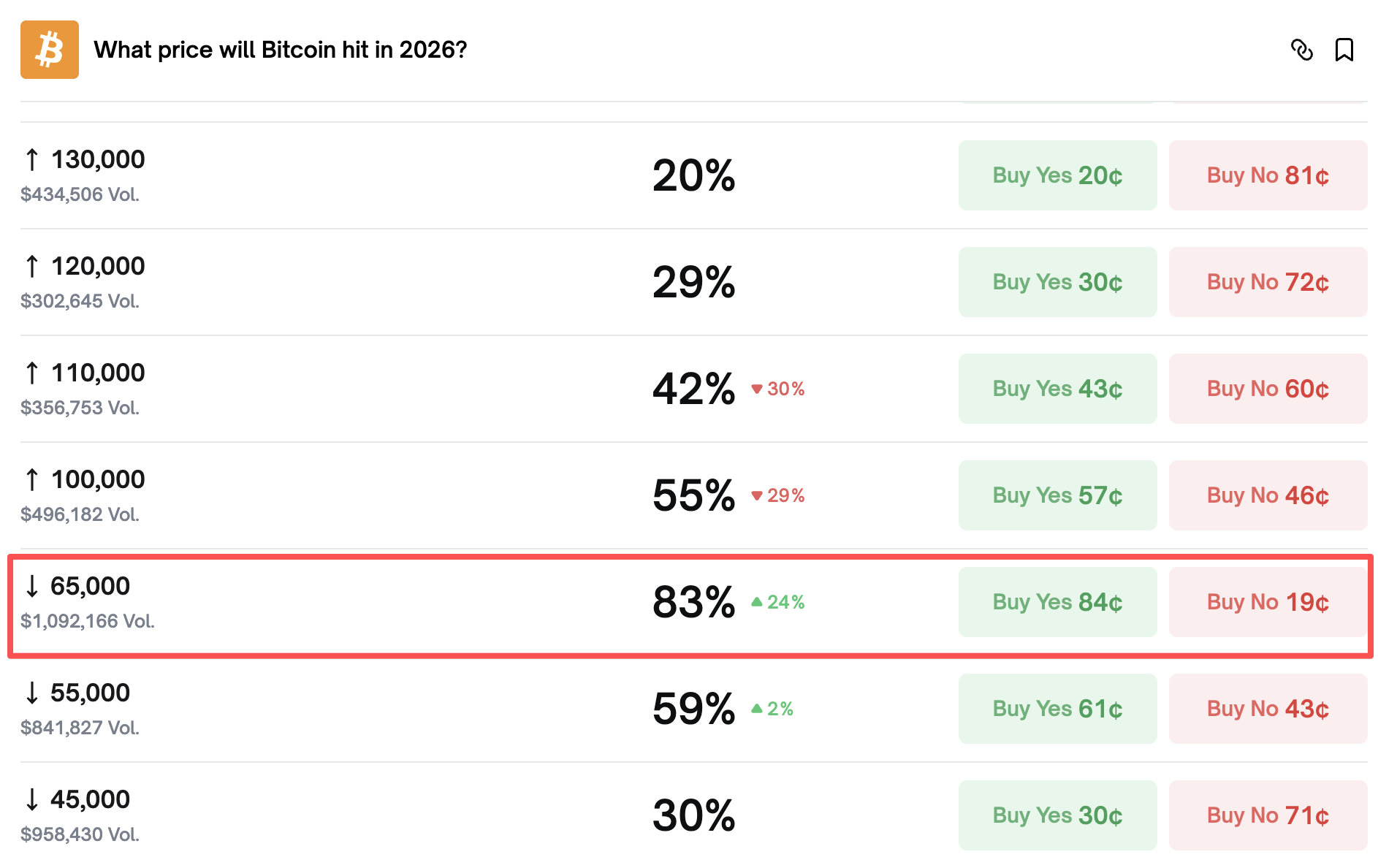
Bitcoin fell below the $72,000 mark, hitting its lowest level since November 2024 and deepening concerns over a "crisis of faith" in the cryptocurrency market. The decline, which saw Bitcoin drop over 42% from its October peak, is now driven by broader cross-asset selling pressure rather than just crypto-specific deleveraging. Global risk aversion intensified as the Nasdaq 100 fell more than 2%, with Bitcoin down in tandem—challenging its narrative as a safe-haven asset. Market sentiment has turned to "extreme fear," and analysts warn that if $72,000 fails to hold, Bitcoin could test $68,000 or even lower levels seen in early 2024. According to prediction markets, there is an 83% chance Bitcoin falls to $65,000 this year, and a 59% probability it drops below $55,000. ETF flows have been volatile, with inflows quickly reversing to outflows, reflecting unstable institutional interest. The crypto market has lost $1.7 trillion in value since its peak, raising questions about Bitcoin’s role during periods of market stress.

Bitcoin's drop below the $72,000 mark has brought the issue of 'faith' in the crypto market to the forefront. Against the backdrop of a sharp decline in global risk appetite, investors are reassessing Bitcoin's role during market turbulence, questioning the safe-haven narrative of crypto assets.

According to Bloomberg, Bitcoin fell to $71,739 at the close of trading in New York on Wednesday, marking the first time it dropped below $72,000 in about 15 months. Compared to its peak last October, Bitcoin has retreated by over 42%, with a year-to-date decline of approximately 17%, reaching its lowest level since November 6, 2024.
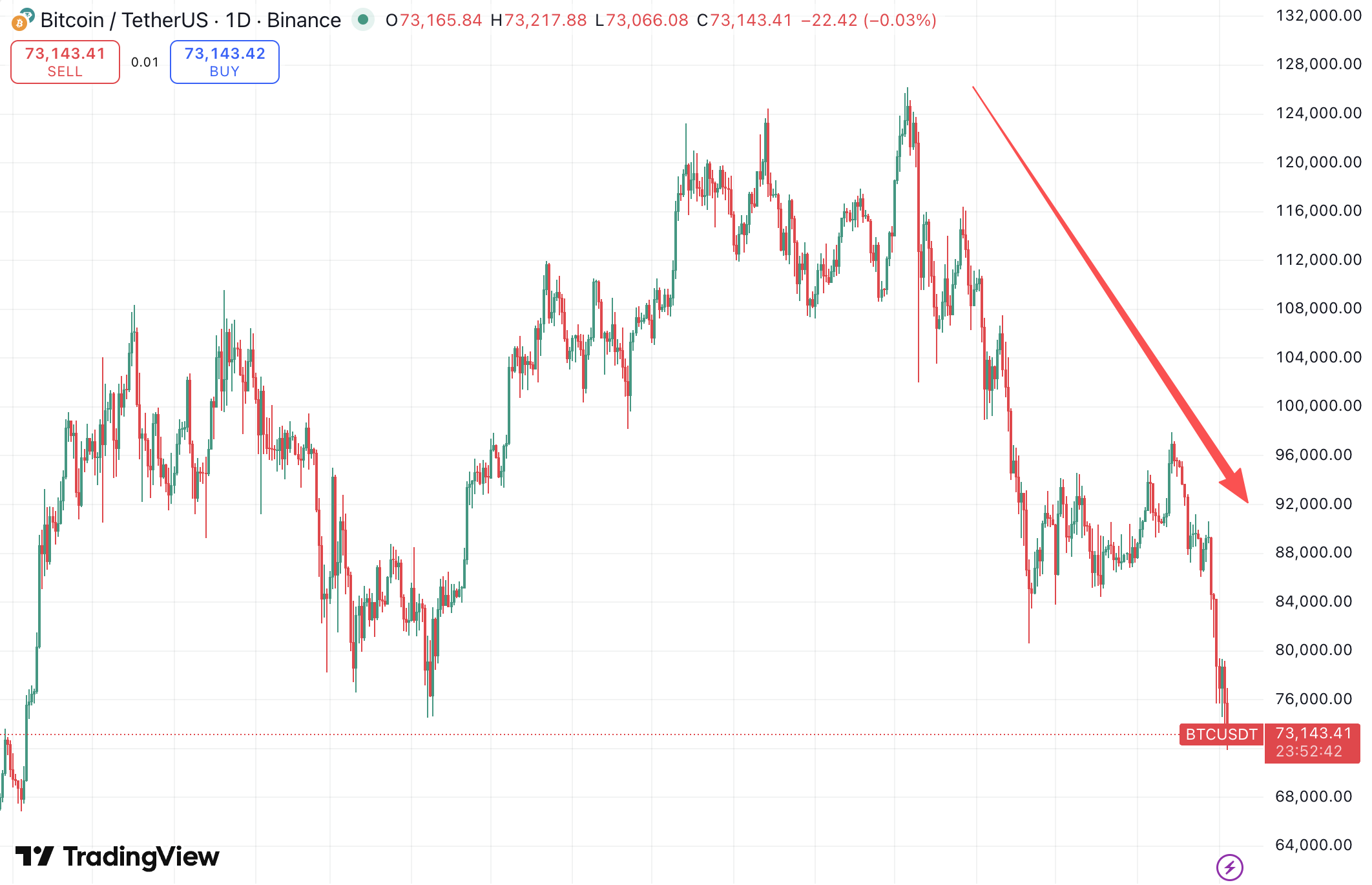
This round of selling is no longer just a continuation of internal deleveraging in the crypto market but is driven by broader cross-asset pressures. Global markets experienced synchronized selling on Wednesday, with the Nasdaq 100 Index falling over 2%. Sectors more sensitive to interest rates, such as software and chips, were under pressure, and Bitcoin weakened accordingly.

On the sentiment front, a 'crisis of faith' is emerging. Shiliang Tang, Managing Partner at Monarq Asset Management, stated that the market is experiencing a 'crisis of faith.'

Andrew Tu, Head of Business Development at Efficient Frontier, added that crypto market sentiment is now in 'extreme fear.' If the $72,000 level is breached, Bitcoin could fall to $68,000 or even return to the low range seen before the initial rebound in early 2024.

According to Polymarket, there is an 83% probability that Bitcoin will fall to $65,000 this year, while the probability of dropping below $55,000 has climbed to about 59%.
According to Bloomberg, the selling pressure on Bitcoin on Wednesday was related to broader cross-asset tensions rather than being solely driven by internal crypto asset liquidations. This sends a clear message to investors: during synchronized selling phases, Bitcoin has not demonstrated resilience independent of risk assets but instead behaves more like a high-volatility, long-tail risk asset.

The Nasdaq 100 Index fell over 2% on the same day, with losses spreading to sectors such as software and chips. Bitcoin's breach of a key psychological level during the same trading session reinforced its perception as moving in tandem with risk appetite.

Price declines are quickly transmitting through market capitalization contraction. According to CoinGecko data, the total market capitalization of crypto assets has shrunk by approximately $1.7 trillion since the peak last October. In the past week alone, the crypto market lost over $460 billion in value.

As the largest cryptocurrency, the extent and speed of Bitcoin's decline have an 'anchoring effect' on market sentiment. When Bitcoin's year-to-date losses widen to around 17%, risk control, margin management, and fund redemption pressures often rise simultaneously, exacerbating overall volatility.

Statements from market participants indicate that sentiment shifts are becoming a core variable. The 'crisis of faith' mentioned by Shiliang Tang points to investors' simultaneous wavering in both the long-term narrative of crypto assets and their short-term pricing mechanisms.

More critically, the driver of the decline has changed. According to Bloomberg, previous downturns were more driven by crypto-specific liquidations, whereas Wednesday's pressure stemmed from broader cross-market tensions.

This means that even if internal leverage unwinding in the crypto market concludes, Bitcoin may still lack catalysts for an independent rebound as long as external risk assets remain under pressure.

Several traders view the $72,000 level as a key short-term price point. Andrew Tu noted that if this level cannot be held, Bitcoin is 'very likely' to test $68,000 and could potentially return to the low range seen before the initial rebound in early 2024.

According to Polymarket, there is an 83% probability that Bitcoin will fall to $65,000 this year, while the probability of dropping below $55,000 has climbed to about 59%.

Fund flows are also sending mixed signals. According to data compiled by Bloomberg, U.S.-listed spot Bitcoin ETFs recorded approximately $562 million in net inflows on Monday but switched to $272 million in net outflows on Tuesday, indicating unstable incremental capital.

Amid the price decline and fluctuating fund flows, market skepticism about Bitcoin's role as a 'safe-haven asset during stress periods' is growing.


Related Questions

QWhat key psychological factor is emerging in the cryptocurrency market according to the article, and who commented on it?

AA 'crisis of faith' is emerging, as commented by Shiliang Tang, managing partner at Monarq Asset Management.

QWhat was the specific price level that Bitcoin fell below, and what is its significance as a potential support level?

ABitcoin fell below the $72,000 level, which is considered a critical short-term support. If it fails to hold, it could drop further to $68,000 or even lower.

QAccording to Polymarket data, what is the probability that Bitcoin will fall to $65,000 this year?

AAccording to Polymarket, there is an 83% probability that Bitcoin will fall to $65,000 this year.

QHow does the article describe the nature of the recent selling pressure on Bitcoin compared to previous downturns?

AThe recent selling pressure is described as being driven by broader cross-asset market tensions and a synchronous global sell-off, rather than being solely driven by internal crypto market liquidations as in previous downturns.

QWhat does the data from U.S. spot Bitcoin ETFs indicate about investor inflows during this period?

AThe data shows unstable investor inflows. The ETFs recorded a net inflow of approximately $562 million on Monday but switched to a net outflow of $272 million on Tuesday.

Related Reads

When AI Traffic Surpasses Humans, How Do You Prove You're Human?

As AI-generated web traffic now surpasses human activity, the internet's foundational business models—built on human attention, browsing, and advertising—face severe disruption. AI agents crawl websites at immense scale without generating ad revenue, while AI summaries divert traffic from original content sites. In response, over 2.5 million sites are blocking AI crawlers, and protections like Cloudflare's "honeypot" traps have emerged, though advanced AI can bypass these. The collapse of traditional CAPTCHAs, which assumed machines were weaker than humans, has led to a shift toward behavioral biometrics for human verification. Companies like IBM and BioCatch now analyze unique human patterns—cursor movements, typing rhythms, keystroke dynamics, and even cognitive delays like the Stroop effect—to distinguish real users from bots. These biometric signatures are difficult to fake or alter, offering a new layer of security but raising significant privacy concerns. Two competing visions for a reliable human verification system are emerging. One, exemplified by Sam Altman’s World (formerly Worldcoin), uses centralized iris scanning to generate unique credentials, though it faces bans and criticism over unauthorized data collection. The other employs cryptographic zero-knowledge proofs, allowing users to prove they are human without revealing identity or biometric data, as advocated by Vitalik Buterin. However, decentralized approaches risk exploitation through identity renting in economically unequal regions. The central dilemma is between a scalable but privacy-invasive centralized system that permanently controls users' biometric data, and a privacy-preserving cryptographic system vulnerable to real-world economic manipulation. The author expresses a preference for the cryptographic path, arguing that despite its flaws, it avoids the irreversible biometric surveillance inherent in centralized alternatives.

Foresight News8m ago

When AI Traffic Surpasses Humans, How Do You Prove You're Human?

Foresight News8m ago

Crypto Primary Market Investment and Financing Forward-Looking Weekly Report | Stablecoin Regulation Nears Implementation, ETF Funds Continue to Withdraw, Capital Begins Betting on Payment and Cash Flow

Crypto Market Weekly Report (Jun 1-7, 2026): Capital Shifts Focus to Payments & Cash Flow Market data indicates a significant divergence: while traditional institutional funds continue exiting via BTC and ETH ETFs (recording net outflows of $1.72B and $168M this week, respectively), stablecoin supply continues growing. This suggests capital is shifting from speculative asset allocation toward defensive positioning within on-chain liquidity, awaiting new, concrete opportunities. This trend is reflected in venture capital focus. Weekly fundraising fell 27% to $302M, with investments concentrating on infrastructure with tangible revenue potential: 1. **Stablecoin Infrastructure (28% of funding):** Projects like M0 Protocol ($35M raise) are gaining attention as regulatory clarity (e.g., the GENIUS Act) nears, shifting the focus from legitimacy to building payment and settlement networks. 2. **AI Agent Infrastructure (26%):** Investments are moving from conceptual AI Agents towards the execution and economic layers required for a functional "Agent economy." Key raises include OpenRouter ($40M) and Halliday ($20M). 3. **Real World Assets (RWA) (18%):** The search for on-chain yield and cash flow drives continued interest in RWA platforms like Ondo Finance. Security threats are evolving from smart contract exploits toward key management failures, permission control issues, and regulatory execution risks (e.g., court-ordered asset freezes). **Key Takeaways:** The investment thesis is shifting from narrative-driven bets to revenue and cash-flow-generating protocols. Future attention should be on the progression of stablecoin regulations, the commercial validation of AI Agent economies, and the performance of high-revenue protocols like derivatives platforms.

marsbit15m ago

Crypto Primary Market Investment and Financing Forward-Looking Weekly Report | Stablecoin Regulation Nears Implementation, ETF Funds Continue to Withdraw, Capital Begins Betting on Payment and Cash Flow

marsbit15m ago

Buy an NFT First to Get a Ticket? The Largest World Cup Ticket Slump in History

"Ticketing Woes for 2026 World Cup: NFT 'Right-to-Buy' and High Prices Dampen Sales" Despite anticipation for the 2026 FIFA World Cup, with 48 teams and 104 matches across North America, the tournament faces significant unsold tickets, with approximately 180,000 group-stage tickets still available for resale just before kick-off. This unexpected shortfall is attributed to FIFA's controversial new ticketing strategy, which includes an NFT-based "Right-to-Buy" (RTB) system and opaque, dynamic pricing. FIFA introduced RTBs as digital collectibles (NFTs) sold on its FIFA Collect platform. An RTB grants the holder only the right to purchase a ticket for a specific match later, not the ticket itself. This two-step process, criticized for selling "scarcity" first, saw RTBs priced from tens to hundreds of dollars, generating millions in revenue for FIFA. With many tickets remaining available on official channels, the value of these prepaid purchase rights is now being questioned. Compounding the issue are ticket prices, reported to be 2 to 4 times higher than the 2022 Qatar World Cup, and up to 7 times more for marquee matches. FIFA employed dynamic pricing, common in U.S. sports, but lacked transparency on seat availability and exact locations during sales, frustrating global fans facing high travel costs. This has drawn scrutiny from regulators in New York and New Jersey. FIFA's official resale platform also drew criticism for imposing high fees—roughly 10% on sellers and 17% on buyers, allowing FIFA to profit further from secondary market transactions. While FIFA President Gianni Infantino states over 6 million tickets have been sold, the situation highlights a potential disconnect between fan enthusiasm and willingness to pay under an aggressive commercial model.

marsbit22m ago

Buy an NFT First to Get a Ticket? The Largest World Cup Ticket Slump in History

marsbit22m ago

Trading

Spot
Futures

Hot Articles

What is $BITCOIN

DIGITAL GOLD ($BITCOIN): A Comprehensive Analysis Introduction to DIGITAL GOLD ($BITCOIN) DIGITAL GOLD ($BITCOIN) is a blockchain-based project operating on the Solana network, which aims to combine the characteristics of traditional precious metals with the innovation of decentralized technologies. While it shares a name with Bitcoin, often referred to as “digital gold” due to its perception as a store of value, DIGITAL GOLD is a separate token designed to create a unique ecosystem within the Web3 landscape. Its goal is to position itself as a viable alternative digital asset, although specifics regarding its applications and functionalities are still developing. What is DIGITAL GOLD ($BITCOIN)? DIGITAL GOLD ($BITCOIN) is a cryptocurrency token explicitly designed for use on the Solana blockchain. In contrast to Bitcoin, which provides a widely recognized value storage role, this token appears to focus on broader applications and characteristics. Notable aspects include: Blockchain Infrastructure: The token is built on the Solana blockchain, known for its capacity to handle high-speed and low-cost transactions. Supply Dynamics: DIGITAL GOLD has a maximum supply capped at 100 quadrillion tokens (100P $BITCOIN), although details regarding its circulating supply are currently undisclosed. Utility: While precise functionalities are not explicitly outlined, there are indications that the token could be utilized for various applications, potentially involving decentralized applications (dApps) or asset tokenization strategies. Who is the Creator of DIGITAL GOLD ($BITCOIN)? At present, the identity of the creators and development team behind DIGITAL GOLD ($BITCOIN) remains unknown. This situation is typical among many innovative projects within the blockchain space, particularly those aligning with decentralized finance and meme coin phenomena. While such anonymity may foster a community-driven culture, it intensifies concerns about governance and accountability. Who are the Investors of DIGITAL GOLD ($BITCOIN)? The available information indicates that DIGITAL GOLD ($BITCOIN) does not have any known institutional backers or prominent venture capital investments. The project seems to operate on a peer-to-peer model focused on community support and adoption rather than traditional funding routes. Its activity and liquidity are primarily situated on decentralized exchanges (DEXs), such as PumpSwap, rather than established centralized trading platforms, further highlighting its grassroots approach. How DIGITAL GOLD ($BITCOIN) Works The operational mechanics of DIGITAL GOLD ($BITCOIN) can be elaborated on based on its blockchain design and network attributes: Consensus Mechanism: By leveraging Solana’s unique proof-of-history (PoH) combined with a proof-of-stake (PoS) model, the project ensures efficient transaction validation contributing to the network's high performance. Tokenomics: While specific deflationary mechanisms have not been extensively detailed, the vast maximum token supply implies that it may cater to microtransactions or niche use cases that are still to be defined. Interoperability: There exists the potential for integration with Solana’s broader ecosystem, including various decentralized finance (DeFi) platforms. However, the details regarding specific integrations remain unspecified. Timeline of Key Events Here is a timeline that highlights significant milestones concerning DIGITAL GOLD ($BITCOIN): 2023: The initial deployment of the token occurs on the Solana blockchain, marked by its contract address. 2024: DIGITAL GOLD gains visibility as it becomes available for trading on decentralized exchanges like PumpSwap, allowing users to trade it against SOL. 2025: The project witnesses sporadic trading activity and potential interest in community-led engagements, although no noteworthy partnerships or technical advancements have been documented as of yet. Critical Analysis Strengths Scalability: The underlying Solana infrastructure supports high transaction volumes, which could enhance the utility of $BITCOIN in various transaction scenarios. Accessibility: The potential low trading price per token could attract retail investors, facilitating wider participation due to fractional ownership opportunities. Risks Lack of Transparency: The absence of publicly known backers, developers, or an audit process may yield skepticism regarding the project's sustainability and trustworthiness. Market Volatility: The trading activity is heavily reliant on speculative behavior, which can result in significant price volatility and uncertainty for investors. Conclusion DIGITAL GOLD ($BITCOIN) emerges as an intriguing yet ambiguous project within the rapidly evolving Solana ecosystem. While it attempts to leverage the “digital gold” narrative, its departure from Bitcoin's established role as a store of value underscores the need for a clearer differentiation of its intended utility and governance structure. Future acceptance and adoption will likely depend on addressing the current opacity and defining its operational and economic strategies more explicitly. Note: This report encompasses synthesised information available as of October 2023, and developments may have transpired beyond the research period.

363 Total ViewsPublished 2025.05.13Updated 2025.05.13

What is $BITCOIN

Discussions

Welcome to the HTX Community. Here, you can stay informed about the latest platform developments and gain access to professional market insights. Users' opinions on the price of BTC (BTC) are presented below.

活动图片














