Bitcoin at $62K: Why CoinShares warns ‘this still looks like early stage of bottoming’

ambcryptoPublished on 2026-07-04Last updated on 2026-07-04

Abstract

Bitcoin has stabilized near $62,000 after a decline, but CoinShares warns this appears to be the early stage of a bottoming process rather than a clear start of a new upward trend. The recent rebound was triggered by a weaker-than-expected U.S. June jobs report, which lowered expectations for imminent Fed rate hikes and made riskier assets like crypto more attractive. However, the report cautions this is a transient market response, noting the Fed's recent stance remains hawkish with higher long-term rate projections. Major challenges persist, including past large-scale sell-offs by whale wallets, geopolitical uncertainty, and capital shifting from Bitcoin ETPs into AI-focused ETFs. While trading interest is rising, the current combination of low price and high market leverage increases the risk of a sharp, liquidation-driven price move in either direction.

After an extended decline, Bitcoin is beginning to stabilize, but macroeconomic factors are still preventing a long-term rebound.

CoinShares reports that the rebound was brought on by a June U.S. nonfarm payrolls report that was weaker than anticipated, adding only 57,000 jobs as opposed to 115,000. This was a lot less than the 129,000 gain (revised from an initially reported 172,000) in May.

Macroeconomic factors supporting Bitcoin’s recovery

Meanwhile, the unemployment rate decreased from 4.3% to 4.2%.

On the release, the market pushed back its pricing for a short-term Fed hike, and the yield on the two-year Treasury fell more than five basis points.

For context, bond yields that are lower make fixed-income assets less appealing and frequently lead investors to shift their money to riskier assets like stocks and cryptocurrencies. This change in perception aided Bitcoin’s [BTC] comeback from its most recent low of about $57,000.

The report contends that investors shouldn’t confuse this transient market response with a more significant shift in Fed policy.

It added,

The Fed held rates at 3.5% to 3.75% at its June meeting, Kevin Warsh’s first as chair, and the accompanying dot plot moved hawkish rather than dovish.

Policymakers are now anticipating rates to average 3.8% at the end of 2026, up from the 3.4% forecast just three months ago.

Concerns remain

Meanwhile, the whales who held over 100,000 Bitcoin sold off about $39 billion worth of the cryptocurrency around the October market peak—the largest drag on the price of the cryptocurrency throughout 2025.

However, this selling has now largely ceased as of 2026.

In fact, though there have been net outflows of about $2.7 billion from Bitcoin exchange-traded products (ETPs) this year, CoinShares argues that this does not indicate waning trust in the cryptocurrency.

Rather, the majority of the capital has shifted into AI-focused exchange-traded funds (ETFs), which have drawn inflows of about $5.5 billion.

The report also identifies geopolitical uncertainty surrounding the Iran conflict, diminishing hopes for the CLARITY Act to pass this year, and possible supply pressure from Strategy’s Bitcoin holdings as additional challenges.

Hence, the report concluded it best when it noted,

This still looks like the early stage of a bottoming process, not the start of a clean new leg higher.

Current market dynamics

This occurs as Bitcoin’s price increased 1.3% over the previous day, trading around $62,494.63 at press time.

Meanwhile, Open Interest has been steady and trending upward since mid-June, suggesting that traders are still taking on new positions despite the recent volatility.
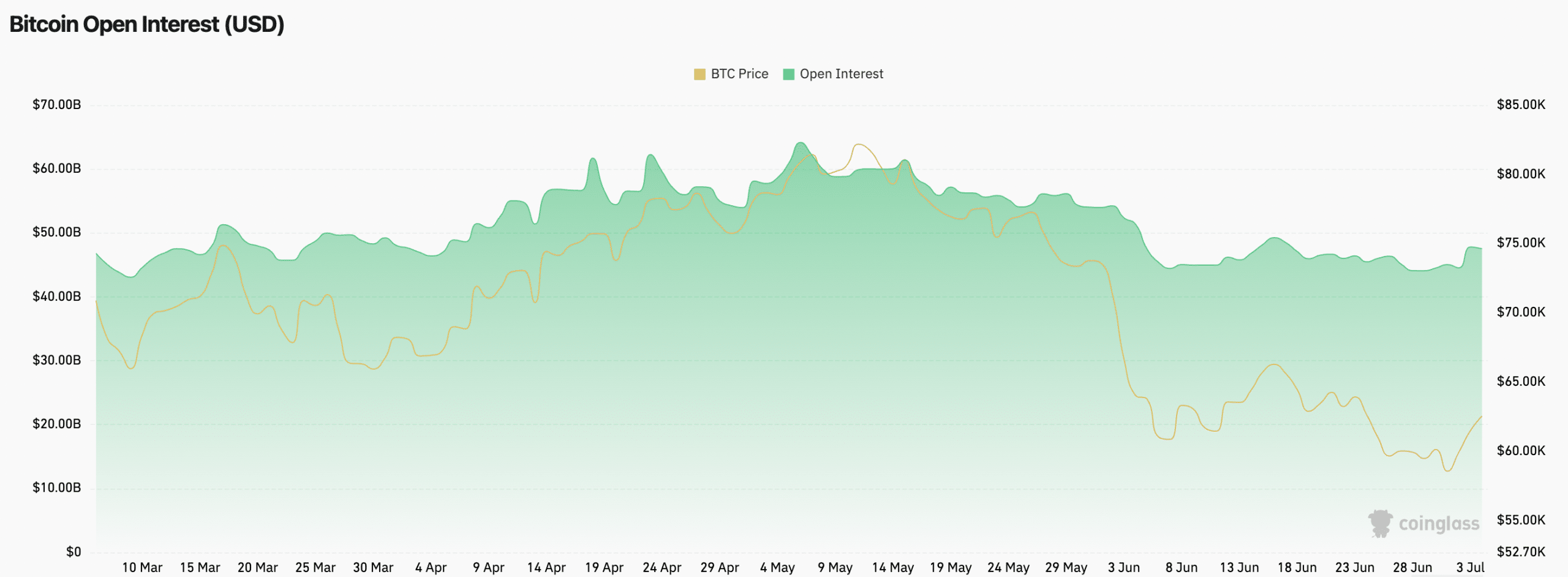
Source: CoinGlass

However, a relatively low price and high open interest also indicate that leverage is growing on both the bullish and bearish sides.

Thus, for now, this raises the possibility of a sudden move as liquidations may intensify Bitcoin’s next significant price swing.


Final Summary

  • A decline in June U.S. nonfarm payrolls along with a decline in the unemployment rate has pushed Bitcoin’s price above $60k.
  • CoinShares dismisses waning trust in the cryptocurrency despite $2.7 billion from Bitcoin exchange-traded products (ETPs).


Trending Cryptos

Related Questions

QAccording to CoinShares' report, what is the main reason why the recent Bitcoin rebound shouldn't be mistaken for a long-term trend reversal?

AThe report argues that the rebound was a transient market response triggered by a weak June U.S. nonfarm payrolls report, and it should not be confused with a significant shift in the Federal Reserve's hawkish monetary policy, which continues to pose a headwind.

QWhat specific macroeconomic data triggered the recent Bitcoin price rebound, and how did it affect market expectations?

AThe rebound was triggered by a weaker-than-expected June U.S. nonfarm payrolls report, which showed only 57,000 jobs added compared to an expected 115,000. This data caused the market to push back its pricing for a near-term Fed rate hike and led to a drop in the two-year Treasury yield, making riskier assets like Bitcoin more attractive temporarily.

QWhat does CoinShares identify as the largest drag on Bitcoin's price throughout 2025, and what is its current status?

AThe largest drag on Bitcoin's price throughout 2025 was the sell-off by whales holding over 100,000 BTC, who sold approximately $39 billion worth of Bitcoin around the October market peak. However, as of 2026, this large-scale selling has largely ceased.

QBesides monetary policy, what are some of the additional challenges for Bitcoin's price mentioned in the report?

AAdditional challenges mentioned include geopolitical uncertainty surrounding the Iran conflict, diminishing hopes for the CLARITY Act to pass this year, and potential supply pressure from Strategy's Bitcoin holdings.

QWhat does the report conclude about the current state of the Bitcoin market based on price action and open interest data?

AThe report concludes that the current situation looks like the early stage of a bottoming process, not the start of a clean new leg higher. It notes that a relatively low price combined with high and rising open interest indicates growing leverage on both sides, raising the possibility of a sudden, volatile price move fueled by liquidations.

Related Reads

Trading

Spot

Hot Articles

What is $BITCOIN

DIGITAL GOLD ($BITCOIN): A Comprehensive Analysis Introduction to DIGITAL GOLD ($BITCOIN) DIGITAL GOLD ($BITCOIN) is a blockchain-based project operating on the Solana network, which aims to combine the characteristics of traditional precious metals with the innovation of decentralized technologies. While it shares a name with Bitcoin, often referred to as “digital gold” due to its perception as a store of value, DIGITAL GOLD is a separate token designed to create a unique ecosystem within the Web3 landscape. Its goal is to position itself as a viable alternative digital asset, although specifics regarding its applications and functionalities are still developing. What is DIGITAL GOLD ($BITCOIN)? DIGITAL GOLD ($BITCOIN) is a cryptocurrency token explicitly designed for use on the Solana blockchain. In contrast to Bitcoin, which provides a widely recognized value storage role, this token appears to focus on broader applications and characteristics. Notable aspects include: Blockchain Infrastructure: The token is built on the Solana blockchain, known for its capacity to handle high-speed and low-cost transactions. Supply Dynamics: DIGITAL GOLD has a maximum supply capped at 100 quadrillion tokens (100P $BITCOIN), although details regarding its circulating supply are currently undisclosed. Utility: While precise functionalities are not explicitly outlined, there are indications that the token could be utilized for various applications, potentially involving decentralized applications (dApps) or asset tokenization strategies. Who is the Creator of DIGITAL GOLD ($BITCOIN)? At present, the identity of the creators and development team behind DIGITAL GOLD ($BITCOIN) remains unknown. This situation is typical among many innovative projects within the blockchain space, particularly those aligning with decentralized finance and meme coin phenomena. While such anonymity may foster a community-driven culture, it intensifies concerns about governance and accountability. Who are the Investors of DIGITAL GOLD ($BITCOIN)? The available information indicates that DIGITAL GOLD ($BITCOIN) does not have any known institutional backers or prominent venture capital investments. The project seems to operate on a peer-to-peer model focused on community support and adoption rather than traditional funding routes. Its activity and liquidity are primarily situated on decentralized exchanges (DEXs), such as PumpSwap, rather than established centralized trading platforms, further highlighting its grassroots approach. How DIGITAL GOLD ($BITCOIN) Works The operational mechanics of DIGITAL GOLD ($BITCOIN) can be elaborated on based on its blockchain design and network attributes: Consensus Mechanism: By leveraging Solana’s unique proof-of-history (PoH) combined with a proof-of-stake (PoS) model, the project ensures efficient transaction validation contributing to the network's high performance. Tokenomics: While specific deflationary mechanisms have not been extensively detailed, the vast maximum token supply implies that it may cater to microtransactions or niche use cases that are still to be defined. Interoperability: There exists the potential for integration with Solana’s broader ecosystem, including various decentralized finance (DeFi) platforms. However, the details regarding specific integrations remain unspecified. Timeline of Key Events Here is a timeline that highlights significant milestones concerning DIGITAL GOLD ($BITCOIN): 2023: The initial deployment of the token occurs on the Solana blockchain, marked by its contract address. 2024: DIGITAL GOLD gains visibility as it becomes available for trading on decentralized exchanges like PumpSwap, allowing users to trade it against SOL. 2025: The project witnesses sporadic trading activity and potential interest in community-led engagements, although no noteworthy partnerships or technical advancements have been documented as of yet. Critical Analysis Strengths Scalability: The underlying Solana infrastructure supports high transaction volumes, which could enhance the utility of $BITCOIN in various transaction scenarios. Accessibility: The potential low trading price per token could attract retail investors, facilitating wider participation due to fractional ownership opportunities. Risks Lack of Transparency: The absence of publicly known backers, developers, or an audit process may yield skepticism regarding the project's sustainability and trustworthiness. Market Volatility: The trading activity is heavily reliant on speculative behavior, which can result in significant price volatility and uncertainty for investors. Conclusion DIGITAL GOLD ($BITCOIN) emerges as an intriguing yet ambiguous project within the rapidly evolving Solana ecosystem. While it attempts to leverage the “digital gold” narrative, its departure from Bitcoin's established role as a store of value underscores the need for a clearer differentiation of its intended utility and governance structure. Future acceptance and adoption will likely depend on addressing the current opacity and defining its operational and economic strategies more explicitly. Note: This report encompasses synthesised information available as of October 2023, and developments may have transpired beyond the research period.

598 Total ViewsPublished 2025.05.13Updated 2025.05.13

What is $BITCOIN

Discussions

Welcome to the HTX Community. Here, you can stay informed about the latest platform developments and gain access to professional market insights. Users' opinions on the price of BTC (BTC) are presented below.

活动图片