How Hinkal protocol’s smart contract flaw sparked $820K USDC exploit

ambcryptoPublished on 2026-07-04Last updated on 2026-07-04

Abstract

The Hinkal stablecoin privacy protocol suffered an exploit resulting in the loss of approximately $820,000 worth of USDC. The attack was enabled by a flaw in one of the protocol's smart contracts. The attacker manipulated the `prooflessDeposit()` function and executed a series of `transact()` calls, allowing them to withdraw funds that should not have been accessible. While the exact technical vulnerability remains unclear, it points to a failure in deposit validation or proof verification within Hinkal's privacy architecture. This incident highlights the persistent risk of smart contract bugs in DeFi, even as overall losses in the first half of 2026 are reported to be less than half of those from the same period in 2025.

Another day, yet another exploit.

News has been circulating that the Hinkal stablecoin privacy protocol may have been compromised. It appears that the suspected exploit was caused by a flaw in one of its smart contracts.

Reportedly, the flaw allowed an attacker to take about $820,000 worth of USDC out of the system.

Initial reports suggest the attacker extracted funds that should not have been accessible. The attacker was able to do this by manipulating Hinkal’s prooflessDeposit() function and then making a string of transact() calls.
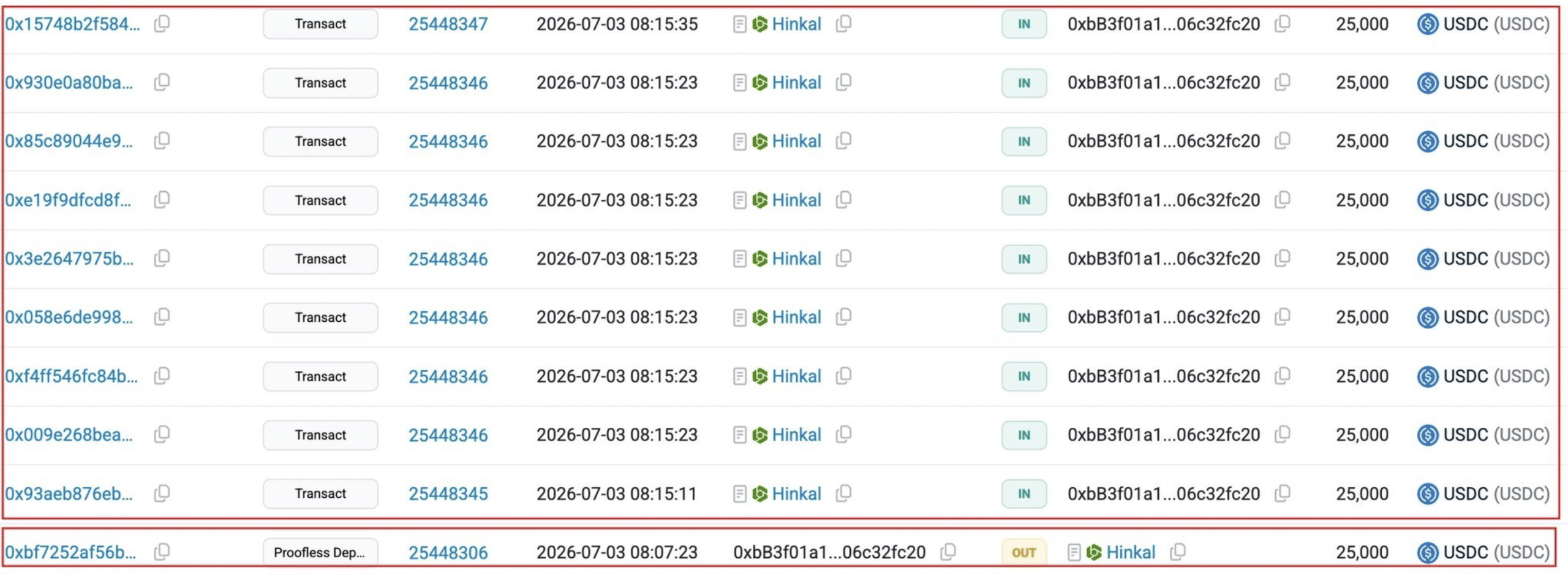
Source: GoPlus Security/X

Technique used to carry out the attack

Although the precise technical defect remains unknown, the attack suggests the protocol may have failed to validate deposits or verify the cryptographic proofs underpinning Hinkal’s privacy architecture.

This may have allowed the attacker to repeatedly call transact() and withdraw USDC held by the smart contract. As a result, a coding error led to a real financial loss.

That said, the suspected Hinkal exploit hints at a smart contract code vulnerability, which is one of the most enduring threats in decentralized finance (DeFi). While the incident does not point to a flaw in DeFi itself, it shows how implementation bugs can lead to significant financial losses.

Rise in exploits in 2026

This comes at a time when there have been other recent exploits. On the 20th of June, the Jaredfromsubway.eth Maximal Extractable Value (MEV) bot was exploited, which resulted in $7.5 million in losses.

In another instance, a hacker used a flash loan to manipulate the wrapped xStocks exchange rate, resulting in an approximately $403,000 exploit for Edel Finance.

Taking all these together, it’s evident that scams have increased significantly in 2026. In fact, in the past six months, there have been 207 distinct hacks, according to TRM Labs.

Yet, despite the rise in incidents, DeFiLlama data showed that total losses came to $948.13 million, which is less than half of the $2.3 billion that was stolen in the first half of 2025.
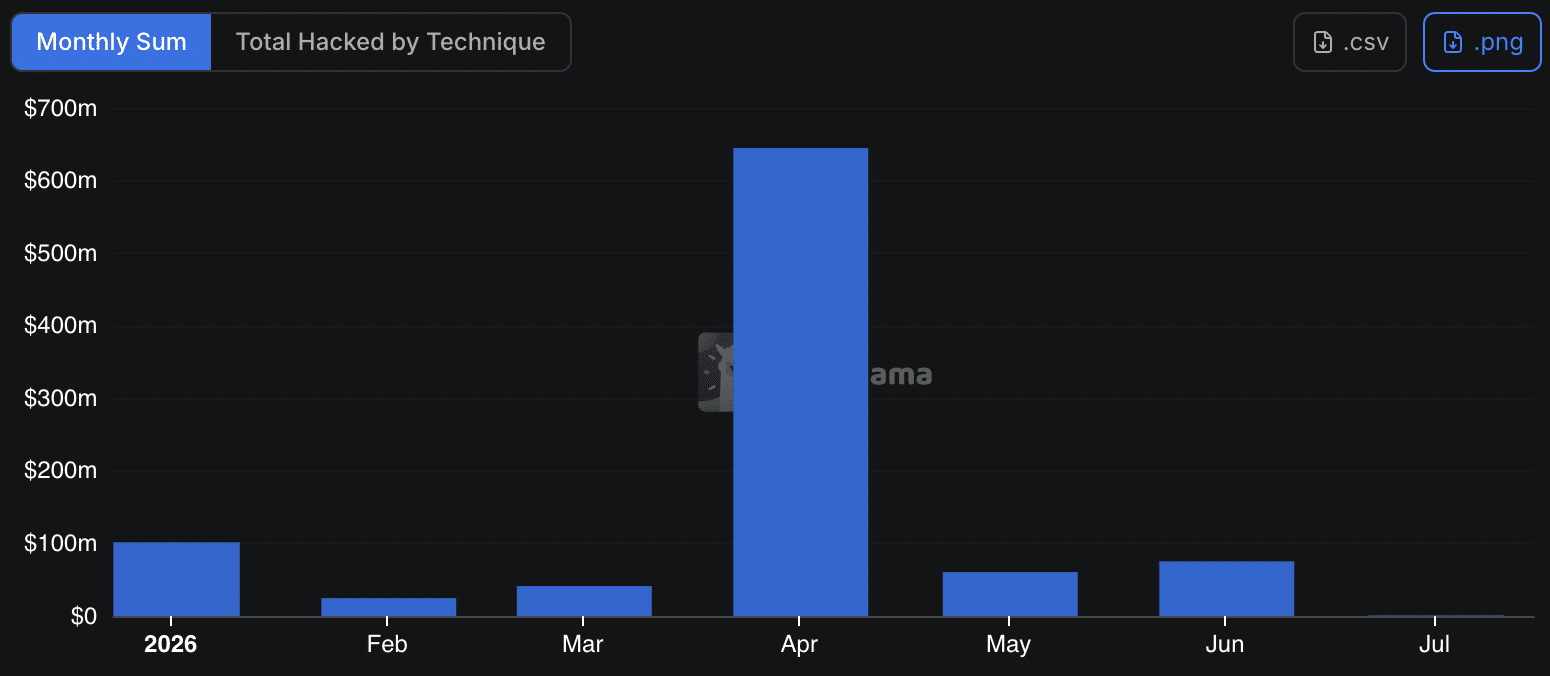
Source: DeFiLlama

Final Summary

  • The Hinkal stablecoin privacy protocol exploit resulted in the compromise of $820,000 worth of USDC.
  • The attacker misused Hinkal’s prooflessDeposit() function and then made a string of transact() calls to carry out this attack.


Related Questions

QWhat was the financial impact of the exploit on the Hinkal protocol?

AThe exploit resulted in the loss of approximately $820,000 worth of USDC.

QWhich specific smart contract functions did the attacker manipulate to carry out the Hinkal exploit?

AThe attacker manipulated the `prooflessDeposit()` function and then made a series of `transact()` calls.

QAccording to the article, what is one of the most enduring threats in decentralized finance (DeFi) highlighted by this incident?

ASmart contract code vulnerability is highlighted as one of the most enduring threats in DeFi.

QHow does the total value lost to hacks in the first half of 2026 compare to the first half of 2025, based on DeFiLlama data?

ATotal losses in the first half of 2026 were $948.13 million, which is less than half of the $2.3 billion stolen in the first half of 2025.

QWhat does the attack on Hinkal's protocol suggest about its validation or verification processes?

AThe attack suggests the protocol may have failed to properly validate deposits or verify the cryptographic proofs underpinning its privacy architecture.

Related Reads

Valuation of $8 Billion, Up 200% in 8 Months! What's Behind Crypto-Friendly Bank Erebor Bank's Rise?

Erebor Bank, a digital bank founded by Palmer Luckey and backed by Peter Thiel, is in talks for new funding at a target valuation of $8 billion, double its $4.35 billion valuation from December. This surge is driven by explosive deposit growth, which soared from $1.1 billion in March to approximately $4.05 billion within a quarter, alongside adding nearly 400 new clients. The bank, launched in February 2026, holds a full national bank charter from the OCC, a strategic choice to avoid reliance on partner banks. It aims to serve tech startups, defense contractors, and crypto-native businesses, addressing gaps left by Silicon Valley Bank's collapse. Core promises include lending against non-traditional assets like hardware, offering 24/7 settlement, and integrating stablecoin services with traditional banking. It has already enabled stablecoin deposits and withdrawals on the Sui network. However, its current financials show minimal lending activity and a net loss, with high liquidity in cash and securities. The valuation hinges on future potential to monetize deposits through lending and crypto services. The bank's experienced management team includes veterans from Wells Fargo and crypto compliance firms. Risks are significant. Its concentrated customer base and exposure to volatile sectors like crypto and venture capital echo SVB's vulnerabilities. Its entire model depends on continued regulatory favor towards digital assets, which could shift. Erebor represents a high-profile experiment at the intersection of banking, crypto, and industrial policy, with its execution and market demand yet to be fully proven.

marsbit6h ago

Valuation of $8 Billion, Up 200% in 8 Months! What's Behind Crypto-Friendly Bank Erebor Bank's Rise?

marsbit6h ago

$8 Billion Valuation, 2x Growth in 8 Months! What Makes Crypto-Friendly Bank Erebor Bank So Special?

Erebor Bank, a crypto-friendly U.S. bank founded by Palmer Luckey, is reportedly in talks for a new funding round targeting a valuation of at least $8 billion, double its $4.35 billion valuation from December. Despite being operational for only a few months, its rapid growth—deposits surged from $1.1 billion in March to approximately $4.05 billion within a quarter, adding nearly 400 clients—has attracted investor interest. The bank aims to fill the void left by Silicon Valley Bank's collapse, targeting startups and businesses with non-traditional assets like defense contracts and digital tokens. Its strategy involves holding its own banking license to offer services like stablecoin deposits, payments, and 24/7 on-chain settlement. While digital assets are a core long-term focus, recent growth has been driven more by financing for U.S. manufacturing and defense sectors. Erebor's leadership combines Luckey's tech/defense background with a seasoned financial team. It received a national bank charter from the OCC in early 2026, benefiting from a favorable regulatory climate for digital assets. However, the bank faces significant risks, including reliance on a concentrated client base, exposure to crypto market volatility, potential regulatory shifts, and the unproven demand for its integrated banking model. Investors are betting on its future potential to monetize deposits through lending and crypto services, despite current losses typical for a new bank.

链捕手6h ago

$8 Billion Valuation, 2x Growth in 8 Months! What Makes Crypto-Friendly Bank Erebor Bank So Special?

链捕手6h ago

Trading

Spot
活动图片