Bitcoin As Bonus: Steak ’n Shake Rolls Out BTC Pay Perks For Workers

bitcoinistPublished on 2026-01-22Last updated on 2026-01-22

Abstract

Steak 'n Shake will pay all hourly employees a Bitcoin bonus of $0.21 in BTC for every hour worked, starting March 1. The bonus is available only to employees who have completed a two-year vesting period. The company, which began accepting Bitcoin payments in May 2025, reported a significant increase in same-store sales since adopting BTC. All Bitcoin revenue is directed to its Strategic Bitcoin Reserve, which recently saw a $10 million expansion. The initiative is supported by Fold, a financial services platform. Meanwhile, institutional demand for Bitcoin remains strong, with wallets holding 100–1,000 BTC accumulating 577,000 BTC over the past year. Bitcoin is currently trading around $89,200, down 6% over the past week.

American fast food chain Steak ‘n Shake has announced that all hourly employees will receive a Bitcoin bonus starting on March 1st.

Steak ‘n Shake Integrates Bitcoin Bonus Payments

Steak ‘n Shake will pay all hourly employees at its company-operated restaurants a bonus in Bitcoin for every hour of work, as revealed by the company’s official X handle. Steak ‘n Shake, primarily based in the United States, is a fast food chain that mainly serves burgers and milkshakes, with its flagship item being the Steakburger. Back in May 2025, the firm opened itself to Bitcoin, allowing customers to pay at all its locations using the cryptocurrency.

Last Friday, Steak ‘n Shake provided an update on the scheme, noting that same-store sales have dramatically increased for the company since it started accepting BTC. The firm added that all of its BTC sales go into its Strategic Bitcoin Reserve (SBR) and announced that it expanded this reserve by an additional $10 million in notional value in that same update.

“We have created a self-sustaining system — growing same-store sales that grow the SBR,” wrote the company. “Improving food quality expands Steak n Shake’s reach and leverages Bitcoin into a new and delicious dimension.” Now, it seems Steak ‘n Shake has taken its BTC acceptance a step further with the employee bonus integration.

According to the announcement, all hourly employees will receive $0.21 BTC for every hour worked. However, only workers who have passed a two-year vesting period will be able to collect their digital asset pay.

Steak ‘n Shake credited Fold for providing assistance on the initiative. Fold is a financial services platform that offers, among other features, a debit card allowing users to earn BTC rewards on payments.

The Bitcoin bonus program is set to go live on March 1st. “We take care of our employees; they, in turn, take care of customers; and the results take care of themselves,” said Steak ‘n Shake.

In some other news, institutional demand for Bitcoin has remained strong recently, according to CryptoQuant founder and CEO Ki Young Ju. To track the behavior of these large entities, Young Ju has referred to the supply of addresses carrying between 100 and 1,000 BTC.

“US custody wallets typically hold 100-1,000 BTC each,” explained the CryptoQuant founder. “Excluding exchanges and miners, this gives a rough read on institutional demand.” As the chart below shows, the supply of this investor segment has shown significant growth in recent months.
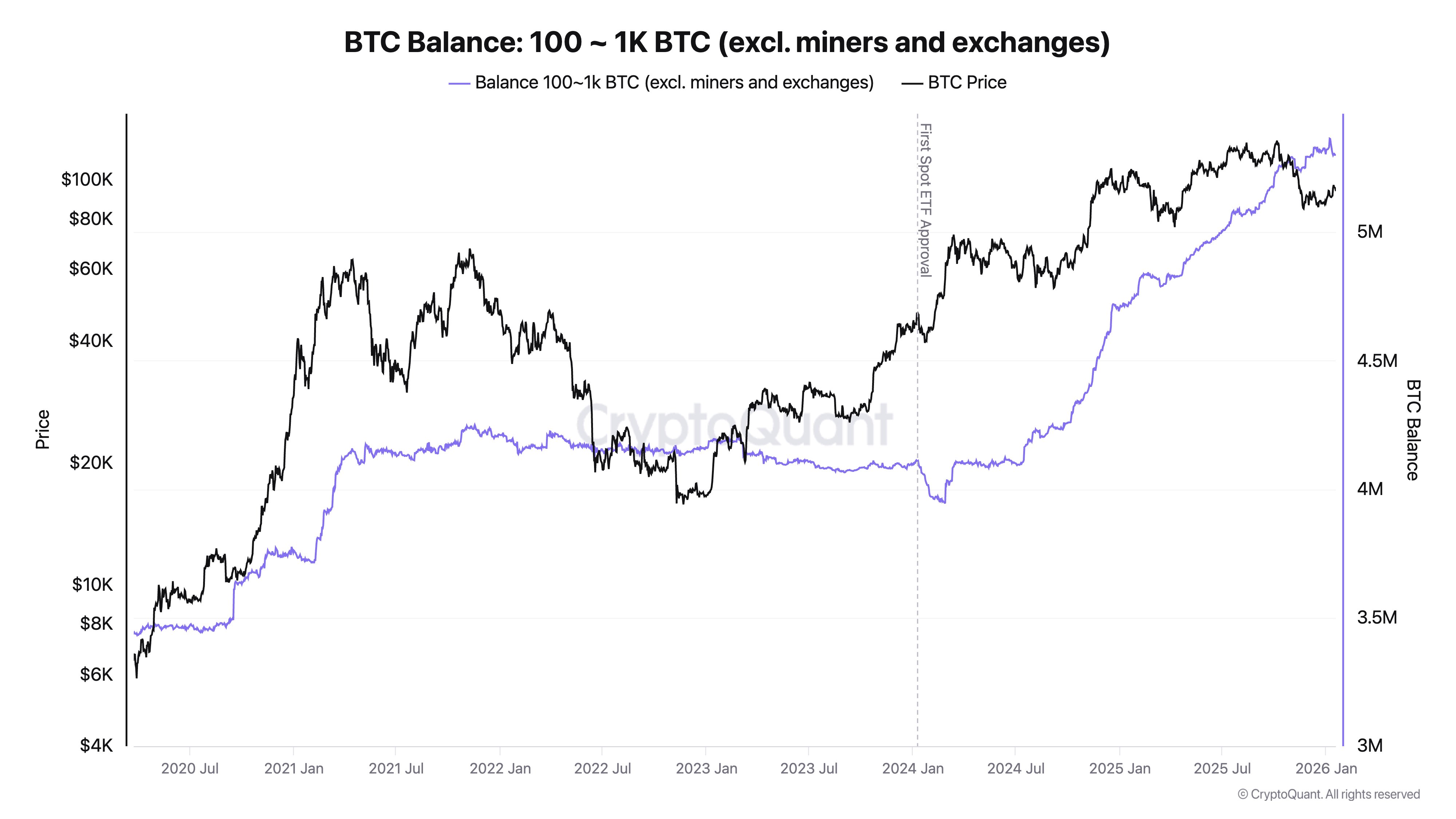
The trend in the combined balance of institution-sized wallets | Source: @ki_young_ju on X

In total, Bitcoin wallets in the 100 to 1,000 tokens range have collectively added 577,000 BTC (roughly worth $51.5 billion) to their holdings over the past year. So far, this accumulation hasn’t shown signs of slowing down.

BTC Price

At the time of writing, Bitcoin is floating around $89,200, down 6% in the last seven days.

The price of the coin seems to have plunged over the past few days | Source: BTCUSDT on TradingView


Related Questions

QWhat is the new Bitcoin bonus program announced by Steak 'n Shake for its employees?

ASteak 'n Shake will pay all hourly employees a bonus of $0.21 in Bitcoin for every hour worked, starting March 1st, but only for those who have passed a two-year vesting period.

QHow has accepting Bitcoin payments impacted Steak 'n Shake's same-store sales?

ASame-store sales have dramatically increased since the company started accepting Bitcoin payments.

QWhat is the Steak 'n Shake Strategic Bitcoin Reserve (SBR), and how was it recently expanded?

AThe Strategic Bitcoin Reserve (SBR) is where all of the company's BTC sales go. It was recently expanded by an additional $10 million in notional value.

QAccording to CryptoQuant's CEO, what does the supply of wallets holding 100-1,000 BTC indicate?

AThe supply of wallets holding 100-1,000 BTC (excluding exchanges and miners) is used as a rough read on institutional demand, which has shown significant growth recently.

QWhat was the total value of Bitcoin accumulated by the 100-1,000 BTC wallet segment over the past year?

AWallets in the 100 to 1,000 BTC range have collectively added 577,000 BTC, which is roughly worth $51.5 billion.

Related Reads

The Value Distribution of Stablecoins

**Summary: The Value Distribution of Stablecoins** The article argues that stablecoins are evolving from mere trading tools into broader channels for dollar access. It divides the stablecoin ecosystem into four layers to analyze how value is distributed: 1. **Issuance Layer:** Mints stablecoins, holds reserve assets, and captures the spread between reserve yield and user costs (e.g., Tether, Circle). This layer currently earns the largest profit margin. 2. **Infrastructure Layer:** Connects stablecoins to the traditional financial system, handling fiat on/off-ramps, banking integration, compliance (KYC/AML), and asset management (e.g., Bridge, BVNK). This is the "unglamorous" but critical work, building the essential bridges between crypto and real-world finance. 3. **Acquiring/Distribution Layer:** Integrates stablecoins into merchant systems, manages payment flows, and provides enterprise financial software (e.g., Stripe, Coinbase). They act as the access point for businesses. 4. **Application Layer:** The end-users and businesses that ultimately use stablecoins for payments, settlements, or as a store of value. They benefit from convenience but have little pricing power. The core thesis is that while the issuance layer currently dominates profits, the often-overlooked **infrastructure layer holds significant long-term potential**. The real challenge and barrier to mass adoption is not the on-chain transfer of stablecoins (which is simple), but the complex "last mile" integration into existing business workflows, banking systems, and regulatory frameworks across different countries. Companies in this layer are currently in a "land grab" phase, investing heavily to build networks, secure bank partnerships, and establish compliance pathways. While their position is currently pressured by the profitable issuers above and distribution platforms below, the article suggests that if stablecoins become a default financial rail for businesses, the infrastructure providers who have done the hard work of integration will ultimately gain strong pricing power and become entrenched, essential players.

marsbit5m ago

The Value Distribution of Stablecoins

marsbit5m ago

The Value Distribution of Stablecoins

The Value Distribution of Stablecoins The article argues that stablecoins are evolving from a mere trading tool into a broad "dollar channel." It analyzes the industry's value chain through four layers: 1. **Issuance Layer (e.g., Tether, Circle):** The top layer that mints stablecoins, holds reserve assets, and captures the thickest interest rate spread. 2. **Infrastructure Layer (e.g., Bridge, BVNK):** Connects stablecoins to the traditional financial system, handling critical but complex "dirty work" like fiat on/off-ramps, banking integration, compliance (KYC/AML), and cross-border settlement. 3. **Acquiring/Distribution Layer (e.g., Stripe, Coinbase):** Embeds stablecoins into merchant systems, manages payment flows, and integrates with enterprise software. 4. **Application Layer:** End-users and businesses that ultimately use stablecoins for payments, settlement, or storing value. The author posits that while the issuance layer currently captures the most profit, the most overlooked and potentially critical layer is infrastructure. The core challenge for stablecoin adoption isn't the on-chain transfer (which is simple), but bridging the gap between blockchain and the real-world financial system. This involves solving practical problems for businesses: fiat conversion, reconciliation, tax handling, and user onboarding. Infrastructure companies are currently in a difficult "land-grab" phase—building networks, securing banking relationships, and achieving compliance country-by-country. They face pressure from both the profitable issuance layer above and distribution platforms below. However, the author suggests this layer is building a crucial moat. Once stablecoins become a default business rail, the infrastructure players who have done the hard work of integration may gain significant, durable value and pricing power.

链捕手8m ago

The Value Distribution of Stablecoins

链捕手8m ago

How to Do Research Well: Deliberately Practice the Real Skills That Matter

No one truly teaches you how to do research. You're often given a desk, a pre-selected problem, and vague instructions to "create something new." Consequently, many people reverse-engineer the job based on visible outputs—papers, posts, announcements—learning only how to *appear* like a researcher rather than how to *become* one. True research capability is built from stacking small, trainable skills, nearly all of which can be developed through deliberate practice. **Pick Your Own Problem:** Most researchers absorb problems from advisors or trends, lacking the underlying reasoning. Choosing a problem you genuinely care about, as John Schulman advises, leads to original work. Develop "taste" like a muscle: predict experiment outcomes, guess paper results from methods, and track which findings remain important over time. **Upgrade Your Inputs:** Relying on shared reading lists (arXiv hot lists, filtered group chats) leads to unoriginal conclusions. Undervalued old literature often holds crucial insights (e.g., MoE, LSTM, backpropagation). Richard Sutton's "The Bitter Lesson" or Claude Shannon's 1952 talk on creative thinking are more predictive than lengthy modern surveys. Breadth matters as much as depth: draw from neuroscience, mechanism design, hardware knowledge, and honest statistics. Read papers directly, especially appendices and limitations sections. **Write Everything Down:** As Paul Graham noted, writing exposes flaws in seemingly mature ideas. Writing is the cheapest defense against self-deception. Following Feynman's principle, Darwin programmatically wrote down facts contradicting his theory to combat memory bias. Maintain a detailed log of hypotheses, setups, predictions, results, and updated understandings. Reviewing past logs fosters essential humility.

marsbit2h ago

How to Do Research Well: Deliberately Practice the Real Skills That Matter

marsbit2h ago

Trading

Spot
Futures

Hot Articles

What is $BITCOIN

DIGITAL GOLD ($BITCOIN): A Comprehensive Analysis Introduction to DIGITAL GOLD ($BITCOIN) DIGITAL GOLD ($BITCOIN) is a blockchain-based project operating on the Solana network, which aims to combine the characteristics of traditional precious metals with the innovation of decentralized technologies. While it shares a name with Bitcoin, often referred to as “digital gold” due to its perception as a store of value, DIGITAL GOLD is a separate token designed to create a unique ecosystem within the Web3 landscape. Its goal is to position itself as a viable alternative digital asset, although specifics regarding its applications and functionalities are still developing. What is DIGITAL GOLD ($BITCOIN)? DIGITAL GOLD ($BITCOIN) is a cryptocurrency token explicitly designed for use on the Solana blockchain. In contrast to Bitcoin, which provides a widely recognized value storage role, this token appears to focus on broader applications and characteristics. Notable aspects include: Blockchain Infrastructure: The token is built on the Solana blockchain, known for its capacity to handle high-speed and low-cost transactions. Supply Dynamics: DIGITAL GOLD has a maximum supply capped at 100 quadrillion tokens (100P $BITCOIN), although details regarding its circulating supply are currently undisclosed. Utility: While precise functionalities are not explicitly outlined, there are indications that the token could be utilized for various applications, potentially involving decentralized applications (dApps) or asset tokenization strategies. Who is the Creator of DIGITAL GOLD ($BITCOIN)? At present, the identity of the creators and development team behind DIGITAL GOLD ($BITCOIN) remains unknown. This situation is typical among many innovative projects within the blockchain space, particularly those aligning with decentralized finance and meme coin phenomena. While such anonymity may foster a community-driven culture, it intensifies concerns about governance and accountability. Who are the Investors of DIGITAL GOLD ($BITCOIN)? The available information indicates that DIGITAL GOLD ($BITCOIN) does not have any known institutional backers or prominent venture capital investments. The project seems to operate on a peer-to-peer model focused on community support and adoption rather than traditional funding routes. Its activity and liquidity are primarily situated on decentralized exchanges (DEXs), such as PumpSwap, rather than established centralized trading platforms, further highlighting its grassroots approach. How DIGITAL GOLD ($BITCOIN) Works The operational mechanics of DIGITAL GOLD ($BITCOIN) can be elaborated on based on its blockchain design and network attributes: Consensus Mechanism: By leveraging Solana’s unique proof-of-history (PoH) combined with a proof-of-stake (PoS) model, the project ensures efficient transaction validation contributing to the network's high performance. Tokenomics: While specific deflationary mechanisms have not been extensively detailed, the vast maximum token supply implies that it may cater to microtransactions or niche use cases that are still to be defined. Interoperability: There exists the potential for integration with Solana’s broader ecosystem, including various decentralized finance (DeFi) platforms. However, the details regarding specific integrations remain unspecified. Timeline of Key Events Here is a timeline that highlights significant milestones concerning DIGITAL GOLD ($BITCOIN): 2023: The initial deployment of the token occurs on the Solana blockchain, marked by its contract address. 2024: DIGITAL GOLD gains visibility as it becomes available for trading on decentralized exchanges like PumpSwap, allowing users to trade it against SOL. 2025: The project witnesses sporadic trading activity and potential interest in community-led engagements, although no noteworthy partnerships or technical advancements have been documented as of yet. Critical Analysis Strengths Scalability: The underlying Solana infrastructure supports high transaction volumes, which could enhance the utility of $BITCOIN in various transaction scenarios. Accessibility: The potential low trading price per token could attract retail investors, facilitating wider participation due to fractional ownership opportunities. Risks Lack of Transparency: The absence of publicly known backers, developers, or an audit process may yield skepticism regarding the project's sustainability and trustworthiness. Market Volatility: The trading activity is heavily reliant on speculative behavior, which can result in significant price volatility and uncertainty for investors. Conclusion DIGITAL GOLD ($BITCOIN) emerges as an intriguing yet ambiguous project within the rapidly evolving Solana ecosystem. While it attempts to leverage the “digital gold” narrative, its departure from Bitcoin's established role as a store of value underscores the need for a clearer differentiation of its intended utility and governance structure. Future acceptance and adoption will likely depend on addressing the current opacity and defining its operational and economic strategies more explicitly. Note: This report encompasses synthesised information available as of October 2023, and developments may have transpired beyond the research period.

364 Total ViewsPublished 2025.05.13Updated 2025.05.13

What is $BITCOIN

Discussions

Welcome to the HTX Community. Here, you can stay informed about the latest platform developments and gain access to professional market insights. Users' opinions on the price of BTC (BTC) are presented below.

活动图片