Binance Alpha Cools Down: User Count Drops 60%, Is No One Claiming 'Eggs' Anymore?

marsbitPublished on 2026-01-28Last updated on 2026-01-28

Abstract

Binance Alpha, once hailed as a lucrative platform for earning token airdrops, has seen a significant decline in user engagement and profitability. According to data from Alpha123, the number of users dropped by over 60%, from nearly 500,000 in November 2025 to around 200,000 by January 2026. Monthly earnings per account have also fallen sharply, with the theoretical maximum for January estimated at approximately $715.7—far below the $2,000 monthly profits seen in mid-2025. The platform’s become more challenging due to rising积分门槛 (score thresholds), which recently reached as high as 257 points. In some cases, users cannot meet the threshold through daily activities alone. For example, earning 15 points requires approximately $32,700 in trading volume, which—for retail traders—could mean around 100 trades per day. This results in high transaction costs, including fees and potential slippage, especially when trading volatile tokens. While some early participants earned significant returns from a few high-value airdrops, such opportunities are now rare. Most airdrops now yield below $50, and increased competition—including automated trading by studios—has made it harder for ordinary users to profit. Many are now questioning whether the effort and risk remain worthwhile, especially as platform incentives appear to be shifting away from high-frequency rewards toward more measured engagement.

"Every generation has its eggs to claim, and perhaps for our generation, it's Binance Alpha," said He Yi, Co-CEO of Binance, in late December 2025.

However, over time, according to data statistics from the Alpha123 platform, the number of Binance Alpha users has dropped from nearly 500,000 in November 2025 to about 200,000 today, a decline of over 60%.

At the same time, overall returns have significantly decreased. The "farming" sector, which once generated monthly earnings of over $2,000 per account in mid-2025, is no longer as prosperous.

According to Alpha123 platform statistics, the current daily active users of Binance Alpha are approximately 203,000. As of January 28, a total of 18 airdrops were distributed this month, with claimable shares ranging from 13,000 to 72,000. The average number of claimable shares is about 33,000, accounting for roughly 16.2% of the average daily active users.
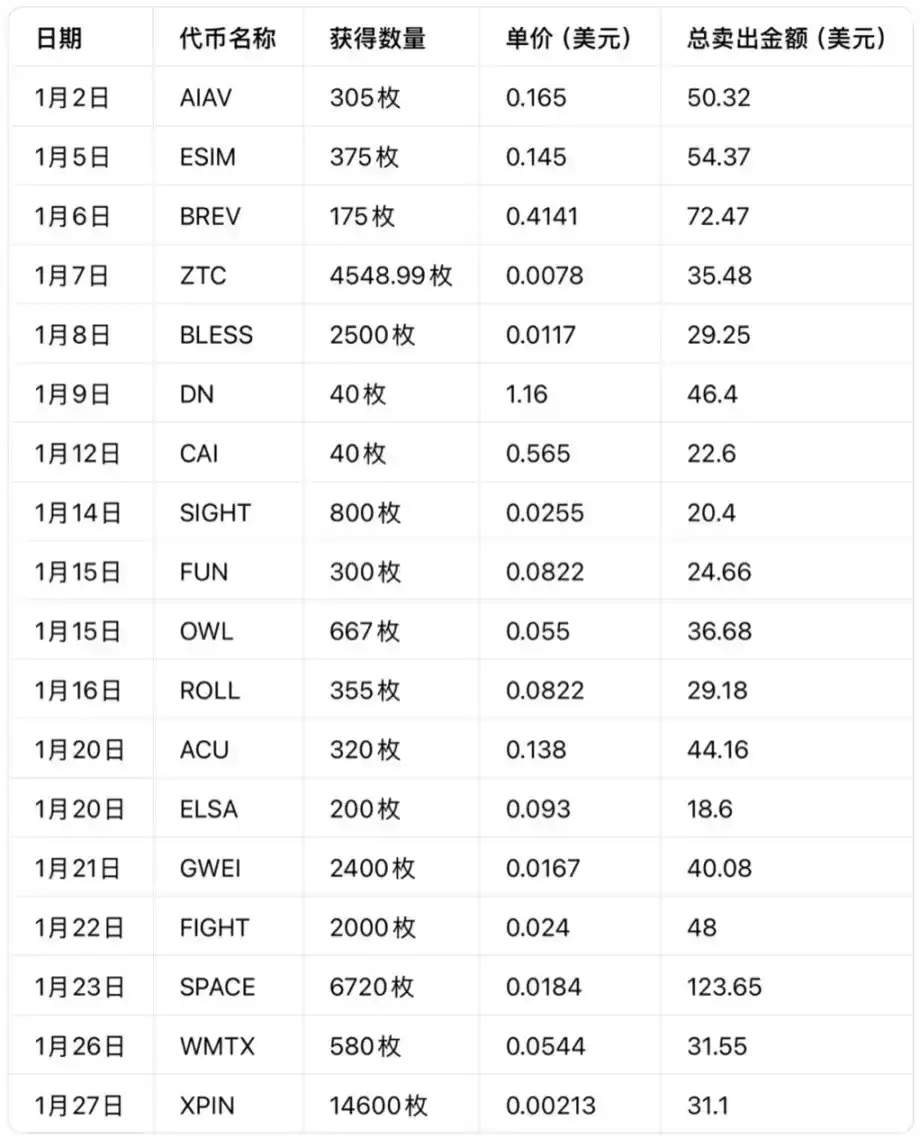
As of January 28, only one of the 18 Alpha rounds this month had a single-round return exceeding $100, which was SPACE at $123.65 (calculated based on the latest opening price 10 minutes after trading began). Meanwhile, 14 rounds had returns below $50, with the lowest round, ELSA, yielding only $18.60.

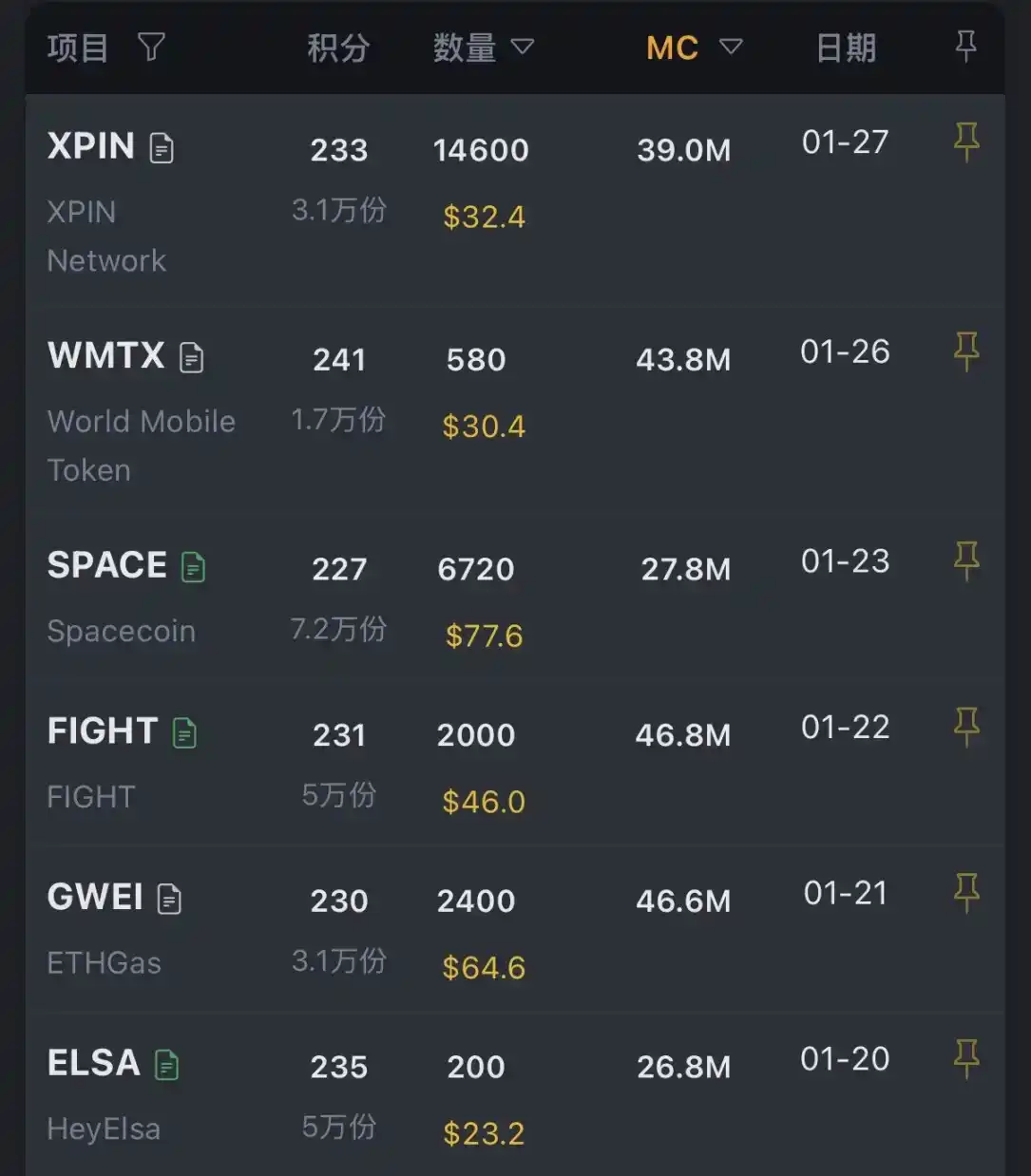
This month, the minimum Alpha points threshold was 230, while the highest reached 257 points. On January 26, the claim threshold for the Alpha token WMTX was as high as 241 points, but the single-round return was only $31.55. If a user earns 16 points per day, since Alpha points reset every 15 days, theoretically, 240 points can be accumulated in 15 days. Once the threshold exceeds 240 points, it becomes impossible to meet the requirement within a single cycle. For example, the 241 points required for WMTX mean that relying solely on stable daily point accumulation cannot meet the threshold within one cycle.
Compared to the period in mid-2025 when single-account monthly income approached $2,000, the theoretical cumulative return for the first 18 rounds this January is approximately $715.70. This figure is based on the premise that "the points threshold is met for every round, and the maximum number of rounds is successfully claimed." However, if a user earns 16 points per day, the maximum number of rounds that can actually be claimed is 5, with returns of about $261.43.

Taking SPACE, which had a return of over $100 in a previous round, as an example, the claim threshold was 227 points, and each claim required 15 points. If a user automatically earns 1 point per day through account balance, the remaining points must be obtained through trading. According to the current relationship between points and trading volume, earning 15 points requires completing approximately $32,700 in trading volume. For mainstream participants with a single trade size of about $330, this equates to completing 100 trades per day.
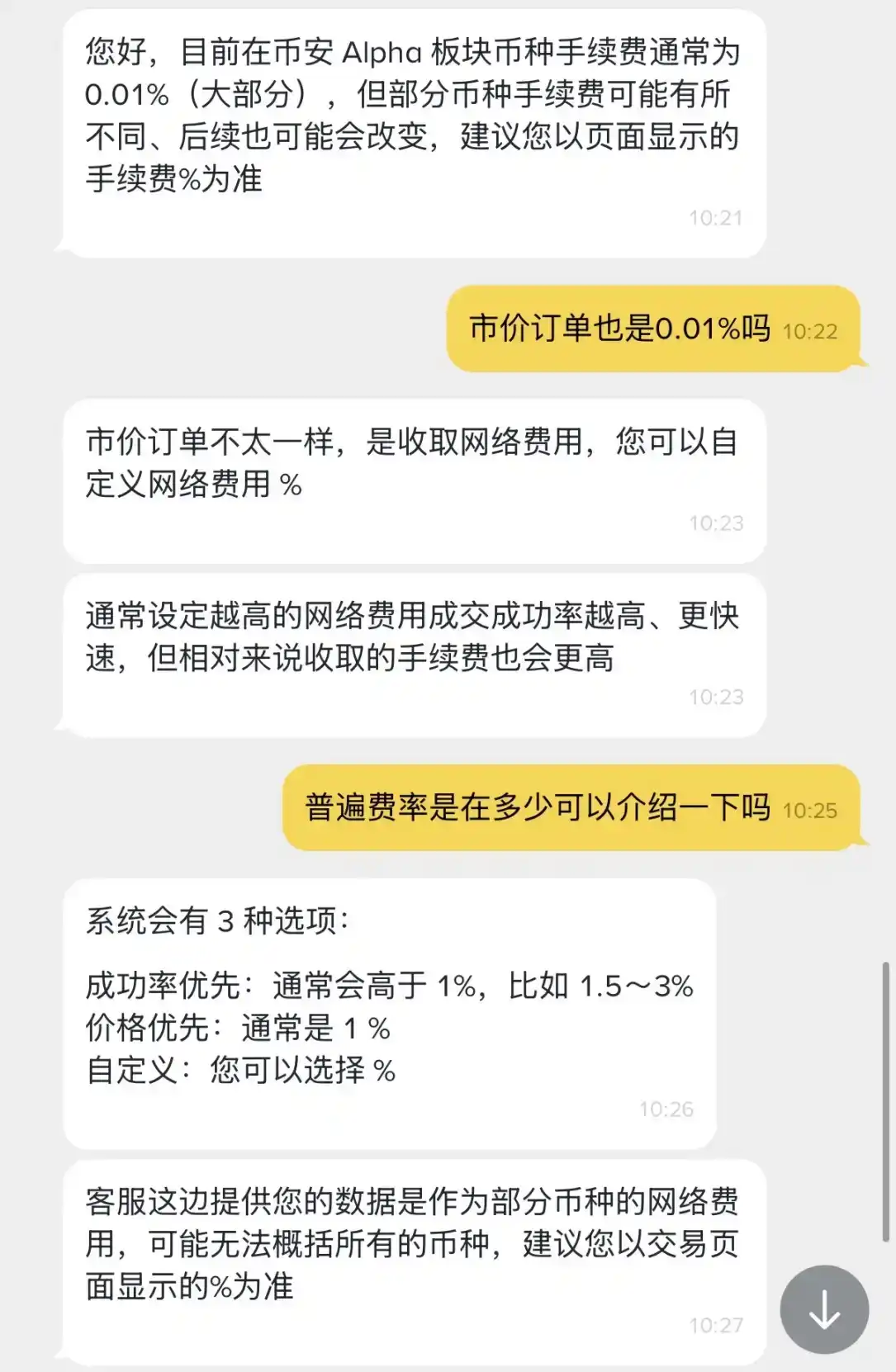
According to the author's investigation, the current limit order fee for the Binance Alpha sector is 0.01%, while the market order fee is typically 1%. If market orders are used to achieve $32,700 in trading volume, at least $327 in fees must be paid daily, excluding price slippage. If trading Alpha sector tokens in the Binance wallet, each transaction incurs a 0.01% service fee and a 0.01% trading fee, with a network fee of about $0.10 per transaction. For a daily trading volume of $32,700, approximately $17 in fees must be paid. If points are accumulated continuously for 15 days to reach 240 points, the minimum cost is $255. Additionally, claiming one Alpha round requires consuming 15 points, which equates to a cost of $17.

To reduce the pressure of the number of trades, the platform occasionally launches multiplier point events, which lower the "number of trades threshold" to some extent but simultaneously amplify price risks. Under a 4x points mechanism, theoretically, only about 25 trades of $330 each are needed daily to earn 15 points. However, such tokens typically experience more剧烈 volatility and have limited liquidity depth, meaning price slippage and short-term fluctuations can quickly erode potential returns.
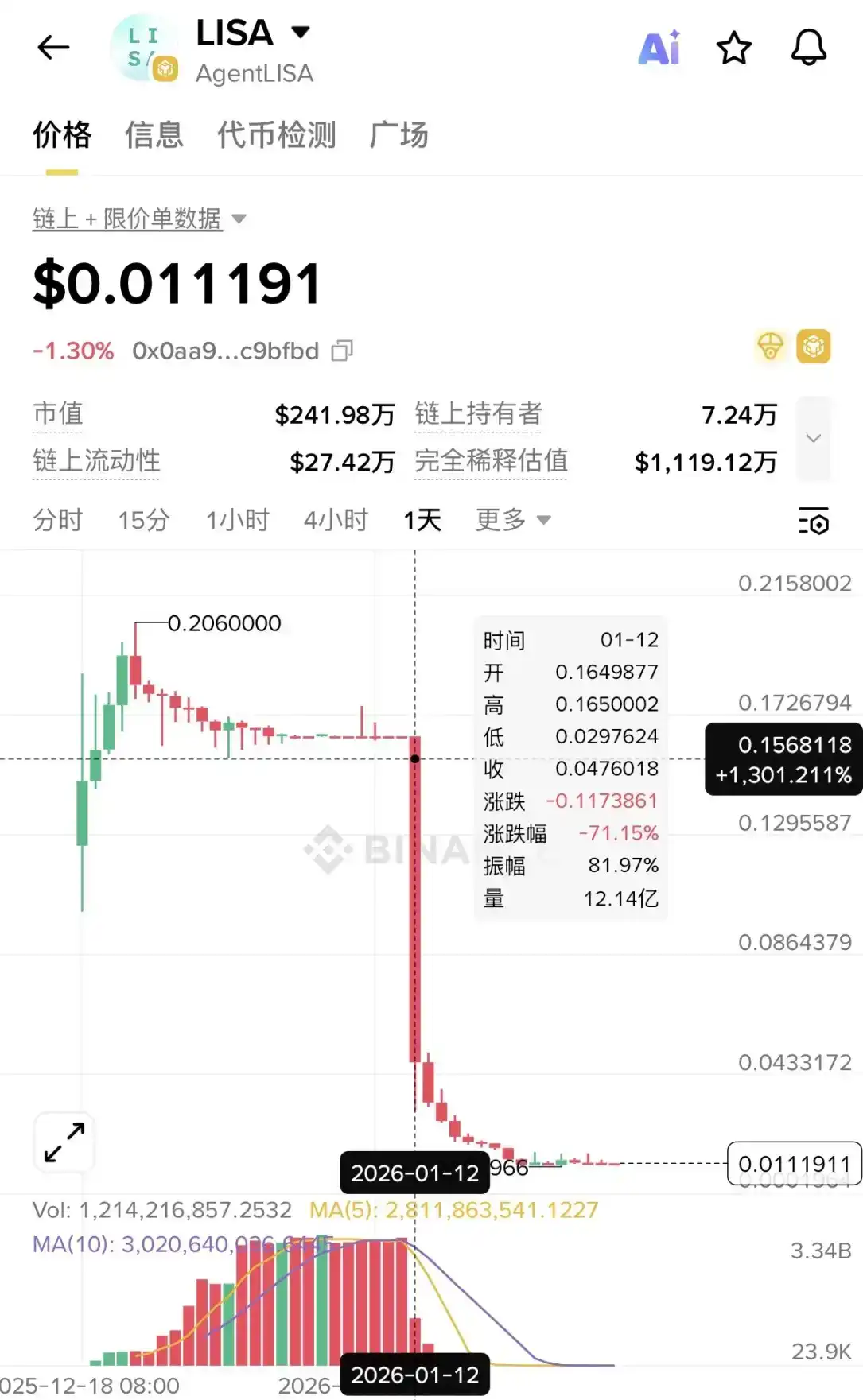
The case of LISA on January 12 became a typical example. The token attracted a large amount of刷量资金 due to its 4x Alpha points incentive, but it experienced concentrated selling within a short period, with a maximum drop of over 80% within 24 hours. The sharp price decline caused some users to incur trading losses far exceeding the airdrop value while earning points.

For users who continue to participate in Alpha, the most direct question is often not "can I still make money" but "is it worth continuing to farm."

Some early participants achieved returns far above the average on certain projects. For example, the 59.82 RIVER tokens obtained on September 19, 2025, if held until now, would be worth about $3,200 at current prices. The 644 MYX tokens obtained on May 6, 2025, are worth about $3,870 at current prices, and if sold at the historical high, the returns would exceed $11,000.

However, such "rare diamond-level big catches" are not consistently replicable. In the current environment of shrinking single-round returns, rising thresholds, and increased volatility, most rounds are closer to small,分散, and uncertain returns. Users are more likely to focus on the overall input-output ratio rather than个别极端收益案例.

The Alpha model本质上 involves exchanging real trading behavior for early token distribution opportunities from projects. Its sustainability relies on the continuous emergence of projects with market performance. When the market enters a stage of存量博弈, the number of high-quality projects is limited, while the number of participants continues to grow, naturally diluting the expected returns for individual users.

At the same time, the core purpose of Alpha in its early stages was to attract traffic for new projects, activate on-chain interactions, and increase user engagement with the Binance wallet ecosystem. During the early high-incentive phase, this goal was clearly achieved, and Alpha一度 became a significant source of user activity and trading volume.
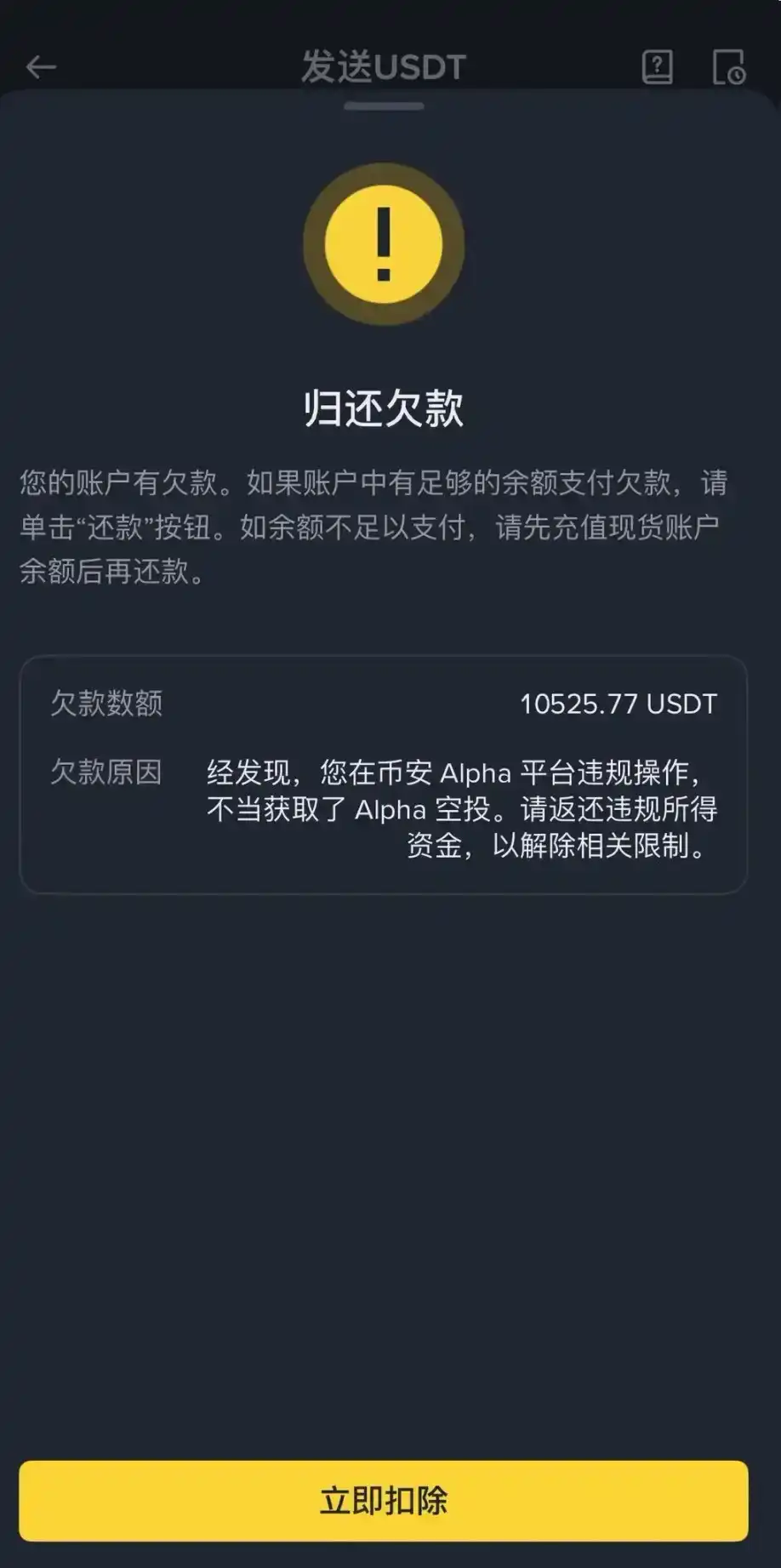
However, as刷量行为, batch operations by studios, and high-frequency gaming intensified, the incentives gradually became套利化. In November 2025, Binance imposed restrictions on some accounts identified as batch-operated by studios and required the return of related earnings. This move showed the platform's effort to压缩异常行为空间, but the community generally believes that automated tools have advantages in efficiency and cost control, putting manual普通用户 at a growing disadvantage in the points competition. Some participants反馈 that in the current environment of high points thresholds and market volatility, continued participation not only yields unstable returns but may also result in net losses due to price fluctuations of the刷量代币, leading them to reduce frequency or even withdraw.

For ordinary users, Alpha is no longer a channel where stable returns can be obtained simply through frequency. Instead, it has become more of a strategic choice requiring careful calculation of costs and risks.


Related Questions

QWhat is the main reason for the decline in Binance Alpha's user base according to the article?

AThe decline is attributed to decreased overall returns, higher participation thresholds, increased volatility, and the platform's crackdown on batch operations by studios, making it less profitable and more risky for ordinary users.

QHow much has the user count of Binance Alpha dropped from its peak?

AThe user count has dropped by over 60%, from nearly 500,000 in November 2025 to about 200,000 currently.

QWhat was the highest single-account monthly income during Binance Alpha's peak period in mid-2025?

ADuring the peak period in mid-2025, a single account could earn nearly $2000 per month.

QWhat challenges do users face in earning enough Alpha points to qualify for airdrops?

AUsers face challenges such as high transaction volumes required to earn points (e.g., $32,700 in trading volume for 15 points), high fees, price slippage, and increased volatility, especially during multiplier events.

QHow did Binance address the issue of batch operations by studios on Alpha?

ABinance imposed restrictions on accounts identified as batch operations by studios in November 2025 and required the return of related earnings to combat abusive practices.

Related Reads

Hyperliquid, Wall Street's All-Day Trading Convenience Store

**Hyperliquid: Wall Street's 24/7 Trading Convenience Store** Written by Vicky Ge Huang, Wall Street Journal. Hyperliquid, a decentralized crypto trading platform, has become a go-to venue for Wall Street traders, especially during weekends when traditional U.S. markets are closed. Operating 24/7, it allows traders to pre-position or close trades ahead of market opens, capitalizing on events like geopolitical news. The platform, founded by former Hudson River Trading quant Jeff Yan, offers perpetual contracts on a wide range of assets, including Bitcoin, the S&P 500, oil, and even pre-IPO companies like SpaceX. Its growth exemplifies the merging of traditional finance and crypto markets, attracting significant volume from professional traders seeking leverage and constant access. A key differentiator, according to Yan, is user self-custody of assets—a necessity highlighted by the FTX collapse. Despite U.S. regulatory restrictions, some American users reportedly access the platform via VPN, drawn by its ease of use, lack of stringent KYC, and strong community culture on platforms like Discord and X. The platform is not without risks. Perpetual contracts are complex and highly leveraged, leading to massive liquidations during market volatility. Hyperliquid itself saw $10 billion in liquidations during a market crash in October last year. Regulatory warnings emphasize insufficient risk disclosure for retail investors. With about 11 employees, Hyperliquid and its associated blockchain reportedly generated around $800 million in revenue last year. Its native token, HYPE, has surged over 100% since late 2024. The platform plans to expand into prediction markets and options trading, aiming to become a hub for all financial activity.

foresightnews_api3m ago

Hyperliquid, Wall Street's All-Day Trading Convenience Store

foresightnews_api3m ago

Former Bankless Member Lucas: Why I Still Bullish on Ethereum

Former Bankless member Lucas explains why he remains bullish on Ethereum despite widespread pessimism. He acknowledges ETH's poor price performance over the past five years compared to Bitcoin and traditional markets, but draws parallels to historical multi-year consolidations seen in tech giants like Amazon and NVIDIA before major breakouts. Fundamentally, Ethereum is stronger than ever: record-high daily transactions (2.27 million in May 2026), significantly lower average gas fees ($0.27), over 400 million total addresses, and more than 32% of ETH staked, securing the network. Lucas's core thesis remains unchanged: all valuable assets will eventually be tokenized, Ethereum will become the primary settlement layer for these assets, and ETH will capture the resulting value. This transition is already underway. Stablecoins, the first proven tokenized real-world asset (RWA), have a $300+ billion market cap, with 54% settled on Ethereum. The broader RWA sector has surpassed $30 billion, with over 53% deployed on Ethereum. He compares the current RWA adoption phase to early DeFi in 2019-20, suggesting immense growth potential. Key catalysts like the potential passage of the U.S. CLARITY Act in 2026 could accelerate institutional adoption. While other blockchains will share the market, Lucas argues that traditional finance prioritizes Ethereum's security, stability, and established ecosystem for trillion-dollar asset tokenization. He concludes that as global assets migrate on-chain, the market will reprice ETH accordingly.

foresightnews_api6m ago

Former Bankless Member Lucas: Why I Still Bullish on Ethereum

foresightnews_api6m ago

Trump's 'Bitcoin Retirement Plan' Hits Roadblock: Democrats Claim It Endangers American Workers' Pensions?

Democratic Senators Bernie Sanders (I-VT) and Elizabeth Warren (D-MA), along with Rep. Bobby Scott (D-VA), are urging the Labor Department to repeal a proposed rule that would open U.S. retirement savings accounts, like 401(k) plans, to investments in Bitcoin and other cryptocurrencies. In a letter to Acting Labor Secretary Keith Sonderling, they argue the rule would endanger workers' financial futures and contradicts long-standing legal precedents under the Employee Retirement Income Security Act (ERISA). The rule, stemming from a Trump executive order, would shift the legal standard for plan fiduciaries. Instead of requiring them to prove they conducted due diligence on volatile assets, it would presume prudence if they followed a specified process. The lawmakers warn this exposes the $14.2 trillion in 401(k) savings to highly volatile and less-regulated assets, citing FINRA warnings on crypto's risks and FBI data on massive crypto scam losses. The letter also alleges a conflict of interest, noting that President Trump's adult children manage the family's crypto business, which has raised billions. They claim the rule could allow the Trump family to profit at the expense of workers and retirees. Consumer advocates echo concerns that it could turn retirement savings into a lifeline for a risky industry. The Trump administration defends the rule as expanding worker choice, with officials stating it ends the department "picking winners and losers" and requires fiduciaries to follow a prudent process.

foresightnews_api9m ago

Trump's 'Bitcoin Retirement Plan' Hits Roadblock: Democrats Claim It Endangers American Workers' Pensions?

foresightnews_api9m ago

Rules Change Mid-Game, Polymarket’s Billion-Dollar Bitcoin Prediction Market Mired in Settlement Controversy

A nearly $150 million prediction market contract on Polymarket is in turmoil after the platform refused to settle in favor of traders who correctly predicted that MicroStrategy (now Strategy) would sell Bitcoin. The core dispute revolves around a sale of 32 BTC, which occurred between May 26-31 but was officially disclosed in an SEC 8-K filing on June 1. The original contract stated it would resolve to "Yes" if Strategy sold any Bitcoin before May 31, 11:59 PM ET, using public disclosures and on-chain data as proof. After the filing on June 1, traders who saw the disclosure rushed to buy "Yes" contracts, believing it was conclusive evidence. However, Polymarket's operators later added a rule that the disclosure itself must occur by the deadline, not just the transaction, invalidating the filing as proof. This retroactive rule change has sparked accusations of market manipulation, leaving traders like "willo2," who invested $527,000, facing total losses. The controversy highlights a deeper structural flaw in Polymarket's decentralized settlement system, which relies on UMA's optimistic oracle. Disputed resolutions are ultimately decided by a vote among UMA token holders, a mechanism critics say is vulnerable to manipulation by large holders ("whales") who can vote in their own financial interest rather than on objective facts. Data suggests a high concentration of voting power and significant overlap between voters and Polymarket traders. The dispute emerges as prediction markets like Polymarket and Kalshi are experiencing massive growth and seeking mainstream financial legitimacy, having recently secured regulatory approval from the U.S. CFTC. However, the incident underscores the unresolved tension between decentralized, token-vote-based settlement and the need for transparent, rules-based outcomes in high-stakes financial contracts.

foresightnews_api13m ago

Rules Change Mid-Game, Polymarket’s Billion-Dollar Bitcoin Prediction Market Mired in Settlement Controversy

foresightnews_api13m ago

Trading

Spot
Futures

Hot Articles

How to Buy ONE

Welcome to HTX.com! We've made purchasing Harmony (ONE) simple and convenient. Follow our step-by-step guide to embark on your crypto journey.Step 1: Create Your HTX AccountUse your email or phone number to sign up for a free account on HTX. Experience a hassle-free registration journey and unlock all features.Get My AccountStep 2: Go to Buy Crypto and Choose Your Payment MethodCredit/Debit Card: Use your Visa or Mastercard to buy Harmony (ONE) instantly.Balance: Use funds from your HTX account balance to trade seamlessly.Third Parties: We've added popular payment methods such as Google Pay and Apple Pay to enhance convenience.P2P: Trade directly with other users on HTX.Over-the-Counter (OTC): We offer tailor-made services and competitive exchange rates for traders.Step 3: Store Your Harmony (ONE)After purchasing your Harmony (ONE), store it in your HTX account. Alternatively, you can send it elsewhere via blockchain transfer or use it to trade other cryptocurrencies.Step 4: Trade Harmony (ONE)Easily trade Harmony (ONE) on HTX's spot market. Simply access your account, select your trading pair, execute your trades, and monitor in real-time. We offer a user-friendly experience for both beginners and seasoned traders.

3.8k Total ViewsPublished 2024.03.29Updated 2026.06.02

How to Buy ONE

Discussions

Welcome to the HTX Community. Here, you can stay informed about the latest platform developments and gain access to professional market insights. Users' opinions on the price of ONE (ONE) are presented below.

活动图片